
Category: Uncategorized

  • Oracle (ORCL) in 2026: The AI Infrastructure Titan’s High-Stakes Metamorphosis

    Oracle (ORCL) in 2026: The AI Infrastructure Titan’s High-Stakes Metamorphosis

    As of March 19, 2026, Oracle Corporation (NYSE: ORCL) stands at a pivotal crossroads in its five-decade history. Once viewed as a "legacy" database provider struggling to catch the first wave of cloud computing, Oracle has undergone a radical metamorphosis into an indispensable titan of the artificial intelligence (AI) era. Today, the company is less a software vendor and more a high-stakes infrastructure provider, powering the world’s most demanding AI models and sovereign data initiatives.

    With a massive backlog of contracted revenue and a multi-billion dollar bet on high-performance computing, Oracle has captured the attention of Wall Street. However, this transformation has come with significant capital intensity and organizational shifts. This feature explores Oracle’s evolution, its financial health in early 2026, and the risks inherent in its quest to become the "neutral" backbone of the global cloud.

    Historical Background

    Founded in 1977 as Software Development Laboratories (SDL) by Larry Ellison, Bob Miner, and Ed Oates, the company was built on a revolutionary concept: the relational database. Inspired by an IBM research paper, Ellison and his team beat IBM to market with the first commercial SQL database, renaming the company Oracle Systems Corporation in 1982.

    For decades, Oracle dominated the enterprise software market through aggressive sales tactics and a string of massive acquisitions. Key milestones included the $10.3 billion hostile takeover of PeopleSoft in 2005, the purchase of Sun Microsystems in 2010 (which brought Java into the fold), and the $9.3 billion acquisition of NetSuite in 2016.

    However, the late 2010s were characterized by a perceived "cloud lag," as Oracle struggled to compete with the rapid rise of Amazon (NASDAQ: AMZN) Web Services and Microsoft (NASDAQ: MSFT) Azure. The 2022 acquisition of Cerner for $28 billion marked its largest bet yet—an attempt to digitize the healthcare industry—which set the stage for its current focus on vertically integrated AI solutions.

    Business Model

    Oracle’s business model has shifted from one-time license fees to a recurring, high-margin cloud model. Its revenue is broadly categorized into four segments:

    1. Cloud Services and License Support: The largest and most profitable segment, including Oracle Cloud Infrastructure (OCI) and Software-as-a-Service (SaaS) applications like Fusion ERP and NetSuite.
    2. Cloud License and On-Premise License: Revenues from traditional software deployments.
    3. Hardware: Sales of high-performance servers, including the Exadata and AI-optimized Superclusters.
    4. Services: Consulting and support, significantly bolstered by the Oracle Health (formerly Cerner) division.

    The "New Oracle" model relies on OCI's high-speed RDMA networking, which attracts AI startups and tech giants like OpenAI and Meta (NASDAQ: META) who require massive computing power for model training.

    Stock Performance Overview

    Over the past decade, ORCL has evolved from a slow-moving "value" stock to a volatile "growth" play:

    • 10-Year Horizon: Long-term shareholders have seen the stock price nearly triple as the company transitioned its massive install base from on-premise to the cloud.
    • 5-Year Horizon: Oracle has outperformed the S&P 500 by a significant margin, returning approximately 150% as the market re-rated the stock based on its AI infrastructure potential.
    • 1-Year Horizon (2025–2026): The last year has been a "roller coaster." After hitting an all-time high of approximately $328 in late 2025 on AI euphoria, the stock experienced a sharp "Capex Correction" in early 2026, dropping as investors grew wary of heavy spending. As of March 19, 2026, the stock trades at approximately $172, following a stabilization after strong Q3 FY26 earnings.

    Financial Performance

    Oracle’s fiscal year 2026 has been characterized by "growth at a cost." In its most recent quarterly report (Q3 FY26, ended February 2026), the company posted:

    • Quarterly Revenue: $17.2 billion, a 22% increase year-over-year.
    • Remaining Performance Obligations (RPO): A staggering $553 billion backlog, up from $138 billion just a year prior. This metric is the "holy grail" for Oracle bulls, signaling years of contracted growth.
    • Operating Margins: Maintained at a robust 43% (Non-GAAP), though heavy depreciation from new data centers is weighing on GAAP figures.
    • Debt and Liquidity: The balance sheet remains a concern for some, with total debt exceeding $108 billion. This is largely a legacy of the Cerner acquisition and the current massive build-out of 100+ new data centers globally.

    Leadership and Management

    In September 2025, Oracle entered a new leadership era. Safra Catz, who served as CEO for over a decade and was known for her financial discipline, transitioned to Executive Vice Chair of the Board. Taking her place are Co-CEOs Clay Magouyrk and Mike Sicilia.

    • Clay Magouyrk: Formerly the head of OCI, his promotion signals that infrastructure is now the heart of the company.
    • Mike Sicilia: Previously led the Global Business Units, he is tasked with the monumental challenge of fixing the healthcare division.
    • Larry Ellison: As Chairman and CTO, Ellison remains the undisputed visionary. At 81, he continues to personally drive the company’s AI strategy and negotiate major GPU allocations with partners like NVIDIA (NASDAQ: NVDA).

    Products, Services, and Innovations

    Oracle’s current edge lies in its OCI Superclusters. By using specialized RDMA (Remote Direct Memory Access) networking, Oracle can link hundreds of thousands of NVIDIA GPUs into a single massive computer, often at a lower cost and higher performance than its rivals.

    Other key innovations include:

    • Autonomous Database: A "self-driving" database that uses machine learning to patch, tune, and update itself without human intervention.
    • Clinical AI Agent: Launched in late 2025, this tool within Oracle Health uses generative AI to automate physician notes, aiming to reduce the burnout that plagued earlier Cerner deployments.
    • Multicloud Partnerships: The "Database@Azure" and "Database@AWS" initiatives have allowed Oracle to place its hardware directly inside its competitors' data centers, removing the friction for customers moving to the cloud.

    Competitive Landscape

    Oracle competes in a market of giants. In the infrastructure (IaaS) space, it remains smaller than AWS, Microsoft Azure, and Google Cloud (NASDAQ: GOOGL), but it is currently the fastest-growing among them.

    In the application (SaaS) space, Oracle’s Fusion ERP competes directly with SAP (NYSE: SAP) and Workday (NASDAQ: WDAY). In healthcare, its primary rival is the privately-held Epic Systems, which has recently gained market share at the expense of Oracle Health. Oracle’s competitive advantage is its "vertical integration"—it owns the database, the operating system, the hardware, and the application.

    Industry and Market Trends

    The three major trends driving Oracle in 2026 are:

    1. Sovereign AI: Governments are increasingly demanding that AI training and data storage stay within their national borders. Oracle’s ability to deploy "Cloud@Customer" (dedicated regions) has made it a favorite for sovereign cloud projects in Europe and the Middle East.
    2. GPU Scarcity to Capacity: As the initial "GPU gold rush" matures, the market is shifting from simply having chips to how efficiently those chips are networked. This favors Oracle’s specialized networking architecture.
    3. The "Neutral" Cloud: Oracle has positioned itself as the "Switzerland of the Cloud," willing to work across platforms (multicloud), which appeals to enterprises wary of vendor lock-in with a single hyperscaler.

    Risks and Challenges

    Oracle’s path is fraught with significant hurdles:

    • CapEx Burden: The company has committed nearly $50 billion to capital expenditures in FY2026. This aggressive spending has led to the Barrows v. Oracle securities class action, alleging that the company misled investors regarding the speed of revenue conversion from this investment.
    • Oracle Health Attrition: The integration of Cerner has been more difficult than expected. Market share in the US hospital sector dropped to 22.9% in 2025, and high executive turnover in this division remains a red flag.
    • Debt Levels: With over $108 billion in debt, Oracle’s flexibility is limited if the AI spending boom cools or interest rates remain elevated.

    Opportunities and Catalysts

    Despite the risks, several catalysts could drive the stock higher in late 2026:

    • RPO Conversion: If Oracle can prove it is successfully converting its $553 billion backlog into recognized revenue at a fast clip, it would silence skeptics of the CapEx plan.
    • OpenAI Expansion: As OpenAI’s training needs grow, Oracle is rumored to be in line for even larger training clusters, potentially cementing its status as the "foundational" cloud for GenAI.
    • Autonomous Adoption: Increased adoption of the Autonomous Database could lead to significant margin expansion as the need for human database administrators diminishes.

    Investor Sentiment and Analyst Coverage

    Analyst sentiment is currently divided. Bullish firms like Jefferies maintain price targets above $300, citing the massive backlog and OCI’s technical superiority. Bearish analysts, such as those at Baird, remain cautious, focusing on the heavy debt and the departure of Safra Catz from the CEO role as a potential loss of fiscal discipline. Institutional ownership remains high, but recent filings show some hedge funds trimming positions following the 2025 peak, waiting for more clarity on the Cerner turnaround.

    Regulatory, Policy, and Geopolitical Factors

    Oracle is uniquely exposed to geopolitical shifts. Its role as the host for TikTok’s US data continues to be a point of scrutiny in Washington. On the other hand, Oracle has been a primary beneficiary of the "Clean Network" and "Sovereign Cloud" initiatives globally.

    In the EU, strict data residency laws (GDPR-related) have driven demand for Oracle’s "Sovereign Regions," which are logically and physically separated from its public cloud. In the US, Oracle remains a top contender for the follow-on contracts to the Department of Defense’s JWCC (Joint Warfighting Cloud Capability).

    Conclusion

    Oracle Corporation is no longer the "legacy" firm of the 2010s. In 2026, it is a high-conviction bet on the physical and digital infrastructure of the AI revolution. The company’s $553 billion backlog offers a level of visibility rare in the technology sector, yet the cost to realize that revenue is historic.

    For investors, Oracle represents a unique blend of a software monopoly (Database) and an infrastructure startup (OCI). The success of the "New Oracle" depends on its ability to manage its massive debt while flawlessly executing its global data center build-out. While the "Capex Correction" of 2025-2026 has reset valuations, the underlying demand for Oracle’s AI Superclusters suggests that the company’s relevance is higher than ever. Investors should watch the quarterly conversion of RPO and executive stability within the Oracle Health division as key indicators of the stock's future trajectory.


    This content is intended for informational purposes only and is not financial advice.

  • From Meme King to Financial Super-App: An In-Depth Analysis of Robinhood Markets (HOOD) in 2026

    From Meme King to Financial Super-App: An In-Depth Analysis of Robinhood Markets (HOOD) in 2026

    As of March 19, 2026, Robinhood Markets, Inc. (NASDAQ: HOOD) stands as a testament to one of the most significant corporate rehabilitations in recent financial history. Once dismissed as a "gamified" trading app synonymous with the 2021 meme-stock frenzy, Robinhood has matured into a diversified "Financial Super-App." Today, the company is not just a gateway for speculative retail trading; it is a primary custodian for retirement assets, a major player in the credit card market, and a pioneer in democratizing private equity for the masses.

    While the stock is currently trading around $78.00—down from its October 2025 highs—the underlying business fundamentals tell a story of aggressive growth and operational discipline. With a record $4.5 billion in revenue for 2025 and a membership-first strategy that is successfully siphoning assets from legacy incumbents like Charles Schwab and Fidelity, Robinhood has become a central fixture of the modern fintech landscape.

    Historical Background

    Founded in 2013 by Stanford roommates Vlad Tenev and Baiju Bhatt, Robinhood's mission was clear: "Democratize finance for all." By pioneering zero-commission trading, they forced the entire brokerage industry—from E*Trade to TD Ameritrade—to eliminate fees. However, the path was never linear. The company reached a fever pitch during the COVID-19 pandemic, culminating in the infamous January 2021 short squeeze of GameStop, which led to liquidity crises and intense regulatory scrutiny.

    Following its IPO in July 2021, the stock plummeted as retail trading volumes cooled and interest rates rose. Between 2022 and 2024, the company underwent a radical transformation. It shifted focus from high-frequency transaction volume to long-term "sticky" assets, launching IRAs with generous matching programs and a subscription-based "Gold" tier. By late 2024, Robinhood achieved consistent GAAP profitability, signaling the start of its "second act" as a full-service financial powerhouse.

    Business Model

    Robinhood’s business model has evolved from a heavy reliance on Payment for Order Flow (PFOF) to a balanced three-pillar structure:

    1. Transaction-Based Revenue: Earnings from equities, options, and cryptocurrencies. While crypto revenue remains volatile, the company has diversified its asset classes.
    2. Net Interest Income (NIM): Robinhood earns significant interest on uninvested customer cash and margin lending. In a higher-for-longer interest rate environment, this has been a primary driver of profitability.
    3. Subscription Revenue (Robinhood Gold): The cornerstone of the current strategy. For a monthly fee, Gold members receive higher interest on cash, larger IRA matches, and access to premium tools. As of early 2026, this recurring revenue stream has significantly derisked the company’s earnings profile.

    Stock Performance Overview

    Over the past year, HOOD has been a volatile but rewarding performer for those who timed the cycles. After a massive rally in mid-2025 that saw shares cross the $150 mark, the stock entered a consolidation phase in early 2026, currently sitting at approximately $78.00.

    • 1-Year Performance: Despite the recent 37% pullback from 2025 peaks, the stock remains up nearly 45% year-over-year, buoyed by record 2025 earnings.
    • 5-Year Performance: Investors who bought at the IPO price ($38) or the post-IPO highs have had a turbulent ride, but the stock has finally broken out of its 2022-2023 "trough" ($8-$12 range), representing a multi-bagger return for those who bought during the period of maximum pessimism.
    • Long-Term Context: Since its founding, Robinhood has disrupted the pricing structure of an entire industry. Its valuation now reflects its status as a growth-tech hybrid rather than a pure-play brokerage.

    Financial Performance

    For the full year 2025, Robinhood reported:

    • Total Revenue: $4.5 billion, a 52% increase year-over-year.
    • Net Income: $1.9 billion (EPS of $2.05), solidifying its status as a GAAP-profitable enterprise.
    • Net Deposits: A staggering $68 billion in 2025 alone, representing a 35% annualized growth rate in Assets Under Custody (AUC).
    • Margins: While net margins compressed slightly in Q4 2025 (to 42.1% from 50.1%) due to aggressive marketing and international expansion costs, the company maintains one of the cleanest balance sheets in fintech, with no significant long-term debt and billions in corporate cash.

    Leadership and Management

    CEO Vlad Tenev remains the face of the company, having navigated the transition from "disruptive founder" to "public company statesman." Under his leadership, the strategy has shifted toward "wallet share"—the idea that a Robinhood customer should never need another financial app.

    The management team was bolstered in 2024 and 2025 with veterans from legacy banking and big tech, focusing on regulatory compliance and international scaling. The board of directors has also matured, adding expertise in global risk management to balance the company’s fast-paced innovation culture.

    Products, Services, and Innovations

    Robinhood’s product velocity in 2025-2026 has been unprecedented:

    • Robinhood Gold Card: A credit card offering 3% cash back, now with over 200,000 active users and a growing waitlist.
    • Robinhood Ventures (RVI): A landmark closed-end fund launched in March 2026 that allows retail investors to trade shares of private unicorns like SpaceX and Stripe.
    • Retirement Supremacy: A 3% IRA match for Gold members has made Robinhood the fastest-growing retirement platform for Millennials and Gen Z.
    • 24/7 Trading: Robinhood remains a leader in overnight markets, allowing users to trade hundreds of stocks and ETFs around the clock.
    • Legend Platform: A new professional-grade desktop interface designed to compete directly with Bloomberg and Thinkorswim.

    Competitive Landscape

    Robinhood operates in a "pincer" competitive environment:

    • Legacy Giants (Charles Schwab, Fidelity): Robinhood is winning on user experience and aggressive incentives (like the 3% IRA match) but still trails in total AUC and fixed-income depth.
    • Digital Rivals (Webull, SoFi): Robinhood has pulled ahead of Webull by offering lower margin rates (~5.5% for Gold members) and a more integrated banking/credit experience.
    • Crypto Natives (Coinbase): Following the acquisition of Bitstamp in 2025, Robinhood has become a formidable crypto competitor, offering lower fees and a unified interface for both stocks and digital assets.

    Industry and Market Trends

    The "Super-App" trend is the dominant macro driver. Consumers are increasingly weary of managing five different apps for banking, investing, and credit. Robinhood is riding the wave of "financial consolidation." Additionally, the tokenization of Real-World Assets (RWAs) is a nascent but massive trend. Robinhood’s development of its own Layer 2 blockchain on Arbitrum positions it to lead the transition of traditional stocks into 24/7 on-chain assets.

    Risks and Challenges

    • Interest Rate Sensitivity: Much of Robinhood's recent profitability was fueled by high interest rates (NIM). If the Fed begins a rapid cutting cycle in late 2026, interest income could drop significantly.
    • Margin Compression: To steal market share from giants, Robinhood is paying high matching bonuses. If these "bought" customers do not remain long-term, the acquisition cost may prove unsustainable.
    • Crypto Volatility: Despite diversification, Robinhood’s stock price remains tethered to crypto cycles. The Q4 2025 decline in crypto transaction revenue was a primary factor in the recent stock price correction.

    Opportunities and Catalysts

    • International Expansion: The launch of the UK ISA in February 2026 and the pending acquisition of WonderFi in Canada provide massive untapped TAM (Total Addressable Market).
    • The "Great Wealth Transfer": As trillions of dollars pass from Boomers to Gen Z and Millennials, Robinhood is perfectly positioned as the "default" app for the recipients of this wealth.
    • Private Market Access: If Robinhood Ventures (RVI) succeeds, it could become the primary platform for "Pre-IPO" liquidity, a market currently closed to most retail investors.

    Investor Sentiment and Analyst Coverage

    Wall Street is cautiously optimistic, with a "Moderate Buy" consensus. Analysts from major firms have set price targets ranging from $120 to $130, suggesting significant upside from the current $78 level. Institutional ownership has increased, with firms like ARK Invest and several pension funds increasing their stakes as Robinhood proved its ability to generate GAAP profits. Retail sentiment remains high, though tempered by the recent price pullback.

    Regulatory, Policy, and Geopolitical Factors

    The regulatory environment in 2026 is markedly clearer than in 2021. The "CLARITY Act of 2025" provided a federal framework for digital assets, reducing the legal cloud over Robinhood’s crypto business. Furthermore, the SEC’s stance on Payment for Order Flow has softened, with regulators opting for transparency requirements rather than a total ban, which has preserved a key revenue stream for the company.

    Conclusion

    Robinhood Markets (HOOD) is no longer the "rebel at the gate"; it is the new establishment. By successfully pivoting from a transactional brokerage to a subscription-based financial ecosystem, the company has built a resilient and highly profitable business model.

    While short-term headwinds—including interest rate uncertainty and crypto market cooling—have weighed on the stock in early 2026, the company’s long-term trajectory is compelling. Investors should closely watch the growth of Gold memberships and the success of the new Robinhood Ventures fund. If Robinhood can continue to convert its 27 million users into multi-product "Gold" loyalists, the current valuation may look like a significant bargain in the years to come.


    This content is intended for informational purposes only and is not financial advice.
  • ServiceNow (NYSE: NOW): The AI Control Tower for the Modern Enterprise

    ServiceNow (NYSE: NOW): The AI Control Tower for the Modern Enterprise

    As of March 19, 2026, ServiceNow (NYSE: NOW) stands as a definitive pillar of the enterprise software ecosystem. Often described as the "operating system for the modern enterprise," the company has transitioned from a niche IT service provider into a global powerhouse of workflow automation. Today, the conversation around ServiceNow is dominated by its aggressive pivot toward "Agentic AI" and its role as the central orchestration layer for businesses attempting to navigate the complexities of digital transformation. Despite a broader valuation reset in the software-as-a-service (SaaS) sector over the past year, ServiceNow remains a high-conviction play for institutional investors, underpinned by its rare ability to maintain the "Rule of 50"—a financial benchmark where the sum of revenue growth and profit margin exceeds 50%.

    Historical Background

    The ServiceNow story began in 2004, founded by Fred Luddy, the former CTO of Peregrine Systems. Luddy’s foundational vision was radical at the time: he wanted to build a cloud-native platform that made routing work through a large organization as simple and intuitive as ordering a package online. While legacy competitors were still mired in fragmented, on-premise software, ServiceNow was built as a unified "Platform-as-a-Service" (PaaS) from day one.

    The company’s early years were focused on IT Service Management (ITSM), effectively digitizing the "help desk." After going public in 2012, ServiceNow began a relentless expansion into adjacent categories like IT Operations Management (ITOM) and HR Service Delivery (HRSD). The 2019 appointment of Bill McDermott, the former CEO of SAP, marked a turning point in the company's narrative, shifting its focus from being a "tool" to becoming a high-level strategic partner for the world’s largest CEOs.

    Business Model

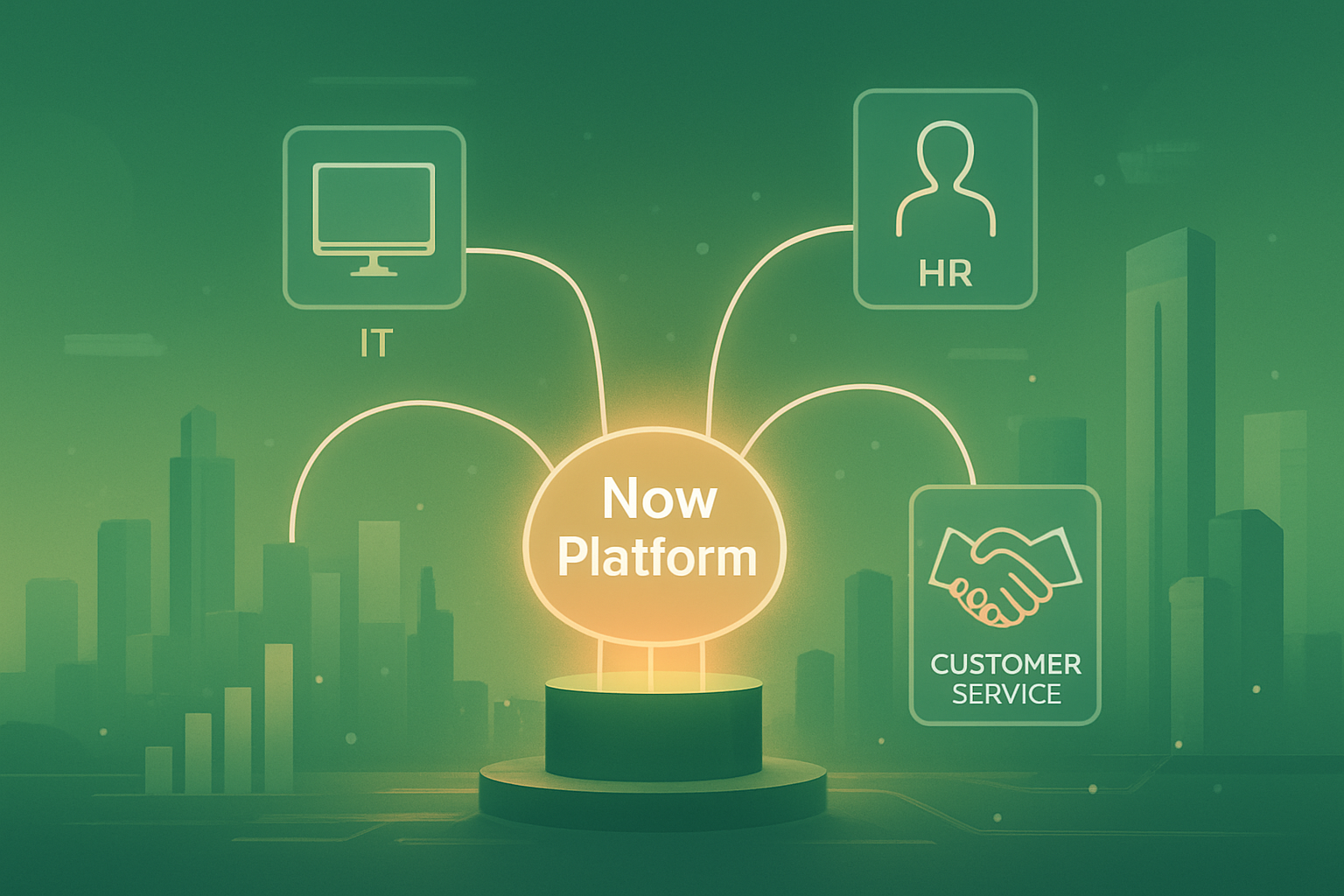
    ServiceNow operates on a multi-layered subscription model, with over 98% of its revenue derived from predictable, recurring sources. Its business is built on a "single architecture, single data model" philosophy, meaning all its products run on the same underlying "Now Platform." This reduces the friction of integration for customers and allows ServiceNow to upsell new "workflows" with high efficiency.

    The company categorizes its business into four primary workflow segments:

    1. IT Workflows: Managing infrastructure, security operations, and service desks.
    2. Employee Workflows: Handling HR services, onboarding, and workspace management.
    3. Customer Workflows: Connecting customer service agents to the back-office technical teams to resolve root-cause issues.
    4. Creator Workflows: A low-code development environment that allows "citizen developers" to build custom applications on top of the ServiceNow platform.

    This diversified model allows ServiceNow to penetrate multiple departments within a single client, leading to a net expansion rate that consistently ranks among the highest in the industry.

    Stock Performance Overview

    Over the past decade, ServiceNow has been a standout performer, though the last 24 months have been characterized by significant volatility. As of March 19, 2026, the stock is trading at approximately $113.71, following a strategic 5-for-1 stock split executed in December 2025 to increase liquidity for retail investors.

    • 1-Year Performance: The stock has declined roughly 31% over the past year. This pullback was not due to poor execution, but rather a sector-wide "valuation reset" as investors recalibrated growth expectations amid rising concerns over how artificial intelligence might impact "per-seat" pricing models.
    • 5-Year Performance: On a split-adjusted basis, the stock has gained roughly 23%, reflecting steady compounding despite the recent drawdown.
    • 10-Year Performance: Long-term holders have seen massive returns, as ServiceNow scaled from a mid-cap player into a large-cap bellwether with a market capitalization of approximately $118 billion.

    Financial Performance

    ServiceNow’s financial profile remains exceptionally robust. For Fiscal Year 2025, the company reported total revenue of approximately $13.28 billion, representing a 21% year-over-year increase. The company’s subscription revenue, the core of its business, hit $3.47 billion in Q4 2025 alone.

    Key financial metrics for FY 2025 include:

    • Operating Margins: Achieved a non-GAAP operating margin of 31%.
    • Free Cash Flow (FCF): A record 36% FCF margin, highlighting the company’s ability to generate cash while investing heavily in R&D.
    • cRPO: Current Remaining Performance Obligations—a key indicator of future revenue—stood at over $10.2 billion by the end of 2025.
    • Valuation: Even after the stock pullback, ServiceNow trades at a premium trailing P/E of roughly 70x, reflecting the high premium investors pay for its "Rule of 50" status.

    Leadership and Management

    CEO Bill McDermott continues to be the driving force behind ServiceNow’s global expansion. His contract was recently extended to 2030, providing long-term stability for the organization. McDermott’s strategy, often referred to as the "McDermott Playbook," emphasizes organic innovation over large, dilutive acquisitions. This is a stark contrast to peers like Salesforce (NYSE: CRM) or Microsoft (NASDAQ: MSFT), which have historically grown through multi-billion dollar deals.

    McDermott is supported by a deep bench of enterprise veterans, including President and COO CJ Desai, who has been instrumental in the company’s technological roadmap. Management enjoys a strong reputation for "under-promising and over-delivering," having beat quarterly guidance consistently for several years. In a notable show of confidence, McDermott purchased $3 million worth of NOW shares in early March 2026, signaling to the market that he believes the current stock price is an attractive entry point.

    Products, Services, and Innovations

    The current crown jewel of ServiceNow’s portfolio is the "Now Assist" suite, its Generative AI (GenAI) platform. Unlike generic AI tools, Now Assist is deeply integrated into the specific workflows of IT and HR departments.

    • Pro Plus SKUs: These premium-priced products, which include specialized GenAI capabilities, saw massive adoption in 2025, contributing over $600 million in annual contract value.
    • Xanadu and Yokohama Releases: The most recent software updates introduced "RaptorDB," a high-performance database layer that allows the platform to handle the massive data loads required for real-time AI reasoning.
    • Agentic AI: The company is currently moving beyond "co-pilots" (which assist humans) to "autonomous agents" that can resolve tasks independently, such as resetting a server or processing an insurance claim without human intervention.

    Competitive Landscape

    ServiceNow sits in a unique position where it both competes and collaborates with other tech giants.

    • Salesforce: The primary rival in the "AI Agent" space. While Salesforce dominates the "front office" (sales and marketing), ServiceNow owns the "back office" (IT, employee services, and operations).
    • Atlassian (NASDAQ: TEAM): A significant competitor in the mid-market space, particularly with its Jira Service Management tool. However, ServiceNow typically wins in the large enterprise segment due to its broader platform capabilities.
    • Microsoft: Microsoft’s Power Platform and Dynamics 365 overlap with ServiceNow, but the two companies remain major partners, with ServiceNow’s platform deeply integrated into Microsoft Teams and Azure.

    Industry and Market Trends

    The enterprise software market in 2026 is defined by "consolidation and intelligence." Companies are looking to reduce the number of vendors they work with, favoring platforms that can "do it all." This trend heavily favors ServiceNow. Additionally, the shift toward "Agentic AI" is the single most important macro driver. Enterprises are no longer satisfied with AI that just answers questions; they want AI that acts. ServiceNow’s "AI Control Tower" positioning places it at the center of this trend, as it has the "plumbing" to execute tasks across different software silos.

    Risks and Challenges

    No investment is without risk, and for ServiceNow, the challenges are primarily centered on valuation and the potential for AI disruption.

    • Valuation Risk: Trading at 70x P/E, the stock is sensitive to interest rate fluctuations. If rates remain higher for longer, the discounted cash flow (DCF) models for high-growth SaaS stocks could face further downward pressure.
    • The "Seat Contraction" Bear Case: There is a growing concern that if AI makes employees twice as productive, enterprises will need fewer "seats" (licenses). Since ServiceNow’s revenue is partly tied to user counts, this remains a long-term structural risk.
    • Execution in AI: While ServiceNow is a leader today, the pace of AI innovation is relentless. Any delay in delivering promised "Agentic" capabilities could lead to market share loss to more nimble startups.

    Opportunities and Catalysts

    Several catalysts could drive ServiceNow’s stock higher in the near term:

    • Public Sector Expansion: The company’s recent launch of "AI for Government" in partnership with NVIDIA (NASDAQ: NVDA) has opened massive new revenue streams in federal and defense sectors, where data security and sovereignty are paramount.
    • M&A Potential: While McDermott prefers organic growth, the current lower valuations across the software sector might present a rare opportunity for ServiceNow to tuck in smaller, niche AI startups.
    • Earnings Consistency: Continued "Rule of 50" performance in upcoming quarterly reports could force a re-rating of the stock as the market realizes that ServiceNow's growth is more resilient than that of its peers.

    Investor Sentiment and Analyst Coverage

    Investor sentiment currently reflects a "wait and see" approach regarding AI monetization, though the underlying fundamentals remain strong. Wall Street's consensus remains a "Moderate Buy." Out of 44 analysts covering the stock, over 35 maintain Buy or Strong Buy ratings. The average price target as of March 2026 is approximately $192, implying significant upside from current levels. Institutional ownership remains very high at over 87%, dominated by stalwarts like Vanguard and BlackRock, suggesting that the "smart money" is looking through the current volatility.

    Regulatory, Policy, and Geopolitical Factors

    ServiceNow has proactively addressed the complex regulatory landscape surrounding AI.

    • EU AI Act Compliance: The company has invested heavily in "Governed AI," ensuring its models provide clear audit trails—a requirement for operating in the European Union.
    • Data Residency: Its global network of "AI Factories" allows ServiceNow to store and process data within specific national borders, a key requirement for financial services and government clients.
    • Geopolitics: While ServiceNow has limited exposure to China compared to hardware firms, any escalation in trade tensions could impact the broader cloud infrastructure supply chain, potentially increasing operating costs.

    Conclusion

    ServiceNow (NYSE: NOW) remains one of the most compelling growth stories in the enterprise software space. By positioning itself as the "AI Control Tower," the company has ensured its relevance in an era where automation is no longer optional. While the stock has suffered from a broader market reset and concerns over AI-driven seat contraction, the company’s financial discipline, high margins, and strategic leadership suggest it is well-equipped to weather the storm. For investors, the key will be watching how successfully ServiceNow can monetize its new "Agentic" workflows and whether it can maintain its 20%+ growth trajectory as it scales toward a $15 billion+ revenue target.


    This content is intended for informational purposes only and is not financial advice.

  • Exxon Mobil (XOM): The New Architecture of Energy Dominance in 2026

    Exxon Mobil (XOM): The New Architecture of Energy Dominance in 2026

    Published: March 19, 2026

    Introduction

    As of March 2026, Exxon Mobil Corporation (NYSE: XOM) stands as the undisputed titan of the global energy sector, navigating a complex dual-track strategy that balances traditional hydrocarbon dominance with a pragmatic, high-margin approach to the energy transition. While many of its European peers spent the early 2020s pivoting toward renewable energy, Exxon doubled down on its core competencies—upstream production and downstream efficiency—a move that has paid significant dividends in the current era of heightened energy security concerns. Today, the company is in focus not just for its record-breaking production in the Permian Basin and Guyana, but for its emerging role as a key player in the carbon capture and lithium supply chains, positioning itself as a "diversified energy technology company" rather than a legacy oil driller.

    Historical Background

    Exxon Mobil’s lineage traces back to the very dawn of the American oil industry. Founded by John D. Rockefeller in 1870 as Standard Oil, the company was later broken up by the U.S. Supreme Court in 1911 due to antitrust concerns, resulting in the creation of Jersey Standard (Exxon) and Socony (Mobil). For much of the 20th century, these entities operated as fierce rivals among the "Seven Sisters" that dominated global oil.

    The modern era began in 1999 with the $81 billion merger of Exxon and Mobil, a deal that remains one of the largest in corporate history. This transformation allowed the combined entity to achieve unprecedented scale, weathering the volatility of the early 2000s and the shale revolution. Over the last decade, the company has survived the 2020 pandemic-induced price collapse and a 2021 proxy battle with activist firm Engine No. 1, which served as a catalyst for the company’s current, more disciplined capital allocation and increased transparency regarding its low-carbon initiatives.

    Business Model

    Exxon Mobil operates through a highly integrated model designed to capture value at every stage of the energy molecule’s journey. Its operations are divided into four primary segments:

    1. Upstream: The "engine room" of the company, focused on the exploration and production of crude oil and natural gas. Key assets include the Permian Basin (now bolstered by the Pioneer Natural Resources acquisition) and the massive offshore blocks in Guyana.
    2. Energy Products (Downstream): This segment manages one of the world's largest refining footprints, converting crude into fuels like gasoline, diesel, and jet fuel. Recent upgrades have focused on high-value lubricants and specialty fuels.
    3. Chemical Products: Leveraging the company’s refining byproducts, this division produces plastics, resins, and synthetic rubber, serving the global manufacturing and consumer goods sectors.
    4. Low Carbon Solutions (LCS): Formed in 2021, this growing segment focuses on commercializing Carbon Capture and Storage (CCS), hydrogen, and lithium production. Unlike speculative green energy ventures, LCS targets technologies that utilize Exxon’s existing engineering and subsurface expertise.

    Stock Performance Overview

    Over the past five years, XOM has significantly outperformed the broader S&P 500 and most of its sector peers.

    • 1-Year Performance: In the last twelve months, the stock has climbed approximately 18%, driven by the successful integration of Pioneer and consistent earnings beats.
    • 5-Year Performance: Since the lows of the 2020-2021 period, XOM has seen a staggering recovery, with the share price rising from under $50 to its current range of $156–$159 in March 2026.
    • 10-Year Performance: On a decade-long horizon, the stock reflects a "V-shaped" recovery, having languished during the 2014-2016 oil glut but finding a structural floor through aggressive cost-cutting and a focus on "advantaged" (low-cost, high-return) barrels.

    Financial Performance

    Exxon’s financial health in 2026 is characterized by robust cash flow and a pristine balance sheet.

    • 2025 Earnings: The company reported full-year 2025 earnings of $28.8 billion, supported by Brent prices averaging $90/bbl.
    • Free Cash Flow (FCF): In 2025, Exxon generated $23.6 billion in FCF, allowing it to fund its capital expenditure (CapEx) program entirely through operations while returning massive amounts of capital to shareholders.
    • Dividends and Buybacks: A member of the S&P 500 Dividend Aristocrats, Exxon raised its quarterly dividend to $1.03 per share in early 2026. The company is currently on pace to execute $20 billion in share repurchases annually through the end of 2026.
    • Debt-to-Capital: The company maintains a conservative leverage ratio of approximately 16%, one of the lowest in the industry.

    Leadership and Management

    Under the leadership of Chairman and CEO Darren Woods, Exxon has undergone a cultural and strategic shift. Woods, who took the helm in 2017, has been the architect of the "Advantaged Assets" strategy, which prioritizes investments in projects with a cost of supply below $35 per barrel.

    The management team has earned a reputation for disciplined capital allocation, a sharp contrast to the era of overspending in the early 2010s. The board has also been refreshed since 2021, incorporating more independent directors with experience in climate science and energy technology, which has significantly improved the company's ESG (Environmental, Social, and Governance) standing among institutional investors.

    Products, Services, and Innovations

    Exxon is increasingly marketing itself as a technology provider as much as a resource extractor.

    • Hydrocarbons: High-grade light tight oil from the Permian and sweet crude from Guyana.
    • Mobil™ Lithium: In a landmark move, Exxon is developing the "Smackover" formation in Arkansas to produce lithium through Direct Lithium Extraction (DLE). By 2027, the company aims to be a leading supplier to the EV battery market.
    • CCS and Denbury Integration: Following the 2023 acquisition of Denbury, Exxon now operates the largest CO2 pipeline network in the U.S., allowing it to offer "decarbonization-as-a-service" to heavy industrial emitters.
    • Advanced Recycling: Exxon has launched large-scale facilities that use molecular recycling to convert plastic waste back into virgin-quality raw materials.

    Competitive Landscape

    Exxon’s primary domestic rival is Chevron (NYSE: CVX). Following Chevron’s acquisition of Hess Corporation (NYSE: HES), which finalized in 2025, the two giants are now partners—and occasional legal adversaries—in the lucrative Stabroek block in Guyana.

    While European rivals like Shell (NYSE: SHEL) and BP (NYSE: BP) have recently slowed their transition to renewables to refocus on oil and gas, Exxon holds a first-mover advantage in high-margin U.S. shale following its acquisition of Pioneer Natural Resources. Exxon’s scale and "all-of-the-above" energy strategy currently command a valuation premium over its international peers.

    Industry and Market Trends

    The global energy market in 2026 is defined by a "re-normalization" of oil and gas demand. Despite the growth of EVs, global demand for liquid fuels remains at or near record highs of 104 million barrels per day. The industry is currently characterized by:

    • Consolidation: The Permian Basin is now dominated by a few major players, leading to higher drilling efficiency and lower costs.
    • Supply Chain Resilience: Energy companies are increasingly reshoring supply chains for critical minerals (like lithium) and equipment.
    • Energy Trilemma: The global focus has shifted from a pure focus on transition to a balance of security, affordability, and sustainability.

    Risks and Challenges

    • Price Volatility: While Exxon is profitable even at $40/bbl, a global recession could depress demand and squeeze margins.
    • Regulatory/Legal: Climate litigation remains a persistent threat. Exxon is currently embroiled in several lawsuits from U.S. states and cities seeking damages for historical carbon emissions.
    • Transition Timing: If the global shift to electric transport happens faster than Exxon’s internal models predict, its massive refining investments could become stranded assets.
    • Geopolitical Friction: Operations in regions like Guyana remain sensitive to territorial disputes with neighboring countries (e.g., Venezuela).

    Opportunities and Catalysts

    • Guyana Growth: With the One Guyana FPSO ramping up and the Uaru project scheduled for late 2026, Exxon is adding hundreds of thousands of barrels of low-cost production.
    • Permian Synergies: The full technical integration of Pioneer’s acreage is expected to unlock another $2 billion in annual savings by 2027.
    • Lithium Startup: News regarding long-term supply agreements with major automakers (e.g., Tesla or Ford) could serve as a major catalyst for re-rating the stock as a "green" play.
    • Legal Redomicile: Rumors that Exxon may move its legal headquarters from New Jersey to Texas could signal a more aggressive stance against regulatory overreach.

    Investor Sentiment and Analyst Coverage

    Wall Street sentiment on XOM is currently "Strong Buy" among the majority of analysts. Institutional ownership remains high, with giants like Vanguard and BlackRock maintaining significant stakes. Analysts praise the company’s "cash-cow" upstream assets and its refusal to chase low-return wind and solar projects. Retail investor sentiment is also positive, bolstered by the company’s commitment to dividend growth, which makes it a staple in retirement portfolios.

    Regulatory, Policy, and Geopolitical Factors

    The U.S. regulatory environment has become significantly more favorable for Exxon following the 2024 elections. The current administration has prioritized domestic energy production and streamlined permitting for LNG terminals and pipelines. However, international policy remains a patchwork. The European Union’s carbon border adjustments and stricter reporting requirements (CSDDD) present an ongoing compliance challenge for Exxon’s global operations. Geopolitically, Exxon’s role as a guarantor of U.S. energy interests in the Atlantic basin has never been more vital.

    Conclusion

    Exxon Mobil enters the second half of the decade as a streamlined, highly profitable, and strategically focused energy powerhouse. By integrating the massive Permian footprint of Pioneer and the generational growth of Guyana, the company has secured a low-cost production base that can withstand significant market volatility. While the long-term threat of peak oil demand looms, Exxon’s pivot into lithium and carbon capture suggests a management team that is not merely waiting for the future, but actively engineering its own place within it. For investors, XOM remains a core "value" play with "growth" characteristics, offering a rare combination of immediate income and long-term optionality in the evolving energy landscape.


    This content is intended for informational purposes only and is not financial advice.

  • ADP in 2026: Navigating the AI Frontier and Labor Market Headwinds

    ADP in 2026: Navigating the AI Frontier and Labor Market Headwinds

    As of March 19, 2026, Automatic Data Processing, Inc. (NASDAQ: ADP) stands at a critical juncture in the global financial and labor markets. Long regarded as the "gold standard" of the payroll and human resources industry, the company is currently navigating a period of significant technological transformation amidst a cooling global labor market. With a market capitalization that remains a cornerstone of the S&P 500, ADP is currently in focus not just for its massive scale—processing paychecks for over 40 million workers globally—but for its aggressive pivot toward "Agentic AI" and next-generation cloud architecture.

    While the stock has faced valuation headwinds over the past twelve months, the company’s recent Q2 fiscal 2026 earnings report suggests a resilient underlying business model. In an era where regulatory complexity is increasing due to new tax laws and AI governance mandates, ADP’s role as an essential compliance partner for businesses of all sizes has never been more relevant. This feature explores the deep mechanics of the ADP machine, from its 1940s roots to its 2026 AI-driven future.

    Historical Background

    The story of ADP began in 1949 in a modest office above an ice cream parlor in Paterson, New Jersey. Founded by Henry Taub as Automatic Payrolls, Inc., the company was born from a simple observation: small business owners were drowning in the manual, error-prone task of calculating payroll. Taub was soon joined by his brother Joe and Frank Lautenberg—the latter of whom would go on to lead the company for decades before becoming a prominent U.S. Senator.

    The first major transformation occurred in 1957, when the company was renamed Automatic Data Processing, Inc., signaling an early embrace of the burgeoning computer age. By 1961, ADP went public with just 300 clients, but its adoption of IBM punched-card machines and early mainframes allowed it to scale at a pace competitors couldn't match. Throughout the 1970s and 80s, ADP moved into the international market and transitioned to the New York Stock Exchange, eventually becoming a multibillion-dollar enterprise.

    In the late 1990s, the company made a strategic leap by entering the Professional Employer Organization (PEO) market, acquiring Staff Management Systems in 1996. This led to the birth of ADP TotalSource, shifting the business from a pure software provider to a co-employment partner. In 2007, the company refined its focus by spinning off its brokerage services into what is now Broadridge Financial Solutions, doubling down on its core mission: Human Capital Management (HCM).

    Business Model

    ADP operates a high-margin, "sticky" business model divided into two primary segments: Employer Services and PEO Services.

    1. Employer Services (ES): This is the core of the business, representing approximately two-thirds of revenue. It provides a comprehensive suite of HCM solutions, including payroll, tax credit services, benefits administration, and talent management. Revenue is generated through recurring per-employee-per-month (PEPM) fees. This segment is highly defensive, boasting a client retention rate of over 92% as of early 2026.
    2. PEO Services (Professional Employer Organization): Operating primarily through ADP TotalSource, this segment operates on a co-employment model. ADP becomes the "employer of record" for tax and insurance purposes for its clients' employees. This allows small and mid-sized businesses to offer "Fortune 500-level" benefits and provides ADP with a revenue stream tied to insurance premiums and workers' compensation, in addition to service fees.

    A critical, often-overlooked component of the business model is "Client Funds Extended Investment Strategy," commonly known as the Float. ADP holds billions of dollars in client funds (intended for taxes and payroll) for short periods. By investing this cash in highly liquid, laddered fixed-income portfolios, ADP generates significant interest income that drops straight to the bottom line with almost 100% margin.

    Stock Performance Overview

    Over the long term, ADP has been a compounding machine, though recent years have tested investor patience. As of March 19, 2026, the stock is trading near $208.67.

    • 1-Year Performance: The stock is down approximately 27.5% over the last year. This decline is largely attributed to a contraction in valuation multiples as investors shifted toward high-growth "AI-native" tech stocks and reacted to signs of a slowing U.S. labor market.
    • 5-Year Performance: Despite the recent dip, the stock has delivered a total return of +24.2% over five years.
    • 10-Year Performance: Long-term holders have enjoyed a +193.3% return, reflecting a CAGR of roughly 11.5%.

    ADP is a member of the elite Dividend Aristocrats, having increased its dividend for over 50 consecutive years. This history of dividend growth provides a "floor" for the stock price, attracting institutional income seekers even during periods of price volatility.

    Financial Performance

    In its latest quarterly report (Q2 Fiscal 2026, ended December 31, 2025), ADP demonstrated robust financial health despite macro headwinds.

    • Revenue: Reached $5.4 billion for the quarter, a 6% year-over-year increase.
    • Earnings Per Share (EPS): Adjusted diluted EPS was $2.62, up 11% year-over-year, beating analyst expectations.
    • Margins: Adjusted EBIT margins expanded by 80 basis points to 26.0%. This expansion was primarily driven by operational efficiencies and higher yields on client fund investments.
    • Guidance: For the full fiscal year 2026, management has projected revenue growth of 6% and EPS growth between 9% and 10%.

    The company maintains a strong balance sheet with a conservative debt-to-equity ratio and consistent free cash flow generation, which supports its dual strategy of dividend payments and strategic acquisitions.

    Leadership and Management

    Since 2023, Maria Black has served as President and CEO, steering the company through its most significant technological shift since the move to the cloud. Black, a veteran of ADP since 1996, has prioritized a "tech-first" culture, moving away from the "service bureau" image of the past.

    Key leadership members in 2026 include:

    • Peter Hadley (CFO): Focused on maintaining the company's rigorous financial discipline and optimizing the $37 billion client fund portfolio.
    • Sreeni Kutam (President, Global Product & Innovation): The architect behind the transition to "Agentic AI."
    • Nela Richardson (Chief Economist): A key figure who provides the data-driven labor market insights that have made ADP a frequent advisor to federal policy makers.

    The board of directors is widely praised for its stability and focus on long-term shareholder value, maintaining a governance reputation that is among the highest in the S&P 500.

    Products, Services, and Innovations

    ADP’s product portfolio in 2026 is anchored by its "Next Gen" ecosystem. The centerpiece is ADP Lyric HCM, a flexible, person-centric platform designed for large enterprises. Unlike legacy systems that are built on rigid job-code hierarchies, Lyric uses a data model that can adapt to fluid, team-based work structures common in the modern global economy.

    In early 2026, the company launched ADP Assist, a generative AI suite that moves beyond simple chatbots. These "Agentic" assistants can proactively flag payroll anomalies, draft localized HR policies that comply with changing state laws, and provide "turnover risk" scores for specific departments using ADP’s unparalleled dataset of 42 million wage earners.

    Furthermore, the 2025 acquisition of WorkForce Software has been fully integrated, giving ADP a dominant edge in complex time and attendance tracking for global workforces with intricate compliance needs in over 140 countries.

    Competitive Landscape

    ADP competes in a three-front war:

    1. Enterprise Level: It battles Workday (NASDAQ: WDAY). While Workday is often the preferred ERP for finance, ADP differentiates itself by providing native global payroll—meaning it owns the underlying compliance and movement of money, whereas Workday often relies on third-party partners.
    2. Mid-Market: Its primary rival is Paychex (NASDAQ: PAYX). Paychex is often seen as a price leader for small businesses, but ADP has countered this with its RUN and Workforce Now platforms, which offer more seamless scalability.
    3. Modern SMB / Tech-Native: Newer entrants like Rippling and Gusto have gained ground with superior user experiences and deep IT/Finance integrations. ADP has responded by modernizing its UX and opening its "ADP Marketplace" to thousands of third-party apps.

    ADP’s competitive edge lies in its data moat. Because it processes such a significant portion of global wages, its AI models are trained on more real-world payroll and tax data than any other entity except perhaps the IRS.

    Industry and Market Trends

    The HR technology sector in 2026 is being shaped by three dominant trends:

    • The Compliance Complexity Wave: As governments introduce more granular tax and labor reporting (such as the recent OBBBA Act of 2025), companies are moving away from "DIY" payroll and toward full-service providers to mitigate risk.
    • The Globalization of Talent: Even small companies now have remote workers in multiple countries. This has turned "Global Payroll" from a niche service into a standard requirement.
    • AI-Driven Productivity: HR departments are under pressure to do more with less. The focus has shifted from "Software as a Service" (SaaS) to "Outcomes as a Service," where the software doesn't just store data but actively manages the workforce.

    Risks and Challenges

    Despite its dominance, ADP faces several meaningful risks:

    • Labor Market Sensitivity: If the cooling labor market of early 2026 turns into a deep recession with widespread layoffs, ADP’s revenue—which is tied to headcount—will inevitably suffer.
    • Margin Pressure in PEO: The PEO segment is currently facing margin compression (down 70 basis points in Q2) due to the rising costs of healthcare premiums and workers' compensation insurance, which are often "pass-through" costs with zero margin.
    • Interest Rate Volatility: While high rates benefit the "Float," a sudden and aggressive pivot by the Federal Reserve to cut rates could reduce this high-margin revenue stream faster than analysts anticipate.
    • Security and Privacy: As a custodian of the financial data for 40 million people, ADP remains a prime target for sophisticated cyberattacks. A major breach would cause irreparable brand damage.

    Opportunities and Catalysts

    • The AI Upsell: ADP has a massive opportunity to transition its existing client base from "Standard" to "AI-Enhanced" tiers, which carry higher PEPM fees.
    • International Market Share: Global payroll remains fragmented. ADP’s ability to provide a "single pane of glass" for a multinational’s entire workforce is a massive growth lever in Europe and Asia.
    • M&A Potential: With a strong cash position, ADP is well-positioned to acquire smaller, niche AI startups or regional payroll players in emerging markets to accelerate its tech roadmap.

    Investor Sentiment and Analyst Coverage

    Current sentiment on Wall Street is characterized by "cautious optimism." The consensus rating among analysts as of March 2026 is a Hold, with a heavy concentration of Neutral ratings. Analysts are impressed by the company's 30% implied upside relative to their average price targets (roughly $275), yet they are waiting for a clear sign that the stock's downward price momentum has bottomed out.

    Institutional confidence remains high. Mega-funds like The Vanguard Group and BlackRock collectively own nearly 20% of the company. These institutions value ADP as a "defensive anchor" in their portfolios, particularly during times of market volatility.

    Regulatory, Policy, and Geopolitical Factors

    The regulatory environment is currently a tailwind for ADP. The OBBBA Act of 2025 (One Big Beautiful Bill Act) introduced complex new reporting requirements for 2026, including specific W-2 coding for tax-exempt overtime and tips. Small and medium-sized businesses are flocking to ADP to automate these requirements, as the penalties for non-compliance have increased.

    Geopolitically, ADP’s "GlobalView" platform is benefiting from the restructuring of global supply chains. As companies move manufacturing out of China and into regions like Vietnam, India, and Mexico, they require the sophisticated multi-country compliance and payroll logic that only a handful of providers like ADP can provide at scale.

    Conclusion

    ADP in March 2026 is a company in the midst of a sophisticated "re-platforming." While the stock price has suffered a significant 1-year correction, the fundamental business remains an indispensable part of the global economic infrastructure. Its pivot toward Agentic AI and its ability to monetize regulatory complexity through platforms like Lyric and ADP Assist suggest that its "data moat" is actually widening.

    For investors, the current valuation represents a classic trade-off: a high-quality, Dividend Aristocrat at a rare discount, weighed against the macro risks of a slowing labor market. In the long run, ADP’s ability to generate high-margin interest income and maintain 90%+ client retention makes it a formidable player that is difficult to bet against. Investors should keep a close eye on PEO margin recovery and the pace of AI-tier adoption in the coming quarters.


    This content is intended for informational purposes only and is not financial advice.

  • Intel’s Pivot Point: A 2026 Deep Dive into the Foundry-First Transformation

    Intel’s Pivot Point: A 2026 Deep Dive into the Foundry-First Transformation

    Today’s Date: March 19, 2026

    Introduction

    Intel Corporation (NASDAQ: INTC) stands at a historic crossroads. Once the undisputed titan of the semiconductor world, the company spent the better part of the last decade grappling with manufacturing delays, leadership transitions, and the meteoric rise of competitors in the artificial intelligence (AI) and foundry sectors. However, as of March 2026, the narrative surrounding Intel has shifted from one of managed decline to one of "execution-led recovery." With the successful completion of its ambitious "five nodes in four years" roadmap and a leadership transition to industry veteran Lip-Bu Tan, Intel is attempting to reinvent itself as the Western world’s premier foundry while defending its dominant position in the burgeoning AI PC market.

    Historical Background

    Founded in 1968 by Robert Noyce and Gordon Moore, Intel was the architect of the silicon age. From the invention of the microprocessor to the "Intel Inside" marketing phenomenon of the 1990s, the company defined the personal computing era. Under the legendary leadership of Andy Grove, Intel adopted a "paranoid" culture of constant innovation. However, the 2010s proved difficult; the company missed the mobile revolution and struggled to transition to the 10nm and 7nm process nodes. This stagnation allowed Taiwan Semiconductor Manufacturing Company (NYSE: TSM) to seize the lead in manufacturing and Advanced Micro Devices (NASDAQ: AMD) to eat into its CPU market share. The return of Pat Gelsinger in 2021 launched the "IDM 2.0" strategy, a high-stakes bet on internal manufacturing and external foundry services that set the stage for the company's current 2026 profile.

    Business Model

    Intel’s business model has undergone its most radical transformation in fifty years. It is now effectively split into two distinct but synergistic entities:

    • Intel Products: This includes the Client Computing Group (CCG), which focuses on PC processors; the Data Center and AI (DCAI) group; and Network and Edge (NEX). This side of the house designs the chips that power the world’s laptops and servers.
    • Intel Foundry (IF): Formerly an internal department, this is now a standalone business unit with its own P&L. It operates as a "systems foundry," offering manufacturing, advanced packaging (Foveros), and software to external customers like Microsoft (NASDAQ: MSFT) and Amazon (NASDAQ: AMZN), as well as to Intel’s own product teams.
    • Other: Intel also holds interests in Mobileye (NASDAQ: MBLY) and has recently spun off its Altera FPGA business to sharpen its focus.

    Stock Performance Overview

    The journey for INTC shareholders over the last decade has been a volatile one.

    • 10-Year Horizon: Intel has significantly underperformed the S&P 500 and the PHLX Semiconductor Index (SOX), as it struggled with the 10nm transition and the rise of NVIDIA (NASDAQ: NVDA).
    • 5-Year Horizon: The stock faced a "lost half-decade" until late 2024, when it hit a traumatic low of approximately $17.66 following massive restructuring and dividend suspensions.
    • 1-Year Horizon: Since March 2025, the stock has experienced a dramatic "Tan Rally." Shares have recovered from the high teens to trade in the $44–$48 range as of early 2026—a gain of over 100% from the 2024 trough—driven by the successful ramp of the 18A process node and newfound cost discipline.

    Financial Performance

    Intel’s FY2025 results, released in early 2026, reflect a company in the "heavy lifting" phase of its turnaround:

    • Revenue: FY2025 revenue settled at $52.9 billion. While flat year-over-year, it showed stabilization in the PC segment.
    • Margins: Gross margins for the full year were 34.8%, still well below the 50-60% historical norms, due to the high costs of ramping the 18A and 20A nodes. However, Q4 2025 saw an uptick to 36.1%.
    • Cash Flow: Adjusted free cash flow for 2025 was -$4.9 billion, a consequence of the aggressive capital expenditure required for new fabs. Critically, Intel turned FCF-positive in Q4 2025 ($800 million), signaling that the peak of the investment cycle may have passed.
    • Valuation: Trading at roughly 22x forward earnings, the market is beginning to price in a "Foundry Inflection" expected in 2027.

    Leadership and Management

    On March 18, 2025, Lip-Bu Tan officially took the helm as CEO, succeeding Pat Gelsinger. Tan, the former CEO of Cadence Design Systems, brought a reputation for operational rigor and deep ties to the fabless semiconductor ecosystem. His leadership has focused on "execution over aspiration." Under Tan, Intel has prioritized high-margin foundry contracts and accelerated the divestment of non-core assets. The management team, including CFO David Zinsner, has been credited with navigating the liquidity crisis of 2024 and securing the finalized $7.86 billion CHIPS Act grant in late 2024.

    Products, Services, and Innovations

    Intel’s current product lineup is centered on the "AI PC" and sovereign manufacturing:

    • 18A Process Node: The "crown jewel" of the turnaround, 18A entered high-volume manufacturing in late 2025. It utilizes RibbonFET and PowerVia technologies, which Intel claims offer a power-efficiency advantage over current TSMC offerings.
    • Panther Lake (Core Ultra Series 3): Launched in early 2026, this is Intel's lead product for the AI PC era, designed to handle complex generative AI tasks locally on the device.
    • Data Center AI: While Intel trails NVIDIA in training, its Gaudi 3 and the newly released "Crescent Island" inference chips have found a niche in the enterprise market as cost-effective alternatives for AI deployment.
    • Advanced Packaging: Intel's Foveros technology remains a competitive edge, allowing the company to "mix and match" chiplets from different manufacturers into a single package.

    Competitive Landscape

    Intel faces a multi-front war:

    • Foundry Rivals: TSMC remains the "gold standard" in yield and capacity. Samsung (OTC: SSNLF) is also competing for the #2 foundry spot. Intel’s advantage is its geographic diversity (US/Europe).
    • CPU Rivals: AMD continues to be a formidable challenger in both data center (EPYC) and consumer (Ryzen) markets, leveraging TSMC’s leading nodes.
    • AI Rivals: NVIDIA dominates the AI training market. Intel is pivoting to "Inference at the Edge," where it believes it can win on volume and integration.
    • ARM-based chips: Apple (NASDAQ: AAPL) and Qualcomm (NASDAQ: QCOM) are pushing ARM architecture into the PC space, threatening Intel’s x86 dominance.

    Industry and Market Trends

    Three macro trends are currently defining Intel’s environment:

    1. Sovereign AI: Nations are increasingly seeking internal semiconductor supply chains to ensure national security. Intel is the primary beneficiary of this "onshoring" trend in the West.
    2. The AI PC Shift: The replacement cycle for PCs is being driven by the need for NPU (Neural Processing Unit) hardware to run AI assistants locally.
    3. Foundry Decoupling: Large tech firms (Hyperscalers) want to design their own silicon but need a manufacturing partner that isn't a direct competitor in the cloud space (like Amazon or Google), giving Intel Foundry a unique "neutral" appeal.

    Risks and Challenges

    Despite the recovery, several risks loom:

    • Yield Maturity: While 18A is in production, yields are reportedly between 55-75%. To achieve industry-standard profitability, Intel must get these closer to 80% by 2027.
    • Execution Risk: The Ohio "Silicon Heartland" project has seen its timeline pushed to 2030, raising concerns about Intel's ability to manage multi-billion dollar builds without further delays.
    • Financial Leverage: High debt and negative cumulative free cash flow over the last two years leave little room for error.
    • The ARM Threat: If Windows-on-ARM gains significant market share, Intel’s CCG margins could face permanent compression.

    Opportunities and Catalysts

    • External Foundry Wins: Rumors of a 2027 manufacturing deal with NVIDIA or Broadcom (NASDAQ: AVGO) for the next-gen 14A node could be a massive catalyst for the stock.
    • AI PC Dominance: If Intel can capture 60%+ of the AI-capable PC market by the end of 2026, it would secure a high-margin revenue stream for years.
    • Divestitures: Potential IPOs or sales of remaining stakes in Mobileye or Altera could provide non-dilutive capital to fund fab expansions.

    Investor Sentiment and Analyst Coverage

    Sentiment has shifted from "Deep Value/Distressed" in 2024 to "Cautious Growth" in 2026. Major institutions like Vanguard and BlackRock remain the largest holders. Analyst coverage is currently mixed; while many have upgraded the stock following the 18A ramp, others remain on the sidelines, waiting for proof of sustainable 40%+ gross margins. Retail sentiment, once extremely negative, has turned optimistic as the company successfully hit its technical milestones under Lip-Bu Tan.

    Regulatory, Policy, and Geopolitical Factors

    Intel is arguably the most geopolitically significant company in the U.S.

    • CHIPS Act: The finalized $7.86 billion in grants and $11 billion in loans provide a massive cushion against market volatility.
    • Export Controls: Tightening restrictions on AI chip exports to China remain a headwind for the DCAI segment.
    • Taiwan Risk: Any escalation in the Taiwan Strait would likely lead to a massive re-rating of Intel as the only viable "Western" alternative for high-end logic chips.

    Conclusion

    As of March 19, 2026, Intel is no longer the company that lost its way in the 2010s, nor is it yet the high-margin powerhouse it once was. It is a work in progress. The "5 nodes in 4 years" mission is complete, but the "profitability mission" is just beginning. For investors, Intel represents a high-conviction bet on the "Siliconization" of the global economy and the strategic importance of domestic manufacturing. The coming 18 months will be defined by one metric: the volume of external customers who choose to build their future on Intel’s silicon.


    This content is intended for informational purposes only and is not financial advice.

  • Apple at 50: The AI Super-Cycle and the $3.7 Trillion Frontier

    Apple at 50: The AI Super-Cycle and the $3.7 Trillion Frontier

    As of March 19, 2026, Apple Inc. (NASDAQ: AAPL) stands on the precipice of its 50th anniversary, a milestone that marks its evolution from a hobbyist computer company in a California garage to a $3.7 trillion global titan. Today, Apple is no longer just a hardware manufacturer; it is a sprawling digital ecosystem that defines the intersection of technology and lifestyle. With the recent success of the iPhone 17 "super-cycle" and the rapid maturation of "Apple Intelligence," the company has silenced critics who feared it was lagging in the generative AI race. This report explores Apple’s current standing, its financial health, and the strategic hurdles it must clear as it enters its second half-century.

    Historical Background

    Founded on April 1, 1976, by Steve Jobs, Steve Wozniak, and Ronald Wayne, Apple’s history is a narrative of radical disruption. From the Macintosh in 1984 to the near-bankruptcy of the mid-1990s, the company’s trajectory changed forever with Jobs’ return in 1997. The ensuing decade saw the release of the iMac, iPod, and the 2007 debut of the iPhone—the device that revolutionized the smartphone industry and remains Apple's primary revenue driver.

    Under the leadership of Tim Cook, who took the helm in 2011, Apple transitioned from a visionary hardware-first company into a diversified services powerhouse. The last decade has been defined by the expansion of the "Walled Garden," the launch of the Apple Watch and AirPods, and the transition to in-house silicon (M-series chips), which has decoupled Apple’s performance from traditional chip-making cycles.

    Business Model

    Apple’s business model is built on "ecosystem lock-in," where hardware, software, and services are seamlessly integrated to create high switching costs for users.

    • iPhone: Remains the cornerstone, contributing roughly 50% of total revenue.
    • Services: Includes the App Store, iCloud, Apple Music, Apple Pay, and Apple TV+. This segment now generates over $100 billion annually with gross margins near 75%.
    • Wearables, Home, and Accessories: Driven by AirPods and the Apple Watch, which command dominant market shares in their respective categories.
    • Mac and iPad: Positioned as productivity tools, powered by Apple’s industry-leading M-series chips.

    The "Apple Intelligence" platform, launched in late 2024 and significantly expanded in 2025, has become the new glue for this model, incentivizing users to upgrade to the latest hardware to access on-device AI capabilities.

    Stock Performance Overview

    Apple has remained a "safe haven" for investors, consistently outperforming the S&P 500 over long horizons.

    • 1-Year Performance: AAPL has returned 19.32% over the past twelve months, buoyed by strong iPhone 17 sales and a record-breaking 2025 holiday quarter.
    • 5-Year Performance: Investors have seen a 109.22% return, as the company successfully navigated the post-pandemic supply chain crisis and the transition to high-margin services.
    • 10-Year Performance: A staggering 955.1% total return. An investment in early 2016 has nearly decupled, reflecting Apple’s ability to grow its earnings base even at massive scale.

    Financial Performance

    In Fiscal Year 2025, Apple reported a record $416.2 billion in revenue, representing a 6.4% year-over-year increase. Net income reached $112.0 billion, with earnings per share (EPS) growing 22% to $7.46.

    Crucially, Apple’s gross margin expanded to 46.9%, a record high driven by the "premiumization" of the iPhone lineup (with a higher mix of Pro and Pro Max models) and the continued growth of high-margin Services. As of Q1 2026, Apple maintains a fortress balance sheet with over $160 billion in cash and marketable securities, allowing for $32 billion in shareholder returns through buybacks and dividends in the last quarter alone.

    Leadership and Management

    Tim Cook continues to serve as CEO, recently dismissing retirement rumors ahead of the company's 50th anniversary. However, the succession plan is becoming clearer. John Ternus, the Senior Vice President of Hardware Engineering, has emerged as the heir apparent, recently expanding his oversight to include the industrial design team.

    The executive suite is currently undergoing a "generational shift." Longtime veterans like John Giannandrea (AI), Lisa Jackson (Environment), and Kate Adams (General Counsel) are expected to retire in 2026. The appointment of Jennifer Newstead as General Counsel signals a more aggressive stance in navigating the global regulatory environment.

    Products, Services, and Innovations

    The current product lineup is led by the iPhone 17 series, which analysts cite as the most successful launch since the iPhone 12. The base iPhone 17 received a significant RAM and display upgrade to support "Apple Intelligence," narrowing the gap between the base and Pro models.

    Apple Intelligence is the flagship innovation of 2026. While maintaining a "privacy-first" approach with on-device processing, Apple has reportedly partnered with Google to integrate the Gemini model for complex, cloud-based queries. The highly anticipated Siri 2.0, slated for release in Spring 2026, promises a truly conversational assistant capable of cross-app task execution.

    The Spatial Computing Question

    While the Vision Pro (launched in 2024) showcased Apple's technical prowess, it has faced a difficult market reception. With fewer than 400,000 units sold to date and a $3,500 price tag, the device remains a niche product. Reports indicate that Apple has slashed production and redirected R&D toward a rumored "Vision Air" or "Vision Lite"—a more affordable consumer-grade headset expected in late 2026.

    Competitive Landscape

    Apple faces intensifying competition on two fronts:

    • Hardware Rivalry: In China, Huawei’s resurgence and aggressive local competition have forced Apple to utilize deep trade-in discounts to maintain its 2025 market share gains. Samsung remains the primary global rival, frequently beating Apple to market with foldable form factors.
    • AI Arms Race: Google, Microsoft, and Meta are ahead in raw LLM (Large Language Model) capabilities. Apple’s strategy is to win on "user experience" rather than raw compute power, banking on its hardware-software integration to make AI feel intuitive.

    Industry and Market Trends

    The tech sector in 2026 is dominated by the "Edge AI" trend—moving AI processing from the cloud to the device. Apple is perfectly positioned for this, as its custom silicon (A-series and M-series) was designed with neural engines years before the AI boom. Additionally, the "premiumization" of the smartphone market continues, with consumers increasingly willing to pay $1,200+ for devices they keep for 4-5 years, a trend that directly benefits Apple’s margins.

    Risks and Challenges

    • Antitrust Litigation: The US Department of Justice’s lawsuit against Apple is currently in trial. A negative ruling could force changes to the App Store’s commission structure or how iMessage interacts with third-party apps.
    • Vision Pro Stagnation: If Apple cannot find a "killer app" or lower the price point for spatial computing, the Vision Pro could become a rare hardware failure for the company.
    • Geopolitical Exposure: While Apple has diversified manufacturing into India and Vietnam, its supply chain and consumer demand remain heavily tethered to China.

    Opportunities and Catalysts

    • The iPhone 17e: Expected in mid-2026, this budget-friendly model could bring Apple Intelligence to the mass market, potentially capturing millions of older iPhone users who have been reluctant to upgrade.
    • Services Expansion: With over 1 billion paid subscriptions, Apple has room to monetize its AI features through an "Apple Intelligence+" subscription tier.
    • Automotive and Health: While the "Apple Car" was shelved, the technology developed is reportedly being integrated into advanced CarPlay systems and autonomous driving software licensing.

    Regulatory, Policy, and Geopolitical Factors

    In the European Union, the Digital Markets Act (DMA) remains a persistent headache, though Apple scored a major win in February 2026 when the EU Commission ruled that Apple Maps and Apple Ads would not be designated as "gatekeepers." In the US, the political climate remains tense, with both parties signaling a desire for stricter oversight of Big Tech’s data privacy and market dominance.

    Investor Sentiment and Analyst Coverage

    Wall Street maintains a "Strong Buy" consensus on AAPL. Analysts, led by Dan Ives at Wedbush, have set a median price target of $300.00, representing approximately 20% upside from current levels. Institutional ownership remains high, with Vanguard and BlackRock continuing to hold core positions. Retail sentiment is largely positive, driven by the belief that Apple’s AI story is just beginning to translate into earnings growth.

    Conclusion

    Apple Inc. in 2026 is a company in transition—from a hardware-centric innovator to an AI-integrated services ecosystem. While the Vision Pro’s slow start and regulatory clouds in the US and EU provide reasons for caution, the company’s financial fundamentals have never been stronger. The iPhone 17 super-cycle has proven that the "Walled Garden" is as resilient as ever. For investors, the key over the next 12 months will be the successful launch of Siri 2.0 and the potential introduction of a more accessible spatial computing device. Apple remains the quintessential "quality" stock: expensive by traditional metrics, but unmatched in its ability to generate cash and command consumer loyalty.


    This content is intended for informational purposes only and is not financial advice.

  • The Inflection Point: Rivian’s High-Stakes Leap into the Mass Market

    The Inflection Point: Rivian’s High-Stakes Leap into the Mass Market

    As of March 19, 2026, Rivian Automotive, Inc. (NASDAQ: RIVN) stands at the most significant crossroads in its 17-year history. After a decade of development and five years as a public entity, the Irvine-based automaker is transitioning from a niche manufacturer of luxury "adventure" electric vehicles (EVs) to a high-volume, mass-market contender. The spotlight on Rivian has intensified this week as the first production units of the R2 SUV begin rolling off the line in Normal, Illinois. This launch represents more than just a new model; it is the ultimate test of Rivian’s ability to scale, achieve sustainable profitability, and prove that its brand can resonate beyond the early-adopter luxury segment.

    Historical Background

    Founded in 2009 by Dr. RJ Scaringe as Mainstream Motors, the company underwent several identity shifts before emerging as Rivian in 2011. Unlike many of its "SPAC-era" peers, Rivian spent years in "stealth mode," focusing on its proprietary "skateboard" platform. The company’s trajectory changed forever in 2019 when it secured a massive $700 million investment led by Amazon, followed by a $500 million stake from Ford.

    The 2021 IPO was one of the largest in U.S. history, valuing the company at over $100 billion before it had delivered a single vehicle. However, the subsequent "reality check" of 2022 and 2023—marked by supply chain crises and a high-interest-rate environment—forced a pivot. By 2024, Rivian shifted its focus from raw volume to "per-unit economics," leading to the landmark 2025 fiscal year where the company achieved its first consolidated gross profit.

    Business Model

    Rivian operates a vertically integrated business model, controlling vehicle design, software, and its direct-to-consumer sales and service network. Its revenue is currently derived from three primary segments:

    1. Consumer Vehicles: The flagship R1T pickup and R1S SUV, and the newly launched R2 platform.
    2. Commercial Vehicles: The Electric Delivery Van (EDV) platform, supported by a 100,000-unit legacy contract with Amazon and now open to other fleet operators.
    3. Software and Services: An increasingly vital segment that includes the Rivian Adventure Network (charging), insurance, and high-margin software licensing.

    Notably, in 2026, "Software-as-a-Service" (SaaS) and technology licensing have become core revenue drivers, significantly bolstered by the Volkswagen joint venture, which contributes to nearly 30% of the company's non-automotive revenue.

    Stock Performance Overview

    Rivian’s stock history has been a rollercoaster of extreme sentiment.

    • 1-Year Performance: From March 2025 to March 2026, RIVN has seen a recovery of approximately 40%, rising from the low $11 range to its current level of ~$15.53. This was driven by the "Autonomy Day" rally in late 2025 and the successful achievement of gross profitability.
    • 5-Year Performance: Despite the recent recovery, the stock remains down nearly 85% from its post-IPO highs of 2021.
    • Recent Volatility: Year-to-date in 2026, the stock has corrected by roughly 25% as the market enters a "wait and see" mode regarding the R2 production ramp.

    Financial Performance

    Fiscal Year 2025 was a "proof of concept" year for Rivian’s finances.

    • Revenue: The company reported $5.39 billion in total revenue for 2025. While automotive revenue saw a slight dip due to factory retooling, software and services revenue surged by over 200%.
    • Profitability: For the first time, Rivian reported a full-year consolidated gross profit of $144 million, a staggering improvement from the $1.2 billion loss in 2024.
    • Cash Position: Rivian maintains a healthy liquidity cushion of $6.1 billion. This is supplemented by the structured $5 billion investment from the Volkswagen joint venture, with $2 billion expected to flow into Rivian’s coffers throughout 2026.
    • Cash Burn: While still reporting an adjusted net loss per share ($0.53 – $0.70), the burn rate has stabilized, with analysts projecting positive free cash flow by late 2027.

    Leadership and Management

    Founder RJ Scaringe remains the central figure of the company. In an unusual move in late 2025, Scaringe stepped in as interim Chief Marketing Officer following the exit of Kjell Gruner, personally overseeing the R2’s market debut.

    The leadership team has been bolstered by "efficiency experts" from the legacy automotive and tech sectors to manage the transition to mass production. However, Scaringe’s dual focus—he recently launched a separate venture, Mind Robotics, focused on industrial AI—has raised some corporate governance questions, though he remains firmly committed to Rivian’s day-to-day operations.

    Products, Services, and Innovations

    The current portfolio is centered on the R2 SUV, a $45,000–$60,000 mid-sized SUV designed to compete directly with the world’s best-selling EVs.

    • R2 Platform: Features a new 4695-cell battery architecture and a simplified "zonal" electronics system that reduces wiring by 50%.
    • Software-Defined Vehicle (SDV) Architecture: This is the "crown jewel" that attracted Volkswagen. The platform allows for rapid over-the-air updates and advanced autonomous features.
    • R3 and R3X: Smaller, more affordable crossovers are currently in the R&D pipeline, with production slated for 2028 at the upcoming Georgia facility.
    • Innovations: Rivian’s recent patents in bidirectional charging and "tank turn" replacement technology for sand/snow continue to define its "adventure" edge.

    Competitive Landscape

    Rivian is currently fighting a two-front war:

    1. Against Tesla (TSLA): The R2 is a direct challenger to the Tesla Model Y. While Tesla has a massive lead in infrastructure and production scale, Rivian’s superior build quality and "outdoor brand" identity have allowed it to take market share in the premium segment.
    2. Against Legacy Auto: Ford (F) and General Motors (GM) have recalibrated their EV goals, focusing on hybrids. This has left a vacuum in the pure-electric SUV market that Rivian is aggressively filling, though the Ford Mustang Mach-E and Chevrolet Blazer EV remain formidable price-competitors.

    Industry and Market Trends

    The "EV Winter" of 2024 has thawed into a "Rational Summer" in 2026. Global EV adoption has stabilized at a slower but steadier growth rate. Key trends include:

    • The Software Shift: Investors no longer value EV companies as "car companies" but as "tech platforms." Rivian’s JV with Volkswagen validates this trend.
    • Charging Standardization: The industry-wide shift to NACS (North American Charging Standard) has removed a major hurdle for Rivian, as its owners now have seamless access to the Tesla Supercharger network.
    • Autonomous Fleet Interest: Rivian’s recent partnership with Uber to deploy 10,000 R2-based robotaxis starting in 2028 indicates a shift toward the "Robotaxi" economy.

    Risks and Challenges

    • Production Ramp: The "Valley of Death" for automakers is the period between launching a mass-market car and reaching full-scale production. Any delays in the R2 ramp could deplete cash reserves.
    • Concentration Risk: A significant portion of Rivian’s commercial success is still tied to Amazon.
    • Macro Factors: While interest rates have begun to subside, they remain high compared to the 2021 era, making the $60,000 price point a tough sell for the average consumer.
    • Geopolitical Supply Chain: Dependence on critical minerals for batteries remains a vulnerability to trade tensions with China.

    Opportunities and Catalysts

    • The R2 Launch: The primary catalyst for 2026. Successful delivery of the first 20,000 units would likely trigger a re-rating of the stock.
    • VW Joint Venture Milestones: As Volkswagen, Audi, and Scout brands begin using Rivian tech, the licensing revenue could exceed current projections.
    • International Expansion: Success in the U.S. with the R2 could pave the way for a European launch, where the smaller R3 platform is expected to be a major hit.

    Investor Sentiment and Analyst Coverage

    Wall Street is currently "cautiously optimistic." Of the major analysts covering RIVN, roughly 55% hold a "Buy" or "Outperform" rating, with 35% at "Hold."

    • Institutional Moves: Major funds like Vanguard and BlackRock have maintained their positions, viewing Rivian as the most likely "non-Tesla" survivor.
    • Retail Chatter: Rivian remains a "cult favorite" among retail investors, often compared to the early days of Tesla due to its strong brand loyalty and high customer satisfaction scores (CSAT).

    Regulatory, Policy, and Geopolitical Factors

    Rivian continues to benefit from the Inflation Reduction Act (IRA), specifically the Section 45X production tax credits for battery cells manufactured in the U.S. These credits are a major contributor to Rivian’s path toward net profitability. However, the upcoming 2026 midterm elections and shifting EPA emissions standards remain a point of regulatory uncertainty that could impact long-term EV mandates.

    Conclusion

    Rivian enters mid-2026 as a leaner, more disciplined, and technologically validated company than it was at its IPO. By achieving gross profitability and securing a transformative partnership with Volkswagen, it has silenced the most immediate bankruptcy concerns. However, the "show me" phase is far from over. The next 12 months will be defined entirely by the R2 SUV. If Rivian can execute a flawless production ramp, it may finally cement its place as the "Third Pillar" of the American automotive industry. Investors should watch production numbers and R2 reservation-to-delivery conversion rates as the ultimate barometers of success.


    This content is intended for informational purposes only and is not financial advice.

  • The Netflix Metamorphosis: From Streaming Pioneer to Diversified Media Giant (2026 Update)

    The Netflix Metamorphosis: From Streaming Pioneer to Diversified Media Giant (2026 Update)

    As of March 19, 2026, Netflix Inc. (NASDAQ: NFLX) stands as a testament to the power of corporate reinvention. Once a disruptor of the video rental industry, Netflix has successfully navigated its most difficult transition yet: moving from a pure-play subscription video-on-demand (SVOD) service to a multifaceted global media powerhouse.

    In a landscape where competitors are struggling with profitability and legacy debt, Netflix has emerged as the clear victor of the "Streaming Wars." With a market capitalization nearing $400 billion and a business model that now integrates high-margin advertising, live global sports, and immersive physical experiences, the company has silenced critics who once predicted its growth had hit a ceiling. Today, Netflix is no longer just a "tech-heavy" media company; it is the primary destination for the world’s attention.

    Historical Background

    Founded in 1997 by Reed Hastings and Marc Randolph, Netflix began as a DVD-by-mail service, famously offering a flat-fee subscription model that eliminated late fees—a direct challenge to the then-dominant Blockbuster. The company's first major transformation occurred in 2007 with the launch of its streaming service, which capitalized on improving internet speeds to deliver content directly to screens.

    The next pivotal shift came in 2013 with the debut of House of Cards, marking Netflix’s entry into original programming. This "Originals" strategy allowed the company to own its library rather than rely solely on licensed content. Over the next decade, Netflix expanded globally, reaching nearly every country on Earth. By 2022, however, the company faced its first major crisis: a decline in subscribers and a plummeting stock price. This prompted the "Third Act" of Netflix: the 2023 launch of an advertising-supported tier and a rigorous crackdown on password sharing, which fundamentally reset the company’s growth trajectory for the mid-2020s.

    Business Model

    Netflix’s revenue model has evolved from a simple monthly fee into a sophisticated, tiered structure designed to maximize Average Revenue per Member (ARM).

    • Subscription Tiers: The company offers Standard with Ads, Standard, and Premium tiers. The ad-supported tier has become the primary growth engine, offering a lower entry price while generating high-margin revenue from advertisers.
    • Advertising: Utilizing its proprietary Netflix Ads Suite, the company monetizes over 190 million monthly active users (MAUs) as of early 2026, leveraging deep viewer data to provide targeted advertising that commands premium rates.
    • Live Events and Sports: By securing multi-year deals with the NFL, WWE, and major combat sports promoters, Netflix has integrated "appointment viewing" into its model, driving ad revenue and reducing churn.
    • Ancillary Streams: Netflix Games (cloud-based gaming) and Netflix House (physical retail and dining venues) represent emerging segments aimed at deepening intellectual property (IP) engagement and diversifying revenue away from digital subscriptions.

    Stock Performance Overview

    Over the last decade, NFLX has been one of the top-performing stocks in the S&P 500, though its path has been anything but linear.

    • 10-Year Performance: Investors who held Netflix since March 2016 have seen gains of over 800%. The stock transitioned from a high-growth "FAANG" darling to a mature cash-flow powerhouse.
    • 5-Year Performance: The 5-year window highlights the "V-shaped" recovery from the 2022 crash. After falling below $200 in mid-2022, the stock rallied to new all-time highs in late 2025 and early 2026, currently trading in the $920–$950 range.
    • 1-Year Performance: Over the past 12 months, NFLX has outperformed the broader Nasdaq 100, up approximately 35%. This surge was driven by the successful scaling of the ad-tier and the 2025 launch of WWE Raw, which proved the platform's stability for massive live audiences.

    Financial Performance

    Netflix’s financial profile in 2026 reflects a company focused on "quality over quantity."

    • Revenue and Growth: For the full year 2025, Netflix reported revenue of $45.2 billion, a 16% year-over-year increase. Analysts project 2026 revenue to exceed $51 billion as the ad-tier matures.
    • Margins: Operating margins reached a record 29.5% in 2025, up from 21% just two years prior. This expansion is attributed to the high-margin nature of ad sales and the stabilization of content spending at roughly $18–$20 billion annually.
    • Free Cash Flow (FCF): In 2025, the company generated $9.2 billion in FCF. This liquidity has allowed Netflix to aggressively buy back shares and maintain a fortress balance sheet, even after paying down significant tranches of its legacy debt.
    • Valuation: Trading at a forward P/E of approximately 32x, Netflix carries a premium valuation relative to legacy media peers like Disney (DIS) or Warner Bros. Discovery (WBD), reflecting its superior growth and profitability profile.

    Leadership and Management

    The transition from founder-led to executive-led has been remarkably smooth.

    • Ted Sarandos (Co-CEO): The creative architect of Netflix’s content strategy, Sarandos continues to steer the "quality first" mandate, shifting away from high-volume production to franchise-building.
    • Greg Peters (Co-CEO): The technical and operational lead, Peters was instrumental in the ad-tier rollout and the password-sharing crackdown. His focus on "product-market fit" and ad-tech innovation is central to the current strategy.
    • Reed Hastings (Executive Chairman): While no longer in day-to-day operations, Hastings provides long-term strategic guidance and maintains the company’s unique "freedom and responsibility" corporate culture.

    Products, Services, and Innovations

    Netflix’s product suite is no longer limited to a scrolling grid of movies.

    • Cloud Gaming: In 2026, Netflix finalized its "Netflix Games" cloud initiative, allowing subscribers to play triple-A titles like GTA and FIFA directly on their smart TVs using their smartphones as controllers—removing the need for expensive consoles.
    • Interactive Content 2.0: Building on Bandersnatch, Netflix now uses generative AI to offer personalized, interactive narratives where viewers can influence the outcome of unscripted and scripted shows in real-time.
    • Netflix House: These permanent physical locations in cities like Tokyo, New York, and Paris offer immersive "Squid Game" challenges and themed dining, turning digital fans into real-world consumers.

    Competitive Landscape

    While the "Streaming Wars" have cooled, the competition for attention remains fierce.

    • Disney (DIS): The primary rival, Disney has narrowed its losses but still trails Netflix in global operating margins. Disney’s strength remains its century of IP, though Netflix has countered by building its own franchises (Bridgerton, Stranger Things).
    • Amazon (AMZN) and Apple (AAPL): These tech giants view streaming as a feature of their larger ecosystems. While they outspend Netflix on individual sports rights, they lack the same singular focus on entertainment engagement.
    • YouTube and TikTok: Netflix management explicitly identifies these platforms as their biggest competitors for the "attention of the youth." Netflix’s push into short-form "Fast Laughs" and mobile gaming is a direct response to this threat.

    Industry and Market Trends

    The media sector in 2026 is defined by consolidation and bundling.

    • The Return of the Bundle: To combat churn, Netflix has participated in "soft bundles" with telecommunications providers (e.g., T-Mobile, Verizon) and even rivals, such as the "StreamPass" bundle in select international markets.
    • AI Integration: Generative AI is being used across the production pipeline to lower costs in VFX, dubbing, and localization, allowing Netflix to launch global hits simultaneously in over 40 languages with near-perfect lip-syncing.
    • Ad-Supported Dominance: The industry has fully pivoted back to advertising. In most mature markets, ad-supported streaming now reaches more households than traditional cable television ever did.

    Risks and Challenges

    Despite its dominance, Netflix faces significant headwinds:

    • Content Inflation: Even as Netflix seeks efficiency, the price for top-tier sports rights and "A-list" talent continues to rise, putting pressure on margins.
    • Ad-Tier Saturation: While initial growth was explosive, the "low-hanging fruit" of ad-tier sign-ups in the U.S. and Europe has been picked. Future growth must come from emerging markets with lower ad-rates (CPM).
    • Technical Scale: Transitioning to live sports has introduced technical risks. Any major outage during a high-profile NFL game or a WWE event could lead to significant brand damage and advertiser clawbacks.

    Opportunities and Catalysts

    • Emerging Markets: India and Southeast Asia remain the final frontiers for subscriber growth. Netflix’s investment in local-language content in these regions is expected to yield high returns through 2028.
    • Ad-Tech Monetization: As Netflix moves more of its ad-tech in-house, it captures a larger share of the "ad-tax," bypassing third-party fees and improving data privacy.
    • M&A Potential: After walking away from a bid for Warner Bros. Discovery in late 2025 due to valuation concerns, Netflix remains a "disciplined predator," likely looking for smaller studio acquisitions or gaming companies.

    Investor Sentiment and Analyst Coverage

    Wall Street sentiment is currently "Strong Buy" to "Overweight."

    • Institutional Backing: Major firms like Vanguard and BlackRock have increased their positions throughout 2025, viewing Netflix as the "utility of entertainment."
    • Analyst View: Analysts highlight Netflix’s "Free Cash Flow inflection" as the key differentiator. While they previously focused on subscriber counts, the focus has shifted to Operating Margin expansion and Revenue per Member.
    • Retail Sentiment: On social media and retail platforms, sentiment is positive, bolstered by the success of live events which generate significant "social buzz" compared to traditional binge-releases.

    Regulatory, Policy, and Geopolitical Factors

    • EU Content Quotas: Netflix continues to navigate strict European regulations requiring 30% of content to be European-made, a hurdle it has cleared by leaning into local production hubs in Spain and Poland.
    • Antitrust Scrutiny: As Netflix enters the live sports and gaming space, it faces increased scrutiny from the FTC and global regulators regarding its dominance in the digital advertising market.
    • Data Sovereignty: Tightening data privacy laws in regions like India and Brazil require Netflix to store user data locally, increasing operational complexity and costs.

    Conclusion

    As of mid-March 2026, Netflix (NFLX) has transitioned from a risky growth stock to a "Blue Chip" media staple. By successfully pivoting to advertising and live sports, the company has diversified its revenue streams and proven its ability to generate massive free cash flow. While the high valuation requires near-perfect execution, the company’s data-driven leadership and unmatched global scale provide a significant moat. Investors should watch the continued scaling of the ad-tier and the company’s ability to turn its "Netflix House" and gaming ventures into meaningful contributors to the bottom line. Netflix has moved beyond the "streaming wars" and is now in a league of its own, redefining what a modern media company looks like in the late 2020s.


    This content is intended for informational purposes only and is not financial advice.

  • The 3M Rebirth: A Deep Dive into the Post-Spinoff Turnaround (2026)

    The 3M Rebirth: A Deep Dive into the Post-Spinoff Turnaround (2026)

    As of March 19, 2026, 3M Company (NYSE: MMM) finds itself at a historic crossroads. Long regarded as the gold standard of American industrial innovation, the "Minnesota Mining and Manufacturing" giant spent much of the early 2020s beleaguered by massive litigation and a sprawling, inefficient corporate structure. However, today’s 3M is a leaner, more focused entity. Following the successful spinoff of its healthcare business, Solventum (NYSE: SOLV), and the aggressive settlement of its primary legal liabilities, the company is attempting to reclaim its title as a premier materials science innovator. Under new leadership and a "back-to-basics" operational strategy, 3M is now being scrutinized by investors as a turnaround story defined by margin expansion and high-growth industrial verticals.

    Historical Background

    Founded in 1902 in Two Harbors, Minnesota, 3M began as a failed mining venture. Its founders originally intended to mine corundum for grinding wheels but quickly realized the mineral was of low quality. This early failure birthed the company’s legendary culture of "patient capital" and innovation; instead of folding, they pivoted to making sandpaper. Over the next century, 3M became a global powerhouse, inventing or perfecting everything from Masking Tape and Post-it Notes to N95 respirators and optical films for smartphones. By the 2010s, however, the conglomerate’s sheer size and a series of environmental and product liability lawsuits—most notably involving "forever chemicals" (PFAS) and Combat Arms earplugs—began to weigh heavily on its valuation and reputation, leading to the structural transformations witnessed in 2024 and 2025.

    Business Model

    Following the April 2024 spinoff of Solventum, 3M’s business model has been consolidated into three primary reporting segments, all rooted in its core competency of materials science:

    • Safety & Industrial (~45% of Revenue): This remains the company's powerhouse, encompassing personal safety equipment, industrial adhesives, abrasives, and electrical markets.
    • Transportation & Electronics (~33% of Revenue): This segment focuses on high-tech materials for automotive electrification, semiconductor manufacturing, and consumer electronics displays.
    • Consumer (~22% of Revenue): Housing iconic brands like Scotch, Post-it, and Command, this segment serves the retail and home improvement markets.

    The company generates revenue primarily through the sale of consumable and mission-critical components to other manufacturers, though its consumer-facing brands remain high-visibility cash cows.

    Stock Performance Overview

    The last decade has been a rollercoaster for MMM shareholders.

    • 10-Year View: The stock peaked in early 2018 near $250 but entered a long-term decline as litigation fears mounted, losing nearly 60% of its value by late 2023.
    • 5-Year View: Performance was dominated by the "litigation overhang," with the stock consistently underperforming the S&P 500.
    • 1-Year View: Since the Solventum spinoff and the stabilization of legal tranches in mid-2025, the stock has staged a notable recovery. In early 2026, MMM is trading in the $180 range, reflecting renewed investor confidence in the "New 3M’s" ability to generate free cash flow despite its settlement obligations.

    Financial Performance

    3M’s fiscal year 2025 results, released in early 2026, signaled a financial turning point. The company reported total sales of $24.9 billion, a 1.5% year-over-year increase. More importantly, adjusted operating margins expanded to 23.4%, up 200 basis points from the prior year. This margin growth was driven by the "3M Excellence Operating System" and supply chain efficiencies.
    The company’s dividend policy was "recalibrated" post-spinoff to $0.73 per share quarterly ($2.92 annually), representing approximately 40% of adjusted free cash flow. While this was a reduction from historic levels, it has provided the company with the liquidity necessary to fund the $10.5 billion+ PFAS settlement tranches, the next of which is a $440 million payment due April 15, 2026.

    Leadership and Management

    In 2024, 3M broke with tradition by appointing Bill Brown, the former CEO of L3Harris, as its chief executive. Brown, who became Chairman in March 2025, has brought an "operational rigor" previously unseen at the company. His strategy focuses on "velocity"—speeding up the time from R&D to market and simplifying the decision-making hierarchy. Under Brown, the management team has transitioned from a focus on "conglomerate management" to "operational excellence," prioritizing high-margin, high-growth products over low-margin legacy lines.

    Products, Services, and Innovations

    Innovation is the lifeblood of 3M, and in 2026, the company has doubled down on its R&D pipeline. Approximately 40% of R&D spending is now dedicated to new product development, a significant increase from years past.
    Key innovations include:

    • AI-Driven Materials Discovery: Using proprietary algorithms to prototype new adhesives and films at three times the historical speed.
    • Electrification Materials: Advanced thermal management materials for Electric Vehicle (EV) batteries.
    • Semiconductor Solutions: Specialized slurries and films for the next generation of 2nm chips.
      With over 350 new products launched in 2025 alone, 3M’s patent portfolio remains one of the most robust in the industrial world.

    Competitive Landscape

    3M operates in a highly competitive global arena.

    • Industrial Sector: It faces off against Honeywell International (NASDAQ: HON) and Saint-Gobain. While Honeywell has pivoted toward software and digital building solutions, 3M remains the dominant leader in "physical" materials.
    • Advanced Materials: In electronics, 3M competes with DuPont (NYSE: DD) and Henkel.
      3M’s competitive edge lies in its "Material Science Platforms"—the ability to take a discovery in adhesives and apply it across thousands of different products, from dental fillings (pre-spinoff) to airplane wings.

    Industry and Market Trends

    Several macro factors are currently driving 3M’s market:

    1. Re-Shoring and Automation: As manufacturers move operations back to North America and Europe, demand for 3M’s automated industrial solutions and abrasives has surged.
    2. Sustainability Mandates: Global regulations are forcing companies to find alternatives to traditional plastics and chemicals, a trend 3M is capitalizing on with its "Green Materials" initiative.
    3. Digitalization of the Supply Chain: 3M is integrating sensors and "smart" tracking into its industrial safety gear, moving from passive protection to active data monitoring.

    Risks and Challenges

    Despite the turnaround, significant risks remain:

    • PFAS Tail Risk: While the $10.5B-$12.5B settlement covers public water systems, private litigation and international environmental claims regarding "forever chemicals" could still emerge.
    • China Exposure: 3M has significant manufacturing and sales exposure in China. Ongoing geopolitical tensions and the slowing Chinese economy represent a headwind for the Transportation & Electronics segment.
    • Inflationary Pressures: While 3M has strong pricing power, sustained increases in raw material costs could squeeze the very margins Bill Brown is trying to expand.

    Opportunities and Catalysts

    • Margin Expansion Targets: 3M has publicly targeted a 25%+ operating margin by 2027. Reaching this milestone ahead of schedule would be a major catalyst for stock appreciation.
    • M&A Potential: With the balance sheet stabilizing, 3M may look to make "bolt-on" acquisitions in high-growth niches like semiconductor cooling or renewable energy materials.
    • Monetization of Solventum Stake: 3M still holds a portion of Solventum’s equity, which it can sell to further deleverage or fund legal payments.

    Investor Sentiment and Analyst Coverage

    As of March 2026, Wall Street sentiment on MMM is "Moderate Buy." Analysts at major firms like Goldman Sachs and J.P. Morgan have noted that the "worst of the litigation era is in the rearview mirror." Institutional investors, who fled the stock between 2021 and 2023, have begun to return, drawn by the company’s improved cash flow profile and a forward P/E ratio that remains attractive compared to the broader industrial sector. Price targets currently range from $136 on the bear side to $228 on the bull side, with a median near $180.

    Regulatory, Policy, and Geopolitical Factors

    The regulatory environment remains the most complex part of the 3M story. The company successfully exited all PFAS manufacturing by the end of 2025, but it remains under the watchful eye of the EPA and international regulators. In Europe, the "REACH" regulations on chemical substances continue to tighten, requiring 3M to constantly reformulate its product lines. Furthermore, government incentives for domestic semiconductor production (such as the CHIPS Act in the US) act as a tailwind for 3M’s electronics division.

    Conclusion

    3M Company in 2026 is a study in corporate resilience. It has transitioned from a litigation-trapped conglomerate into a streamlined materials science specialist. The "New 3M" is defined by the operational rigor of Bill Brown, a stabilized (though reduced) dividend, and a focus on the high-tech markets of tomorrow—semiconductors, EV batteries, and smart industrial safety. While the shadow of PFAS will linger for a decade in the form of settlement tranches, the company's ability to generate significant free cash flow suggests it can manage these liabilities while still investing in the innovations that made it a household name. For investors, 3M represents a classic "value-to-growth" turnaround play, where the primary challenge will be maintaining execution in a volatile global economy.


    This content is intended for informational purposes only and is not financial advice.