Tag: AI in Retail

  • The Tech-Powered Retail Giant: A Comprehensive Research Deep-Dive into Walmart (WMT) in 2026

    The Tech-Powered Retail Giant: A Comprehensive Research Deep-Dive into Walmart (WMT) in 2026

    Date: March 25, 2026

    Introduction

    In the spring of 2026, Walmart Inc. (Nasdaq: WMT) stands as a testament to the power of digital transformation. Long categorized as a legacy "big-box" retailer, the company has successfully pivoted into a high-tech, omnichannel ecosystem that rivals the world’s most advanced platform companies. With its recent transition from the New York Stock Exchange to the Nasdaq in late 2025, Walmart signaled to the global markets that it is no longer just a seller of goods, but a leader in AI-driven commerce, advertising, and automated logistics. As of today, Walmart remains the world’s largest employer and a bellwether for the global consumer economy, currently navigating a pivotal leadership transition and a massive surge in high-margin service revenue.

    Historical Background

    Founded in 1962 by Sam Walton in Rogers, Arkansas, Walmart was built on the revolutionary "Everyday Low Price" (EDLP) model. Walton’s strategy focused on rural markets where competition was thin, allowing the company to build a dominant regional footprint before expanding nationally.

    The company went public in 1970 and spent the next three decades perfecting the art of supply chain management and inventory logistics. By the 1990s, the introduction of the "Supercenter"—combining a full grocery store with general merchandise—solidified Walmart’s position as the dominant force in American retail. Over the last decade, under the leadership of Doug McMillon, the company underwent a "digital-first" transformation, acquiring Jet.com in 2016 and aggressively investing in Flipkart and PhonePe to capture the burgeoning Indian market.

    Business Model

    Walmart’s business model has evolved into a diversified engine with three primary revenue streams:

    1. Omnichannel Retail: Selling physical goods through Walmart U.S., Walmart International, and Sam’s Club. This remains the core volume driver, with grocery accounting for over 50% of U.S. sales.
    2. Membership and Services: Walmart+ and Sam’s Club memberships provide recurring, high-margin revenue and foster customer loyalty.
    3. The "New" Walmart: This includes Walmart Connect (advertising), data monetization, and fulfillment services. This segment is the company’s fastest-growing and most profitable, as it leverages Walmart’s 250 million weekly customer visits to sell targeted advertising to third-party brands.

    Stock Performance Overview

    The last two years have been transformative for Walmart shareholders. Following a historic 3-for-1 stock split in February 2024, the stock has defied the "boring retail" stereotype:

    • 1-Year Performance: Up approximately 42%, significantly outperforming the S&P 500 as the market rewarded Walmart’s margin expansion.
    • 5-Year Performance: The stock has more than doubled, driven by the successful integration of e-commerce and the scaling of its advertising business.
    • Post-Split Momentum: Since the split price of ~$60 in early 2024, the stock has surged to its current level of $122.05, representing a ~105% gain in roughly 25 months.

    Financial Performance

    Walmart’s Fiscal Year 2026 (ending January 31, 2026) was a record-breaker. The company reported total revenue of $713.2 billion, a 4.7% increase year-over-year. While top-line growth was steady, the bottom line was the real story:

    • Net Income: Reached $21.89 billion, up 12.6% from FY2025.
    • E-commerce: Global e-commerce sales crossed the $150 billion threshold, with U.S. online growth accelerating to 27%.
    • Margins: Operating margins expanded as high-margin advertising and membership fees now account for roughly one-third of total operating income.
    • Balance Sheet: Walmart maintains a fortress-like balance sheet, utilizing strong cash flows to fund $10 billion in annual automation CAPEX while continuing its 50-year streak of dividend increases.

    Leadership and Management

    On February 1, 2026, Walmart entered a new era with John Furner taking the helm as President and CEO, succeeding Doug McMillon. Furner, who previously led Walmart U.S., is credited with the successful "Store of the Future" rollout and the integration of e-commerce into the store workflow.

    The leadership bench is deeply technical. David Guggina, the new head of Walmart U.S., transitioned from a background in e-commerce and supply chain automation, signaling that the company’s future is built on robotics and "agentic commerce"—where AI assistants handle the replenishment of household goods autonomously.

    Products, Services, and Innovations

    Walmart is currently at the forefront of several technological frontiers:

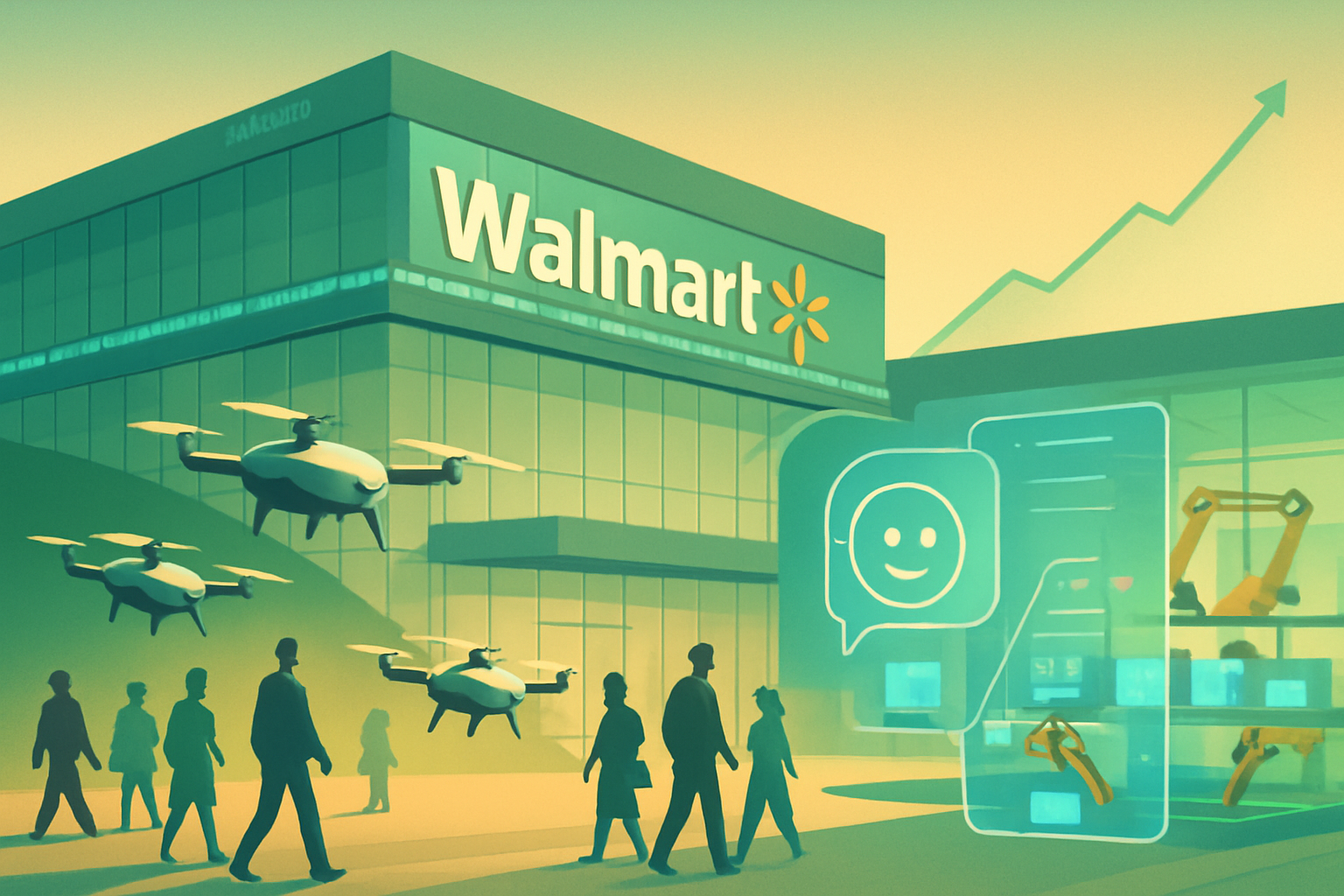
    • Sparky AI: A proprietary conversational AI assistant integrated with Google Gemini, allowing customers to shop through natural dialogue.
    • Shoppable TV: Following the 2024 Vizio acquisition, Walmart has turned millions of smart TVs into direct-to-consumer storefronts via the Vizio SmartCast OS.
    • Automation: As of 2026, nearly 65% of Walmart stores are serviced by automated fulfillment centers, utilizing robotics to triple the speed of order processing.
    • Drone Delivery: Walmart now operates the largest retail drone delivery network in the U.S., capable of reaching over 10 million households with 30-minute delivery times.

    Competitive Landscape

    While Amazon.com, Inc. (Nasdaq: AMZN) remains the primary rival in the digital space, Walmart holds a significant advantage in "phygital" retail. Walmart's physical proximity to 90% of the U.S. population allows it to use stores as fulfillment hubs, a cost advantage Amazon struggles to replicate in the grocery sector.

    In the warehouse club space, Costco Wholesale Corp. (Nasdaq: COST) remains a formidable competitor, though Sam’s Club has gained ground by leveraging Walmart’s superior technology stack for "Scan & Go" checkout and digital-native member experiences.

    Industry and Market Trends

    Two macro trends are currently favoring Walmart:

    1. Value-Seeking High Earners: High interest rates and persistent inflation in services have driven households earning over $100,000 to shop at Walmart for groceries, expanding the company’s total addressable market (TAM).
    2. Retail Media Expansion: As third-party cookies disappear, Walmart’s first-party data (knowing exactly what people buy) has become "gold" for advertisers, fueling the rapid growth of Walmart Connect.

    Risks and Challenges

    Despite its dominance, Walmart faces headwinds:

    • Labor Relations: As the nation’s largest private employer, Walmart is highly sensitive to wage inflation and unionization efforts.
    • International Volatility: While Flipkart is thriving, other international markets remain lower-margin and subject to currency fluctuations.
    • Regulatory Scrutiny: The Federal Trade Commission (FTC) continues to monitor Walmart’s data privacy practices and its influence over the grocery supply chain.

    Opportunities and Catalysts

    • Agentic Commerce: If Walmart’s AI can successfully automate "the weekly grocery run" for millions, it will lock in a level of recurring revenue previously unseen in retail.
    • IPO Potential: Investors are closely watching for potential spin-offs of Flipkart or PhonePe in India, which could unlock billions in shareholder value.
    • Healthcare Expansion: While Walmart scaled back physical clinics in 2024, its pharmacy and digital health play remains a massive untapped opportunity.

    Investor Sentiment and Analyst Coverage

    Wall Street is overwhelmingly bullish. As of March 2026, roughly 85% of analysts covering WMT have a "Buy" or "Strong Buy" rating. Hedge funds have increased their positions throughout 2025, viewing Walmart as both a defensive play in volatile markets and a growth play on AI and advertising. The consensus price target currently sits near $140, implying further upside.

    Regulatory, Policy, and Geopolitical Factors

    Walmart is a key player in the "Inflation Reduction" conversation. Its ability to keep food prices low is a matter of national economic policy. Geopolitically, the company has worked aggressively to diversify its supply chain away from China, shifting significant sourcing to India and Southeast Asia to mitigate potential tariff risks or trade disruptions.

    Conclusion

    Walmart Inc. has successfully navigated the most difficult transition in retail history: moving from the physical past to the digital future without losing its core identity as the low-price leader. By leveraging its physical footprint as a technical asset and high-margin services as a profit engine, Walmart has evolved into a diversified tech-retail giant. For investors, Walmart offers a unique combination of defensive stability and tech-driven growth potential. As John Furner begins his tenure, the market will be watching to see if his "Agentic Era" can keep the momentum going in an increasingly automated world.


    This content is intended for informational purposes only and is not financial advice.

  • The RenAIssance of Retail: A Deep Dive into Shopify (SHOP) in 2026

    The RenAIssance of Retail: A Deep Dive into Shopify (SHOP) in 2026

    As of February 20, 2026, Shopify Inc. (NYSE: SHOP; TSX: SHOP) stands as the undisputed backbone of the global independent e-commerce ecosystem. Once viewed primarily as a tool for small businesses to build web storefronts, the Ottawa-based giant has evolved into a high-margin, AI-driven infrastructure powerhouse. After a tumultuous period following the 2021 pandemic highs and a painful restructuring in 2023, Shopify has entered 2026 with a leaner operating model and a renewed focus on "Agentic Commerce." With a market capitalization that has reclaimed much of its former glory, Shopify is currently a focal point for investors seeking to capture the intersection of retail software and autonomous artificial intelligence.

    Historical Background

    Founded in 2004 by Tobi Lütke, Daniel Weinand, and Scott Lake, Shopify’s origin story is rooted in the founders' struggle to sell snowboards online. Frustrated by the lack of user-friendly commerce tools, Lütke—a programmer by trade—built his own platform, Snowdevil. This transitioned into a public offering in 2015, where Shopify began its ascent as the "anti-Amazon," empowering merchants to own their customer relationships.

    The company's history is marked by two major pivots. The first was the aggressive expansion into fulfillment and logistics between 2019 and 2022, which culminated in the multi-billion dollar acquisition of Deliverr. However, realizing the capital intensity of physical logistics, Shopify executed its second major pivot in May 2023, divesting its logistics arm to Flexport and refocusing on its high-margin software "Main Quest." By early 2026, this shift has proven to be a masterstroke, allowing the company to achieve the structural profitability that critics long doubted.

    Business Model

    Shopify operates a "flywheel" model centered on two primary revenue streams:

    1. Subscription Solutions: Recurring revenue from platform access, ranging from the "Basic" plan for solo entrepreneurs to "Shopify Plus" for enterprise giants. This segment provides the predictable, high-margin foundation of the business.
    2. Merchant Solutions: Variable revenue tied to the success of its users. This includes Shopify Payments, Shopify Capital, and increasingly, AI-driven marketing tools like Shopify Audiences.

    As of 2026, a third pillar has emerged: Agentic Commerce Services. Through its "Sidekick" ecosystem, Shopify now monetizes autonomous AI agents that handle customer service, inventory forecasting, and digital marketing for merchants, creating a new high-margin revenue layer that scales with merchant volume.

    Stock Performance Overview

    Shopify’s stock chart remains one of the most storied in the technology sector:

    • 10-Year View: Investors who held through the volatility since 2016 have seen a staggering CAGR of approximately 50%, significantly outperforming the S&P 500.
    • 5-Year View: The stock remains down roughly 15% from its split-adjusted all-time highs of 2021, reflecting the massive valuation reset that occurred in 2022.
    • 1-Year View: Over the last 12 months, SHOP has seen a slight decline of 5%, though this follows a massive 55% surge in 2025.
    • Recent Momentum: After reaching a local peak of $179.01 in late 2025, the stock faced a valuation "breather" in early 2026, currently trading in the $120–$125 range as investors digest its high P/E ratio relative to interest rate forecasts.

    Financial Performance

    Fiscal Year 2025 was a record-breaking period for Shopify. The company reported annual revenue of $11.6 billion, a 30% year-over-year increase. More importantly, the Gross Merchandise Volume (GMV) processed through the platform reached $378.4 billion, with the final quarter of 2025 alone accounting for $124 billion.

    Profitability metrics have been the highlight of recent earnings calls. Operating margins have stabilized between 16% and 20%, a result of the "logistics-free" strategy. Shopify generated $2 billion in Free Cash Flow (FCF) in 2025, representing a healthy 17% margin. With a clean balance sheet and a newly authorized $2 billion share buyback program announced in February 2026, the company is signaling its transition into a mature, cash-generative leader.

    Leadership and Management

    CEO Tobi Lütke continues to be the visionary heart of the company, emphasizing a "long-term greedy" philosophy that prioritizes product velocity over quarterly smoothing. Alongside him, President Harley Finkelstein has become the public face of the company’s enterprise push, successfully onboarding legacy brands like General Motors and L'Oreal to the platform.

    The leadership team has seen some 2025 departures, including Chief Revenue Officer Bobby Morrison and COO Kaz Nejatian. While executive turnover can be a red flag, analysts generally view this as part of Lütke’s "crafter" philosophy—flattening the organization to remove layers between engineers and the final product.

    Products, Services, and Innovations

    Shopify's "Winter Editions ’26" release, titled "The RenAIssance," highlighted its most significant innovations:

    • Sidekick Pulse: An evolution of their AI assistant that no longer waits for prompts but proactively identifies business opportunities, such as "Product X is trending in Tokyo; should I launch a localized ad campaign?"
    • Universal Commerce Protocol (UCP): A collaborative effort with Google (NASDAQ: GOOGL) that allows Shopify merchants to sync product data instantly with AI-driven search interfaces.
    • B2B Expansion: Once a weakness, Shopify’s B2B segment grew 96% in 2025, offering wholesale tools that rival specialist platforms like BigCommerce (NASDAQ: BIGC).

    Competitive Landscape

    Shopify occupies a unique middle ground in the "Commerce Wars."

    • The Amazon Rivalry: While Amazon (NASDAQ: AMZN) dominates high-intent search and rapid fulfillment, Shopify has embraced a "co-opetition" model, integrating "Buy with Prime" while positioning itself as the only way for brands to truly own their customer data.
    • Social Commerce: The rise of TikTok Shop threatened to disrupt Shopify’s merchant base. However, Shopify has successfully positioned itself as the "back-end of record" for social sellers, ensuring that while the discovery happens on TikTok, the business runs on Shopify.
    • Enterprise Shift: Shopify is increasingly competing with Salesforce (NYSE: CRM) and Adobe (NASDAQ: ADBE) for large-scale enterprise contracts, leveraging a lower Total Cost of Ownership (TCO) to win over traditional retailers.

    Industry and Market Trends

    The e-commerce landscape in 2026 is defined by "Agentic Commerce"—where AI agents, rather than humans, perform much of the discovery and purchasing logic. Shopify’s early bet on integrating LLMs (Large Language Models) into its core stack has placed it at the forefront of this shift. Additionally, the "Retail Everywhere" trend—where a brand must sell simultaneously on a website, social apps, marketplaces, and physical stores—has made Shopify’s unified back-end more essential than ever.

    Risks and Challenges

    Despite its strengths, Shopify faces several headwinds:

    1. Valuation: Trading at over 80x forward earnings, Shopify remains priced for perfection. Any miss in growth or margin expansion could lead to significant share price compression.
    2. Geopolitical Friction: As an international company with significant US exposure, Shopify is vulnerable to trade tensions. In early 2026, potential "retaliatory fees" from the US Trade Representative regarding digital services taxes in Europe have introduced new regulatory risks.
    3. Discretionary Spend: While Shopify has moved into B2B and essentials, its merchant base is still heavily weighted toward discretionary consumer goods, making it sensitive to global economic slowdowns.

    Opportunities and Catalysts

    • B2B Scaling: The wholesale market is multiple times larger than the D2C market. Continued penetration here is a massive tailwind.
    • International Markets: Expansion into Southeast Asia and parts of Europe remains a relatively untapped growth lever.
    • M&A Potential: With $2 billion in annual FCF, Shopify is well-positioned to acquire smaller AI startups or niche commerce tool providers to enhance its ecosystem.

    Investor Sentiment and Analyst Coverage

    Wall Street sentiment remains overwhelmingly positive as of February 2026. The consensus rating is a "Strong Buy," with a median price target of $165. Analysts at firms like RBC and Mizuho point to the 15x surge in AI-driven orders as proof of Shopify’s "operating leverage story." Institutional ownership remains high, with major hedge funds maintaining large positions, viewing Shopify as the "safest" bet in the high-growth software-as-a-service (SaaS) sector.

    Regulatory, Policy, and Geopolitical Factors

    The EU’s Digital Markets Act (DMA) has emerged as a surprising tailwind for Shopify in 2026. By curbing the ability of "gatekeepers" like Google and Amazon to self-preference their own services, the DMA has lowered the customer acquisition costs for Shopify’s independent merchants in Europe. However, compliance costs and the ever-looming threat of global digital taxes remain a complex puzzle for the company’s legal teams.

    Conclusion

    Shopify enters 2026 as a more disciplined, profitable, and technologically advanced version of its former self. By divesting its logistics distractions and doubling down on AI-driven commerce infrastructure, it has solidified its role as the operating system for modern retail. For investors, the "Main Quest" is clear: Shopify is no longer just a growth stock; it is a fundamental piece of global economic infrastructure. While the valuation remains high and geopolitical risks persist, Shopify’s ability to innovate faster than its peers makes it a compelling, albeit volatile, cornerstone for any tech-focused portfolio.


    This content is intended for informational purposes only and is not financial advice. Today's date is 2/20/2026.