Tag: AI PC

  • The Intel Inflection: Inside the 121% Surge, the 19% Correction, and the CFO’s $250,000 Bet

    The Intel Inflection: Inside the 121% Surge, the 19% Correction, and the CFO’s $250,000 Bet

    As of January 28, 2026, Intel Corporation (Nasdaq: INTC) finds itself at the center of a high-stakes narrative that reads more like a financial thriller than a corporate quarterly report. After a spectacular 2025 that saw the stock price rocket upward by 121%, the Santa Clara-based chip giant has suddenly faced a bracing 19% weekly correction. This volatility has left investors questioning whether the company’s turnaround is finally materializing or if it has hit a manufacturing wall. However, a significant insider signal—a quarter-million-dollar stock purchase by CFO David Zinsner—suggests that those closest to the engine room see this dip as a buying opportunity rather than a structural collapse.

    Historical Background

    Intel’s journey is the history of the modern computing era itself. Founded in 1968 by Robert Noyce and Gordon Moore, the company pioneered the microprocessor and defined the pace of technological progress for five decades via Moore’s Law. However, the 2010s were marked by a series of manufacturing delays and a failure to capitalize on the mobile chip revolution, allowing rivals like Taiwan Semiconductor Manufacturing Company (TSMC) to seize the lead in process technology.

    The 2021 launch of the "IDM 2.0" strategy marked the beginning of a radical transformation. By early 2025, the company took another bold step with the appointment of industry veteran Lip-Bu Tan as CEO, signaling a renewed focus on design excellence and ecosystem partnerships. This era has been defined by the painful but necessary separation of Intel’s product design business from its capital-intensive manufacturing arm, Intel Foundry.

    Business Model

    Intel’s business model is currently in a state of dual-track evolution. Traditionally a vertically integrated device manufacturer (IDM), Intel is now splitting its identity into two distinct entities:

    1. Intel Products: This remains the primary revenue driver, encompassing the Client Computing Group (CCG), which dominates the PC market, and the Data Center and AI (DCAI) group. These segments design the CPUs and AI accelerators that power everything from laptops to massive cloud infrastructures.
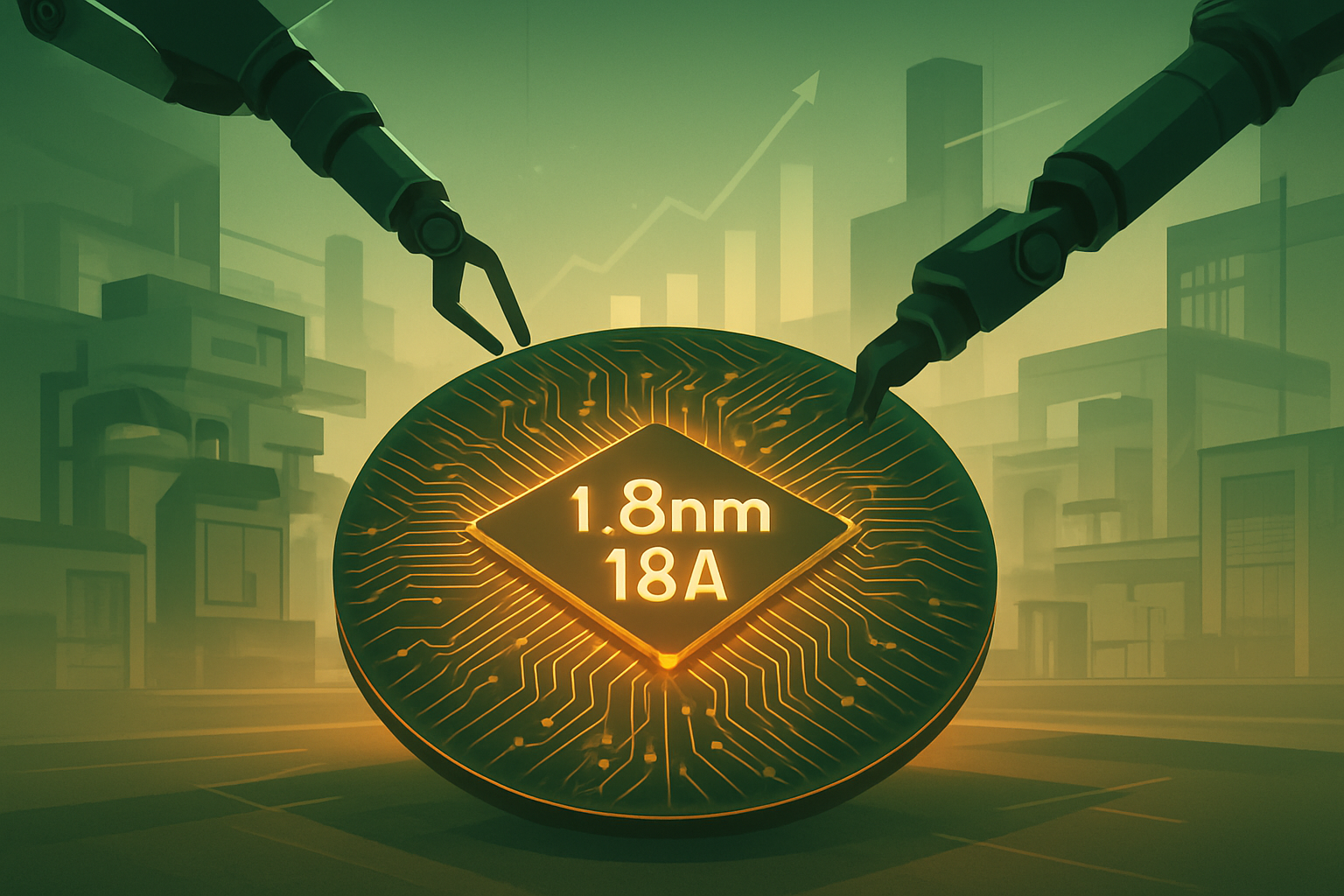
    2. Intel Foundry: This is the company’s high-stakes bet to become a world-class contract manufacturer. Intel Foundry aims to compete directly with TSMC by manufacturing chips for external customers, including former rivals. This segment operates as a standalone business with its own P&L, focusing on the upcoming 18A (1.8nm) process node as its "anchor" offering.

    Stock Performance Overview

    The last twelve months have been a roller coaster for INTC shareholders. Throughout 2025, the stock enjoyed a "revival rally," surging 121.87% from its 2024 lows. This was fueled by the successful tape-out of the 18A node and a landmark $5 billion strategic investment from NVIDIA.

    However, the week of January 22, 2026, saw a sharp reversal. Following the Q4 2025 earnings report, the stock plummeted 19.02% in just five trading days. While the earnings beat expectations, a "revenue cliff" in the Q1 2026 guidance—stemming from supply constraints rather than lack of demand—spooked the market. As of today, January 28, 2026, the stock is trading around $43.93, looking for a floor after its recent correction.

    Financial Performance

    Intel’s FY2025 financials reflect the high cost of a turnaround. Total revenue for the year stood at $52.9 billion, a flat year-over-year performance that masks significant internal shifts. The Non-GAAP gross margin improved to 36.7%, up 70 basis points from 2024, though recent guidance suggests a temporary dip to 34.5% in the coming quarter.

    The most glaring figure remains the operating loss in Intel Foundry, which widened to $10.3 billion in 2025. This loss is attributed to the massive "pre-ramp" costs of the 18A process node in Arizona. Conversely, the Product Groups generated $49.1 billion in revenue, with the Data Center segment showing a healthy 15% growth in the final quarter of the year.

    Leadership and Management

    The current leadership team is viewed as a "war cabinet" tasked with reclaiming Intel’s crown. CEO Lip-Bu Tan, known for his success at Cadence Design Systems, has brought a focused, engineering-first culture back to the company.

    Supporting him is CFO David Zinsner, whose recent actions have spoken louder than any press release. On January 26, 2026, Zinsner purchased 5,882 shares at an average price of $42.50. This $250,000 "vote of confidence" during the height of the weekly correction has been interpreted by analysts as a signal that the Q1 manufacturing bottlenecks are temporary and that the long-term roadmap remains intact.

    Products, Services, and Innovations

    The "North Star" for Intel’s innovation pipeline is the 18A process node. As of early 2026, 18A has officially reached High-Volume Manufacturing (HVM) at Arizona’s Fab 52. The node is reporting yield improvements of 7–8% per month, reaching an estimated 65–75% yield—a critical threshold for profitability.

    The lead product for this node, the Core Ultra Series 3 (Panther Lake), is now shipping to OEMs. In the AI space, the Gaudi 3 accelerator has found a niche in mid-tier AI training, while the "AI PC" remains Intel's stronghold, with the Core Ultra series powering over 200 distinct laptop and desktop designs.

    Competitive Landscape

    Intel remains in a fierce three-way battle with NVIDIA (Nasdaq: NVDA) and AMD (Nasdaq: AMD). While NVIDIA maintains a dominant 86% share of the AI data center revenue, Intel’s strategy has pivoted toward a "co-opetition" model. The recent partnership to co-develop custom x86 CPUs with NVLink integration for NVIDIA’s infrastructure has transformed a primary rival into a key foundry customer.

    Against AMD, Intel continues to defend its PC market share vigorously. While AMD has captured nearly 10% of the AI accelerator market, Intel still leads in the "AI PC" category, which is expected to reach a $25 billion total addressable market (TAM) by the end of 2026.

    Industry and Market Trends

    The semiconductor industry in 2026 is defined by "The Inventory Paradox." While demand for AI-capable silicon is at an all-time high, manufacturing capacity remains the primary bottleneck. Intel’s 19% stock correction was largely driven by the revelation that the company had completely depleted its buffer inventory by late 2025. Entering 2026, Intel is in a "hand-to-mouth" scenario where it cannot manufacture chips fast enough to meet demand, specifically prioritizing high-margin server wafers over PC chips.

    Risks and Challenges

    Intel faces two primary categories of risk:

    1. Operational Execution: The 18A ramp-up is the most complex manufacturing feat in the company’s history. Any delay in yield improvements could lead to further multi-billion dollar losses in the Foundry segment.
    2. Market Share Erosion: While Intel is pivoting to Foundry, it cannot afford to lose more ground in the CPU market to ARM-based competitors or AMD’s rising EPYC server share.

    Opportunities and Catalysts

    The most significant catalyst on the horizon is the Foundry External Customer ramp. Beyond NVIDIA, Intel is reportedly in advanced talks with major cloud service providers to manufacture custom silicon. Additionally, the full activation of Fab 52 in Arizona later this year will alleviate the current "supply cliff," potentially allowing Intel to recapture the revenue it is currently leaving on the table.

    Investor Sentiment and Analyst Coverage

    Wall Street is currently divided on Intel. Institutional sentiment is cautiously optimistic, with many "wait-and-see" ratings as analysts monitor the 18A yield curve. However, the recent 19% correction has moved Intel into what some consider deep value territory, with its price-to-book ratio significantly lower than its peers. Retail sentiment remains volatile, frequently reacting to short-term news cycles regarding the US-China trade war and the progress of the CHIPS Act.

    Regulatory, Policy, and Geopolitical Factors

    Intel is the primary beneficiary of the U.S. CHIPS and Science Act, having secured billions in direct grants and loans to build out domestic manufacturing. In a world of increasing geopolitical tension, Intel’s "Western-based supply chain" is its greatest strategic asset. Policymakers view Intel as a national security priority, ensuring a level of government support that no other domestic semiconductor firm enjoys.

    Conclusion

    As we stand in late January 2026, Intel is at an inflection point. The 121% surge of the past year was a recognition of its potential; the 19% correction is a reminder of the difficulty of the task. While the "inventory drought" will make for a difficult first half of 2026, the technical success of the 18A node and the strategic backing of NVIDIA suggest that the foundation is stronger than the recent price action implies. For investors, CFO David Zinsner’s recent purchase serves as a quiet but firm reminder: in the world of semiconductors, the long game is the only game that matters.


    This content is intended for informational purposes only and is not financial advice.
  • The Silicon Renaissance: A Deep-Dive into Intel’s (INTC) 2026 Turnaround

    The Silicon Renaissance: A Deep-Dive into Intel’s (INTC) 2026 Turnaround

    Date: January 14, 2026

    Introduction

    Intel Corporation (NASDAQ: INTC) enters 2026 as one of the most remarkable turnaround stories in modern corporate history. After a harrowing 2024 that saw the silicon giant’s market value plummet to decade-lows and its very survival questioned by skeptics, the company has emerged as a leaner, more focused "National Champion." Today, Intel is no longer just a processor company; it is the linchpin of the United States’ strategy to reshore semiconductor manufacturing. With its revolutionary 18A process node now in high-volume production and a new leadership team emphasizing operational rigor, Intel is at the center of the global AI infrastructure race and the burgeoning "AI PC" market.

    Historical Background

    Founded in 1968 by Robert Noyce and Gordon Moore, Intel was the pioneer of the microprocessor—the "brain" of the modern computer. Under the legendary leadership of Andy Grove in the 1980s and 90s, Intel pivoted from memory chips to CPUs, establishing the "Intel Inside" era and the "x86" dominance that powered the PC revolution. However, the 2010s were marked by stagnation. Delayed transitions to 10nm and 7nm processes allowed competitors like Taiwan Semiconductor Manufacturing Company (NYSE: TSM) and Advanced Micro Devices (NASDAQ: AMD) to seize the technological lead. In 2021, Pat Gelsinger returned as CEO to launch the "IDM 2.0" strategy—a multi-year, multi-billion-dollar bet to reclaim manufacturing parity. His retirement in early 2025 paved the way for the current "Foundry First" era under Lip-Bu Tan.

    Business Model

    Intel’s business model has undergone a fundamental split into two primary engines:

    1. Intel Product: This includes the Client Computing Group (CCG), which dominates the consumer laptop and desktop market, and the Data Center and AI (DCAI) group, which sells Xeon processors and Gaudi AI accelerators.
    2. Intel Foundry (IFS): Operating as a separate P&L, the Foundry business aims to manufacture chips for external customers, including rivals. This segment provides design services, wafer fabrication, and advanced packaging (EMIB, Foveros).
    3. NEX (Network and Edge): Focuses on edge computing and telecommunications infrastructure, a growing segment as AI processing moves closer to the end-user.

    Stock Performance Overview

    The last 12 months have been a renaissance for shareholders. Following a dismal 2024 where the stock bottomed out in the low $20s, INTC rallied 84% in 2025.

    • 1-Year Performance: As of mid-January 2026, Intel is trading in the $44.00 – $48.00 range, a levels not seen since the pre-inflationary peaks of 2021.
    • 5-Year Performance: On a five-year horizon, the stock is finally nearing a "breakeven" for long-term holders, though it still trails the broader S&P 500 and the PHLX Semiconductor Index (SOX).
    • Recent Momentum: A 10.8% surge in early January 2026 followed reports of successful 18A yields and a strategic $5 billion investment from NVIDIA (NASDAQ: NVDA) to secure future packaging capacity.

    Financial Performance

    Intel’s Q3 and Q4 2025 earnings signaled a definitive return to profitability.

    • Revenue: Q3 2025 revenue hit $13.7 billion, a 3% year-over-year increase, driven by the explosive adoption of AI PCs.
    • Profitability: The company reported a net income of $4.1 billion in Q3, a sharp recovery from the massive $16.6 billion write-down and loss recorded in late 2024.
    • Margins: Gross margins have expanded to 38.2%, up from the mid-20s during the height of the transition. This improvement is attributed to the $10 billion cost-cutting initiative implemented throughout 2025 and higher fab utilization.
    • Cash Flow: The company expects to reach full-year cash-flow positivity in 2026, supported by federal grants and capital offsets from the "Smart Capital" strategy.

    Leadership and Management

    In March 2025, industry veteran and former Cadence Design Systems CEO Lip-Bu Tan took the helm as CEO. Tan’s leadership has been defined by a "Foundry First" philosophy. While Pat Gelsinger focused on the visionary roadmap (5 nodes in 4 years), Tan has focused on execution and yield.
    His administration has:

    • Stabilized the leadership team after significant exits in 2024.
    • Secured high-profile foundry customers like Microsoft and Amazon Web Services (AWS).
    • Managed the delicate conversion of CHIPS Act grants into a government equity stake, effectively "de-risking" Intel's balance sheet from a debt spiral.

    Products, Services, and Innovations

    Innovation at Intel is currently defined by the 18A process node. This technology introduces two industry firsts: PowerVia (backside power delivery) and RibbonFET (gate-all-around transistors).

    • Panther Lake: Launched at CES 2026, this is the first consumer CPU built entirely on 18A. It offers a 30% performance-per-watt improvement over previous generations, positioning Intel to fight back against Apple (NASDAQ: AAPL) Silicon and ARM-based rivals.
    • Gaudi 3 & 4: While NVIDIA dominates the "training" market, Intel’s Gaudi accelerators have found a niche in AI inference, where they offer superior price-performance for enterprise applications.
    • High-NA EUV: Intel is currently the only firm with multiple ASML (NASDAQ: ASML) High-NA EUV lithography machines in operation, a key advantage for the upcoming 14A node.

    Competitive Landscape

    The competitive environment remains fierce but has shifted in Intel's favor in specific areas:

    • TSMC: Still the leader in total volume, TSMC’s 2nm node is expected to ramp in late 2026. Intel’s 18A, arriving earlier with backside power, gives it a temporary technological "window" of efficiency superiority.
    • AMD: AMD continues to pressure Intel in the server market with its EPYC processors. However, Intel’s Clearwater Forest Xeons (built on 18A) are beginning to reclaim market share in power-sensitive hyperscale data centers.
    • NVIDIA: No longer just a rival, NVIDIA is now a critical "frenemy." Their $5 billion investment in Intel stock highlights Intel's unique position as the only US-based provider of the advanced packaging required for H100/B200 successors.

    Industry and Market Trends

    Three macro trends are favoring Intel’s current trajectory:

    1. AI PC Adoption: The industry is shifting from cloud-only AI to "Local AI." Intel estimates that by the end of 2026, 60% of new laptop shipments will be AI-capable, a segment Intel currently leads.
    2. Sovereign AI: Governments in Europe and Asia are seeking non-Taiwan-based manufacturing to ensure supply chain resilience. Intel Foundry is the primary beneficiary of this "Sovereign AI" movement.
    3. Foundry Secular Growth: The decoupling of chip design and chip manufacturing continues to accelerate, with more "Hyper-scalers" (Google, Meta) designing their own silicon and needing a foundry to build it.

    Risks and Challenges

    Despite the recovery, Intel is not yet in the clear:

    • Execution Risk: The ramp of 18A must remain flawless. Any yield regressions could cause customers like Microsoft or AWS to revert to TSMC.
    • Debt and Liquidity: Even with government aid, Intel’s capital expenditures are massive ($20B+ annually). Maintaining a healthy balance sheet while building fabs in Ohio and Germany is a high-wire act.
    • ARM Intrusion: Qualcomm (NASDAQ: QCOM) and Apple are making aggressive gains in the Windows-on-ARM laptop space, threatening Intel's CCG margins.

    Opportunities and Catalysts

    • Intel Foundry Spinoff: Rumors persist that Lip-Bu Tan may eventually spin off the Foundry business into a separate public entity by 2027. This could unlock massive shareholder value by removing the "manufacturing drag" from the product side's valuation.
    • 18A Customer Wins: Announcements of a major mobile player (e.g., Apple or Samsung) using 18A for a specific chip line would be a massive catalyst for the stock.
    • Sustained AI PC Cycle: A faster-than-expected replacement cycle for enterprise laptops could drive CCG revenues to record highs.

    Investor Sentiment and Analyst Coverage

    Wall Street has largely shifted its consensus from "Sell" or "Underperform" to "Hold" or "Buy."

    • KeyBanc recently raised its price target to $60, citing Intel's unique "National Champion" status.
    • Institutional Holdings: Major asset managers like BlackRock and Vanguard have maintained their 8%+ stakes, while several "turnaround-focused" hedge funds increased their positions in Q4 2025.
    • Retail Sentiment: On social platforms, the narrative has shifted from mocking Intel’s "legacy" status to highlighting its role as a strategic defense asset for the US.

    Regulatory, Policy, and Geopolitical Factors

    Intel is now inextricably tied to US geopolitical interests.

    • US Government Equity: In August 2025, the U.S. Department of Commerce converted $8.9 billion of CHIPS Act grants into a 9.9% direct equity stake in Intel. This makes the US government the company's single largest shareholder, effectively guaranteeing that the company is "too big to fail."
    • The Secure Enclave: Intel has been designated the primary manufacturer for the Pentagon’s "Secure Enclave" program, providing a steady stream of high-margin, sensitive government contracts.

    Conclusion

    Intel is no longer the lumbering giant of the 2010s. By embracing its role as a foundry for the world and securing the backing of the United States government, it has stabilized its foundation. The successful high-volume manufacturing of 18A marks the first time in a decade that Intel has a legitimate claim to the "world's best transistor." For investors, Intel represents a high-stakes play on the future of US manufacturing and AI hardware. While risks of execution and heavy capital requirements remain, the "Silicon Renaissance" of 2026 suggests that Intel’s best days may not be behind it after all.


    This content is intended for informational purposes only and is not financial advice.