
Tag: AI

  • Unity Software (NYSE: U): The Great Rebuild and the AI Horizon

    Unity Software (NYSE: U): The Great Rebuild and the AI Horizon

    As of February 12, 2026, Unity Software (NYSE: U) stands at a critical crossroads. Once the undisputed king of mobile game development, the company is currently navigating the most significant "rebuild" in its history. After a tumultuous 2023 and 2024 defined by leadership changes and a pricing scandal that nearly broke the brand, Unity has emerged as a leaner, AI-first entity.

    Today, Unity is more than just a game engine; it is a battle-tested platform for real-time 3D (RT3D) content that powers everything from mobile hits to industrial digital twins. However, with its stock price recently experiencing a sharp 28% correction following its FY2025 earnings report, the central question for investors is whether Unity has finally stabilized its foundation or if it is still catching its breath in a hyper-competitive landscape dominated by Epic Games and AppLovin.

    Historical Background

    Unity’s story began in 2004 in a Copenhagen basement, where founders Joachim Ante, David Helgason, and Nicholas Francis sought to "democratize" game development. Their engine, launched originally for Mac OS, provided a unified environment that allowed developers to write code once and deploy it across multiple platforms—a revolutionary concept at the time.

    By the mid-2010s, Unity was the backbone of the mobile gaming explosion, powering titles like Pokémon GO and Among Us. Under CEO John Riccitiello, the company went public in 2020 and embarked on an aggressive acquisition spree, most notably the $4.4 billion merger with ironSource in 2022 to bolster its advertising capabilities.

    However, the "growth at all costs" era culminated in the disastrous September 2023 "Runtime Fee" announcement. The plan to charge developers per installation sparked a massive industry revolt, leading to Riccitiello’s departure and a year of painful restructuring. In 2024 and 2025, new leadership under Matthew Bromberg spent their efforts retracting the fee, cutting 25% of the workforce, and refocusing the company on its core engine and a new AI-driven ad tech stack.

    Business Model

    Unity’s revenue model has been simplified into two core pillars:

    1. Create Solutions (The Engine): This segment generates revenue through tiered subscriptions (Pro, Enterprise, and Industry). Following the release of Unity 6, the company shifted toward a more traditional SaaS model, raising prices for high-end users while keeping the "Personal" tier free to maintain the developer pipeline. This segment also includes professional services for non-gaming industries like automotive and architecture.
    2. Grow Solutions (Monetization): This is the company’s profit engine. It includes ad networks and publishing tools. In late 2025, Unity officially sunsetted the legacy ironSource network in favor of Unity Vector, an AI-powered ad platform that uses deep learning to match players with games more effectively than traditional tracking methods.

    Stock Performance Overview

    Unity's stock performance has been a roller coaster for long-term holders.

    • 1-Year Horizon: The stock has seen extreme volatility. While it rallied in late 2025 on the successful launch of Unity 6, it faced a massive 28% drop yesterday (February 11, 2026) following a cautious revenue outlook for Q1 2026.
    • 5-Year Horizon: Investors who bought during the 2021 tech peak remain significantly underwater. The stock has struggled to return to its triple-digit highs as the market shifted focus from revenue growth to GAAP profitability.
    • Current Standing: At roughly $21.40 (as of today, Feb 12, 2026), Unity is trading near historical valuation lows, reflecting deep skepticism about its ability to outpace competitors in the mobile ad space.

    Financial Performance

    Unity’s FY 2025 results, reported yesterday, showcased a company that is finally disciplined but still fighting for top-line growth.

    • Revenue: Unity reported $1.85 billion for the full year 2025. Q4 2025 revenue came in at $503 million, a 10% year-over-year increase, beating internal guidance.
    • Profitability: The company reached an Adjusted EBITDA of $125 million in Q4, representing a 25% margin. However, on a GAAP basis, it still posted a net loss of $89 million for the quarter.
    • Balance Sheet: Unity ended 2025 with $2.06 billion in cash. It successfully refinanced its 2026 convertible notes, pushing significant debt maturities out to 2030, which has alleviated immediate bankruptcy fears.
    • AI-Generated Estimate (2026): For the full year 2026, we project revenue to reach $2.05 billion (+11% YoY) as the Vector ad platform scales, with Adjusted EBITDA margins potentially expanding to 28-30% by Q4 2026.

    Leadership and Management

    Matthew Bromberg, the former COO of Zynga, took over as CEO in May 2024. His tenure has been characterized by "radical execution." Bromberg has successfully:

    • Repaired the relationship with the developer community by killing the Runtime Fee.
    • Slimmed down the product portfolio, exiting money-losing ventures like Weta FX.
    • Recruited a board of directors with deep operational experience in mobile gaming (including Bernard Kim).

    His leadership style is viewed as pragmatic and "boring" in a positive sense, focusing on predictable margins over speculative moonshots.

    Products, Services, and Innovations

    The centerpiece of Unity’s current offering is Unity 6, released in late 2024.

    • Unity 6 & 6.1: These versions offer 20% better performance for mobile and XR (Extended Reality) applications.
    • Unity Muse: A suite of generative AI tools that allows developers to create 3D textures, sprites, and animations through natural language prompts.
    • Unity Sentis: A groundbreaking runtime engine that allows developers to embed AI models directly into their games, enabling "smart" NPCs and dynamic world-building that runs locally on user devices without high cloud costs.

    Competitive Landscape

    Unity faces a "barbell" competitive threat:

    • Unreal Engine (Epic Games): Unreal remains the gold standard for high-fidelity AAA games (PC/Console) and film production. While Unity leads in mobile, Unreal has been making inroads with its "Lumen" and "Nanite" technologies.
    • Godot (Open Source): The fastest-growing threat in the indie space. Following the 2023 scandal, many small developers migrated to Godot to avoid "vendor lock-in."
    • AppLovin (NASDAQ: APP): In the "Grow" segment, AppLovin’s AXON 2.0 AI engine has proven to be a formidable rival to Unity’s Vector platform, often leading to fierce price wars in the mobile ad-bidding space.

    Industry and Market Trends

    • Spatial Computing: With the maturation of headsets like the Apple Vision Pro and Meta Quest 4, Unity remains the primary development platform for VR/AR, a sector expected to grow at a 25% CAGR through 2030.
    • The AI Pivot: Game development is becoming an AI-assisted craft. Unity’s integration of Muse and Sentis positions it as a "toll booth" for the next generation of AI-native games.
    • Digital Twins: Beyond gaming, Unity is seeing adoption in "Industrial 3D," where companies like BMW and Boeing use the engine to simulate factories and training environments.

    Risks and Challenges

    • The "Trust Deficit": While the Runtime Fee is gone, the "scar tissue" remains. Many developers still maintain "Plan B" options like Godot to ensure they aren't trapped by future licensing changes.
    • Ad-Market Volatility: Unity’s transition from ironSource to Vector is a "changing of the engines mid-flight." Any slowdown in mobile ad spend or a failure of Vector to deliver high ROAS would be catastrophic.
    • Competition from AppLovin: AppLovin has recently shown higher efficiency in its AI-driven ad matching, threatening Unity’s market share in game monetization.

    Opportunities and Catalysts

    • Vector's Scaling: If Unity Vector hits its projected $1B+ run rate by late 2026, the stock could see a significant re-rating as a high-margin AI play.
    • M&A Potential: At a market cap currently under $10 billion, Unity remains an attractive acquisition target for a tech giant (like Microsoft or Sony) looking to own the "picks and shovels" of the metaverse.
    • Unity 6 Adoption: Higher-than-expected upgrades to the Pro and Enterprise tiers could drive "Create" revenue surprises in late 2026.

    Investor Sentiment and Analyst Coverage

    Investor sentiment is currently fragile.

    • Wall Street: Consensus is a "Moderate Buy," but price targets were slashed following the Feb 11 earnings. BTIG lowered its target to $41, while BofA Securities remains bearish with an $18 target.
    • Institutional Moves: There has been notable "tax-loss harvesting" in late 2025, but some value funds have begun nibbling at the stock, viewing the $20-22 range as a floor.

    Regulatory, Policy, and Geopolitical Factors

    • The DMA (EU): The European Digital Markets Act has opened the door for alternative app stores. Unity is capitalizing on this by launching its own cross-platform commerce tools, allowing developers to bypass the 30% "Apple Tax."
    • AI Regulation: The EU AI Act (effective late 2025) requires Unity to be transparent about its Muse training data. While this adds a compliance burden, Unity’s focus on "ethically sourced" datasets may give it a competitive edge over "black box" AI models.
    • Privacy: Apple’s transition to "AdAttributionKit" continues to disrupt traditional mobile marketing, but Unity’s Vector platform is designed specifically to thrive in this privacy-first environment.

    Conclusion

    Unity Software enters 2026 as a survivor. The "Great Rebuild" under Matthew Bromberg has successfully stabilized the company's finances and restored its technical edge through Unity 6 and AI innovation. However, the market’s punishing reaction to its latest guidance shows that investors are no longer willing to pay for "potential"—they demand consistent, profitable execution.

    For the patient investor, Unity represents a high-upside play on the future of real-time 3D and AI-driven advertising, trading at a steep discount to its historical norms. For the cautious, the lingering threat from AppLovin and the memory of 2023’s PR disaster may be reason enough to wait for further confirmation of a top-line turnaround.


    Analyst Insight: "Unity is currently a story of 'Show Me.' The technology (Unity 6/Sentis) is impressive, but the valuation will remain compressed until the Grow segment proves it can consistently out-compete AppLovin in a post-IDFA world."


    This content is intended for informational purposes only and is not financial advice.

  • AppLovin (APP) Deep Dive: The AI-Driven Pivot and the Path to 2026 Dominance

    AppLovin (APP) Deep Dive: The AI-Driven Pivot and the Path to 2026 Dominance

    Today’s date is February 11, 2026.

    Introduction

    AppLovin Corporation (NASDAQ: APP) stands at a critical crossroads as it prepares to report its fourth-quarter and full-year 2025 earnings results today. Once viewed as a niche player in the mobile gaming space, the company has undergone one of the most aggressive and successful corporate transformations in recent technology history. By pivoting from a mobile game publisher to a high-margin AI software powerhouse, AppLovin has captured the attention of Wall Street, becoming a "third pillar" in the digital advertising ecosystem alongside giants like Meta and Google. Following a period of extreme volatility in early 2026—marked by regulatory rumors and the retraction of a high-profile short-seller report—today’s earnings slate represents a definitive moment for investors to assess whether the company's technical moat, powered by its AXON 2.0 engine, can sustain its triple-digit growth trajectory.

    Historical Background

    Founded in 2012 in Palo Alto, AppLovin was the brainchild of Adam Foroughi, John Krystynak, and Andrew Karam. In its early years, the company faced significant skepticism; Foroughi was famously turned down by dozens of venture capitalists, leading the team to bootstrap the business for years. This forced a culture of profitability and capital discipline that persists today.

    Originally focused on mobile app discovery, AppLovin expanded vertically in 2018 by launching Lion Studios and acquiring various game developers (including Machine Zone in 2020). The goal was to build a "closed-loop" ecosystem where the company could use its own games to test and refine its advertising algorithms. The company went public on the NASDAQ in April 2021 at $80 per share. However, the subsequent years were tumultuous, as Apple’s privacy changes decimated the traditional mobile ad market. It wasn't until 2023, with the debut of the AXON 2.0 AI engine, that AppLovin began its "Great Pivot," culminanting in the 2025 divestiture of its gaming studios to focus exclusively on its software platform.

    Business Model

    As of early 2026, AppLovin’s business model is centered almost entirely on its Software Platform segment, which has become the primary driver of enterprise value. This segment comprises three core pillars:

    1. AppDiscovery: A performance-based marketing tool powered by the AXON 2.0 AI engine, allowing advertisers to bid on and place ads across a global network.
    2. MAX: The market-leading supply-side mediation platform that helps developers monetize their apps through automated auctions. It currently holds an estimated 60% share of the mobile mediation market.
    3. Adjust: A suite of measurement and attribution tools that provide advertisers with deep data on campaign performance.

    By divesting its first-party game portfolio in July 2025 to Tripledot Studios, AppLovin effectively eliminated the "hit-driven" risk of game development, shifting to a predictable, recurring revenue model with software-as-a-service (SaaS) style economics.

    Stock Performance Overview

    The five-year journey of APP stock has been a masterclass in market sentiment shifts. After its 2021 IPO, the stock plummeted to a low of approximately $10 in 2022 during the post-ATT (App Tracking Transparency) "signal loss" panic. However, 2024 and 2025 saw a meteoric rise, with shares surging over 700% to an all-time high of $745 in late December 2025.

    Entering 2026, the stock faced a sharp correction of nearly 40%, triggered by a combination of sector-wide tech profit-taking and a now-retracted short-seller report alleging operational improprieties. As of today, February 11, 2026, the stock is trading in the $480 range, with investors looking to the earnings call to provide a catalyst for a return to previous highs.

    Financial Performance

    Financial analysts are laser-focused on today’s Q4 2025 earnings release. The consensus estimates suggest quarterly revenue of $1.61 billion and earnings per share (EPS) of $3.07. For the full year 2025, revenue is projected to hit $5.76 billion, a massive leap driven by the Software Platform’s exponential growth.

    Perhaps more impressive than the top-line growth is the margin expansion. AppLovin’s software segment reported Adjusted EBITDA margins of 81% in late 2025, a figure that rivals the most efficient companies in the S&P 500. This profitability is a direct result of the AXON 2.0 engine’s ability to scale revenue without a corresponding increase in overhead or headcount.

    Leadership and Management

    CEO Adam Foroughi remains the driving force behind the company’s strategic vision. Known for his "founder-led" intensity and contrarian moves—such as the decision to exit gaming just as the market began to stabilize—Foroughi has earned a reputation as a shrewd operator. Under his leadership, the management team has maintained a lean structure and a focus on "shareholder-friendly" capital allocation, including significant share buybacks in 2024 that helped bolster EPS growth. Governance has generally been viewed as stable, though the company’s high degree of insider control via Foroughi’s stake remains a point of observation for institutional investors.

    Products, Services, and Innovations

    The crown jewel of AppLovin’s current offering is AXON 2.0, an AI-driven recommendation engine that processes billions of signals per second to optimize ad placements. Unlike its predecessors, AXON 2.0 is fully predictive, allowing advertisers to achieve a Return on Ad Spend (ROAS) that many analysts believe exceeds that of Meta’s Audience Network in the mobile gaming and e-commerce niches.

    In late 2024, the company launched the AXON Ads Manager, a self-service interface designed to take its technology beyond the gaming sector. This innovation has allowed AppLovin to successfully penetrate the broader retail and e-commerce markets, which were previously dominated by search and social media advertising.

    Competitive Landscape

    AppLovin currently operates in a "winner-takes-most" environment in the mobile mediation space. Its primary rival, Unity Software Inc. (NYSE: U), has struggled to integrate its IronSource acquisition effectively, leading to a loss of market share to AppLovin’s MAX platform.

    On the broader stage, AppLovin competes with Google (NASDAQ: GOOGL) and Meta Platforms (NASDAQ: META) for performance marketing budgets. While it lacks the social graph of Meta or the search intent of Google, AppLovin’s dominance in the "in-app" economy provides it with a unique data moat. The January 2026 announcement of Google’s "Project Genie" was initially seen as a threat, but the market has increasingly viewed it as a potential tailwind that could increase the supply of high-quality app inventory.

    Industry and Market Trends

    The digital advertising industry in 2026 is defined by the "Death of the Cookie" and the rise of deterministic, first-party AI models. As privacy regulations make traditional tracking harder, advertisers are shifting budgets toward platforms like AppLovin that can prove immediate ROI through closed-loop performance data. Additionally, the convergence of AI and retail media has created a massive opportunity for AppLovin to expand its "performance-first" philosophy into the multi-billion dollar e-commerce advertising market.

    Risks and Challenges

    Despite its technical prowess, AppLovin is not without significant risks:

    • Regulatory Scrutiny: The company is currently navigating an SEC investigation into "identifier bridging," a technique alleged to bypass certain privacy restrictions. While the company maintains its compliance, any adverse ruling could impact its data-gathering capabilities.
    • Valuation Volatility: With a high P/E ratio relative to traditional ad-tech, any slowdown in growth or margin compression could lead to further sharp corrections.
    • Platform Dependency: AppLovin remains heavily dependent on the policies of Apple (NASDAQ: AAPL) and Google, whose OS-level changes can shift the industry landscape overnight.

    Opportunities and Catalysts

    The primary catalyst for the coming year is the continued expansion into non-gaming verticals. If AppLovin can prove that AXON 2.0 is as effective for a furniture retailer or a fashion brand as it is for a mobile game, the Total Addressable Market (TAM) for its software platform could triple. Furthermore, the company’s massive cash flow positions it as a potential acquirer of smaller AI or attribution startups, further consolidating its lead in the ad-tech stack.

    Investor Sentiment and Analyst Coverage

    Sentiment among institutional investors is currently "cautiously optimistic" following the 2026 correction. Many hedge funds used the January dip to increase their positions, viewing the short-seller attacks as a "buying opportunity" rather than a fundamental flaw. Analyst coverage remains bullish; Jefferies recently reiterated a "Buy" rating with a $750 price target, citing the company’s unparalleled margins. However, the retail sentiment (often tracked on platforms like Reddit and X) remains volatile, with many traders waiting for today's earnings call to confirm the 2026 growth story.

    Regulatory, Policy, and Geopolitical Factors

    Globally, the push for stricter data privacy laws (such as updated versions of GDPR and CCPA) continues to create headwinds for the advertising industry. AppLovin’s focus on on-device processing and first-party attribution through Adjust provides some insulation, but the company must constantly evolve its stack to stay ahead of international compliance standards. Geopolitically, the company has minimal exposure to high-risk regions, as its revenue is primarily driven by North American and European markets.

    Conclusion

    AppLovin enters the final stretch of Q1 2026 as a transformed entity. No longer just a "gaming company," it is now a pure-play AI software engine that has successfully navigated the most difficult privacy environment in the history of the internet. While regulatory investigations and high market expectations provide a backdrop of uncertainty, the fundamental strength of the AXON 2.0 engine and the company's 80%+ EBITDA margins are difficult for investors to ignore. As the market digests today’s earnings, the central question will not be whether AppLovin can survive, but how far its AI-driven "performance machine" can scale into the broader global advertising market.


    This content is intended for informational purposes only and is not financial advice.

  • Shopify Deep Dive: AI Innovation and Record Earnings Drive SHOP to New Heights in 2026

    Shopify Deep Dive: AI Innovation and Record Earnings Drive SHOP to New Heights in 2026

    On February 11, 2026, Shopify Inc. (NYSE: SHOP; TSX: SHOP) silenced skeptics and reaffirmed its status as the global operating system for commerce. Following the release of its Q4 2025 earnings report this morning, the company’s stock surged over 12% in early trading, fueled by a "double beat" on revenue and earnings, optimistic 2026 guidance, and the announcement of a massive $2 billion share repurchase program. As retail continues its digital-first metamorphosis, Shopify has moved beyond being a mere "store builder" to become an AI-driven powerhouse, pioneering what CEO Tobi Lütke calls "Agentic Commerce." Today’s news marks a pivotal moment for the Canadian tech giant, positioning it as a dominant force in an increasingly automated global marketplace.

    Historical Background

    Founded in 2004 by Tobi Lütke, Daniel Weinand, and Scott Lake, Shopify’s origin story is rooted in the "Snowdevil" snowboard shop. Frustrated by the lack of capable e-commerce software, Lütke—a programmer by trade—built his own. By 2006, the platform was launched to the public. The company went public in 2015, but its true inflection point arrived during the 2020 global pandemic, which accelerated a decade of e-commerce adoption into a single year. While the 2022-2023 "post-pandemic hangover" forced a painful restructuring—including the divestment of its logistics arm to Flexport—Shopify emerged leaner and more focused on its core software mission.

    Business Model

    Shopify operates a dual-pronged revenue model. The first is Subscription Solutions, which provides predictable recurring revenue from merchants paying for monthly plans (Basic, Shopify, Advanced, and Shopify Plus). The second, and more volatile but high-growth, is Merchant Solutions. This segment generates revenue primarily through payment processing fees (Shop Pay), referral fees, and advertising. As of 2026, Merchant Solutions represents the lion's share of total revenue, closely tied to the Gross Merchandise Volume (GMV) processed through the platform. By focusing on "unifying" the merchant experience—from B2B and retail point-of-sale (POS) to online storefronts—Shopify creates a high-switching-cost ecosystem.

    Stock Performance Overview

    Shopify’s stock history is a saga of extreme volatility and resilient recovery. Over the last 10 years, the stock has outperformed the broader S&P 500 significantly, despite a 75% drawdown in 2022.

    • 1-Year Performance: Up approximately 45%, driven by the successful integration of AI and a pivot toward GAAP profitability.
    • 5-Year Performance: A rollercoaster that saw shares peak in 2021, crash in 2022, and steadily climb back throughout 2024 and 2025.
    • 10-Year Performance: A multi-bagger return for early investors, solidifying it as one of the best-performing tech stocks of the decade.
      As of today, February 11, 2026, the stock is trading around the $145 level, recovering from a January "valuation reset" that saw it briefly dip to $112.

    Financial Performance

    Today’s earnings report for Q4 2025 was a masterclass in operational efficiency.

    • Revenue: $3.67 billion (31% YoY growth).
    • GMV: $123.84 billion, a record-breaking figure driven by the 2025 holiday season.
    • Free Cash Flow (FCF): $715 million for the quarter, representing a 19% margin—a metric that has become the "North Star" for the company’s new financial discipline.
    • Valuation: While the P/E ratio remains high at approximately 93x, the company's accelerating free cash flow and the $2 billion buyback suggest that management believes the stock is still undervalued relative to its long-term earnings power.

    Leadership and Management

    CEO Tobi Lütke remains the undisputed visionary of Shopify. Known for his "founder-led" approach, Lütke has steered the company through several cultural shifts, emphasizing a "crafter" mentality and lean operations. CFO Jeff Hoffmeister, who joined in late 2022, is widely credited with the company’s newfound fiscal rigor. The leadership team’s strategy in 2025 and 2026 has been focused on "Agentic Commerce"—the use of autonomous AI agents to handle back-office tasks—effectively allowing small teams to run enterprise-scale businesses.

    Products, Services, and Innovations

    The Winter ‘26 Edition of Shopify's product roadmap highlighted its lead in AI. Shopify Sidekick, the AI assistant, has evolved into an autonomous operator capable of modifying site code, managing inventory, and even building custom apps via natural language commands. Other key innovations include:

    • Variant Expansion: Support for up to 2,048 product variants, catering to complex enterprise inventories.
    • Shopify Magic: AI-generated product photography and marketing copy that has significantly reduced merchant overhead.
    • B2B Enhancements: Tailored features for wholesale, which saw nearly 100% GMV growth in 2025.

    Competitive Landscape

    Shopify currently commands nearly 30% of the U.S. e-commerce software market. Its primary rivals include:

    • Amazon (NASDAQ: AMZN): While a competitor through its "Buy with Prime" service, Shopify has managed to coexist by focusing on brand-first, independent storefronts.
    • BigCommerce (NASDAQ: BIGC) & Salesforce (NYSE: CRM): These firms compete for the enterprise market, though Shopify’s "Commerce Components" has begun to win over large-scale brands like Estée Lauder.
    • Social Commerce: TikTok Shop and Meta (NASDAQ: META) platforms are both partners and competitors, though Shopify’s integration with these channels remains its strongest "moat."

    Industry and Market Trends

    Three major trends are currently favoring Shopify:

    1. The Rise of B2B E-commerce: Traditional wholesalers are moving online at an unprecedented rate.
    2. Social Commerce: The "creator economy" is increasingly looking for owned storefronts rather than relying solely on marketplace algorithms.
    3. Agentic AI: The transition from AI as a "chat tool" to AI as an "autonomous employee" is reducing the barrier to entry for new entrepreneurs.

    Risks and Challenges

    Despite the euphoria of today’s earnings, Shopify faces headwinds:

    • Macroeconomic Sensitivity: As a GMV-driven business, any significant slowdown in consumer spending directly impacts the bottom line.
    • Valuation Risk: With a P/E near 100x, any slight miss in future guidance could lead to brutal sell-offs.
    • Competitive Pressure: Amazon’s logistics prowess remains a looming threat to Shopify’s merchant-centric ecosystem.

    Opportunities and Catalysts

    The primary catalyst for 2026 is International Expansion. Shopify is aggressively moving into European and Southeast Asian markets, where e-commerce penetration is still lagging behind the U.S. and China. Additionally, the $2 billion share buyback serves as a floor for the stock price and a signal that Shopify has entered its "mature growth" phase where it can reward shareholders while still investing in R&D.

    Investor Sentiment and Analyst Coverage

    Wall Street is decidedly bullish. Following today’s results, several firms, including RBC Capital and Scotiabank, raised their price targets to $200. The consensus rating is a "Strong Buy," with analysts praising the company's ability to maintain 30% growth while expanding margins. Institutional ownership remains high, with major funds seeing Shopify as the definitive "long-term play" on the future of global trade.

    Regulatory, Policy, and Geopolitical Factors

    Shopify operates in a complex regulatory environment. Data privacy laws like GDPR and the evolving landscape of AI ethics are constant considerations. Furthermore, as a Canadian company with massive U.S. exposure, it is sensitive to trade policies and cross-border tax regulations. However, Shopify’s move away from logistics has simplified its regulatory profile, as it no longer has to navigate the labor and physical infrastructure laws that plague companies like Amazon.

    Conclusion

    As of February 11, 2026, Shopify is no longer just an e-commerce platform; it is the essential infrastructure of modern commerce. By successfully navigating the transition from a post-pandemic slump to an AI-first future, the company has proven its resilience. Today’s blowout earnings and the massive buyback program underscore a business that is firing on all cylinders. For investors, the question remains one of valuation—but for those looking for the definitive leader in the digitization of global retail, Shopify remains the gold standard.


    This content is intended for informational purposes only and is not financial advice.

  • Palo Alto Networks (PANW) Deep Dive: The AI-Driven Platformization Era in 2026

    Palo Alto Networks (PANW) Deep Dive: The AI-Driven Platformization Era in 2026

    As of February 11, 2026, Palo Alto Networks (NASDAQ: PANW) finds itself at the epicenter of a tectonic shift in the cybersecurity industry. Following the company’s latest strategic update and the formal integration of its most ambitious acquisitions to date, the market is reassessing what it means to be a "platform" in a world dominated by autonomous AI threats. Today’s market focus centers on PANW’s pivot toward "Agentic Remediation"—a transition from AI that merely flags threats to AI that autonomously neutralizes them. With a market capitalization that has seen significant appreciation over the last 24 months, Palo Alto Networks is no longer just a firewall company; it is the primary architect of the "Autonomous SOC."

    Historical Background

    Founded in 2005 by Nir Zuk, a former engineer at Check Point and NetScreen, Palo Alto Networks was born out of a desire to reinvent the firewall. At a time when traditional firewalls were struggling to keep up with the complexity of web applications, Zuk introduced the "Next-Generation Firewall" (NGFW), which could identify and control applications and users, not just ports and protocols.

    The company went public in 2012, but its most transformative era began in 2018 with the appointment of Nikesh Arora as CEO. Arora, a former Google executive, recognized that the future of security lay in the cloud and AI, not just on-premises hardware. Under his leadership, the company embarked on a multi-billion dollar acquisition spree—absorbing companies like RedLock, Demisto, and Twistlock—to build what would eventually become the Prisma and Cortex platforms. By early 2026, PANW has successfully navigated the transition from a hardware-heavy business to a software-and-services titan.

    Business Model

    Palo Alto Networks operates a multi-faceted business model centered on three primary "platforms":

    1. Strata (Network Security): The legacy NGFW business, now augmented by Cloud-Delivered Security Services (CDSS) and SASE (Secure Access Service Edge).
    2. Prisma (Cloud Security): A comprehensive Cloud Native Application Protection Platform (CNAPP) that secures multi-cloud environments.
    3. Cortex (Security Operations): An AI-driven suite for endpoint security, automation, and analytics, anchored by XSIAM (Extended Security Intelligence and Automation Management).

    The company’s revenue is primarily derived from high-margin subscriptions and support services. Its "platformization" strategy—encouraging customers to consolidate their entire security stack onto PANW’s ecosystem—has become the cornerstone of its growth, shifting the focus from individual product sales to long-term Annual Recurring Revenue (ARR).

    Stock Performance Overview

    Palo Alto Networks has been a consistent outperformer in the technology sector. Over the 10-year horizon, the stock has delivered massive returns, significantly outstripping the S&P 500 and the Nasdaq-100.

    • 1-Year Performance: The stock has seen a roughly 25% increase, buoyed by the successful integration of its 2025 identity-security acquisitions.
    • 5-Year Performance: Investors who held PANW through the "platformization pivot" of 2024 have seen their positions more than double, despite periods of volatility as the company sacrificed short-term billings for long-term market share.
    • Split History: A notable 3-for-1 stock split in 2022 and subsequent adjustments in late 2024 have kept the shares accessible to a broader retail investor base.

    Financial Performance

    In the fiscal year ending 2025, Palo Alto Networks achieved a historic milestone, becoming the first dedicated cybersecurity firm to surpass a $10 billion annual revenue run-rate.

    • Revenue Growth: In the most recent quarter (Q1 FY2026), revenue grew 16% year-over-year to $2.5 billion.
    • Next-Gen Security ARR: This metric, crucial for the company’s valuation, reached $5.9 billion, a 29% increase.
    • Remaining Performance Obligation (RPO): At $15.5 billion, PANW’s backlog remains robust, providing high visibility into future revenue.
    • Margins: Non-GAAP operating margins remain healthy at 30%+, while adjusted free cash flow margins are trending toward the company's 40% target.
    • Valuation: Trading at a premium (P/E ~100x), the stock reflects high expectations for its "Precision AI" initiatives.

    Leadership and Management

    Nikesh Arora continues to be the defining force at Palo Alto Networks. His aggressive strategy of "platformization" was initially met with skepticism in early 2024 but has since become the industry standard. Arora’s leadership is characterized by rapid execution and a willingness to cannibalize existing product lines to stay ahead of tech cycles.
    The management team is further bolstered by veterans like Lee Klarich (Chief Product Officer), who is credited with the technical coherence of the three-platform strategy. The board’s governance has focused on high-stakes M&A, including the massive $25 billion acquisition of CyberArk in 2025, which positioned identity as a central pillar of the PANW stack.

    Products, Services, and Innovations

    The current "Jewel in the Crown" is Precision AI. Unlike generic Large Language Models (LLMs), Precision AI combines machine learning with real-time deep learning to block zero-day threats instantly.

    • Cortex XSIAM: This AI-driven SOC platform is designed to replace legacy SIEMs. It has seen rapid adoption, with many customers reporting a reduction in mean-time-to-remediation (MTTR) from days to minutes.
    • Prisma AIRS (AI Runtime Security): Launched in 2025, this tool secures the AI applications that other companies are building, protecting against "prompt injection" and "data poisoning."
    • Agentic AI: Today’s focus is on "Agentic Remediation," where PANW’s AI agents autonomously investigate and patch vulnerabilities across the network without human intervention.

    Competitive Landscape

    Palo Alto Networks faces intense competition from several fronts:

    • Microsoft (NASDAQ: MSFT): The biggest threat in terms of scale. Microsoft’s ability to bundle security with Office 365 makes it a formidable low-cost competitor, though PANW maintains a "best-of-breed" technical edge.
    • CrowdStrike (NASDAQ: CRWD): A fierce rival in endpoint security. CrowdStrike’s Falcon platform is highly regarded, but PANW’s broader "network + cloud + endpoint" story often wins in complex enterprise consolidations.
    • Fortinet (NASDAQ: FTNT) & Zscaler (NASDAQ: ZS): These rivals compete heavily in the firewall and Zero Trust (SASE) markets, respectively. PANW has positioned itself as the "premium" choice for organizations looking to avoid vendor fragmentation.

    Industry and Market Trends

    The cybersecurity industry is currently driven by several macro factors:

    • Consolidation: Enterprises are tired of managing 50+ different security vendors. This "vendor fatigue" favors platform players like PANW.
    • AI-on-AI Warfare: As hackers use GenAI to launch more sophisticated, high-velocity attacks, the demand for autonomous, AI-driven defense has shifted from a "luxury" to a "necessity."
    • Cloud Migration: The shift to multi-cloud and hybrid environments continues to drive demand for Prisma Cloud.

    Risks and Challenges

    Despite its dominance, PANW is not without risk:

    • Execution Risk: The integration of massive acquisitions like CyberArk remains a Herculean task. Any cultural or technical friction could slow down innovation.
    • Platformization Fatigue: The strategy of offering "free" initial periods to pull customers away from competitors initially hurt billings. If these customers do not convert to high-paying long-term contracts, the strategy could backfire.
    • Valuation Sensitivity: At its current premium valuation, any slight miss in revenue growth or ARR targets could lead to significant stock price corrections.

    Opportunities and Catalysts

    • Government Spending: Increased federal mandates for "Zero Trust" architectures provide a steady pipeline of large-scale contracts.
    • The AI Security Market: As every Fortune 500 company builds its own AI models, the market for "Securing AI" (Prisma AIRS) is effectively a new greenfield opportunity.
    • International Expansion: PANW still has significant room to grow in EMEA and APJ regions, where security consolidation is lagging behind North America.

    Investor Sentiment and Analyst Coverage

    Wall Street remains largely bullish on PANW. Most major investment banks maintain "Outperform" or "Strong Buy" ratings, with price targets ranging from $220 to $250.

    • Institutional Holdings: High institutional ownership from firms like Vanguard and BlackRock provides a level of stability.
    • Retail Sentiment: Retail investors have stayed engaged, particularly following the stock splits and the company’s vocal AI-centric marketing.

    Regulatory, Policy, and Geopolitical Factors

    Regulatory tailwinds are currently working in PANW's favor:

    • SEC Disclosure Rules: Strict reporting requirements for cyber incidents are forcing boards to invest in high-end automation platforms like XSIAM.
    • EU AI Act: The phased implementation of the EU AI Act through 2026 is driving demand for PANW’s compliance and monitoring tools in Europe.
    • Geopolitical Tensions: Ongoing cyber-warfare linked to geopolitical conflicts ensures that cybersecurity remains a "recession-proof" priority for both governments and critical infrastructure providers.

    Conclusion

    Palo Alto Networks has successfully navigated the transition from a hardware firewall pioneer to an AI-led cybersecurity platform. As of February 2026, the company’s "platformization" bet appears to be paying off, evidenced by a $10 billion revenue run-rate and a leadership position in the emerging AI security market.

    While the valuation remains high and the integration of its newest identity and observability assets will require flawless execution, PANW’s comprehensive ecosystem makes it a difficult vendor to displace. For investors, the key metrics to watch will be the growth of XSIAM adoption and the conversion of "platformization" pilots into high-margin, long-term ARR. In the "Year of the Defender," Palo Alto Networks is arguably the one holding the most powerful shield.


    This content is intended for informational purposes only and is not financial advice.

  • Deep Dive: Datadog (DDOG) Surges in 2026 as AI and Security Pivots Pay Off

    Deep Dive: Datadog (DDOG) Surges in 2026 as AI and Security Pivots Pay Off

    On this Wednesday, February 11, 2026, the technology sector is buzzing with the aftershocks of Datadog, Inc. (NASDAQ: DDOG) and its latest fiscal reporting. Once considered a niche "observability" tool for DevOps engineers, Datadog has transformed into an essential central nervous system for the modern enterprise cloud. Following a blowout Q4 2025 earnings report released yesterday, which saw shares surge over 16% in a single trading session, the company has firmly re-established itself as a bellwether for software-as-a-service (SaaS) health. As organizations grapple with the dual challenges of managing sprawling multi-cloud environments and integrating generative AI (GenAI) into their stacks, Datadog’s role as the "single pane of glass" has never been more relevant—or more scrutinized by Wall Street.

    Historical Background

    Datadog was founded in 2010 by Olivier Pomel and Alexis Lê-Quôc, two engineers who met at École Centrale Paris and later worked together at Wireless Generation. The company was born out of the persistent friction between development and operations teams—a cultural divide known as "the wall of confusion." Pomel and Lê-Quôc envisioned a platform that could break these silos by providing a unified view of infrastructure and application performance data.

    The company spent its first decade quietly building a robust SaaS platform in New York City, far from the Silicon Valley echo chamber. It achieved significant milestones, including its first $1 million in venture capital in 2011 and its public debut on the NASDAQ in September 2019. Since then, Datadog has evolved from a simple infrastructure monitoring tool into a massive observability and security suite, weathering the post-pandemic tech contraction to emerge as one of the few high-growth software companies to maintain high margins and consistent free cash flow.

    Business Model

    Datadog operates a pure-play SaaS model centered on high-velocity, bottom-up adoption. Its revenue is primarily derived from usage-based subscriptions, which allow customers to start small (monitoring a few servers) and scale seamlessly as their cloud footprint grows.

    The business is structured around three core pillars:

    1. Infrastructure Monitoring: Monitoring the health of servers, containers, and databases.
    2. Application Performance Monitoring (APM): Deep-dive analysis into code execution and user experience.
    3. Log Management: Indexing and analyzing vast amounts of machine-generated data.

    Over the last three years, the company has expanded its segments to include Cloud Security, Network Monitoring, and LLM (Large Language Model) Observability. This "land and expand" strategy is highly effective; as of early 2026, nearly 85% of customers use two or more products, while over 45% use four or more, creating high switching costs and a powerful network effect within a client’s IT stack.

    Stock Performance Overview

    While Datadog has not yet reached its 10th anniversary as a public company, its performance since its 2019 IPO has been a rollercoaster reflective of the broader "cloud mania" and subsequent "rate hike reality."

    • 1-Year Performance: Over the past 12 months, DDOG has outperformed the Nasdaq-100, driven by the successful monetization of its AI observability tools.
    • 5-Year Performance: Looking back to February 2021, the stock has weathered the 2022 tech wreck significantly better than its peers. While it remains below its 2021 all-time highs of nearly $200, its recovery in late 2024 and throughout 2025 has reclaimed a significant portion of its valuation.
    • Since IPO (2019): Investors who bought at the $27 IPO price have seen returns exceeding 380%, a testament to the company’s ability to grow revenue from ~$360 million in 2019 to over $3.4 billion in 2025.

    Financial Performance

    Datadog’s fiscal 2025 results, finalized this month, paint a picture of a "Rule of 40" superstar. The company reported full-year revenue of $3.43 billion, a 28% year-over-year increase. More importantly, the company’s focus on efficiency has paid off; non-GAAP operating margins reached 22% in Q4 2025.

    Key metrics for investors:

    • Free Cash Flow (FCF): $915 million in 2025, representing a healthy 26% margin.
    • Net Revenue Retention (NRR): While slightly down from the 130%+ highs of 2021, NRR remains stable in the mid-110s, indicating that existing customers continue to spend more each year.
    • Large Customer Growth: Customers with an Annual Recurring Revenue (ARR) of $1 million or more grew 31% year-over-year to 603, proving that Datadog is successfully moving up-market into the Fortune 500.

    Leadership and Management

    The leadership at Datadog is characterized by unusual stability in an industry prone to executive churn. Co-founder Olivier Pomel remains CEO, and Alexis Lê-Quôc continues as CTO. This "founder-led" continuity is highly valued by investors, as it ensures a long-term technical vision.

    In 2024 and 2025, the management team was bolstered by the addition of Yanbing Li as Chief Product Officer, who brought critical experience from Google Cloud. CFO David Obstler is widely respected on Wall Street for his conservative guidance and disciplined approach to stock-based compensation, which has helped Datadog avoid the dilution traps that have plagued other high-growth SaaS firms.

    Products, Services, and Innovations

    Innovation at Datadog is currently centered on Bits AI, a generative AI assistant that acts as an autonomous site reliability engineer (SRE). Unlike basic chatbots, Bits AI can investigate outages, suggest code changes, and even execute "remediation playbooks" to fix server issues before a human operator intervenes.

    Other notable innovations include:

    • LLM Observability: A specialized tool for monitoring the costs and performance of AI models (like GPT-4 or Claude), helping companies manage their "AI spend."
    • Cloud Security Management: Integrating security directly into the monitoring agent, allowing DevOps teams to spot vulnerabilities in real-time.
    • FedRAMP High Authorization: Achieving this status in late 2025 has opened the door for massive federal government contracts, a sector previously dominated by legacy players.

    Competitive Landscape

    The market for observability has consolidated into a "Big Three" battle:

    1. Datadog (DDOG): The leader in cloud-native, ease-of-use, and multi-product integration.
    2. Dynatrace (DT): A formidable competitor that excels in massive, complex enterprise environments with high levels of automation.
    3. Cisco-Splunk: Following Cisco’s (CSCO) acquisition of Splunk, this giant offers a combined networking and security powerhouse. However, Datadog has successfully won over customers wary of the integration friction and "legacy feel" of the Splunk platform.

    Secondary rivals include Elastic (ESTC) and New Relic, though Datadog’s pace of innovation has allowed it to maintain a premium valuation relative to these players.

    Industry and Market Trends

    Three macro trends are currently favoring Datadog:

    • Cloud Migration 2.0: After a period of "optimization" in 2023-2024, companies are again migrating core workloads to the cloud, specifically to support AI initiatives.
    • Consolidation of Tools: CFOs are looking to reduce the number of software vendors. Datadog’s ability to replace 5 or 6 point-solutions with one platform is a major selling point.
    • The AI "Tax": Every company building an AI app needs to monitor it. This creates a new, massive tailwind for observability that didn't exist two years ago.

    Risks and Challenges

    Despite its recent success, Datadog faces significant hurdles:

    • Cloud Spending Sensitivity: Because it is usage-based, a sudden economic downturn can lead to customers scaling back their data ingestion almost instantly, as seen in early 2023.
    • Security Market Crowding: As Datadog moves into the security space, it is increasingly competing with giants like CrowdStrike (CRWD) and Palo Alto Networks (PANW).
    • Valuation Premium: Trading at a high multiple of sales and earnings, the stock has little room for error. Any guidance miss in 2026 could result in a sharp correction.

    Opportunities and Catalysts

    Looking ahead, several catalysts could drive the next leg of growth:

    • Federal Expansion: The recent FedRAMP High certification allows Datadog to bid on the most sensitive government cloud contracts.
    • International Markets: While strong in North America, Datadog still has a massive untapped opportunity in Europe and Asia-Pacific.
    • Autonomous Operations: If Bits AI can successfully transition from "assisting" to "automating" IT fixes, Datadog could become a mission-critical utility that is impossible to turn off.

    Investor Sentiment and Analyst Coverage

    Sentiment on the street is overwhelmingly bullish following the February 2026 earnings call. Of the 42 analysts covering the stock, approximately 90% maintain "Buy" or "Strong Buy" ratings. Institutional ownership remains high, with major positions held by Vanguard, BlackRock, and specialized tech funds. Retail sentiment has also trended positive as the stock’s price action shows "higher lows" on the technical charts, suggesting a base of support at the $125 level.

    Regulatory, Policy, and Geopolitical Factors

    As a data-centric company, Datadog is sensitive to changing privacy laws like the EU's GDPR and various US state-level regulations. The company has invested heavily in "Data Observability," allowing customers to track where their data goes and ensure it doesn't cross jurisdictional boundaries in violation of local laws. Additionally, the rise of "Sovereign Clouds" in regions like the Middle East and Europe presents a challenge that Datadog is meeting by deploying localized instances of its platform.

    Conclusion

    As of February 11, 2026, Datadog stands as a rare example of a high-growth tech company that has successfully navigated the transition from the "growth at all costs" era to the "profitable growth" era. By aggressively pivoting toward AI observability and cloud security, the company has diversified its revenue streams and deepened its "moat." While its high valuation requires a certain stomach for volatility, Datadog’s disciplined management and best-in-class product suite make it a primary beneficiary of the ongoing digital and AI transformations. Investors should keep a close eye on the adoption rates of Bits AI and the company’s ability to maintain its margin expansion as it scales toward a $4 billion revenue run rate in 2026.


    This content is intended for informational purposes only and is not financial advice.
  • Deep Dive: Knowledge Atlas (HKEX: 2513) — The GLM Architect and China’s AGI Race

    Deep Dive: Knowledge Atlas (HKEX: 2513) — The GLM Architect and China’s AGI Race

    Introduction

    In an unprecedented milestone for the global AI industry, Knowledge Atlas Technology Joint Stock Co., Ltd. (HKEX: 2513) — branded internationally as z.ai and domestically as Zhipu AI — became the world’s first pure-play foundation model developer to go public on January 8, 2026. With a $6.6 billion IPO valuation and a market cap exceeding $19 billion by mid-February, the company has emerged as a cornerstone of China’s “New Quality Productive Forces” initiative and a critical player in the race toward Artificial General Intelligence (AGI).

    Zhipu AI’s flagship contribution is the GLM (General Language Model) series, a family of large language models distinguished by a unique blank-filling training objective and 2D positional encoding — architectural innovations that differentiate it from both GPT-style decoders (e.g., OpenAI) and encoder-decoder frameworks (e.g., T5). Its GLM-4.7 model outperforms GPT-4o and Claude 4 Sonnet on SWE-bench Verified, while the upcoming GLM-5 promises 745B parameters and deep multi-step reasoning.

    This deep dive explores the company’s historical roots at Tsinghua University, its model-driven business model, its aggressive hardware sovereignty strategy in the face of U.S. sanctions, and its positioning in one of the world’s most dynamic AI ecosystems. We analyze its financial trajectory, competitive landscape, regulatory headwinds, and the investor frenzy that followed its landmark IPO — providing a comprehensive framework for understanding Zhipu AI’s present impact and future potential.


    Historical Background

    Founding and Academic Genesis (2019–2021)

    Zhipu AI traces its lineage to the Knowledge Engineering Group (KEG) at Tsinghua University. In 2019, Professor Tang Jie and Professor Li Juanzi — leaders in natural language processing and knowledge representation — spun off a research project aimed at closing the performance gap between Chinese and English models in large-scale pre-training. Their core hypothesis: standard GPT-style causal decoding suffered from token-level bias against Chinese, a language with dense meaning-per-character and complex semantics.

    The solution was the General Language Model (GLM) architecture, introduced in 2021. Unlike BERT (encoder-only) or GPT (decoder-only), GLM used an autoregressive blank infilling objective: it masked continuous spans of tokens and reconstructed them sequentially, using 2D positional embeddings to distinguish between input and generation phases. This unified architecture delivered strong performance on both natural language understanding (NLU) and generation (NLG), laying the foundation for future dominance.

    The first open-sourced milestone came in August 2022: GLM-130B, a bilingual (Chinese/English) 130B-parameter model trained on 400B tokens. With MIT-style openness (though under early usage restrictions), GLM-130B became a popular choice for Chinese researchers and developers seeking an alternative to GPT-3.

    Commercialization and the Rise of the AI Tigers (2023–2024)

    In 2023, Zhipu AI launched ChatGLM-6B, a compact, GPU-friendly variant optimized for consumer hardware. Its Apache 2.0 license and 6GB VRAM requirement democratized large-model development across China, catalyzing an ecosystem of startups, governments, and enterprises building on top of its APIs and frameworks.

    The financial and strategic inflection point arrived in mid-2023: Zhipu raised RMB 2.5 billion (US$342M) in Series B funding, led by Meituan, Alibaba, and Tencent — the “Big Three” Chinese tech platforms. This round cemented Zhipu’s status as the “oldest” among China’s “Six AI Tigers,” positioning it to compete directly with Baidu (ERNIE) and Alibaba (Qwen) in the enterprise B2B market.

    The Sovereign AI Pivot and IPO (2025–2026)

    The U.S. Department of Commerce’s January 2025 addition of Zhipu AI to the Entity List marked a turning point. Cut off from NVIDIA H100/H200 chips, the company accelerated its “sovereign AI” strategy — retraining flagship models like GLM-Image and GLM-4.6 entirely on Chinese hardware (Huawei Ascend 910C, Cambricon MLU, Moore Threads MTT S800).

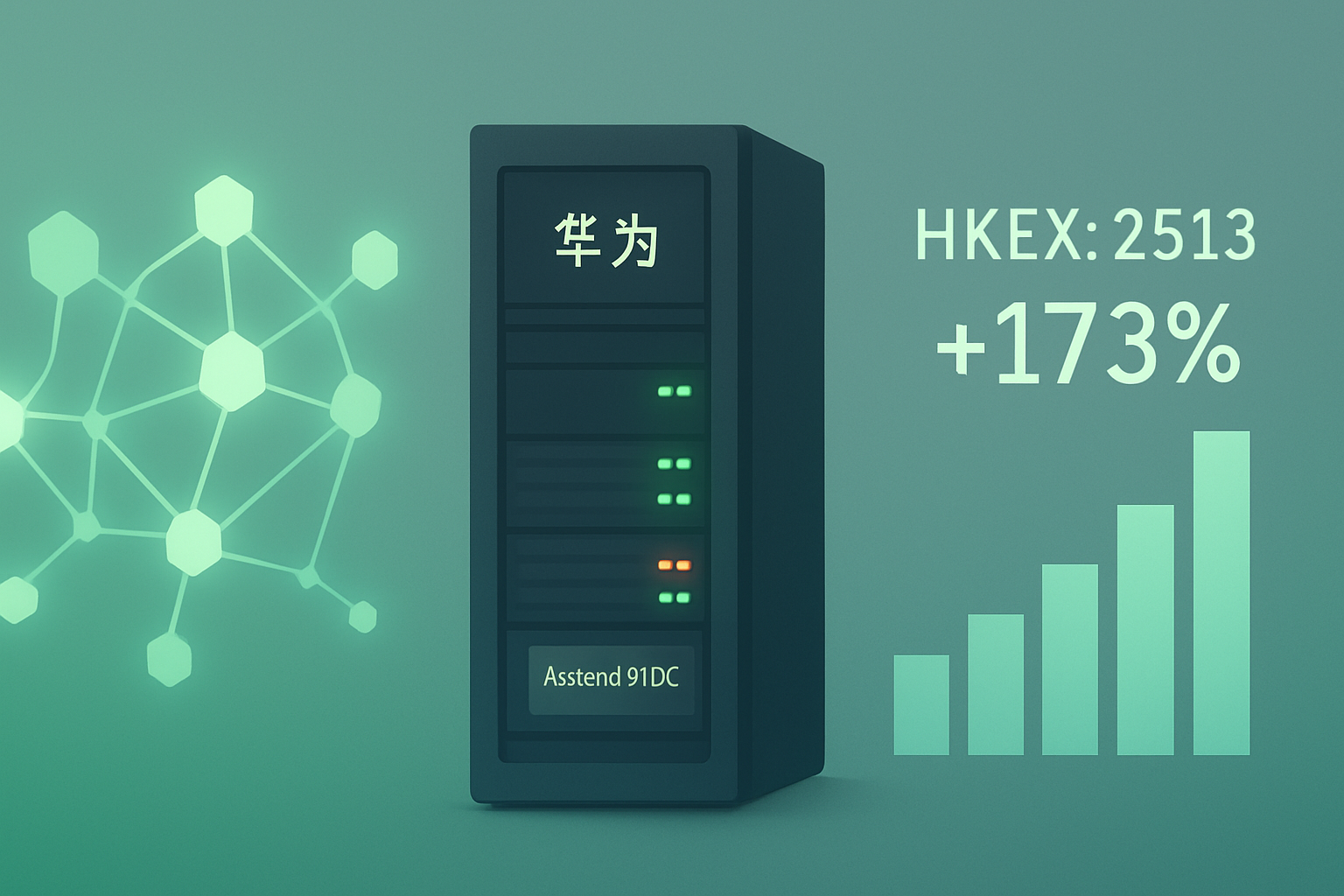
    This operational pivot paid off: by December 2025, Zhipu had filed for an IPO on the Hong Kong Stock Exchange. On January 8, 2026, it debuted at HK$116.20, raising $558 million in the largest AI foundation model IPO to date. Post-IPO, the stock surged 173% in one month, peaking at HK$317.80, driven by a combination of retail enthusiasm, cornerstone investor backing, and a JPMorgan “Overweight” rating with a HK$400 price target.


    Business Model

    Zhipu AI operates a Model-as-a-Service (MaaS) business model, targeting enterprise and developer markets with a tiered monetization strategy.

    Revenue Streams

    • Enterprise B2B (≈95% of 2024 revenue):
      • On-prem/Privatized Cloud: High-margin deployments for state-owned enterprises (SOEs), government agencies, and financial institutions. Revenue for 2024: RMB 263.7M (84.5% of total).
      • API & SDK Licenses: Per-call or annual enterprise API access; 30-fold YoY growth in 2024.
    • Consumer B2C (≈5% of 2024 revenue):
      • Zhipu Qingyan App: Free chatbot with optional premium features.
      • GLM Coding Plan: $3/month subscription for developers; 150,000+ users by Q1 2026.
      • Developer Tools: MIT-licensed model weights, AutoGLM agent framework.

    Pricing and Unit Economics

    • Gross Margins (2024): 56% overall — but 80%+ for on-premise, versus 0–5% for public API (due to compute subsidies).
    • Burn Efficiency: 70% of R&D spend (RMB 1.55B in 2024) covered compute and cloud infrastructure. Zhipu’s edge lies in algorithmic efficiency: its MoE models (e.g., GLM-4.7: 355B total, 32B active) achieve high accuracy with fewer active parameters, reducing inference costs.

    Go-to-Market Strategy

    Zhipu employs a “dual-track” GTM approach:

    1. Enterprise “Top-Down”: Direct sales teams embedded with SOEs and provincial governments; contracts often bundled with hardware (Ascend servers) and support services.
    2. Developer “Bottom-Up”: Open-source models, aggressive API pricing, and integration with popular dev tools (Cursor, Cline, VS Code) to drive organic adoption.

    Stock Performance Overview

    Period Stock Price (HKD) Change vs. IPO Market Cap (HKD)
    IPO Price (Jan 8, 2026) HK$116.20 HK$57.89B
    First Close HK$131.50 +13.2% HK$74.12B
    Jan 16 Peak (Interim) HK$202.40 +74.3% HK$110.06B
    Feb 9 ATH HK$287.80 +147.7% ~HK$135.6B
    Feb 10 Close HK$317.80 +173.5% ~HK$150.1B
    • Retail Demand: IPO oversubscribed 1,159x; 20% allocation to retail.
    • Institutional Backing: Cornerstone investors included Taikang Life, JSC International, and GF Fund.
    • Benchmark Comparison: Outperformed the Hang Seng Tech Index (HSTECH), which fell ~1.7% in the same period.

    Financial Performance

    Metric (RMB Millions) FY2022 FY2023 FY2024 H1 2025
    Total Revenue 57.4 119.2 (est.) 312.4 190.9
    YoY Revenue Growth ~108% ~162% 325% (vs H1 2024)
    Gross Margin ~48% ~52% 56% 51.5%
    Net Loss (97.0) (580.0) (2,470.0) (2,360.0)
    R&D Spend 84.0 410.0 2,200.0 1,590.0
    Cash & Equivalents ~400 ~1,200 2,740.0 2,550.0
    Valuation (Pre-IPO) $1.0B $2.8B $4.0B $6.6B (IPO)

    Key Insights

    • R&D Intensity: R&D spending equaled 705% of total 2024 revenue, with 70% allocated to compute infrastructure.
    • Runway: Pre-IPO, Zhipu had ~8–10 months of runway (burn rate: RMB 300M/month).
    • Use of IPO Proceeds: 70% to R&D (GLM-5 and beyond), 10% to MaaS optimization, 10% to global expansion.

    Leadership and Management

    Executive Team

    • CEO & Executive Director: Dr. Zhang Peng — Tsinghua PhD, former KEG researcher. Known for rational, research-first leadership and a focus on AGI as the ultimate goal.
    • Co-founder & Non-exec Director: Prof. Li Juanzi — Professor at Tsinghua, continues to lead foundational research through the KEG Lab.
    • Chairman & Co-founder: Dr. Liu Debing — Former Technicolor (China) executive; oversees state-level alignment and corporate governance.
    • Chief Scientist: Prof. Tang Jie — Architect of the GLM design; now focuses on long-term model roadmap and AGI theory.

    Board Composition (2026)

    Name Role Background
    Liu Debing Chairman & Exec Dir Co-founder, Tsinghua engineer
    Zhang Peng Exec Dir CEO, former KEG researcher
    Li Juanzi Non-exec Dir Co-founder, Tsinghua Professor
    Yang Qiang Independent Non-exec Dir HKUST AI expert (Transfer Learning, Federated Learning)
    Xie Deren Independent Non-exec Dir Tsinghua Accounting Professor
    Li Jiaqing Non-exec Dir Legend Capital representative

    Governance and Strategy

    Zhipu AI is widely recognized as a “national champion” aligned with China’s 15th Five-Year Plan and “New Quality Productive Forces” initiatives. Its governance emphasizes compliance (CAC, MIIT, CSRC), data security (PIPL), and hardware sovereignty (Ascend, Cambricon). The leadership has publicly emphasized “cognitive supremacy” over raw scale, positioning Zhipu’s path to AGI as algorithmic — not just computational — advancement.


    Products, Services, and Innovations

    The GLM Model Series: Evolution and Capabilities

    Model Release Parameters Context License Key Innovation
    GLM-1 2021 10B 1K Academic Blank-filling objective, 2D position encoding
    GLM-130B Aug 2022 130B 2K MIT First bilingual (ZH/EN) model; open-source
    ChatGLM-6B Mar 2023 6.2B 2K Apache 2.0 GPU-friendly for local inference
    GLM-4 Jan 2024 ~100B+ 128K Proprietary “All Tools” (web, Python, image gen)
    GLM-4.5 Jul 2025 355B (MoE) 128K MIT “Thinking Mode” hybrid reasoning
    GLM-4.7 Dec 2025 400B (MoE) 200K MIT SOTA on SWE-bench, coding, math
    GLM-4.7-Flash Jan 2026 31B (MoE) 128K MIT Runs on consumer GPUs (RTX 3090)
    GLM-5 Feb 2026 745B (MoE) 256K+ Anticipated DSA (Deep Reasoning Architecture), AGI Stage 1

    z.ai Platform (Global Brand, 2025–2026)

    • Bigmodel.cn: API platform; 2.7 million paying developers and 12,000+ enterprise clients.
    • Zhipu Qingyan: Consumer app with video calling and multimodal input.
    • AutoGLM: First mobile agent capable of navigating app UIs (e.g., WeChat, Didi, Meituan) to execute multi-step tasks.
    • GLM-Image: First SOTA image generation model trained solely on Huawei Ascend 910C chips.

    Intellectual Property and R&D

    • Over 300 patents filed in China (as of Q4 2025), covering 2D positional encoding, blank-filling training, and MoE routing.
    • 70% of funding post-IPO dedicated to Frontier AGI Research, with emphasis on multi-turn agentic reasoning and self-supervised self-critique.

    Competitive Landscape

    Company Model Series Strength Weakness
    Zhipu AI (Z.ai) GLM MoE efficiency, hardware sovereignty, MIT licensing, SOTA coding (GLM-4.7) Low B2C conversion, high compute costs
    Baidu ERNIE 4.5/5.0 Search + knowledge graph integration, deep Chinese idiomatic fluency Slower inference, weaker tool use
    Alibaba Qwen 3/3.5 Massive multilingual coverage (119+), high-throughput 1M+ context Less focus on agentic workflows
    DeepSeek V3/R1 Aggressive pricing, strong math (AIME), venture backing Less enterprise deployment, unprofitable
    Tencent HunYuan Enterprise + gaming ecosystem integration Limited transparency, proprietary stack

    Market Position

    • China Market Share (IDC, 2024): ~18% — ranked #3 (after Baidu and Alibaba).
    • Global LLM Positioning: Among top 10 foundation models by open weights and closed performance (per Hugging Face Leaderboard).
    • Unique Edge: Only model family trained entirely on Chinese hardware at SOTA scale (GLM-4.7, GLM-5).

    Industry and Market Trends

    • New Quality Productive Forces: China’s national policy prioritizes AI that boosts industrial efficiency — Zhipu’s SOE and manufacturing deployments align perfectly.
    • Model Compression & Edge Deployment: Zhipu’s GLM-4.7-Flash targets 2026 consumer hardware; Samsung Galaxy S25 (China) includes Zhipu’s edge model.
    • Global South Expansion: Zhipu leads the “Alliance for Independent Large Model Co-construction” with ASEAN and Belt & Road nations.
    • MoE Dominance: Most 2025–2026 releases (GLM-4.5+, Qwen 3.5, ERNIE 5.0) use MoE — Zhipu’s first-mover advantage in MoE training on Ascend chips is critical.
    • Compute Price War: DeepSeek’s aggressive API pricing (Q4 2025) pressured Zhipu’s public cloud margins, driving Zhipu to double down on high-margin enterprise contracts.

    Risks and Challenges

    • U.S. Entity List (Jan 2025): Bans Zhipu from NVIDIA H100/H200 and U.S. cloud inference; forces reliance on lower-efficiency domestic chips.
    • Profitability Lag: Net loss of RMB 2.47B in 2024; R&D burn remains >700% of revenue. Path to breakeven is 2027–2028.
    • Geopolitical Decoupling: Limited ability to deploy GLM-5 in U.S./EU markets; restricted model export under China’s Export Control Law.
    • Regulatory Scrutiny (China): CAC-mandated security assessments for every model update; PIPL compliance for user data.
    • Valuation Volatility: Current P/S of 150x (2024) and 39x (2025E) leaves stock vulnerable to earnings disappointment.

    Opportunities and Catalysts

    • GLM-5 Launch (Feb 2026): Anticipated to rival GPT-5 in AGI-stage reasoning — potential catalyst for 30–50% stock re-rating.
    • SOE Procurement Mandates: 70% of government AI spending must use “First Batch” domestic models — Zhipu holds largest share.
    • Hardware Partnerships: Huawei (Ascend), Cambricon, and Moore Threads offer subsidized compute vouchers; Zhipu receives MIIT “AI Tiger” subsidies covering ~30% of power costs.
    • Global Developer Adoption: MIT licensing and open weights accelerate integrations in OpenRouter, Hugging Face, and ASEAN cloud providers.
    • Runway Extension: IPO proceeds extend runway to >36 months; capital allows aggressive R&D without secondary dilution.

    Investor Sentiment and Analyst Coverage

    Analyst Ratings (Post-IPO, as of Feb 10, 2026)

    Firm Rating Price Target (HKD) Note
    JPMorgan Overweight 400 “Top pick for global AI value creation”
    Goldman Sachs (Asia) Buy 42.50 “Proprietary Knowledge Graph LLM” advantage
    Morgan Stanley Overweight 38.00 Enterprise integration in GBA
    HSBC Global Research Hold 31.00 Compute cost concerns

    Institutional & Retail Activity

    • Cornerstone Investors (5.8 months lock-up): Taikang Life, JSC International, GF Fund (~68.6% of offering).
    • Hedge Funds: 3W Fund (3.8% long), WT Asset Management (added 1.2M shares Jan 2026).
    • Retail Sentiment: 1,159x oversubscription; StockStreet and LittleWhitePanda bullish, though caution noted at HK$36 resistance.

    Finterra-Style Metrics (Est.)

    Metric Value
    Implied FY2026 P/E 33.5x
    P/S (2025E) 9.2x
    EV/EBITDA 24.5x
    Implied EPS (FY26) HK$1.12
    Cash Runway >36 months (post-IPO)

    Regulatory, Policy, and Geopolitical Factors

    • U.S. Entity List (Jan 2025): Blocked H100/H200 access; forced domestic chip migration (Ascend 910C).
    • China CAC Regulations: GenAI Service Measures (2023) and TC260-003 (2024) mandate model registration, human-in-the-loop safety testing, and keyword filtering.
    • Export Control Law (2025): Model weights classified as “restricted exports” — GLM-5 can only be hosted on Chinese mainland or Hong Kong servers.
    • Cross-Border Data Flow (2025 Updates): Tightened for model weights; Zhipu uses “Hong Kong Gateway” to host APIs while core compute remains in mainland.
    • Policy Dividends:
      • “AI Tiger” Support (MIIT): Grants cover ~30% of compute costs.
      • East Data West Compute (东数西算): Zhipu’s clusters in Gansu/Guizhou use cheap hydroelectric power.

    Conclusion

    Knowledge Atlas (HKEX: 2513) is not merely a stock — it is a national infrastructure play. Its GLM models represent a rare case where algorithmic innovation (blank-filling, 2D positional encoding) translated directly into market leadership and operational sovereignty. The company has turned U.S. sanctions into a catalyst for domestic silicon adoption, and its focus on MoE efficiency positions it well for a future where compute scarcity — not abundance — defines competitive advantage.

    Investors face a binary narrative: either Zhipu’s high burn and valuation will be justified by GLM-5’s AGI breakthrough and SOE dominance, or the stock will correct toward more traditional SaaS multiples in a maturing AI market. Key watchpoints for the next 90 days include:

    • GLM-5 performance benchmarks (C-Eval, AIME, SWE-bench)
    • Enterprise renewal rates and avg. contract value (ACV) growth
    • MIIT subsidies and Ascend chip yield improvements

    At its current price, Zhipu offers explosive upside if AGI milestones are hit — but substantial risk if hardware bottlenecks or regulatory shifts slow execution. For investors with a multi-year horizon and high-risk tolerance, the company remains a compelling, high-conviction proxy for the global AI arms race — one that may well define the next decade of tech leadership.


    This article is for informational purposes only and is not financial advice. Finterra does not hold positions in any securities mentioned. Data as of February 10, 2026.

  • Datadog (DDOG) 2026 Research Report: The AI-Native Command Center for the Modern Enterprise

    Datadog (DDOG) 2026 Research Report: The AI-Native Command Center for the Modern Enterprise

    Date: February 10, 2026

    Introduction

    As the enterprise landscape navigates the "Second Wave" of generative AI deployment, few companies have positioned themselves as centrally as Datadog, Inc. (NASDAQ: DDOG). What began as a tool to bridge the gap between developers and operations (DevOps) has evolved into a comprehensive, AI-native command center for the modern cloud era. Following its strong Q4 2025 earnings report released today, February 10, 2026, Datadog remains a focal point for institutional investors seeking exposure to the intersection of cloud observability, cybersecurity, and artificial intelligence.

    The company’s relevance in 2026 is underscored by a simple reality: as organizations deploy more complex LLM-based applications, the "stack" becomes harder to manage. Datadog has moved beyond mere monitoring to become the "intelligence layer" that prevents catastrophic downtime and secures fragmented cloud environments.

    Historical Background

    Founded in 2010 by Olivier Pomel and Alexis Lê-Quôc, Datadog was born from the founders' shared frustration with the "siloed" nature of IT departments. Their vision was to create a unified platform that allowed developers and operations teams to see the same data in real-time.

    Datadog’s journey is marked by high-velocity execution. After a successful IPO in 2019, the company quickly expanded from infrastructure monitoring into Application Performance Monitoring (APM) and Log Management. By 2022, it had aggressively entered the Cloud Security market, and by 2024, it became a pioneer in LLM Observability. This evolution reflects a decade-long transformation from a point solution to a multi-product platform that currently offers over 20 integrated modules.

    Business Model

    Datadog operates a pure-play Software-as-a-Service (SaaS) model. Its primary revenue source is subscription-based, with pricing typically structured around the volume of data processed (e.g., number of hosts, volume of logs, or number of events).

    The company’s core strategy is a "Land and Expand" motion. Datadog often enters an organization through a single module—such as infrastructure monitoring—and then upsells additional products like Security or Cloud Cost Management. As of late 2025, over 85% of Datadog customers use two or more products, while the number of customers with an Annual Recurring Revenue (ARR) exceeding $1 million has surged to over 600. This multi-product adoption creates high "stickiness," resulting in a consistently strong net revenue retention (NRR) rate, currently hovering around 120%.

    Stock Performance Overview

    Datadog has been a high-beta performer over the last several years.

    • 1-Year Performance: Over the past 12 months, DDOG has climbed approximately 35%, significantly outperforming the broader Nasdaq index as the market rewarded its successful AI integration.
    • 5-Year Performance: Looking back to 2021, the stock has weathered the 2022 tech correction and the 2023 "efficiency" phase. Investors who held through the volatility have seen substantial gains as the company transitioned from a high-growth "cash burner" to a free-cash-flow (FCF) machine.
    • Long-Term View: Since its 2019 IPO, DDOG has consistently outperformed legacy IT peers, driven by the secular shift to the cloud. Despite trading well off its speculative 2021 peaks, the current price of ~$125 (as of Feb 10, 2026) reflects a more mature, valuation-grounded growth story.

    Financial Performance

    In its Q4 2025 earnings report, Datadog reported full-year 2025 revenue of $3.39 billion, a 28% increase year-over-year.

    • Margins: The company maintains enviable non-GAAP gross margins of approximately 80%.
    • Profitability: Datadog has successfully balanced growth with profitability, generating over $915 million in free cash flow in 2025.
    • Valuation: Trading at roughly 60x forward P/E, Datadog remains "expensive" relative to the S&P 500. However, analysts argue this premium is justified by its "Rule of 40" performance—the rare combination of 20%+ revenue growth and 25%+ FCF margins.
    • Debt: The company maintains a healthy balance sheet with minimal debt and a significant cash pile of over $2.5 billion, providing ample dry powder for M&A.

    Leadership and Management

    Datadog’s leadership is noted for its stability. CEO Olivier Pomel and CTO Alexis Lê-Quôc have led the company since its inception, a rarity in the hyper-competitive SaaS world. This continuity has allowed the company to maintain a coherent long-term strategy.

    CFO David Obstler is highly regarded on Wall Street for his conservative guidance and disciplined approach to capital allocation. Under this team, Datadog has avoided the massive over-hiring and subsequent "reset" layoffs seen at many of its peers in 2023, positioning the firm as a model of operational efficiency. Recent additions to the executive team, including Chief Product Officer Yanbing Li (formerly of Google), have focused specifically on scaling the company’s AI and Public Sector divisions.

    Products, Services, and Innovations

    Innovation is the engine of Datadog’s growth. In 2025, the company launched its most significant product suite to date: Bits AI.

    • Bits AI: An autonomous DevOps assistant that triages alerts, writes fix-code, and automates incident post-mortems.
    • LLM Observability: This tool allows enterprises to track the performance and "drift" of their AI models, ensuring that LLMs are not generating toxic or hallucinated content.
    • Security Command Center: Datadog’s shift into security is now a major revenue driver. Its Cloud SIEM (Security Information and Event Management) and CSPM (Cloud Security Posture Management) tools allow security teams to monitor threats in the same interface that developers use to monitor performance, fostering "DevSecOps" collaboration.

    Competitive Landscape

    The observability market is consolidating. Datadog’s primary rivals include:

    • Dynatrace, Inc. (NYSE: DT): A formidable competitor in the enterprise space, known for its strong automation and "Davis" AI engine. Dynatrace often wins in legacy "on-prem" migrations, while Datadog leads in "cloud-native" environments.
    • Cisco Systems, Inc. (NASDAQ: CSCO): Following its massive acquisition of Splunk, Cisco is attempting to integrate Splunk’s log data with AppDynamics. While a threat due to its massive sales force, the integration of these legacy platforms remains a challenge.
    • New Relic: Now private, New Relic continues to compete on price, but has lost some mindshare in the high-end enterprise segment to Datadog’s unified platform.

    Industry and Market Trends

    Three macro trends are currently driving Datadog's growth in 2026:

    1. Cloud Complexity: As companies move to "multi-cloud" (using AWS, Azure, and Google Cloud simultaneously), they need a third-party tool like Datadog to provide a "single pane of glass" view across all providers.
    2. The AI Stack: Monitoring GPUs (like those from NVIDIA) and LLMs has become a mission-critical requirement for the Fortune 500.
    3. Consolidation: CFOs are looking to reduce the number of vendors they use. Datadog’s ability to replace 5 or 6 point solutions (monitoring, logs, security, cost management) with one platform is a major competitive advantage.

    Risks and Challenges

    • Valuation Compression: With a high forward multiple, any slight miss in revenue guidance can lead to double-digit stock price corrections.
    • AI Concentration: A significant portion of Datadog's recent growth has come from "AI-first" companies and early LLM adopters. If the AI "hype" cycle cools or enterprise ROI on AI projects disappoints, Datadog’s growth could stall.
    • Open Source Alternatives: Tools like Grafana and Prometheus offer free alternatives for observability, though they often lack the enterprise-grade features and ease of use that Datadog provides.

    Opportunities and Catalysts

    • U.S. Public Sector: In 2025, Datadog achieved FedRAMP High "In Process" status. Finalizing this authorization in 2026 will allow the company to capture massive federal government contracts that were previously off-limits.
    • AI Security: The emergence of "Prompt Injection" attacks and other LLM-specific vulnerabilities has created a new market for AI security tools—a segment where Datadog is an early leader.
    • Expansion in APJ: Europe and Asia-Pacific remain under-penetrated relative to the U.S. market, representing a multi-year growth runway.

    Investor Sentiment and Analyst Coverage

    As of February 2026, Wall Street sentiment remains overwhelmingly bullish. Approximately 90% of analysts tracking DDOG maintain a "Buy" or "Strong Buy" rating. Major firms like J.P. Morgan and Goldman Sachs have highlighted the company’s ability to maintain high growth while increasing FCF margins. Institutional ownership is high, with major positions held by Vanguard, BlackRock, and several prominent tech-focused hedge funds.

    Regulatory, Policy, and Geopolitical Factors

    Datadog is increasingly impacted by global data sovereignty laws.

    • EU AI Act: The company has invested heavily in compliance tools to help customers meet the strict transparency and risk-management requirements of the European Union’s AI regulations.
    • Data Residency: To combat "Digital Nationalism," Datadog has opened local data regions in Germany, Japan, and Australia, ensuring that sensitive monitoring data remains within national borders.
    • Cybersecurity Regulation: New SEC rules in the U.S. and NIS2 directives in Europe requiring faster breach reporting have made Datadog’s real-time security alerts a regulatory "must-have" for many corporations.

    Conclusion

    Datadog enters 2026 not just as a monitoring tool, but as the essential nervous system for the AI-enabled enterprise. Its financial profile is among the strongest in the SaaS sector, combining high growth with disciplined profitability.

    While the stock’s valuation will always require a "growth premium," the company’s expanding footprint in cybersecurity and the public sector provides a diversified cushion against macro-economic volatility. For investors, the key metrics to watch in 2026 will be the adoption rate of "Bits AI" and the company's progress in securing high-value federal contracts. In a world where "downtime is the new bankruptcy," Datadog’s mission is more critical than ever.


    This content is intended for informational purposes only and is not financial advice.

  • The Architect of Intelligence: A Deep Dive into NVIDIA (NVDA) in 2026

    The Architect of Intelligence: A Deep Dive into NVIDIA (NVDA) in 2026

    As of February 10, 2026, NVIDIA Corporation (NASDAQ: NVDA) stands not just as a semiconductor manufacturer, but as the foundational architect of the global intelligence economy. With a market capitalization hovering between $4.3 trillion and $4.6 trillion, the company has eclipsed traditional tech titans to become the most valuable enterprise in the world. The current focus on NVIDIA stems from its pivotal role in the "Agentic AI" revolution—a shift from simple chatbots to autonomous AI agents capable of complex reasoning and task execution. As the world transitions from the "Blackwell" era to the newly unveiled "Rubin" architecture, NVIDIA’s influence over global compute capacity has made its quarterly earnings more significant to macro markets than many central bank meetings.

    Historical Background

    Founded in 1993 by Jensen Huang, Chris Malachowsky, and Curtis Priem over a meal at a Denny's in San Jose, NVIDIA’s journey began with a vision to bring 3D graphics to the gaming and multimedia markets. The company’s first major success came with the RIVA TNT in 1998, followed by the invention of the Graphics Processing Unit (GPU) with the GeForce 256 in 1999.

    However, the most critical pivot in the company's history occurred in 2006 with the launch of CUDA (Compute Unified Device Architecture). By allowing researchers to use GPUs for general-purpose computing, NVIDIA spent nearly two decades and billions in R&D building a software-hardware moat that no competitor has yet breached. This "bet-the-company" investment in parallel processing laid the groundwork for the modern AI explosion, transforming NVIDIA from a niche gaming hardware firm into the engine of the Fourth Industrial Revolution.

    Business Model

    NVIDIA’s business model has evolved into a comprehensive "full-stack" ecosystem. While it is primarily known for its silicon, the company sells entire data center systems, networking solutions, and software platforms.

    The revenue structure is currently divided into four primary segments:

    1. Data Center (90% of Revenue): This includes AI accelerators like the H200 and Blackwell series, as well as networking hardware (Mellanox/Spectrum-X).
    2. Gaming: High-performance GPUs for PCs (GeForce RTX series) and SOCs for gaming consoles.
    3. Professional Visualization: Solutions for enterprise design, simulation, and the "Omniverse" industrial metaverse.
    4. Automotive and Robotics: Autonomous driving systems and the "Isaac" robotics platform.

    The company’s modern strategy focuses on "AI-as-a-Service" and recurring software revenue through the NVIDIA AI Enterprise suite, which provides the necessary operating system for the world’s AI models.

    Stock Performance Overview

    As of today, February 10, 2026, NVIDIA’s stock performance is legendary among market historians.

    • 1-Year Performance: The stock is up approximately 43% over the last twelve months. This reflects a "normalization" of growth as the market moved from speculative excitement about Blackwell to valuing the actual delivery of tens of billions in revenue.
    • 5-Year Performance: Up a staggering 1,236%. Investors who bought in early 2021 have seen their capital grow more than 12-fold as the AI narrative shifted from hype to a mandatory corporate requirement.
    • 10-Year Performance: An astronomical 30,355% increase. This makes NVDA one of the top-performing stocks of the decade, driven by its transition from a $50 billion gaming company to a $4.5 trillion infrastructure giant.

    Notable moves in the past year were driven by the "Blackwell Ultra" rollout and the January 2026 announcement of the "Rubin" architecture at CES.

    Financial Performance

    In its most recent quarterly report (Q3 FY2026), NVIDIA reported record revenue of $57.0 billion, a testament to the insatiable demand for generative AI.

    • Margins: Gross margins remain exceptionally high at 73.4%, despite the massive costs of 3nm production. This is significantly higher than traditional hardware peers, reflecting NVIDIA's software-like pricing power.
    • Profitability: For the full fiscal year 2025, NVIDIA generated nearly $50 billion in free cash flow, much of which has been used for aggressive R&D and a massive $50 billion share buyback program.
    • Valuation: Despite its price appreciation, NVDA trades at a forward P/E ratio of roughly 28x. While high by traditional standards, this is considered "fair" by analysts given the projected 50% earnings growth as the Rubin architecture begins shipping in late 2026.

    Leadership and Management

    The company continues to be led by its co-founder and CEO, Jensen Huang. Known for his iconic leather jacket and "flat" management style (having 50+ direct reports), Huang is widely regarded as one of the greatest living CEOs. His strategy of "building the whole factory, not just the chip" has redefined the company.

    The management team is bolstered by CFO Colette Kress, who has been praised for her disciplined capital allocation and transparent communication with Wall Street. The leadership team’s reputation is one of long-term vision, often making 5-to-10-year technology bets that have consistently paid off.

    Products, Services, and Innovations

    NVIDIA’s current product pipeline is centered on the Blackwell platform, which is currently the dominant AI chip in data centers. However, all eyes are now on Rubin, announced last month.

    • Rubin Architecture: Utilizing TSMC’s N3P process (3nm) and HBM4 memory, Rubin is designed for "World Models"—AI that understands physics and 3D space.
    • Vera CPU: This new processor, paired with the Rubin GPU, aims to further reduce the reliance on Intel or AMD CPUs in the data center.
    • Networking: The Spectrum-X Ethernet platform has become a multi-billion dollar business, ensuring that data moves between GPUs fast enough to prevent bottlenecks.
    • Innovation Moat: NVIDIA’s primary edge remains the CUDA software ecosystem, which now boasts over 5 million developers globally.

    Competitive Landscape

    While NVIDIA holds an estimated 85-90% market share in AI accelerators, the competition is intensifying:

    • AMD (Advanced Micro Devices): The MI350 series has gained traction among customers looking for a "second source" to avoid vendor lock-in. AMD currently holds about 7-8% of the market.
    • Hyperscalers: Amazon, Google, and Meta are all developing internal silicon (Trainium, TPU, MTIA) to reduce their reliance on NVIDIA for specific workloads.
    • Intel: While struggling to catch up in the high-end data center market, Intel’s Gaudi 3 and 4 chips are targeting the mid-range inference market.

    NVIDIA’s strength lies in its "full-stack" approach; while competitors may match its hardware specs, they struggle to match its software ecosystem and interconnected networking.

    Industry and Market Trends

    The primary trend in early 2026 is the shift from Training to Inference. In 2023-2024, the focus was on building LLMs (Large Language Models). Now, the focus is on running those models at scale.

    • Agentic AI: AI "agents" that work in the background require constant, low-latency compute, driving a new wave of demand.
    • Sovereignty AI: Nations (Japan, France, Saudi Arabia) are building their own domestic AI clouds to ensure data security, creating a massive new customer class beyond the "Magnificent 7" tech companies.

    Risks and Challenges

    Despite its dominance, NVIDIA faces significant risks:

    • Supply Chain Concentration: NVIDIA is almost entirely dependent on TSMC for advanced manufacturing and CoWoS packaging. Any disruption in Taiwan would be catastrophic.
    • Cyclicality: Historically, the semiconductor industry is highly cyclical. While AI demand seems structural, a "digestion period" where CSPs pause spending remains a primary concern.
    • Customer Concentration: A handful of cloud providers (Microsoft, Google, Amazon) account for a significant portion of NVIDIA's revenue. If they pivot toward internal chips, NVIDIA’s growth could decelerate.

    Opportunities and Catalysts

    • Physical AI and Robotics: The "GR00T" project for humanoid robots is seen as the next major growth engine for NVIDIA’s edge computing business.
    • Healthcare: NVIDIA’s BioNeMo platform for drug discovery is beginning to yield commercial results, potentially opening a trillion-dollar vertical.
    • Rubin Ramp: The transition to the Rubin architecture in H2 2026 is expected to provide a massive uplift in both revenue and average selling prices (ASPs).

    Investor Sentiment and Analyst Coverage

    Wall Street remains overwhelmingly bullish on NVDA. As of February 2026, over 90% of analysts cover the stock with a "Buy" or "Strong Buy" rating. Hedge fund ownership remains high, though some institutional investors have trimmed positions to manage portfolio concentration risks given NVIDIA’s massive weight in the S&P 500. Retail sentiment is equally strong, with NVDA consistently ranking as the most-traded stock among individual investors.

    Regulatory, Policy, and Geopolitical Factors

    Geopolitics remains the "wild card" for NVIDIA.

    • US-China Trade: In early 2026, the new Trump administration eased some export restrictions on "legacy" AI chips (like the H200) to China while maintaining strict bans on the latest Blackwell and Rubin architectures. This has provided a slight revenue boost but also forced China to accelerate its domestic chip industry (Huawei/Biren).
    • Antitrust: Regulatory bodies in the EU and the US (FTC) continue to monitor NVIDIA’s dominance in the AI software layer, investigating whether the CUDA platform unfairly prevents competition.

    Conclusion

    NVIDIA enters 2026 in a position of unprecedented power. It is no longer just a chip company; it is the central utility for the age of artificial intelligence. While risks regarding geopolitical tensions and the cyclical nature of hardware spending persist, the company’s relentless 1-year innovation cycle—moving from Blackwell to Rubin—keeps it several steps ahead of both traditional rivals and in-house hyperscaler efforts. For investors, the key will be watching the "Inference" ramp and the adoption of "Agentic AI." If NVIDIA can successfully transition from being the "builder" of the AI world to being its "operating system," its $4.5 trillion valuation may eventually be seen as only the beginning.


    This content is intended for informational purposes only and is not financial advice.

  • The Software Fortress: A Comprehensive Analysis of Palantir Technologies (PLTR) in 2026

    The Software Fortress: A Comprehensive Analysis of Palantir Technologies (PLTR) in 2026

    As of February 10, 2026, Palantir Technologies (NYSE: PLTR) has transitioned from a controversial, niche "black box" of the intelligence community to one of the most influential forces in the global enterprise software and Artificial Intelligence (AI) sectors. Long regarded with skepticism by Wall Street for its unconventional leadership and heavy reliance on government contracts, the company has silenced critics through a multi-year run of GAAP profitability and the successful monetization of its Artificial Intelligence Platform (AIP). Today, Palantir stands as a cornerstone of the S&P 500, serving as the "operating system" for both modern warfare and the modern Fortune 500.

    Historical Background

    Founded in 2003 by Peter Thiel, Alex Karp, Stephen Cohen, Joe Lonsdale, and Nathan Gettings, Palantir was born in the wake of the September 11 attacks. Its initial mission was to provide the U.S. intelligence community with software capable of finding "needles in haystacks" to prevent terrorism. Early funding came from the CIA’s venture arm, In-Q-Tel, which helped cement its reputation as a secretive defense contractor.

    For its first decade, the company focused almost exclusively on the public sector with its Gotham platform. However, the 2016 launch of Foundry marked a pivotal shift toward the commercial sector, aiming to solve data silo problems for massive corporations. Following its Direct Public Offering (DPO) in September 2020, Palantir faced a turbulent period of high stock-based compensation and fluctuating growth before the 2023 generative AI boom provided the ultimate catalyst for its current dominance.

    Business Model

    Palantir’s business model revolves around the central thesis that most organizations do not have a "data problem," but an "integration and decision problem." The company operates through two primary segments:

    1. Government: Serving defense, intelligence, and healthcare agencies worldwide. This remains a high-moat, long-cycle business with multi-year, multi-billion dollar contracts.
    2. Commercial: Focusing on large-scale enterprises in finance, energy, manufacturing, and retail.

    Unlike traditional SaaS companies that rely on a large "army" of sales representatives, Palantir utilizes a high-intensity "bootcamp" strategy. This allows potential customers to build live AI workflows on their own data within five days, drastically reducing the sales cycle and increasing conversion rates. Revenue is typically generated through multi-year subscriptions, though recent "Agentic AI" modules have introduced more granular, usage-based components.

    Stock Performance Overview

    The journey for PLTR shareholders has been one of extreme volatility followed by sustained institutional accumulation.

    • 1-Year Performance: Over the last 12 months, the stock has risen approximately 65%, driven by the massive scale-up of U.S. commercial revenue.
    • 5-Year Performance: Since 2021, the stock has experienced a massive "U-shaped" recovery. After bottoming out near $6.00 in late 2022, it surged to an all-time high of $207.18 in late 2025 before consolidating.
    • Long-Term Horizon: From its DPO price of $10, long-term investors have seen nearly a 15x return as of February 2026, outperforming the majority of the Nasdaq-100 and software-focused ETFs.

    Financial Performance

    Palantir’s 2025 fiscal year results, released recently, confirmed its status as a financial powerhouse.

    • Revenue: Total FY 2025 revenue reached $4.475 billion, a 56% year-over-year increase.
    • Profitability: The company reported its 13th consecutive quarter of GAAP net income, totaling $1.625 billion for the year.
    • Efficiency: Management’s "Rule of 40" score reached a staggering 127% in Q4 2025, a testament to its ability to grow rapidly while maintaining high operating margins (currently at 50% on an adjusted basis).
    • Valuation: Despite these strengths, the stock remains expensive, trading at high multiples of earnings and sales, reflecting the market's expectation of continued 50%+ growth through 2027.

    Leadership and Management

    CEO Alex Karp remains the company's most vocal and visible leader. His eccentric, philosophical style and staunch defense of Western democratic values have become synonymous with the Palantir brand. Alongside Karp, CTO Shyam Sankar and CRO Ryan Taylor have been instrumental in the recent "bootcamp" pivot, moving the company away from its "consultancy-heavy" roots toward a scalable, product-first organization.

    The board, still chaired by co-founder Peter Thiel, remains stable, though some governance critics have pointed to the super-voting share structure that gives the founders perpetual control—a structure that has become less of a focus as the company continues to deliver record profits.

    Products, Services, and Innovations

    Palantir’s product suite is now unified under the "AIP" umbrella:

    • AIP (Artificial Intelligence Platform): The core engine that allows organizations to deploy Large Language Models (LLMs) and "Agentic AI" across their private networks securely.
    • Gotham: The premier platform for defense and intelligence, used for everything from battlefield management in Ukraine to counter-terrorism.
    • Foundry: The "operating system" for the enterprise, allowing companies to create a "digital twin" of their entire operation.
    • Apollo: The continuous delivery software that allows Palantir’s platforms to run in the most disconnected, "edge" environments (e.g., on satellites or inside tanks).
    • Agentic AI: The 2025 innovation that allows AI "agents" to autonomously execute tasks, such as re-routing supply chains or processing insurance claims, rather than simply generating text.

    Competitive Landscape

    By early 2026, Palantir’s competition has split into two camps:

    • Data Rivals: Companies like Snowflake (NYSE: SNOW) and Databricks compete for data storage and processing. However, Palantir has carved a niche as the "Intelligence Layer" that sits on top of these data stores, often forming partnerships rather than direct competition.
    • Defense Rivals: Traditional "Primes" like Lockheed Martin (NYSE: LMT) and Raytheon (RTX) are both partners and competitors. Palantir’s agility in software gives it an edge, but the legacy firms still hold the keys to major hardware platforms. The rise of Anduril Industries as a "software-first" hardware firm presents a unique, modern competitive threat in the defense tech space.

    Industry and Market Trends

    The current macro environment is dominated by two trends that favor Palantir:

    1. Sovereign AI: Governments are increasingly seeking "sovereign" AI capabilities—AI that they control entirely, without relying on foreign-hosted clouds. Palantir’s history of high-security deployments makes it the default choice for these initiatives.
    2. Military Modernization: As geopolitical tensions remain high in Eastern Europe and the Indo-Pacific, the "software-defined battlefield" is no longer a concept but a requirement, driving demand for Palantir’s TITAN and Gotham systems.

    Risks and Challenges

    Despite its recent success, Palantir is not without risks:

    • Concentration: While commercial revenue is growing, a large portion of its business still depends on a few massive government contracts.
    • Valuation Risk: With a P/E ratio significantly higher than the software average, any slowdown in the AIP adoption rate could lead to a sharp correction.
    • Data Privacy Backlash: The company continues to face scrutiny over privacy, most notably in the UK with the NHS contract, which remains a political lightning rod.
    • Stock-Based Compensation (SBC): Although GAAP profitable, the company still uses significant SBC to retain talent, which can lead to shareholder dilution.

    Opportunities and Catalysts

    • $10 Billion Army Deal: The 2025 Army enterprise agreement is just beginning to scale, providing a massive multi-year revenue floor.
    • Agentic AI Upsell: The transition from "chatting with data" to "autonomous agents" allows Palantir to charge based on the value or volume of tasks completed, potentially increasing Average Revenue Per User (ARPU).
    • S&P 500 Inclusion: Having joined the index in 2024, the stock now benefits from consistent institutional buying and inclusion in major ETFs.

    Investor Sentiment and Analyst Coverage

    Investor sentiment has shifted from "cautious" to "frenzied" over the past 24 months. Wall Street analysts, many of whom maintained "Sell" ratings in 2023, have largely capitulated, with the majority now holding "Buy" or "Strong Buy" ratings. Retail investors—the self-titled "Palantirians"—remain a powerful force, often acting as a support floor during market pullbacks. Institutional ownership has notably climbed from 35% to over 60% in early 2026.

    Regulatory, Policy, and Geopolitical Factors

    Palantir is uniquely sensitive to geopolitics. Its "Western-first" stance has won it favor in Washington and London but effectively bans it from competing in China and several other emerging markets. On the regulatory front, the company is positioning itself as a leader in "Ethical AI," advocating for frameworks that keep humans "in the loop" for lethal decisions—a policy stance that helps mitigate the risk of restrictive AI regulations.

    Conclusion

    Palantir Technologies has entered 2026 as a reformed titan of the tech world. By successfully bridging the gap between secretive government work and mass-market commercial AI, it has achieved a level of "indispensability" that few software firms ever reach. For investors, the story is no longer about whether the company can make a profit, but how fast it can scale its AI agents across the global economy. While its premium valuation requires a high degree of execution, the company's $10 billion backlog and record-breaking "Rule of 40" scores suggest that Palantir is only just beginning its era of dominance.


    This content is intended for informational purposes only and is not financial advice.

  • The SaaS Paradox: Can monday.com (MNDY) Survive the AI Agent Revolution?

    The SaaS Paradox: Can monday.com (MNDY) Survive the AI Agent Revolution?

    As of February 10, 2026, the software-as-a-service (SaaS) sector is undergoing a profound structural transformation, and perhaps no company better exemplifies this turbulence than monday.com Ltd. (NASDAQ: MNDY). Long heralded as the vanguard of the "Work OS" movement, monday.com is currently navigating a high-stakes pivot from a project-tracking tool to an AI-native orchestration layer for the modern enterprise.

    The company is in sharp focus this week following its February 9, 2026, earnings release. Despite reporting solid fiscal year 2025 growth, the stock suffered a punishing 21% single-day collapse. This move reflects a broader market "reckoning" as investors debate whether the traditional seat-based licensing model—the bedrock of SaaS for two decades—can survive the rise of autonomous AI agents. Today, monday.com stands at a crossroads: a cash-rich, operationally efficient leader fighting to redefine the value of human "work" in a software-driven world.

    Historical Background

    Monday.com’s journey began in February 2012 in Tel Aviv, Israel. Founded by Roy Mann and Eran Zinman (along with early contributor Eran Kampf), the platform originated as an internal tool for Wix.com. Initially named daPulse, the software was designed to solve the transparency issues inherent in hyper-growth startups.

    By 2017, the company realized that "daPulse" lacked the professional gravitas required for enterprise expansion and rebranded to monday.com. This rebranding coincided with a fundamental shift in strategy: moving away from simple project management toward a "Work Operating System" (Work OS). This concept allowed non-technical users to build their own custom applications using modular, "no-code" building blocks.

    The company went public on the NASDAQ in June 2021 at an IPO price of $155, quickly becoming a darling of the pandemic-era digital transformation boom. After reaching an all-time high of approximately $450 in late 2021, the stock weathered the 2022 tech sell-off, eventually finding a stable footing by 2024 as it reached GAAP profitability—a milestone that signaled its transition from a "growth-at-all-costs" startup to a mature, disciplined enterprise.

    Business Model

    Monday.com operates a multi-product SaaS model designed to act as the "connective tissue" of an organization. Its revenue is derived primarily from recurring subscriptions across several specialized product lines:

    1. monday Work OS: The core platform for general project and task management.
    2. monday CRM: A rapidly growing customer relationship management tool designed for sales teams.
    3. monday Dev: A specialized suite for product and software development teams, competing directly with legacy players like Jira.
    4. monday Service: An IT and operations management tool introduced to broaden the platform's footprint.

    Historically, the company utilized a "seat-based" pricing model, where revenue grows alongside a customer’s headcount. However, in late 2025, the company introduced a hybrid model featuring "AI Credits." This allows monday.com to monetize autonomous workflows and AI-driven actions, providing a hedge against potential headcount reductions in its customer base as AI takes over manual tasks.

    Stock Performance Overview

    The five-year trajectory of MNDY has been a rollercoaster for investors. Following its 2021 IPO at $155, the stock peaked at $450 before crashing to a low of ~$73 in late 2022. Between 2023 and 2024, the company staged a remarkable recovery, climbing back into the $230–$250 range on the back of resilient enterprise spending.

    However, 2026 has been a year of extreme volatility. After hitting a 52-week high of $342 in late 2025, the stock entered a "SaaSpocalypse" period. As of February 10, 2026, the stock is trading between $76.00 and $98.00, down nearly 50% year-to-date. The primary driver of this recent move was not a financial miss, but rather conservative 2026 revenue guidance that failed to satisfy a market hungry for AI-driven hyper-growth.

    Financial Performance

    Despite the stock price carnage, monday.com’s financials for the fiscal year 2025 remain structurally sound.

    • Revenue: The company reported total 2025 revenue of $1.232 billion, representing a healthy 27% year-over-year growth.
    • Margins: Non-GAAP operating margins hit a record 14% in 2025.
    • Cash Position: The company ended the year with $1.503 billion in cash and cash equivalents and no significant long-term debt.
    • Free Cash Flow: Adjusted FCF for 2025 exceeded $290 million.
    • Guidance: The catalyst for the recent sell-off was the 2026 revenue forecast of 18–19% growth. While still robust for many sectors, the "deceleration narrative" has spooked growth-oriented investors who are re-valuing SaaS multiples in the face of AI disruption.

    Leadership and Management

    Monday.com is led by its original founders, Roy Mann and Eran Zinman, who serve as Co-CEOs. This co-leadership structure is rare but has been credited with the company’s ability to balance rapid product innovation with disciplined financial execution.

    Mann focuses heavily on the company's long-term vision and product-led growth (PLG) strategies, while Zinman oversees the technological architecture and the transition to an AI-first infrastructure. The management team has earned a reputation for transparency, though they are currently under pressure to prove that their "AI Agents" strategy can compensate for the slowdown in traditional seat expansion.

    Products, Services, and Innovations

    The year 2025 marked the "Year of the Agent" for monday.com. The company’s current product innovation is centered on four core capabilities:

    • monday sidekick: An embedded generative AI assistant that can summarize meetings, draft emails, and build project boards from natural language prompts.
    • monday vibe: A breakout success in 2025, this product focuses on team engagement and sentiment analysis, reaching $1 million in ARR faster than any previous release.
    • monday agents: Autonomous software agents that can execute end-to-end workflows (e.g., qualifying a lead in the CRM, updating the task board, and notifying the finance team) without human intervention.
    • monday workflows: An upgraded automation engine designed to replace brittle, legacy "if-this-then-that" logic with more flexible, AI-driven reasoning.

    Competitive Landscape

    Monday.com competes in the crowded "Work Management" and "Collaborative Applications" sector.

    • Asana (ASAN): A long-time rival that has struggled more than monday.com to achieve consistent GAAP profitability.
    • Smartsheet (SMAR): The preferred choice for data-heavy, spreadsheet-centric users.
    • Atlassian (TEAM): The dominant force in the developer space. monday.com's "monday Dev" is a direct challenger to Atlassian’s Jira.
    • Microsoft (MSFT): With the integration of Copilot into Microsoft 365 and Planner, Microsoft remains the "sleeping giant" that can bundle similar tools for free or low cost into existing enterprise agreements.

    The newest and most significant "competitors" are not other SaaS companies, but the underlying AI models themselves. If a company can use a raw LLM (like OpenAI's Frontier or Anthropic's Claude 4.6) to manage its own workflows, the need for a specialized UI like monday.com may diminish—a risk the company is fighting by becoming an "aggregator" of these models.

    Industry and Market Trends

    The SaaS industry in early 2026 is grappling with a shift from headcount-based licensing to outcome-based pricing.

    For years, SaaS companies grew by "landing and expanding"—selling a few seats and then waiting for the customer's headcount to grow. As AI improves productivity, many companies are hiring fewer people to do the same amount of work. This "productivity paradox" is forcing the industry to find new ways to charge for the "labor" performed by AI agents rather than just the humans using the software.

    Risks and Challenges

    1. AI Cannibalization: If an AI agent allows one person to do the work of five, monday.com could lose 80% of its seat revenue from that customer unless its AI Credit system can bridge the gap.
    2. Geopolitical Risk: Headquartered in Tel Aviv, the company remains exposed to regional instability. While the "Israeli tech resilience" brand is strong, sustained conflict or significant currency (Shekel) volatility can impact operational costs and talent retention.
    3. Growth Deceleration: The drop from 27% growth in 2025 to a projected 18-19% in 2026 suggests the "low-hanging fruit" of digital transformation may have been picked.

    Opportunities and Catalysts

    1. Upmarket Migration: The company is successfully moving into the "Enterprise" segment (customers with >$100k ARR). These large organizations are more "sticky" and less prone to churn.
    2. M&A Potential: With over $1.5 billion in cash and a depressed stock price for many smaller competitors, monday.com is in a prime position to acquire specialized AI startups to bolster its platform.
    3. The "AI Agent" Monopoly: If monday.com becomes the easiest place for a non-technical manager to deploy an "AI Agent," it could capture a massive new market of "AI-enabled labor" that dwarfs the current project management market.

    Investor Sentiment and Analyst Coverage

    Current sentiment on Wall Street is deeply divided.

    • The Bears point to the recent guidance cut and the "seat-based death spiral" as reasons to avoid the stock, viewing the 21% crash as a permanent "re-rating" of the company's valuation.
    • The Bulls argue that monday.com is being unfairly punished for being honest about the macro environment. They point to the $1.5 billion cash pile, high FCF, and the early success of "monday vibe" as proof that the company’s innovation engine is still firing.

    The consensus price target post-February crash has drifted toward $168, though many analysts are currently in a "wait-and-see" mode regarding the adoption of AI Credits.

    Regulatory, Policy, and Geopolitical Factors

    As an Israeli-based company, monday.com must navigate a complex geopolitical landscape. While it has diversified its workforce globally, its core R&D remains in Tel Aviv. The company has navigated the regional conflicts of 2023–2025 with minimal disruption to service, but any escalation remains a tail-risk for investors.

    From a regulatory standpoint, the rise of "AI Agents" is bringing new scrutiny to data privacy. Monday.com's "AI Work Platform" must comply with evolving EU and US regulations regarding how AI models process proprietary corporate data, a challenge the company is meeting through its SOC2 and GDPR compliance infrastructure.

    Conclusion

    Monday.com finds itself in a paradoxical position in February 2026. Operationally, it is a powerhouse: generating significant cash flow, maintaining a pristine balance sheet, and growing at a rate many software companies would envy. However, it is also a "canary in the coal mine" for the SaaS industry’s transition into the age of AI.

    For investors, the current valuation represents either a value trap—as the seat-based model slowly erodes—or a generational buying opportunity to own a profitable, AI-ready "operating system" for the future of work at a steep discount. The key metrics to watch in 2026 will not just be revenue growth, but the velocity of AI Credit adoption and the company's ability to maintain enterprise seat counts in a world of autonomous software.


    This content is intended for informational purposes only and is not financial advice.