
Tag: Apple

  • Apple at the $4 Trillion Threshold: A 2026 Deep Dive into AI, Innovation, and Regulatory Realities

    Apple at the $4 Trillion Threshold: A 2026 Deep Dive into AI, Innovation, and Regulatory Realities

    As of March 5, 2026, Apple Inc. (NASDAQ: AAPL) stands at a historic crossroads, teetering on the edge of a $4 trillion market capitalization. While the tech giant has long been defined by its hardware prowess and ecosystem "moat," the current narrative is dominated by its transition into a generative AI powerhouse and its strategic pivot to capture the entry-level computing market. With the recent launch of "Apple Intelligence" and the rollout of the high-stakes "Siri 2.0," Apple is no longer just selling devices; it is selling a vertically integrated, privacy-first AI lifestyle. Despite escalating antitrust pressures in the United States and Europe, investor confidence remains buoyed by record-breaking Services margins and a surprisingly aggressive expansion into budget-friendly hardware.

    Historical Background

    Founded in 1976 by Steve Jobs, Steve Wozniak, and Ronald Wayne, Apple’s journey is one of the most storied in corporate history. From the early success of the Apple II to the brink of bankruptcy in the late 1990s, the company’s trajectory changed forever with the return of Steve Jobs in 1997. The subsequent decade saw the release of the iMac, iPod, and the 2007 debut of the iPhone—a device that fundamentally altered global communication and commerce. Under the leadership of Tim Cook, who became CEO in 2011, Apple shifted from a product-cycle dependent firm to a services-oriented behemoth, consistently returning massive amounts of capital to shareholders through dividends and buybacks while refining its supply chain into the most efficient in the world.

    Business Model

    Apple’s business model is built on a high-margin hardware "on-ramp" that feeds into a recurring Services ecosystem.

    • Hardware (iPhone, Mac, iPad, Wearables): Historically the primary revenue driver, Apple’s hardware now serves as the platform for its proprietary "Apple Silicon" (M-series and A-series chips), which provides a performance-per-watt advantage over competitors.
    • Services: This segment—including the App Store, Apple Music, iCloud+, Apple Pay, and the new Apple Intelligence Pro subscriptions—generates nearly 25% of total revenue but accounts for a disproportionate share of profits due to gross margins exceeding 70%.
    • The "Walled Garden": The seamless integration between hardware, software, and services creates high switching costs for users, ensuring a loyal customer base with a high lifetime value.

    Stock Performance Overview

    Over the past decade, AAPL has been a cornerstone of the modern portfolio.

    • 10-Year View: Apple has significantly outperformed the S&P 500, driven by its 2014 and 2020 stock splits and a relentless buyback program that has retired billions of shares.
    • 5-Year View: The stock navigated the post-pandemic supply chain crisis and the 2022 inflationary environment with remarkable resilience.
    • 1-Year View: As of March 5, 2026, the stock is trading near $264.39, up approximately 35% over the trailing 12 months. This rally was fueled by the successful launch of the iPhone 17 series and the market’s realization that Apple’s AI strategy would not sacrifice its industry-leading margins.

    Financial Performance

    For the fiscal year 2025, Apple reported record-breaking revenue of $416.2 billion, a 6.4% increase year-over-year. Net income reached an all-time high of $112.0 billion.

    • Margins: Operating margins have remained robust at roughly 30%, even as the company invested heavily in AI server infrastructure and R&D for spatial computing.
    • Q1 2026 Recap: In late January 2026, Apple reported its strongest holiday quarter in history ($143.8 billion), largely credited to the high ASP (Average Selling Price) of the iPhone 17 Pro and a 14% surge in Services revenue.
    • Cash Position: Apple maintains a massive cash pile, though it continues to move toward a "cash neutral" position by returning value to shareholders, primarily through its $100 billion+ annual buyback authorization.

    Leadership and Management

    Apple’s leadership transition is currently a primary focus for governance analysts.

    • Tim Cook (CEO): Now in his 15th year as CEO, Cook continues to provide steady guidance, though succession rumors have intensified.
    • Kevan Parekh (CFO): Having succeeded Luca Maestri on January 1, 2025, Parekh has successfully managed the transition, maintaining Apple’s disciplined capital allocation strategy.
    • New Appointments: Jennifer Newstead, formerly of Meta (NASDAQ: META), joined as General Counsel on March 1, 2026, signaling Apple's intent to bolster its legal defense against global antitrust regulators.
    • AI Leadership: Following the retirement of John Giannandrea, Amar Subramanya now leads the AI division, reporting to Craig Federighi, emphasizing the integration of AI directly into the OS.

    Products, Services, and Innovations

    The March 2026 "Spring Forward" event showcased Apple’s new "bifurcated" strategy:

    • Apple Intelligence & Siri 2.0: The LLM-powered Siri is in final beta, offering deep "on-screen awareness" and the ability to execute complex tasks across third-party apps.
    • MacBook Neo: Priced at $599, this new entry-level laptop aims to capture the education market and lower the entry barrier to the Apple ecosystem.
    • Spatial Computing: While the original Vision Pro faced a mid-2025 slump, rumors of a "Vision Air" model priced at $2,000 have kept the market's interest in the category alive.
    • iPhone 17e: A refreshed budget iPhone that brings Apple Intelligence features to a broader demographic.

    Competitive Landscape

    Apple faces multi-front competition:

    • Smartphones: Samsung (OTC: SSNLF) and Huawei remain fierce competitors, with Samsung’s "Galaxy AI" suite challenging Apple’s premium narrative in international markets.
    • AI Infrastructure: Microsoft (NASDAQ: MSFT) and Google (NASDAQ: GOOGL) have a lead in cloud-based generative AI, though Apple’s "local-first" approach on-device is increasingly seen as a unique selling point for privacy-conscious users.
    • Spatial Computing: Meta continues to dominate the affordable VR/AR market with the Quest series, forcing Apple to reconsider its "Pro-only" pricing strategy.

    Industry and Market Trends

    The "Edge AI" revolution is the most significant trend of 2026. As consumers become wary of sending personal data to the cloud, Apple’s strategy of processing generative AI models locally on its proprietary A18 and M5 chips has become a major competitive advantage. Additionally, the tightening of global supply chains has led Apple to further diversify its manufacturing base into India and Vietnam, reducing its long-term dependency on Chinese assembly.

    Risks and Challenges

    Despite its financial strength, Apple faces significant risks:

    • Regulatory Scrutiny: The ongoing US DOJ antitrust lawsuit is currently in a massive discovery phase, with a trial set for 2028. This represents a long-term "overhang" on the stock.
    • EU Compliance: The European Commission continues to challenge Apple’s App Store fees under the Digital Markets Act (DMA), which could lead to further erosion of Services margins in Europe.
    • Hardware Saturation: With iPhone replacement cycles lengthening, Apple must continuously find new revenue streams (like AI subscriptions) to maintain growth.

    Opportunities and Catalysts

    • Siri 2.0 Monetization: The full release of Siri 2.0 (expected in May 2026) could trigger a massive upgrade cycle for older devices that cannot handle the new LLM features.
    • The "Neo" Strategy: The $599 MacBook Neo could significantly increase Apple’s market share in emerging markets and the education sector.
    • Enterprise AI: Apple’s partnership with Google Gemini for cloud-based AI tasks, combined with its local security, makes it an attractive partner for enterprise-scale AI deployments.

    Investor Sentiment and Analyst Coverage

    Wall Street remains largely bullish, with a median price target of $285 as of March 2026. Analysts highlight the "sticky" nature of the ecosystem and the potential for a multi-year "AI Supercycle." Institutional ownership remains high, though some hedge funds have trimmed positions due to valuation concerns, as AAPL’s Forward P/E ratio currently sits near 32x—high by historical standards but justified by some due to the growth in Services.

    Regulatory, Policy, and Geopolitical Factors

    The geopolitical landscape remains complex. Apple is navigating a delicate balance between its production needs in China and the increasing "Buy American" sentiment in the U.S. Furthermore, the 2025 fine of €500 million by the EU for anti-steering violations serves as a reminder that the "Walled Garden" is under constant legal siege. Investors are watching closely to see if Jennifer Newstead’s appointment as General Counsel will lead to a more conciliatory or a more litigious approach to these global regulators.

    Conclusion

    As of March 5, 2026, Apple Inc. is a company in transition, successfully bridging the gap between its legacy as a hardware innovator and its future as an AI-driven services provider. The $4 trillion valuation is within reach, supported by a "best-in-class" balance sheet and a strategic expansion into both ultra-premium spatial computing and budget-friendly entry-level devices. While regulatory risks are real and persistent, Apple’s ability to control both the silicon and the software gives it a structural advantage that few competitors can match. Investors should watch the rollout of Siri 2.0 and the adoption of the MacBook Neo as the key indicators of Apple's growth trajectory for the remainder of 2026.


    This content is intended for informational purposes only and is not financial advice.
  • Apple Inc. (AAPL): The S&P 500’s Gravity and the AI Supercycle

    Apple Inc. (AAPL): The S&P 500’s Gravity and the AI Supercycle

    As of February 26, 2026, Apple Inc. (NASDAQ: AAPL) occupies a singular position in the global financial ecosystem. Often described as the "gravity" of the U.S. stock market, Apple’s influence extends far beyond its consumer hardware. With a market capitalization hovering near $4 trillion, it remains one of the largest single weights in the S&P 500, accounting for approximately 6.8% of the index. Today, the narrative surrounding the Cupertino titan has shifted from its historical mastery of the smartphone to its high-stakes pivot into generative artificial intelligence. Investors are closely watching how "Apple Intelligence" translates into a sustained "AI Supercycle," even as the company navigates intensifying regulatory scrutiny and a generational leadership transition.

    Historical Background

    Founded in 1976 by Steve Jobs, Steve Wozniak, and Ronald Wayne, Apple’s journey is one of the most storied in corporate history. From the launch of the Apple II and the Macintosh to the "wilderness years" of the mid-1990s, the company’s trajectory changed forever with the return of Steve Jobs in 1997. The subsequent decade saw a string of era-defining products: the iMac, iPod, and the 2007 debut of the iPhone. Under the stewardship of Tim Cook, who took the helm in 2011, Apple transitioned from a hardware innovator into a services powerhouse and a master of operational efficiency. By 2024, the company began its most significant transformation since the iPhone: the integration of generative AI across its entire hardware stack, aiming to redefine the relationship between humans and their personal devices.

    Business Model

    Apple’s business model is built on a "walled garden" ecosystem that prioritizes high switching costs and deep integration between hardware, software, and services.

    • Hardware (The Gateway): The iPhone remains the primary revenue driver, supplemented by the Mac, iPad, and Wearables (Apple Watch, AirPods). In 2025, the "iPhone Air" emerged as a new high-growth category for style-conscious professionals.
    • Services (The High-Margin Engine): This segment includes the App Store, iCloud+, Apple Music, Apple Pay, and Apple TV+. In late 2025, Services revenue surpassed the $100 billion annual milestone for the first time.
    • AI Monetization: Apple has begun testing premium AI features under a "Services+" tier, though the core "Apple Intelligence" features remain bundled with the latest hardware to drive upgrade cycles.
    • Customer Base: Apple targets the premium segment of the global population, maintaining an active installed base of over 2.4 billion devices as of early 2026.

    Stock Performance Overview

    Apple has long been a "sleep-well-at-night" stock for institutional and retail investors alike.

    • 1-Year Performance: Over the past twelve months, AAPL has outperformed the broader market, rising approximately 32% as the "Apple Intelligence" roadmap gained clarity and FY 2025 earnings set new records.
    • 5-Year Performance: On a 5-year horizon, the stock has more than doubled, driven by the massive expansion of its Services gross margins and aggressive share buyback programs.
    • 10-Year Performance: Long-term shareholders have seen extraordinary returns, with the stock up nearly 800% (split-adjusted), cementing its status as the cornerstone of most passive and active portfolios.
    • Recent Moves: The stock recently moved into the $265–$275 range following a strong Q1 FY2026 earnings report in late January.

    Financial Performance

    Apple’s financial health remains robust, characterized by massive cash flow and industry-leading margins.

    • FY 2025 Results: For the fiscal year ending September 2025, Apple reported record annual revenue of $416.2 billion, a 6% increase year-over-year.
    • Profitability: Net income reached a record $112.0 billion, with diluted EPS at $7.46.
    • Margins: Services gross margins now exceed 75%, helping to offset rising component costs in the hardware segment caused by the global memory chip shortage of early 2026.
    • Capital Return: Apple continues its massive buyback program, having returned over $90 billion to shareholders in the last fiscal year through dividends and share repurchases.

    Leadership and Management

    Apple is currently in the midst of its most significant executive reshuffle in a decade.

    • The CEO: Tim Cook continues to lead, though 2026 has seen intensified speculation regarding his eventual successor.
    • New Faces: Kevan Parekh has successfully taken the reins as CFO from Luca Maestri. Jennifer Newstead, formerly of Meta (NASDAQ: META), is set to become General Counsel in March 2026.
    • AI Leadership: Following the retirement of John Giannandrea, the AI division is now led by Amar Subramanya, who is tasked with accelerating the "Siri Overhaul" expected to go live in the coming months.
    • Operational Continuity: Despite the retirement of long-time COO Jeff Williams in late 2025, Sabih Khan has maintained Apple’s supply chain resilience.

    Products, Services, and Innovations

    The 2025–2026 product cycle has been defined by the "Intelligence" upgrade.

    • iPhone 17 & iPhone Air: These models feature the A19 Pro chip, designed specifically for multi-modal AI tasks on-device.
    • Apple Intelligence: In early 2026, Apple began rolling out the "Siri Overhaul," which introduces contextual understanding across apps. Users can now ask Siri to "find the document my manager sent yesterday and summarize the action items in a new Note," a level of agentic AI that was previously speculative.
    • Vision Pro & Beyond: While still a niche product, the Vision Pro has evolved into a productivity tool, with a lighter "Vision Air" rumored for late 2026.
    • R&D Focus: Apple’s R&D spend has pivoted toward "Private Cloud Compute," ensuring AI requests that cannot be handled on-device are processed in secure, Apple-silicon-based servers.

    Competitive Landscape

    Apple faces a two-front war in 2026.

    • AI Rivals: In the generative AI space, Apple is playing catch-up with Google (NASDAQ: GOOGL) and Microsoft (NASDAQ: MSFT). While Google’s Gemini and Microsoft’s Copilot offer more raw power for research and enterprise workflows, Apple is positioning itself as the leader in "Personal AI" and "Privacy-First AI."
    • Hardware Rivals: In China, Huawei and Xiaomi continue to challenge Apple with aggressive pricing and early-to-market foldable devices. Samsung (KRX: 005930) remains the primary global rival, frequently beating Apple to market with innovative display technologies.
    • The Moat: Apple’s primary advantage remains its integrated ecosystem; while Gemini might be a "smarter" chatbot, Siri has deeper access to a user’s personal data (emails, photos, messages) in a way that remains private.

    Industry and Market Trends

    • Agentic AI: The industry is moving from "Chat" to "Action." AI is no longer just answering questions; it is performing tasks.
    • Premiumization: Consumers are increasingly willing to pay more for "Pro" devices that can handle heavy AI workloads, a trend that favors Apple’s high Average Selling Price (ASP).
    • Supply Chain Volatility: A 2026 shortage in high-bandwidth memory (HBM) and NAND storage—diverted to AI data centers—is driving up component costs, creating a margin challenge for the hardware sector.
    • Interest Rate Glide: With the Federal Reserve lowering rates toward a 3.0%–3.5% range, the macro environment remains supportive for high-valuation tech stocks.

    Risks and Challenges

    • AI Execution Risk: If the 2026 Siri overhaul fails to meet consumer expectations, Apple risks losing its "cool factor" to more nimble AI-first hardware competitors.
    • Concentration Risk: As a 6.8% weight in the S&P 500, any negative catalyst for Apple can trigger broader market sell-offs, increasing its beta during periods of uncertainty.
    • Component Inflation: Rising costs for AI-capable chips could squeeze hardware margins if Apple cannot pass those costs onto the consumer.
    • Geopolitical Sensitivity: Apple’s reliance on China for both manufacturing and 18% of its revenue remains a persistent vulnerability.

    Opportunities and Catalysts

    • The "Agent" Upgrade Cycle: Analysts predict that the new Siri capabilities will trigger the largest upgrade cycle in five years, as older iPhones lack the NPU (Neural Processing Unit) power required for the 2026 features.
    • Foldable iPhone: Long-rumored, a potential "iPhone Flip" in late 2026 could reinvigorate the premium hardware segment.
    • Healthcare AI: Apple is reportedly developing a personalized "Health Coach" powered by Apple Intelligence, which could open a new high-margin subscription revenue stream.
    • Partnership Expansion: Continued collaboration with Google Gemini for cloud-based AI allows Apple to provide top-tier intelligence without the R&D cost of building a massive LLM from scratch.

    Investor Sentiment and Analyst Coverage

    The investor community is currently categorized by "cautious optimism."

    • Analyst Ratings: Approximately 68% of analysts maintain a "Buy" or "Strong Buy" rating.
    • Price Targets: The consensus 12-month target is $295, representing a modest upside from current levels.
    • Institutional Moves: Major hedge funds have remained "overweight" on Apple, viewing it as a defensive AI play that offers more stability than the more volatile Nvidia (NASDAQ: NVDA).
    • Retail Sentiment: On social platforms, the sentiment is high regarding the "Siri 2.0" beta tests, though some users express frustration over the "slow and steady" rollout of features.

    Regulatory, Policy, and Geopolitical Factors

    Apple is facing a "regulatory pincer movement" in early 2026.

    • DOJ Antitrust: The U.S. Department of Justice’s lawsuit is in the discovery phase. A ruling against Apple could force it to open up its iMessage and Apple Pay protocols, potentially weakening the "walled garden."
    • EU Digital Markets Act (DMA): Apple remains in a contentious battle with the European Commission over alternative app stores. Following a €500 million fine in 2025, the company is under pressure to further decouple its services in the EU.
    • China Policy: Apple has had to seek local AI partners in China, as its "Apple Intelligence" cloud infrastructure faces regulatory hurdles in the region.

    Conclusion

    As we move through 2026, Apple Inc. stands at a crossroads. It is no longer just a smartphone maker; it is the gatekeeper of a personalized, AI-driven digital existence. Its massive weight in the S&P 500 makes it a "must-own" for many, yet its $4 trillion valuation leaves little room for error. Investors should focus on three key metrics: the adoption rate of the new Siri capabilities, the stability of gross margins amidst rising component costs, and the outcome of the DOJ’s antitrust discovery. While the "AI laggard" narrative has largely been debunked, the "AI winner" narrative depends entirely on whether Apple can make artificial intelligence as intuitive and essential as the multitouch screen was two decades ago.


    This content is intended for informational purposes only and is not financial advice. Today's date: 2/26/2026.

  • The Apple Intelligence Super-Cycle: Siri’s $4 Trillion Evolution and the Future of AAPL

    The Apple Intelligence Super-Cycle: Siri’s $4 Trillion Evolution and the Future of AAPL

    As of February 26, 2026, Apple Inc. (NASDAQ: AAPL) finds itself at a historic crossroads. After decades of defining the smartphone era, the Cupertino giant is now aggressively pivoting to define the age of personal artificial intelligence. With a market capitalization that recently surged past the $4 trillion mark, Apple remains the world’s most scrutinized public company. The narrative surrounding the stock has shifted from concerns over stagnating hardware sales to intense anticipation of an "AI super-cycle," driven by the most significant overhaul of its software ecosystem since the introduction of the App Store. At the center of this transformation is "Apple Intelligence" and the long-awaited evolution of Siri into a truly proactive digital companion.

    Historical Background

    Founded in a Los Altos garage in 1976 by Steve Jobs, Steve Wozniak, and Ronald Wayne, Apple has undergone three distinct "acts." Act I was the personal computer revolution, led by the Macintosh in 1984. Act II began with Jobs’s return in 1997, giving birth to the iMac, iPod, and eventually the iPhone in 2007—a device that fundamentally rewired global society. Act III, the "Cook Era," began in 2011. Under CEO Tim Cook, Apple transitioned from a hardware-centric company into a services and ecosystem powerhouse, leveraging its massive installed base to generate high-margin recurring revenue. Today, we are witnessing the dawn of Act IV: the integration of generative AI into the very fabric of the Apple ecosystem, aiming to make the iPhone not just a tool, but an extension of the user’s cognitive identity.

    Business Model

    Apple’s business model is a masterclass in vertical integration and ecosystem "lock-in." It is divided into two primary engines:

    • Products: The iPhone remains the crown jewel, accounting for roughly 50-60% of total revenue. Other hardware pillars include the Mac, iPad, and a burgeoning "Wearables, Home, and Accessories" segment (Apple Watch, AirPods, and Vision Pro).
    • Services: This high-margin segment—comprising the App Store, Apple Music, iCloud, Apple Pay, and Apple TV+—has become the company’s primary growth driver. By early 2026, Services revenue has surpassed $100 billion annually, boasting gross margins near 75%.
      The synergy between these segments creates a "walled garden" where hardware sales drive service subscriptions, and service ecosystem stickiness ensures future hardware upgrades.

    Stock Performance Overview

    Apple’s stock has rewarded long-term shareholders with staggering returns, though the journey has seen periods of "flatness" during transition years.

    • 1-Year Performance: AAPL has gained approximately 11.5% over the past year. After a volatile mid-2025 where investors questioned the speed of AI deployment, the stock surged in late 2025 following record-breaking iPhone 17 sales.
    • 5-Year Performance: Investors have seen a 132.7% return since early 2021, reflecting the company’s resilience during the post-pandemic supply chain crisis and its successful expansion of the Services business.
    • 10-Year Performance: Over the last decade, AAPL has delivered an incredible 1,151.5% return, outperforming the S&P 500 by a wide margin and solidifying its place as a cornerstone of institutional and retail portfolios.

    Financial Performance

    In the fiscal year 2025, Apple reported a record $416.2 billion in total revenue, driven by a rebound in the Chinese market and sustained demand for high-end iPhone models.

    • Q1 2026 Results: For the quarter ending December 27, 2025, Apple posted revenue of $143.8 billion (a 16% year-over-year increase).
    • Profitability: Net income for Q1 2026 was $42.1 billion, with a diluted EPS of $2.84.
    • Margins: Gross margins hit a record 48.2%, benefited by the shift toward premium "Pro" models and the continued growth of higher-margin Services.
    • Cash Position: Apple continues to hold a massive cash pile of nearly $165 billion, which it uses aggressively for share buybacks and dividends, returning over $25 billion to shareholders in the last quarter alone.

    Leadership and Management

    Tim Cook, now 65, continues to lead with his signature focus on operational excellence and privacy. However, 2026 has seen a spotlight on succession. John Ternus, Senior VP of Hardware Engineering, has increasingly become the face of product launches, fueling rumors that he is the designated heir-apparent. The leadership team remains remarkably stable, though the recent retirement of AI head John Giannandrea in early 2026 has led to a reorganization under Amar Subramanya. Cook’s strategy is currently focused on "Local-First AI," prioritizing on-device processing to maintain Apple’s core brand promise of user privacy.

    Products, Services, and Innovations

    The defining innovation of 2026 is Siri 2.0. Moving away from the rigid, command-based assistant of the past, Siri 2.0 is powered by a proprietary Large Language Model (LLM). It now features "personal context awareness," meaning it can cross-reference data from emails, calendars, and messages to perform complex tasks (e.g., "Siri, find that PDF my accountant sent last week and summarize the tax liabilities").
    Beyond AI, the Vision Pro 2 has launched with a lighter form factor and a lower price point, aiming for mass-market adoption of spatial computing. Apple’s R&D spend remains at historic highs, focusing on custom silicon (M5 and A19 chips) and advanced health sensors for future wearables.

    Competitive Landscape

    Apple faces a two-front war. In hardware, Samsung (OTCPK: SSNLF) continues to innovate with foldable displays, while Huawei has regained significant ground in the high-end Chinese market. In AI, Apple is playing "catch-up" with Microsoft (NASDAQ: MSFT) and Google (NASDAQ: GOOGL). While Apple lacks the massive cloud-compute infrastructure of its rivals, it leverages a unique advantage: the world’s most powerful fleet of edge devices. By running AI models directly on the iPhone's Neural Engine, Apple offers a speed and privacy advantage that cloud-dependent rivals struggle to match.

    Industry and Market Trends

    The primary trend in 2026 is the "Edge AI" revolution. As LLMs become more efficient, the industry is shifting from centralized cloud processing to on-device execution. This favors Apple’s vertically integrated stack. Additionally, the "Services-as-a-Platform" trend continues, where AI features are bundled into premium subscription tiers, providing a new recurring revenue stream for Apple Intelligence features.

    Risks and Challenges

    Despite its dominance, Apple faces significant headwinds:

    • Regulatory Stranglehold: The U.S. Department of Justice (DOJ) is actively pursuing an antitrust case targeting the "Walled Garden," which could force changes to the App Store and iMessage.
    • Geopolitical Fragility: With significant manufacturing and revenue tied to China, any escalation in Taiwan Strait tensions remains a "black swan" risk for the company.
    • AI Execution: If Siri 2.0 fails to meet the high expectations set by competitors like OpenAI’s "o2" models, Apple risks losing its premium "innovation" status.

    Opportunities and Catalysts

    • The AI Super-Cycle: Analysts believe hundreds of millions of older iPhones are now "technologically obsolete" for AI features, creating a massive upgrade cycle in 2026 and 2027.
    • Health Tech: Apple’s expansion into non-invasive glucose monitoring and advanced cardiac diagnostics could turn the Apple Watch into an essential medical device.
    • Manufacturing Diversification: The shift of production to India and Vietnam is reaching a critical mass, potentially insulating the company from future trade wars.

    Investor Sentiment and Analyst Coverage

    Wall Street is currently "Risk-On" for Apple.

    • Wedbush Securities: Dan Ives has a "top pick" rating and a $350 price target, calling the AI rollout a "historical pivot."
    • Goldman Sachs: Maintains a "Buy" with a $330 target, focusing on the underappreciated growth in the Services ecosystem.
    • Morgan Stanley: While bullish ($315 target), they caution that high memory costs in AI-capable chips could slightly compress hardware margins in late 2026.
      Institutional ownership remains high, with major funds viewing AAPL as a "defensive growth" play.

    Regulatory, Policy, and Geopolitical Factors

    In the European Union, the Digital Markets Act (DMA) continues to challenge Apple’s control. Apple has entered a standoff with the EU over "interoperability" requirements for its AI features, leading to temporary delays in regional rollouts. In the U.S., the policy environment is increasingly focused on data privacy and the competitive impact of "Big Tech." Geopolitically, Apple’s recent move to assemble Mac minis in Houston, Texas, reflects a broader "de-risking" strategy away from total Asian dependency.

    Conclusion

    Apple Inc. enters the mid-2020s as a behemoth in transition. While its financial engine is more powerful than ever, its future depends on the successful execution of its AI strategy. Siri 2.0 represents more than just a software update; it is the cornerstone of a new user interface paradigm. For investors, the bull case rests on the "super-cycle" of AI hardware upgrades and the expansion of the high-margin Services business. However, regulatory pressures and the inherent volatility of the AI arms race require a balanced perspective. Apple has navigated tech transitions before—from desktop to mobile—and its current trajectory suggests it is well-positioned to lead the move from mobile to personal intelligence.


    This content is intended for informational purposes only and is not financial advice.
  • Apple Inc. (AAPL) Deep Dive: Navigating the 2026 Tariff Ruling and the AI Supercycle

    Apple Inc. (AAPL) Deep Dive: Navigating the 2026 Tariff Ruling and the AI Supercycle

    Today is February 23, 2026. This date marks a significant turning point for the world’s most valuable company, Apple Inc. (NASDAQ: AAPL), as it grapples with a radical shift in U.S. trade policy following a landmark Supreme Court ruling. While Apple has just come off a record-breaking fiscal 2025—buoyed by the "AI Supercycle" of the iPhone 17—the market is currently digesting the implications of a new 15% flat tariff on imported electronics components. This research feature dives deep into Apple’s current standing, its strategic pivot toward India, and the resilience of its ecosystem in the face of geopolitical volatility.

    Historical Background

    Founded in a California garage in 1976 by Steve Jobs, Steve Wozniak, and Ronald Wayne, Apple’s journey from a niche computer maker to a global cultural and financial hegemon is unparalleled. The company’s early years were marked by the success of the Apple II and the revolutionary Macintosh, followed by a near-collapse in the mid-1990s. The return of Steve Jobs in 1997 sparked the greatest corporate turnaround in history, characterized by the iMac, iPod, and eventually the 2007 debut of the iPhone. Under the leadership of Tim Cook since 2011, Apple has transformed from a hardware-centric company into a services powerhouse, achieving a market capitalization that has repeatedly breached the $3 trillion mark.

    Business Model

    Apple’s business model is built on a "walled garden" ecosystem designed to maximize user retention and lifetime value. Revenue is categorized into two primary pillars:

    • Hardware: Including iPhone, Mac, iPad, Wearables, and Home (Apple Watch, AirPods, Vision Pro). The iPhone remains the crown jewel, accounting for roughly 50% of total revenue.
    • Services: This high-margin segment includes the App Store, Apple Music, iCloud, Apple Pay, and Apple TV+. By February 2026, Services has surpassed $100 billion in annual revenue, providing a stable, recurring revenue stream that offsets the cyclical nature of hardware launches.

    Apple's competitive edge lies in its vertical integration—designing its own silicon (M-series and A-series chips) and operating systems (iOS, macOS), which allows for seamless performance and industry-leading privacy features.

    Stock Performance Overview

    As of today’s market open on February 23, 2026, Apple’s stock is trading in the $265 range, reflecting a period of sustained growth despite recent tariff-related volatility.

    • 1-Year Performance: AAPL has climbed approximately 22% over the last 12 months, largely driven by the adoption of "Apple Intelligence" in the iPhone 17.
    • 5-Year Performance: Since February 2021, the stock has more than doubled, showcasing the success of the transition to internal silicon and the expansion of the Services segment.
    • 10-Year Performance: Long-term investors have seen a split-adjusted return of over 950% since 2016, a testament to the compounding power of the Apple ecosystem.

    Financial Performance

    Apple concluded its 2025 fiscal year with record-shattering metrics. The company reported $416.2 billion in annual revenue and $112.0 billion in net income. In the most recent quarterly report (Q1 2026, ending December 2025), Apple posted a record $143.8 billion in revenue, with a gross margin of 48.2%. The company’s cash position remains formidable at roughly $145 billion, enabling continuous share buybacks and dividend increases, which have been a cornerstone of its shareholder-friendly capital allocation strategy.

    Leadership and Management

    CEO Tim Cook continues to lead the company with a focus on operational excellence and supply chain diversification. Despite recurring rumors of a succession plan, Cook remains firmly at the helm. The leadership team, including CFO Luca Maestri and COO Jeff Williams, is credited with navigating the "China Plus One" strategy, which has successfully moved significant production capacity to India and Vietnam. Governance remains a high point for the company, though it faces ongoing scrutiny regarding App Store policies and antitrust challenges.

    Products, Services, and Innovations

    The 2025-2026 period has been defined by Apple Intelligence (AI). With the release of iOS 26, Apple has achieved a 74% adoption rate among eligible devices.

    • iPhone 17 Series: Featuring 12GB of RAM as a standard for "Pro" models, these devices are designed for on-device localized AI processing, reducing reliance on cloud servers.
    • Vision Pro 2: The second generation of Apple’s spatial computer has seen improved sales in the enterprise sector, moving the device toward the mainstream.
    • R&D: Apple’s research and development spending hit a record $32 billion in 2025, focusing on generative AI, battery technology, and health-tech sensors.

    Competitive Landscape

    Apple currently holds the #1 spot in the global smartphone market with a 20% share. Its primary rivals include:

    • Samsung: Remains a fierce competitor in the high-end Android market, though it has struggled to match Apple’s AI integration.
    • Huawei: Regaining ground in China, creating a significant headwind for Apple’s growth in the Asian market.
    • Google (Alphabet Inc.): Competing directly in the AI space and through its Pixel hardware line.
      Despite these rivals, Apple’s ecosystem lock-in (iMessage, iCloud) creates high switching costs that protect its market share.

    Industry and Market Trends

    The "AI Supercycle" is the dominant trend of 2026. Consumers are no longer upgrading for better cameras alone; they are upgrading for "cognitive utility"—AI features that can manage schedules, draft communications, and provide visual intelligence in real-time. Additionally, the industry is seeing a massive shift in supply chains away from China, with India emerging as a global electronics manufacturing hub.

    Risks and Challenges

    The primary risk facing Apple today, February 23, 2026, is the Tariff Ruling Impact. Following a Supreme Court decision on February 20 that invalidated certain executive trade powers, the U.S. administration has implemented a new 15% flat "Section 122" tariff on all imported electronic components.

    • Margin Compression: Analysts estimate this could cost Apple $3.3 billion annually if not passed on to consumers.
    • China Dependency: While 25% of production has moved to India, the high-end component ecosystem still relies heavily on Chinese facilities.
    • Antitrust: Ongoing investigations in the EU and the US regarding the "walled garden" continue to threaten Services revenue.

    Opportunities and Catalysts

    • India Market Expansion: As Apple scales manufacturing in India (now 25% of global production), it is also capturing the growing Indian middle class as a consumer base.
    • Services Monetization: Potential for a "Siri Premium" or AI-as-a-Service subscription model could drive the next leg of Services growth.
    • M&A Potential: With $145 billion in cash, Apple is well-positioned to acquire smaller AI startups or media companies to bolster its ecosystem.

    Investor Sentiment and Analyst Coverage

    Wall Street remains divided on today's tariff developments.

    • Wedbush’s Dan Ives remains "Outperform," arguing that Apple’s brand loyalty allows it to pass tariff costs to consumers with minimal churn.
    • Morgan Stanley has moved to a more cautious "Neutral" stance, citing the potential for "tariff whiplash" to dampen the 2026 earnings trajectory.
    • Retail sentiment remains high, driven by the success of the iPhone 17, though institutional investors are closely watching the $145B cash pile's deployment.

    Regulatory, Policy, and Geopolitical Factors

    The geopolitical landscape is fraught. The move to shift 44% of US-bound iPhone imports from India is a direct response to the "de-risking" from China. However, the new 15% flat tariff announced today serves as a reminder that policy remains the greatest variable in Apple’s valuation. Investors must monitor the potential for retaliatory tariffs from the Chinese government, which could impact Apple’s operations in its largest growth market.

    Conclusion

    Apple Inc. enters the late first quarter of 2026 from a position of immense strength, balanced by unprecedented regulatory and trade challenges. The success of its AI integration has confirmed the longevity of the iPhone cycle, but the "Section 122" tariff ruling introduced today represents a fresh hurdle for its supply chain team. For investors, the narrative is no longer just about hardware sales, but about how effectively Apple can navigate a fragmented global trade environment while maintaining the high margins of its thriving Services ecosystem.


    This content is intended for informational purposes only and is not financial advice.

  • Apple in 2026: The AI Supercycle and the Evolution of a $4 Trillion Giant

    Apple in 2026: The AI Supercycle and the Evolution of a $4 Trillion Giant

    As of February 17, 2026, Apple Inc. (NASDAQ:AAPL) stands at a pivotal juncture in its nearly 50-year history. Traditionally celebrated as the world’s premier hardware innovator, the Cupertino-based giant is currently deep in the throes of a fundamental metamorphosis: transitioning into a "Premium AI Utility." Following the successful launch of the iPhone 17 series and the subsequent rollout of "iOS 26," Apple has successfully silenced critics who once claimed the company was trailing in the generative artificial intelligence (GenAI) race. With a market capitalization that has flirted with the $4 trillion mark in early 2026, Apple’s relevance today is defined by its ability to integrate complex agentic AI into the daily lives of over two billion active device users.

    Historical Background

    Founded in 1976 by Steve Jobs, Steve Wozniak, and Ronald Wayne, Apple’s journey began in a garage with the Apple I. The company’s trajectory has been marked by era-defining product cycles: the Macintosh in 1984, the iPod in 2001, and the iPhone in 2007. After Steve Jobs’ passing in 2011, Tim Cook took the helm, shifting the company’s focus toward operational excellence, supply chain optimization, and the expansion of the Services ecosystem. By the early 2020s, Apple had successfully transitioned from a hardware-dependent firm to one where high-margin Services (App Store, iCloud, Apple Music) provided a stable floor for valuation, even during hardware stagnation. The current 2024–2026 era is being viewed by historians as the "Intelligence Pivot," where AI became the glue binding the entire ecosystem together.

    Business Model

    Apple’s business model is a masterclass in vertical integration and ecosystem "lock-in." The company generates revenue through five primary segments:

    • iPhone: Remains the primary engine, accounting for over 50% of total revenue.
    • Services: The fastest-growing high-margin segment, including advertising, cloud services, and digital content.
    • Mac & iPad: Productivity-focused hardware powered by proprietary Apple Silicon (M-series chips).
    • Wearables, Home, and Accessories: Including the dominant Apple Watch and AirPods lines.
    • Spatial Computing: A nascent category currently led by the Vision Pro and the rumored upcoming "Vision Air."

    The core of the model is the "walled garden"—a seamless interoperability between devices that makes the cost of switching to a competitor (like Android) prohibitively high for the consumer.

    Stock Performance Overview

    Apple’s stock has demonstrated remarkable resilience and growth over the last decade:

    • 10-Year Horizon: Since 2016, AAPL has delivered a staggering return of over 900%, driven by massive share buybacks and the expansion of Services.
    • 5-Year Horizon: Investors have seen the stock more than double, navigating the post-pandemic supply chain crisis and the 2022 inflationary environment.
    • 1-Year Horizon: Over the past 12 months (Feb 2025 – Feb 2026), the stock has surged approximately 35%, significantly outperforming the S&P 500. This rally was catalyzed by the "AI Supercycle" and record-breaking Q1 2026 earnings that proved Apple Intelligence was driving hardware upgrades at a faster rate than the 5G transition of 2020.

    Financial Performance

    In its most recent fiscal Q1 2026 report (released late January), Apple posted a record $143.8 billion in revenue, a 16% year-over-year increase. Diluted earnings per share (EPS) grew 19% to $2.84.

    • Margins: Gross margin reached an impressive 48.2%, aided by the high-end mix of iPhone 17 Pro models and a Services gross margin of 76.5%.
    • Cash Position: Apple’s "cash fortress" remains unrivaled, with operating cash flow hitting $53.9 billion in a single quarter.
    • Capital Return: The company returned $32 billion to shareholders in the last quarter, maintaining its status as one of the world’s most aggressive "buyback machines."
    • Valuation: As of February 2026, AAPL trades at a Forward P/E of approximately 32x, a premium to its historical average but justified by analysts due to its recurring Services revenue and AI-driven growth.

    Leadership and Management

    Under CEO Tim Cook, Apple has prioritized privacy, sustainability, and incremental but high-impact innovation. The leadership team remains stable, with key figures like COO Jeff Williams (often cited as a potential successor) and Greg "Joz" Joswiak (SVP of Worldwide Marketing) steering the ship. The board of directors, which includes veterans like Al Gore and Monica Lozano, has maintained a focus on ESG goals, including the ambitious "Apple 2030" plan to be carbon neutral across the entire supply chain. Cook’s governance is characterized by a "wait and perfect" approach to new technologies, which has been successfully applied to the AI rollout.

    Products, Services, and Innovations

    The current product lineup is headlined by the iPhone 17 series, which introduced the "iPhone 17 Air"—a ultra-thin flagship that has captured the premium market.

    • Apple Intelligence (iOS 26): The software ecosystem now features "Siri 2.0," an agentic AI capable of performing complex multi-app tasks (e.g., "Siri, find the PDF my accountant sent last Tuesday and summarize the tax liabilities into a Note").
    • Vision Pro & Spatial Computing: While the first-generation Vision Pro faced headwinds due to its $3,499 price tag, R&D has pivoted toward a more affordable "Vision Air" and AR-enabled smart glasses, expected to launch in late 2026 or 2027.
    • Apple Silicon: The transition to the 2nm process for M5 and A19 chips has given Apple a significant lead in on-device AI processing power per watt.

    Competitive Landscape

    Apple faces multi-front competition:

    • Hardware Rivals: Samsung continues to lead in volume, while Huawei has made a significant comeback in the high-end Chinese market.
    • AI Rivals: Google (Alphabet) and Microsoft remain formidable in cloud-based GenAI, though Apple’s "On-Device" privacy-first approach is a unique differentiator.
    • Wearables: Meta Platforms (NASDAQ:META) remains the primary competitor in the XR (Extended Reality) space, with its Quest line maintaining a lead in the budget-friendly VR market.

    Industry and Market Trends

    Three macro trends are currently shaping Apple’s trajectory:

    1. The Shift to the Edge: Moving AI processing from the cloud to the device ("Edge AI") to enhance privacy and reduce latency.
    2. Supply Chain Diversification: Apple continues to shift production away from China toward India and Vietnam to mitigate geopolitical risks.
    3. Sustainability Mandates: Global regulations are forcing tech giants to adopt circular economies; Apple’s focus on recycled materials is now a competitive advantage in the EU market.

    Risks and Challenges

    Despite its dominance, Apple is not without risks:

    • Hardware Saturation: Smartphone replacement cycles have lengthened to nearly 4 years in many developed markets.
    • Vision Pro Adoption: The sluggish sales of the first-gen spatial computer suggest that the "next big thing" after the iPhone is not yet a guaranteed success.
    • AI Hallucinations and Privacy: As Siri becomes more agentic, the risk of AI errors or data breaches increases, potentially damaging Apple’s "Privacy" brand pillar.

    Opportunities and Catalysts

    • Health Tech: Further integration of non-invasive glucose monitoring or advanced sleep apnea detection in Apple Watch could unlock massive healthcare revenue.
    • The "Siri 2.0" Revenue Model: Rumors suggest a "Siri Premium" subscription tier could be introduced by 2027, adding another high-margin Services stream.
    • India’s Expansion: As India’s middle class grows, it is expected to become Apple's third-largest market by 2028.

    Investor Sentiment and Analyst Coverage

    Wall Street remains largely bullish, with 80% of analysts carrying a "Buy" or "Strong Buy" rating on AAPL as of February 2026. Institutional ownership remains high, with Vanguard and BlackRock holding significant stakes. Retail sentiment is bolstered by the "Apple Intelligence" narrative, with social media buzz focusing on the convenience of the new AI features. However, some "value" investors express concern over the current P/E ratio, arguing that much of the AI growth is already "priced in."

    Regulatory, Policy, and Geopolitical Factors

    Regulatory headwinds are Apple’s most persistent threat:

    • U.S. DOJ Lawsuit: The landmark antitrust case initiated in 2024 is currently in the discovery phase, with a trial expected in 2027. The focus remains on "green bubbles" and App Store exclusivity.
    • European Union (DMA): Apple continues to negotiate with the European Commission over the Digital Markets Act. While it won a victory in early 2026 regarding Apple Maps not being a "gatekeeper," it still faces pressure to allow third-party app stores with lower commission fees.
    • U.S.-China Relations: Any escalation in trade tensions could impact both Apple’s manufacturing hub and its massive consumer base in Greater China.

    Conclusion

    Apple Inc. enters the mid-2020s not just as a hardware company, but as an indispensable AI ecosystem provider. By leveraging its massive install base and proprietary silicon, Apple has successfully turned the "AI threat" into a "supercycle catalyst." While regulatory challenges in the U.S. and EU pose long-term structural risks, the company’s unparalleled cash flow and brand loyalty provide a significant margin of safety. For investors, the key metric to watch in 2026 will be the continued growth of Services and the successful transition of Siri from a voice assistant into a fully functional autonomous agent.


    This content is intended for informational purposes only and is not financial advice.
  • The $3 Trillion Blueprint: A Deep Dive into TSMC’s AI-Driven Dominance

    The $3 Trillion Blueprint: A Deep Dive into TSMC’s AI-Driven Dominance

    As of February 16, 2026, the global technology landscape is defined by a single acronym: TSM. Taiwan Semiconductor Manufacturing Company (NYSE: TSM), the world’s largest dedicated independent semiconductor foundry, has moved beyond being a mere supplier to becoming the fundamental substrate of the "AI Giga-cycle." With the company currently hovering near a $1.9 trillion market capitalization and eyeing the historic $2 trillion and $3 trillion milestones, TSMC finds itself at a unique crossroads of unprecedented financial growth and intensifying geopolitical complexity. Following a year of stellar performance marked by 26% revenue growth, the company is no longer just a bellwether for the chip industry—it is the central engine of the global digital economy.

    Historical Background

    Founded in 1987 by Dr. Morris Chang, TSMC pioneered the "pure-play" foundry model. Before TSMC, semiconductor companies designed and manufactured their own chips (Integrated Device Manufacturers, or IDMs). Chang’s radical insight was that many designers would prefer to outsource the capital-intensive manufacturing process to a trusted partner that did not compete with them in design.

    Based in Hsinchu Science Park, Taiwan, the company initially focused on mature nodes but rapidly climbed the "learning curve." By the early 2000s, TSMC was matching the world’s best in process technology. The mobile revolution, led by the iPhone, catapulted TSMC to global dominance as it became the exclusive manufacturer for Apple’s A-series chips. Over four decades, TSMC has evolved from a government-backed experiment into a global monopoly on the most advanced "leading-edge" logic chips, accounting for over 90% of the world's production of sub-5nm processors.

    Business Model

    TSMC’s business model remains remarkably consistent: it does not design, brand, or sell its own semiconductor products. Instead, it offers fabrication services to "fabless" clients like Nvidia (NASDAQ: NVDA), Apple (NASDAQ: AAPL), AMD (NASDAQ: AMD), and Qualcomm (NASDAQ: QCOM).

    The revenue model is primarily driven by wafer shipments and price-per-wafer, which increases significantly with each new node (e.g., 3nm wafers are significantly more expensive than 5nm). Beyond pure fabrication, TSMC has expanded into advanced packaging—technologies like CoWoS (Chip-on-Wafer-on-Substrate)—which are essential for stacking HBM (High Bandwidth Memory) with GPUs for AI applications. This "Foundry 2.0" model ensures that as chips become harder to shrink, TSMC captures value through complex assembly and multi-chip integration.

    Stock Performance Overview

    Over the past decade, TSM has been a "generational" wealth creator.

    • 10-Year Horizon: Investors have seen returns exceeding 800% as the company transitioned from a 28nm leader to the sole provider of 3nm technology.
    • 5-Year Horizon: The stock benefited from the post-pandemic digitalization surge and the 2023-2025 AI boom, roughly tripling in value since 2021.
    • 1-Year Horizon: In the last 12 months, TSM has outperformed the S&P 500 significantly, fueled by the realization that AI demand is "structural" rather than "cyclical."

    In early 2026, the stock has shown resilience despite higher interest rates, trading at a premium P/E multiple compared to its historical average, reflecting its status as a "defensive growth" play in the tech sector.

    Financial Performance

    TSMC’s financial results for the 2025 fiscal year were nothing short of extraordinary. The company reported a 26% year-over-year revenue growth, closing the year with approximately $115 billion in total revenue. This growth was underpinned by the aggressive ramp-up of the 3nm (N3P) node and early revenue from the 2nm (N2) pilot lines.

    The company maintains an industry-leading gross margin of approximately 54-56%, even as it invests heavily in overseas expansion. For 2026, management has signaled a record-breaking Capital Expenditure (CapEx) budget of $52–$56 billion, a signal to the market that they expect demand for AI silicon to persist through the end of the decade. Net debt remains negligible, with a cash-rich balance sheet that allows for both massive R&D and consistent dividend growth.

    Leadership and Management

    Under the leadership of Chairman and CEO Dr. C.C. Wei, TSMC has maintained a culture of "operational excellence." Following the retirement of Mark Liu in 2024, Wei consolidated power, emphasizing a strategy of "global footprint, Taiwan core."

    The management team is widely regarded by analysts as the most disciplined in the semiconductor industry. Their ability to manage "yield"—the percentage of usable chips on a wafer—is their primary competitive advantage. Governance remains a strong suit, with a board that balances Taiwanese industrial expertise with international corporate experience, ensuring the company navigates its role as a "geopolitical focal point" with diplomatic precision.

    Products, Services, and Innovations

    TSMC’s product is essentially "the future."

    • 2nm (N2) Node: Having entered volume production in late 2025, the 2nm node is the first to use Gate-All-Around (GAA) nanosheet transistors, providing a 15% speed boost or 30% power reduction over 3nm.
    • A16 (1.6nm) Node: Slated for mass production in the second half of 2026, the A16 node introduces the "Super Power Rail," a backside power delivery network that is expected to be a game-changer for high-performance AI GPUs.
    • Advanced Packaging: TSMC’s CoWoS and SoIC (System on Integrated Chips) technologies have become the bottleneck for AI chip supply, and the company is doubling its packaging capacity in 2026 to meet Nvidia’s voracious appetite.

    Competitive Landscape

    While TSMC holds a dominant market share (over 60% of the total foundry market), it faces renewed competition:

    • Intel (NASDAQ: INTC): Under its "Intel Foundry" rebrand, Intel is racing to regain "process leadership" with its 18A and 14A nodes. While Intel has secured some U.S. government support, it still lags TSMC in yield and customer trust.
    • Samsung Foundry: The South Korean giant remains the "second source" for many. Samsung has improved its 2nm GAA yields to approximately 60% in late 2025, securing a major contract with AMD for its 2nm-based chips.

    Despite these rivals, TSMC’s "ecosystem" of design tools and library partners (the Open Innovation Platform) creates a massive "moat" that makes it difficult for customers to switch.

    Industry and Market Trends

    The semiconductor industry is currently driven by three secular trends:

    1. The AI Giga-cycle: The shift from general-purpose computing to accelerated computing requires massive quantities of high-end logic and memory.
    2. Sovereign AI: Nations are increasingly seeking to build their own AI data centers, diversifying the customer base beyond US "Hyperscalers."
    3. Silicon Diversification: Companies like Amazon, Google, and Meta are designing their own "in-house" chips (ASICs), all of which are manufactured by TSMC.

    Risks and Challenges

    TSMC's primary risks are not technological, but structural:

    • Geopolitical Sensitivity: With the majority of its production in Taiwan, the risk of a cross-strait conflict remains the "black swan" for global markets.
    • Concentration Risk: A significant portion of revenue comes from a handful of customers (Apple and Nvidia). Any slowdown in these specific ecosystems would weigh heavily on TSMC.
    • Resource Constraints: In Taiwan, TSMC consumes nearly 8-10% of the island's electricity. Managing water and power in a climate-stressed world is an ongoing operational challenge.
    • Execution at 2nm: While yields are currently strong, the transition to GAA architecture is a major shift that carries inherent technical risks.

    Opportunities and Catalysts

    The "Path to $3 Trillion" is paved with specific catalysts:

    • The 2nm Ramp: As 2nm moves from pilot to high-volume production in 2026, ASPs (Average Selling Prices) will rise, boosting margins.
    • Edge AI: The integration of AI capabilities into smartphones and PCs (AI PCs) will require a massive refresh cycle of chips, benefiting TSMC’s older and newer nodes alike.
    • Automotive Evolution: As cars become "data centers on wheels," the demand for 5nm and 3nm chips in the automotive sector is projected to grow by 40% annually.
    • Valuation Rerating: If TSMC successfully proves that its Arizona and Japan fabs can produce high yields, the "geopolitical discount" on the stock may evaporate, leading to a higher P/E multiple.

    Investor Sentiment and Analyst Coverage

    Wall Street remains overwhelmingly bullish on TSMC. Most major investment banks maintain "Buy" or "Strong Buy" ratings, citing the company as the "safest way to play AI." Institutional ownership remains high, with heavyweights like BlackRock and Vanguard maintaining significant positions.

    The retail sentiment, often tracked via social platforms, has shifted from fearing a "Taiwan invasion" to "FOMO" (Fear Of Missing Out) regarding the AI growth. Hedge funds have also increased their "long" positions in late 2025, viewing TSM as a cheaper alternative to Nvidia on a PEG (Price/Earnings-to-Growth) basis.

    Regulatory, Policy, and Geopolitical Factors

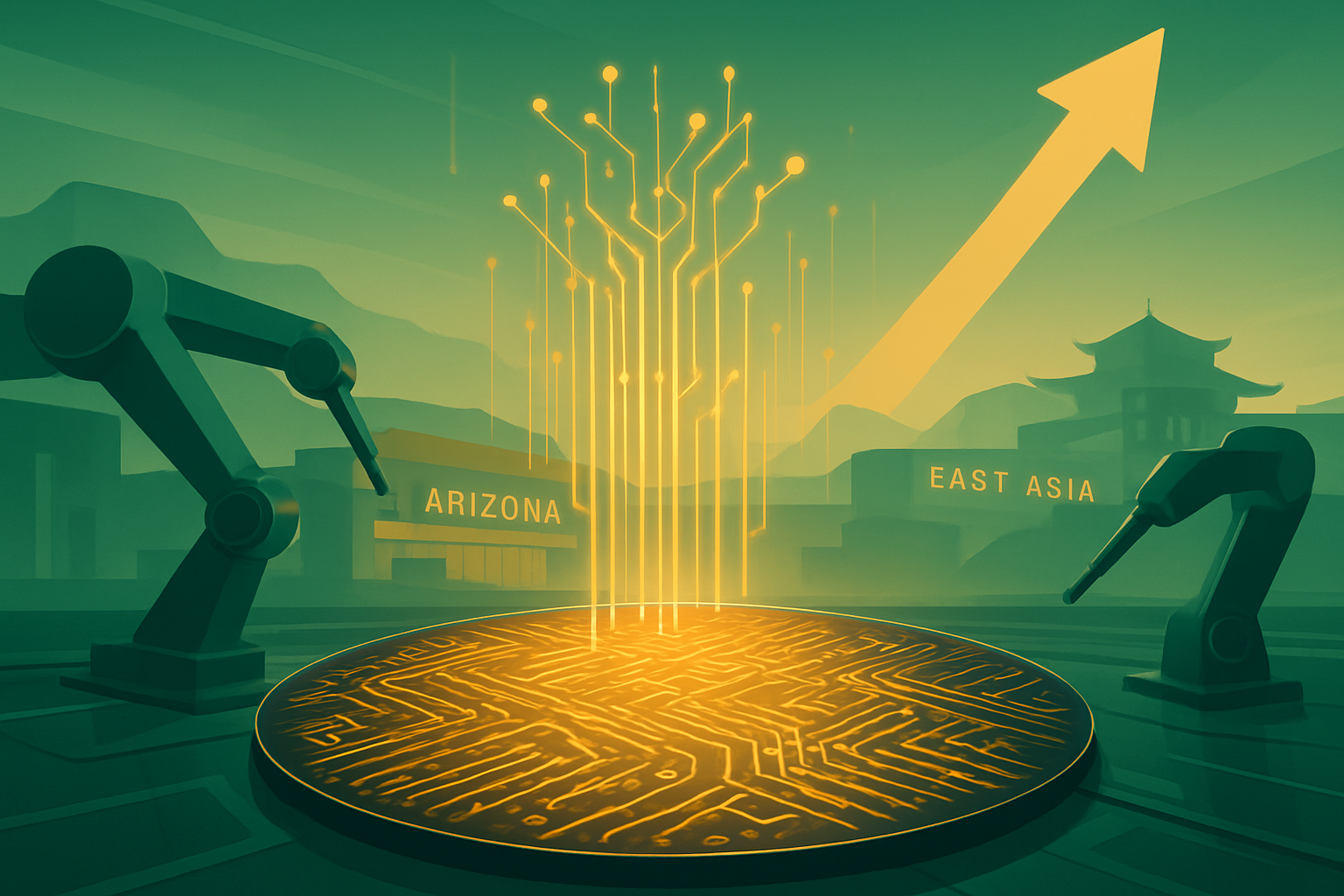
    The geopolitical landscape is a double-edged sword. On one hand, the U.S. CHIPS and Science Act has provided billions in grants for TSMC’s Arizona expansion (Fabs 21 and 22). On the other hand, increasingly stringent U.S. export controls on China have forced TSMC to strictly monitor its client list, potentially limiting its "legacy node" business in the Chinese market.

    Furthermore, the "Silicon Shield"—the idea that TSMC's importance to the global economy prevents conflict in the Taiwan Strait—is being tested as the company diversifies its manufacturing to Japan (Kumamoto) and Germany (Dresden). This "globalization" reduces risk but increases the cost of production, a factor investors must weigh carefully.

    Conclusion

    TSMC enters 2026 as the undisputed king of the silicon world. Its 26% revenue growth and the imminent rollout of 2nm and A16 technologies demonstrate a company that is not just participating in the AI revolution, but dictating its pace. While geopolitical risks and the astronomical costs of overseas expansion remain permanent fixtures of the TSMC narrative, the company’s "quasi-monopoly" on the world’s most advanced technology makes it an indispensable asset.

    For investors, the journey toward a $3 trillion market cap will depend on two factors: the continued "insatiable" demand for AI compute and TSMC's ability to maintain its "Taiwan-level" efficiency in Arizona and beyond. As we look toward the remainder of 2026, TSMC stands as the bridge between the digital present and an AI-driven future.


    This content is intended for informational purposes only and is not financial advice.
  • Apple Inc. (AAPL): Record Revenue vs. Regulatory Reality – A 2026 Deep Dive

    Apple Inc. (AAPL): Record Revenue vs. Regulatory Reality – A 2026 Deep Dive

    Today’s Date: February 16, 2026

    Introduction

    Apple Inc. (NASDAQ: AAPL) remains the ultimate barometer for the global technology sector. As of February 2026, the Cupertino giant finds itself at a fascinating crossroads. Just weeks ago, the company reported a staggering Q1 2026 revenue beat of $143.7 billion—the highest quarterly figure in its history—driven by a massive hardware "super-cycle" and the rapid maturation of its artificial intelligence (AI) ecosystem. Yet, despite these record-breaking fundamentals, the stock has faced notable price pressure in recent weeks, slipping nearly 6% from its January highs. This article explores the tension between Apple’s operational dominance and the growing list of regulatory and macroeconomic headwinds that have investors momentarily hitting the "pause" button.

    Historical Background

    Founded in 1976 by Steve Jobs, Steve Wozniak, and Ronald Wayne, Apple’s journey is one of the most storied in corporate history. From the early success of the Apple II to the near-bankruptcy of the 1990s, the company’s trajectory changed forever with the return of Steve Jobs in 1997. The subsequent "Golden Era" saw the launch of the iMac, iPod, and the 2007 debut of the iPhone, which fundamentally redefined personal computing. Under the leadership of Tim Cook since 2011, Apple transitioned from a hardware-centric company into a services and ecosystem powerhouse, surpassing a $3 trillion valuation and establishing a level of brand loyalty rarely seen in any industry. By 2026, Apple has evolved again, positioning itself as a leader in "Privacy-First AI" and spatial computing.

    Business Model

    Apple’s business model is built on a "walled garden" strategy that integrates hardware, software, and services to create high switching costs for users.

    • Hardware: The iPhone remains the crown jewel, accounting for roughly 59% of total revenue. Other segments include Mac, iPad, and Wearables (Apple Watch and AirPods).
    • Services: This high-margin segment includes the App Store, Apple Music, iCloud, Apple Pay, and the burgeoning Apple Intelligence premium tiers. Services now generate over $30 billion per quarter.
    • Ecosystem Synergy: By controlling the entire stack—from the A-series and M-series silicon to the iOS and macOS software—Apple extracts maximum value from its 2.5 billion active installed devices.

    Stock Performance Overview

    Over the long term, AAPL has been a generational wealth creator.

    • 10-Year Performance: Investors who held AAPL through the last decade have seen returns exceeding 800%, far outstripping the S&P 500.
    • 5-Year Performance: Growth was fueled by the 5G iPhone transition and the post-pandemic digital acceleration.
    • 1-Year Performance: 2025 was a standout year, with the stock climbing from the $190 range to a peak of $288.62 in early January 2026. However, the recent pullback to the $255–$262 range reflects profit-taking and caution regarding the 2026 outlook.

    Financial Performance

    The Q1 2026 earnings report was a masterclass in scale. Apple reported:

    • Revenue: $143.7 billion (16% YoY growth).
    • Net Profit: $42.09 billion.
    • Earnings Per Share (EPS): $2.84, beating consensus estimates of $2.71.
    • Gross Margin: Remains robust at approximately 45%, despite rising component costs.
      The balance sheet remains fortress-like, with over $160 billion in cash and marketable securities, allowing for continued aggressive share buybacks and dividend growth.

    Leadership and Management

    Tim Cook continues to lead as CEO, marking 15 years at the helm. Known for his operational brilliance, Cook has successfully navigated the company through global supply chain crises and the pivot to services. The leadership team remains stable, with Jeff Williams (COO) and Greg "Joz" Joswiak (SVP Worldwide Marketing) playing pivotal roles. However, as 2026 progresses, "succession talk" is a recurring theme among institutional investors, though Cook has given no public indication of an imminent departure.

    Products, Services, and Innovations

    The current product lineup is dominated by the iPhone 17 series, which introduced the A19 chip and 120Hz displays across all models.

    • Apple Intelligence: Moving beyond beta, "Liquid Glass" iOS 26 features a fully revamped Siri with screen awareness and personal context.
    • Spatial Computing: The Vision Pro 2 and the rumored "Vision Air" are beginning to find traction in enterprise sectors, though they remain a small fraction of total revenue.
    • R&D Focus: Apple’s R&D spend has pivoted heavily toward on-device LLMs (Large Language Models) and health-tech integration, including non-invasive glucose monitoring features in the latest Apple Watch.

    Competitive Landscape

    Apple faces a multi-front war in 2026:

    • Smartphones: Samsung (KRX: 005930) continues to lead in foldable innovation, while Huawei remains a formidable challenger in the critical China market.
    • AI Rallies: Google (NASDAQ: GOOGL) and Microsoft (NASDAQ: MSFT) have more mature cloud-AI offerings, though Apple maintains a lead in private, on-device processing.
    • Services: Competitive pressure from Spotify (NYSE: SPOT) and Netflix (NASDAQ: NFLX) persists, though Apple’s integrated billing and hardware "pre-installs" provide a significant advantage.

    Industry and Market Trends

    The tech industry in 2026 is defined by "Premiumization" and "Edge AI." Consumers are increasingly willing to pay for "Pro" devices that can handle heavy local AI processing. Additionally, the shift in manufacturing from China to India and Vietnam is nearly 25% complete for Apple, reducing geopolitical risk but initially pressuring margins due to logistics and training costs.

    Risks and Challenges

    Despite the record revenue, the stock's recent price pressure is rooted in specific risks:

    • Component Inflation: Memory prices have surged 40-50% in the last year, threatening to compress margins in the second half of 2026.
    • Regulatory Overhang: The ongoing DOJ antitrust trial and EU Digital Markets Act (DMA) fines have created a cloud of uncertainty.
    • Slowing China Growth: Economic headwinds in China continue to dampen demand for high-end electronics.

    Opportunities and Catalysts

    Several near-term events could reignite the stock:

    • iPhone 17e Launch: Expected later this month, this "budget" AI-capable phone could capture significant market share in emerging markets.
    • Foldable iPhone: Persistent rumors of a late-2026 "iPhone Flip" launch could trigger the next massive upgrade cycle.
    • Apple Intelligence Monetization: The potential for a "Siri Premium" subscription model could add a new high-margin revenue stream.

    Investor Sentiment and Analyst Coverage

    Wall Street remains broadly bullish but cautious. The consensus price target sits at approximately $315, with high-end targets reaching $367. Institutional investors like Berkshire Hathaway and BlackRock remain anchors of the shareholder base, though some hedge funds trimmed positions in Q4 2025 to lock in gains after the 2025 AI-led rally.

    Regulatory, Policy, and Geopolitical Factors

    Apple is currently in the "Discovery" phase of a landmark DOJ antitrust lawsuit, with a trial likely in 2027. In Europe, the EU Commission’s "anti-steering" fines (totaling €500 million) and strict DMA enforcement regarding the App Store are forcing Apple to open its ecosystem, potentially impacting Services revenue. Geopolitically, the company remains caught between US-China trade tensions, though its increased investment in India serves as a strategic hedge.

    Conclusion

    Apple’s Q1 2026 results prove that the company is a financial juggernaut, capable of delivering record growth even in a mature market. The current price pressure should be viewed not as a sign of fundamental decay, but as a period of consolidation as the market digests regulatory risks and component cost concerns. For long-term investors, the rollout of full Apple Intelligence and the potential for a foldable hardware refresh provide significant catalysts. While the "easy money" of the 2025 rally may be over, Apple’s unrivaled ecosystem and massive cash flow make it a resilient cornerstone for any portfolio.


    This content is intended for informational purposes only and is not financial advice.

  • Apple at $4 Trillion: Navigating the AI Supercycle and Regulatory Storms

    Apple at $4 Trillion: Navigating the AI Supercycle and Regulatory Storms

    As of February 5, 2026, Apple Inc. (NASDAQ: AAPL) stands at a pivotal intersection of legacy dominance and future uncertainty. With its market capitalization hovering near the historic $4 trillion mark, the Cupertino giant remains the primary bellwether for the global technology sector. The company is currently riding the crest of what analysts are calling the "AI Supercycle," catalyzed by the iPhone 17 lineup and the deep integration of "Apple Intelligence." While recent quarterly results have shattered records, the company is simultaneously navigating a complex landscape of regulatory headwinds in the United States and Europe, alongside a shifting consumer narrative regarding its spatial computing ambitions.

    Historical Background

    Founded in a California garage in 1976 by Steve Jobs, Steve Wozniak, and Ronald Wayne, Apple’s journey is one of the most storied in corporate history. After the initial success of the Apple II and the revolutionary introduction of the Macintosh in 1984, the company faced a decade of decline that nearly ended in bankruptcy. The return of Steve Jobs in 1997 marked the beginning of a legendary turnaround, characterized by the iMac, iPod, and eventually the 2007 launch of the iPhone—a device that redefined modern computing.

    Under the leadership of Tim Cook, who took the helm in 2011, Apple transformed from a hardware-centric innovator into an operational powerhouse with a diversified ecosystem. The last decade has been defined by the explosive growth of the Services segment and the successful transition to in-house "Apple Silicon," which decoupled Apple’s hardware performance from third-party chipmakers like Intel.

    Business Model

    Apple’s business model is built on a "walled garden" ecosystem designed to maximize customer lifetime value through hardware-software integration.

    • iPhone: Remains the primary revenue driver (approx. 50-60% of total sales), acting as the gateway to the ecosystem.
    • Services: Includes the App Store, iCloud, Apple Music, Apple TV+, and advertising. This high-margin segment (70%+ gross margins) provides recurring revenue and reduces cyclical volatility.
    • Wearables, Home, and Accessories: Includes the Apple Watch, AirPods, and the Vision Pro. This segment reinforces user "stickiness."
    • Mac and iPad: Mature product lines that leverage Apple’s proprietary M-series chips to maintain premium market positioning.

    The strategy relies on high switching costs; once a user is invested in the iOS/macOS ecosystem, moving to a competitor involves significant friction, both technical and emotional.

    Stock Performance Overview

    Over the last decade, AAPL has been a cornerstone of the S&P 500's growth.

    • 10-Year Performance: Investors have seen returns exceeding 900%, driven by massive share buybacks and consistent earnings growth.
    • 5-Year Performance: The stock has more than doubled, navigating the post-pandemic supply chain crisis and the transition to the 5G era.
    • 1-Year Performance: In the past 12 months leading up to February 2026, the stock has climbed approximately 28%, largely fueled by the realization of the AI-driven upgrade cycle and a significant recovery in the Greater China market.

    Financial Performance

    Apple’s Fiscal Year 2025 was a record-breaking period, with total revenue reaching $416 billion. The momentum carried into the Q1 2026 holiday quarter, where the company reported a staggering $143.8 billion in revenue—a 16% year-over-year increase.

    • Net Income: FY 2025 net income reached $112.01 billion.
    • Margins: Gross margins remain robust at approximately 46%, supported by the growing mix of Services revenue.
    • Cash Position: Apple continues to hold a massive cash pile, enabling a $110 billion share repurchase program announced in 2024 and maintained through 2025.
    • Earnings Per Share (EPS): Q1 2026 EPS of $2.84 beat consensus estimates, reflecting high operational efficiency.

    Leadership and Management

    Tim Cook continues to serve as CEO, maintaining a reputation for logistical brilliance and fiscal discipline. However, the management team is in a period of gradual transition. Luca Maestri’s transition from the CFO role (and the rise of his successor) has been handled with the typical Apple "quietness," ensuring market stability. The leadership’s current focus is squarely on "Apple Intelligence," with Senior VP of Software Engineering Craig Federighi and Head of Machine Learning John Giannandrea taking center stage in recent product keynotes.

    Products, Services, and Innovations

    The product roadmap in 2026 is defined by the "Apple Intelligence" (AI) rollout.

    • iPhone 17 Series: The standout performer of late 2025, driven by AI features like "Visual Intelligence" and enhanced Siri capabilities.
    • The "iPhone Air" Experiment: A new, ultra-thin model introduced in the 17-series has seen surprisingly weak demand due to compromises in battery life and camera specs, leading to rumored production cuts.
    • Vision Pro: Despite the initial hype, the high-end spatial computer has struggled, with only 45,000 units shipped in the 2025 holiday quarter. Apple is reportedly pivoting toward a more affordable "Vision" model and lightweight AR glasses.
    • Apple Silicon: The M5 and A19 Pro chips are now industry leaders in NPU (Neural Processing Unit) performance, essential for on-device AI.

    Competitive Landscape

    Apple faces fierce competition across all segments:

    • High-End Smartphones: Samsung (KRX: 005930) continues to challenge with its foldable lineup and "Galaxy AI." In China, Huawei has made a significant comeback, though Apple’s iPhone 17 cycle has recently regained lost ground.
    • AI Leadership: Microsoft (NASDAQ: MSFT) and Alphabet (NASDAQ: GOOGL) are Apple’s primary rivals in the AI arms race. While Microsoft leads in enterprise and cloud AI, Apple aims to win on privacy-centric, on-device consumer AI.
    • Streaming and Services: Apple TV+ competes with Netflix (NASDAQ: NFLX) and Disney (NYSE: DIS), focusing on "quality over quantity" to drive its 36% annual viewership growth.

    Industry and Market Trends

    The "Age of the AI Phone" is the dominant trend of 2026. Consumers are no longer upgrading for better cameras alone; they are upgrading for integrated personal assistants and generative tools. Additionally, the industry is seeing a shift toward "Sovereign AI," where hardware must comply with local data residency laws, a trend Apple has managed well through its emphasis on local processing.

    Risks and Challenges

    • Vision Pro Stagnation: The failure of the first-generation Vision Pro to gain mainstream traction raises questions about Apple’s next "big thing."
    • Hardware Saturation: If the AI supercycle peaks in 2026, Apple may face a "growth cliff" in 2027 as upgrade cycles lengthen again.
    • Concentration Risk: Heavy reliance on the iPhone and the Chinese manufacturing base remains a perennial concern, despite efforts to diversify into India and Vietnam.

    Opportunities and Catalysts

    • Healthcare Integration: Apple is increasingly positioning the Watch and AirPods as medical devices, with rumored non-invasive glucose monitoring features nearing regulatory approval.
    • Ad Business Expansion: Apple is aggressively scaling its first-party advertising network within the App Store and Apple News, representing a multi-billion dollar opportunity.
    • Cheaper Vision Headset: A rumored $2,000 "Vision" model could democratize spatial computing and revitalize the segment in late 2026.

    Investor Sentiment and Analyst Coverage

    Wall Street remains generally bullish on Apple, though a divide has emerged.

    • Bulls: Analysts like Dan Ives at Wedbush maintain a "Strong Buy" with a $350 price target, citing the "unprecedented" installed base of 300M+ iPhones ready for upgrade.
    • Bears: Analysts at Barclays have expressed caution, with targets as low as $205, citing high component costs (memory/OLED) and the legal risks surrounding the App Store.

    Regulatory, Policy, and Geopolitical Factors

    Apple is currently navigating a "regulatory minefield."

    • US DOJ Trial: A landmark antitrust trial regarding Apple’s smartphone monopoly is ongoing as of February 2026. A negative ruling could force Apple to open its ecosystem in ways that threaten Services margins.
    • EU Digital Markets Act (DMA): Apple continues to clash with the European Commission over alternative app stores and "Core Technology Fees," having already faced a €500 million fine in late 2025.
    • Geopolitics: Relations with China remain a delicate balancing act. While sales have rebounded, the threat of export controls on high-end chips or retaliation for US trade policies remains a "black swan" risk.

    Conclusion

    As we look through the lens of February 2026, Apple Inc. remains a formidable fortress of cash and consumer loyalty. The success of the iPhone 17 has proved that the "walled garden" is more resilient than skeptics predicted, and the company's pivot to "Apple Intelligence" has effectively neutralized the threat of being left behind in the AI race. However, the plateauing of the Vision Pro and the looming shadow of the DOJ trial suggest that the $4 trillion giant must continue to evolve. For investors, the next 12 months will be defined by whether Apple can translate its AI dominance into a sustainable multi-year growth story, or if regulatory intervention will finally crack the walls of its lucrative ecosystem.


    This content is intended for informational purposes only and is not financial advice.
  • The Silicon Fortress: An In-Depth Research Report on Apple Inc. (AAPL) in the Age of Generative Intelligence

    The Silicon Fortress: An In-Depth Research Report on Apple Inc. (AAPL) in the Age of Generative Intelligence

    Date: January 28, 2026

    Introduction

    As the sun sets on January 28, 2026, Apple Inc. (NASDAQ: AAPL) stands at a critical juncture in its five-decade history. Tomorrow, the Cupertino giant will release its fiscal first-quarter earnings for 2026—a report that investors hope will justify the company's aggressive pivot toward generative artificial intelligence and clarify the future of its hardware lineup. Following a year of record-breaking revenues in 2025, the market is currently digesting a "two-speed" reality: the runaway success of the iPhone 17 Pro series and the unexpected commercial struggle of the ultra-thin iPhone 17 Air. With rumors of a leadership transition and a historic partnership with Google to power Siri, Apple is no longer just a hardware company; it is an AI ecosystem in the making.

    Historical Background

    Founded in 1976 by Steve Jobs, Steve Wozniak, and Ronald Wayne, Apple’s journey from a garage in Los Altos to a multi-trillion-dollar entity is the definitive narrative of the Silicon Valley era. The company’s trajectory has been defined by three distinct "acts." Act One was the Macintosh and the democratization of personal computing. Act Two, spearheaded by the iPod and iPhone, redefined consumer electronics and mobile connectivity. Act Three, under the leadership of Tim Cook, transitioned the company into a Services-led powerhouse, capitalizing on a "walled garden" that now encompasses over 2.2 billion active devices. By early 2026, Apple has entered what analysts call "Act Four": the era of Spatial Computing and On-Device Intelligence.

    Business Model

    Apple’s business model remains one of the most resilient "moats" in global finance. It rests on two pillars:

    1. Hardware as the Entry Point: The iPhone remains the primary revenue driver (approx. 50-55% of revenue), supported by the iPad, Mac, and a robust "Wearables, Home, and Accessories" segment (Apple Watch, AirPods, Vision Pro).
    2. Services as the Profit Engine: Once a user enters the ecosystem, Apple monetizes them through the App Store, iCloud, Apple Music, Apple Pay, and Apple TV+. In fiscal year 2025, Services revenue hit a record $28.75 billion in the fourth quarter alone, carrying gross margins significantly higher than hardware.

    In 2026, this model is evolving to include AI-as-a-Service. While many core "Apple Intelligence" features are free, the company has begun exploring "Apple Intelligence+" subscriptions for enterprise-grade features and cloud-based generative power.

    Stock Performance Overview

    As of today, January 28, 2026, AAPL is trading in the $255–$260 range.

    • 1-Year Performance: The stock has seen a volatile but upward trend, hitting an all-time high of $288.62 in December 2025 before a 10% pullback in January 2026.
    • 5-Year Performance: AAPL has significantly outperformed the S&P 500, driven by the post-pandemic digital acceleration and the expansion of the Services segment.
    • 10-Year Performance: Investors who held since 2016 have seen returns exceeding 800% (adjusted for splits), cementing Apple as a cornerstone of institutional portfolios.
      The recent January pullback is largely attributed to "leadership anxiety" regarding Tim Cook’s retirement rumors and the scaling back of iPhone 17 Air production.

    Financial Performance

    Apple concluded fiscal 2025 with staggering numbers:

    • Annual Revenue: $416.2 billion.
    • Net Income: $112 billion.
    • Earnings Per Share (EPS): Consistently beating consensus through 2025.
    • Cash Position: Apple continues to hold a massive cash hoard, utilizing much of it for its industry-leading share buyback program.

    For the upcoming Q1 2026 report (covering the 2025 holiday season), analysts expect revenue between $138.4 billion and $141.2 billion. Investors are specifically focused on margins; while iPhone 17 Pro sales were high-margin, the R&D costs for Apple Intelligence and the logistical costs of the iPhone 17 Air "flop" may weigh on the bottom line.

    Leadership and Management

    Tim Cook, CEO since 2011, is the subject of intense speculation as he nears 15 years at the helm. While he has not officially set a date, internal shifts suggest a transition plan is in motion.

    • Succession: Jeff Williams (COO) and John Ternus (Hardware Engineering) are currently viewed as the front-runners.
    • AI Leadership: Following the retirement of John Giannandrea in late 2025, the AI division was reorganized under Amar Subramanya. This move signals a shift from "AI as a research project" to "AI as a core OS feature" under the direct supervision of Software Chief Craig Federighi.

    Products, Services, and Innovations

    The current product landscape is defined by the iPhone 17 Series. The "Pro" models, featuring the A19 Pro chip, have been praised for their AI processing capabilities. However, the iPhone 17 Air—designed to be the thinnest phone ever—was poorly received due to thermal issues and a high $999 price tag, leading to an 80% production cut.

    Apple Intelligence 2.0: The centerpiece of Apple's 2026 strategy is the integration of Google’s Gemini models into Siri, scheduled for a February rollout. This partnership represents a rare admission that third-party LLMs are necessary to meet consumer expectations for generative AI.

    Future Pipeline: Rumors for the iPhone 18 (expected Sept 2026) suggest the debut of the A20 chip on a 2nm process and the potential launch of a book-style foldable, the "iPhone Fold."

    Competitive Landscape

    Apple faces a multi-front war in 2026:

    • Samsung: Continues to lead in the foldable market, a category Apple has yet to enter.
    • Google: The Pixel line, integrated deeply with Gemini, is winning "AI-first" consumers.
    • Huawei: In China, Huawei’s resurgence has forced Apple into aggressive discounting. However, Apple reclaimed the #1 spot in China in Q4 2025 with a 22% market share.
    • Microsoft/Nvidia: While not direct hardware rivals, they compete for the "AI narrative" and investor capital.

    Industry and Market Trends

    The "AI Supercycle" is the dominant trend of 2026. Consumers are no longer upgrading for better cameras alone; they are upgrading for the RAM and NPU (Neural Processing Unit) requirements of on-device AI. Additionally, the industry is shifting toward 2nm silicon production, with Apple securing the lion's share of TSMC's initial capacity for late 2026.

    Risks and Challenges

    1. Product Missteps: The failure of the iPhone 17 Air suggests a rare disconnect between Apple’s design ambitions and consumer utility.
    2. AI Lag: Despite the Gemini partnership, Apple is still perceived as "playing catch-up" to OpenAI and Google.
    3. China Concentration: While sales have recovered, the geopolitical risk of manufacturing in China remains a perennial "black swan" risk.
    4. Hardware Saturation: With smartphone replacement cycles stretching to 4+ years, Apple must find new ways to drive upgrades.

    Opportunities and Catalysts

    • The Foldable Leap: If the iPhone 18 Fold launches in late 2026, it could trigger the largest upgrade cycle since the iPhone 6.
    • Vision Pro 2/Air: A more affordable "Vision Air" headset could finally bring spatial computing to the mass market.
    • AI Monetization: The transition of Siri from a basic assistant to a "personal agent" creates a massive opportunity for a premium "Apple Intelligence+" subscription tier.

    Investor Sentiment and Analyst Coverage

    Wall Street remains "Overweight" on AAPL, though the conviction is split. Bulls point to the $28 billion/quarter Services revenue and the AI supercycle. Bears point to the 30x P/E ratio and the leadership transition risks. Retail sentiment, tracked via social platforms, is currently "cautiously optimistic" as enthusiasts wait for the Siri/Gemini update in February.

    Regulatory, Policy, and Geopolitical Factors

    Regulatory pressure is at an all-time high:

    • EU Digital Markets Act (DMA): Apple’s latest update (iOS 26.3) introduced "full interoperability," a major concession that allows competitors like Garmin and Samsung to integrate with the iPhone as deeply as the Apple Watch.
    • DOJ Antitrust Lawsuit: The U.S. case is entering a critical trial phase in February 2026. A loss could force Apple to allow third-party app stores or change its "default" search engine agreements.
    • China AI Compliance: To operate AI in China, Apple has partnered with Baidu for its Ernie Bot, navigating a complex web of local censorship and data laws.

    Conclusion

    As of January 28, 2026, Apple Inc. remains the world’s premier consumer technology fortress. Its financial health is beyond reproach, but its strategic direction is undergoing its most significant shift since the launch of the iPhone. The upcoming Q1 earnings will tell us if the high-end "Pro" consumers can carry the weight of the "Air" failure, and the February AI update will determine if Apple can lead—rather than follow—the generative revolution. For investors, the next 12 months will be defined by two words: Execution and Succession.


    This content is intended for informational purposes only and is not financial advice.

  • Apple Inc. (AAPL) Deep Dive: The AI Supercycle and the Road to the 2026 Earnings Report

    Apple Inc. (AAPL) Deep Dive: The AI Supercycle and the Road to the 2026 Earnings Report

    Today’s date is January 27, 2026. As the world’s most valuable technology company, Apple Inc. (NASDAQ: AAPL) prepares to report its fiscal 2026 first-quarter earnings this Thursday, January 29, the stakes for the Cupertino giant have never been higher. Following a year of transformation defined by the rollout of "Apple Intelligence" and the successful launch of the iPhone 17, investors are looking for confirmation that the long-promised "AI supercycle" has finally arrived. This deep-dive research explores Apple’s current market standing, its recent performance, and the headwinds it faces in an increasingly regulated global landscape.

    Historical Background

    Apple was founded in a Los Altos garage in 1976 by Steve Jobs, Steve Wozniak, and Ronald Wayne. From its early days as a pioneer in personal computing with the Apple II and the Macintosh, the company survived a near-bankruptcy in the 1990s before Steve Jobs’ return heralded one of the greatest corporate turnarounds in history.

    The 21st century redefined Apple. The launch of the iPod (2001), iPhone (2007), and iPad (2010) shifted the company from a computer manufacturer to a mobile electronics and digital lifestyle leader. Under Tim Cook, who took the helm in 2011, Apple transitioned from a hardware-first business into a diversified ecosystem powerhouse, emphasizing Services and Wearables while scaling the iPhone to reach over 2 billion active devices globally.

    Business Model

    Apple’s business model is built on the concept of a "walled garden"—a seamless integration of hardware, software, and services that creates high switching costs for consumers. Its revenue streams are categorized into:

    • Hardware: iPhone (the primary revenue driver), Mac, iPad, and Wearables, Home, and Accessories (Apple Watch, AirPods, Vision Pro).
    • Services: App Store, iCloud+, Apple Music, Apple TV+, Apple Pay, and the newly monetized Apple Intelligence subscription tiers.
    • The Ecosystem Effect: By controlling the silicon (Apple Silicon) and the operating systems (iOS, macOS), Apple captures value at every level of the tech stack, ensuring high margins and a loyal customer base.

    Stock Performance Overview

    As of early 2026, Apple continues to be a cornerstone of global equity markets.

    • 1-Year Performance: The stock has outperformed the S&P 500, gaining roughly 22% as the "Apple Intelligence" cycle took hold and concerns over Chinese demand subsided.
    • 5-Year Performance: AAPL has seen a steady climb of approximately 140%, driven by massive share buybacks and the explosive growth of the Services segment.
    • 10-Year Performance: Long-term investors have seen returns exceeding 800% (split-adjusted), cementing Apple’s reputation as a generational wealth creator.
      The stock currently trades near its all-time highs, reflecting optimism about the holiday quarter results.

    Financial Performance

    Apple concluded its fiscal 2025 with strong momentum. The September quarter (Q4 2025) saw revenue of $102.5 billion, up 8% year-over-year.

    • Profitability: Net income for the full year 2025 reached record levels, with gross margins hovering near 47%.
    • Services Growth: The Services segment now contributes nearly 30% of total revenue, with margins exceeding 75%, effectively decoupling Apple's bottom line from the volatility of hardware cycles.
    • Cash Position: With $132 billion in cash and marketable securities, Apple maintains one of the strongest balance sheets in corporate history, continuing its aggressive program of dividends and share repurchases.

    Leadership and Management

    Tim Cook’s leadership has been characterized by operational excellence and supply chain mastery. While skeptics once questioned his ability to innovate compared to Steve Jobs, Cook has overseen the growth of Apple’s market cap from $350 billion to over $3.5 trillion.
    The executive team, including COO Jeff Williams (often seen as a potential successor) and CFO Luca Maestri (who recently transitioned to a more strategic role), has maintained a culture of discipline and privacy. Governance remains a strong suit, though the board faces increasing pressure to provide more transparency regarding AI safety and carbon neutrality goals.

    Products, Services, and Innovations

    The current flagship, the iPhone 17, has been the primary driver of late-2025 performance. For the first time, Apple mandated 12GB of RAM across the Pro lineup to handle on-device AI, a hardware requirement that successfully nudged millions of users to upgrade.

    • Apple Intelligence: In late 2025, Apple launched a "Pro" AI tier, charging $15/month for advanced agentic capabilities that allow Siri to handle complex, cross-app workflows.
    • Apple Silicon: The M5 chip family has further widened the performance-per-watt gap against rivals, keeping the Mac segment robust.
    • The Vision Pro Dilemma: While a technical marvel, the Vision Pro has faced a "reality check." Sales slowed significantly in late 2025, leading to reports that Apple has shifted focus to a more affordable "Vision" model and lightweight smart glasses expected later this year.

    Competitive Landscape

    Apple faces a dual-front battle:

    1. Hardware: Samsung remains the primary global rival, recently launching AI-integrated Galaxy devices that challenge the iPhone on "Smarter" features. In China, Huawei’s resurgence with its own high-end silicon has challenged Apple's high-end dominance.
    2. Services/AI: In the AI space, Apple is both a partner and a competitor to Google and Microsoft. While Apple uses Google Gemini for certain cloud-based LLM queries, it is positioning itself as the "Privacy First" alternative to the data-hungry AI models of its peers.

    Industry and Market Trends

    The smartphone industry has transitioned into the "AI Phone" era. Consumers are no longer upgrading for better cameras alone; they are looking for productivity-enhancing AI. This shift has favored Apple’s vertically integrated approach, where software and hardware are designed in tandem.
    Additionally, the trend toward "Edge Computing"—processing data on the device rather than the cloud—plays directly into Apple’s strengths, allowing the company to market privacy as a premium feature in a world increasingly wary of data breaches.

    Risks and Challenges

    Despite its dominance, Apple is not without significant risks:

    • Regulatory Backlash: The company is currently defending itself against a massive DOJ antitrust lawsuit in the US and navigating the European Union’s Digital Markets Act (DMA), which has already led to hundreds of millions in fines and forced changes to the App Store.
    • China Exposure: While demand has rebounded, the geopolitical tension between the US and China remains a persistent threat to both sales and supply chain stability.
    • Vision Pro Stagnation: If the mixed-reality category fails to gain mainstream traction, Apple risks a multi-billion-dollar R&D write-down.

    Opportunities and Catalysts

    • AI Monetization: The transition of Apple Intelligence into a recurring revenue stream could significantly boost Services margins.
    • Health Technology: Continuous glucose monitoring and other advanced health sensors in the Apple Watch remain a major long-term growth lever.
    • Emerging Markets: Apple’s expansion in India—both as a manufacturing hub and a retail market—is in its early innings, with massive potential for the next decade of growth.

    Investor Sentiment and Analyst Coverage

    Wall Street enters the Thursday earnings report with high expectations. Consensus revenue is projected at roughly $139 billion, which would be the largest quarter in Apple’s history. Analysts are particularly focused on "Average Selling Price" (ASP), as the shift toward the more expensive Pro and Pro Max models is expected to drive record earnings per share (EPS). Institutional sentiment remains "Overweight," though some hedge funds have expressed caution regarding the ongoing DOJ antitrust trial.

    Regulatory, Policy, and Geopolitical Factors

    The regulatory environment is Apple's most complex headwind. In the EU, Apple has had to delay certain "Apple Intelligence" features due to interoperability requirements, leading to a fragmented user experience globally. In the US, the outcome of the DOJ’s probe into the "walled garden" could potentially force Apple to allow third-party app stores or alternative payment systems on a more permanent, global basis, threatening the lucrative 30% "Apple Tax."

    Conclusion

    As we approach the January 29 earnings call, Apple stands at a pivotal crossroads. The iPhone 17 supercycle appears to be delivering the hardware growth that investors craved, while the strategic pivot into AI monetization promises to further solidify the company's "Services-first" future. However, the stagnation of the Vision Pro and the mounting pressure from global regulators serve as reminders that even the world’s most successful company is not immune to market shifts and policy changes.

    Investors should watch for two things on Thursday: management’s guidance for the March quarter and any updates on the adoption rates of the paid Apple Intelligence tiers. If Apple can prove that AI is driving both hardware upgrades and recurring service fees, the stock's premium valuation may be well-justified for years to come.


    This content is intended for informational purposes only and is not financial advice.