Tag: CAT

  • The 100-Year Pivot: Why Caterpillar (CAT) Is the Surprising Powerhouse of the AI and Energy Era

    The 100-Year Pivot: Why Caterpillar (CAT) Is the Surprising Powerhouse of the AI and Energy Era

    As of April 2, 2026, Caterpillar Inc. (NYSE: CAT) stands at a historic crossroads. Fresh off its centennial anniversary in 2025, the world’s leading manufacturer of construction and mining equipment has transformed itself from a traditional "heavy iron" manufacturer into a high-tech powerhouse. While the iconic "Caterpillar Yellow" machines remain ubiquitous on job sites globally, the company's recent focus on autonomy, AI-driven power solutions for data centers, and the energy transition has redefined its market position.

    Today, Caterpillar is no longer just a bellwether for global industrial activity; it is a critical player in the technological infrastructure of the 21st century. With a record backlog of $51 billion and a stock price that has seen triple-digit gains over the last year, CAT is currently one of the most closely watched stocks on the New York Stock Exchange.

    Historical Background

    Caterpillar’s journey began in 1925 with the merger of the Holt Manufacturing Company and the C. L. Best Tractor Co. Benjamin Holt had pioneered the continuous-track tractor—the "Caterpillar"—which replaced wheels to prevent heavy machinery from sinking into soft soil.

    Over the past century, the company has weathered the Great Depression, played a vital role in World War II (providing engines and tractors for the Allied effort), and became synonymous with the post-war global infrastructure boom. In the 21st century, Caterpillar transitioned through several strategic eras, most recently shifting its headquarters from Peoria, Illinois, to Deerfield, and finally to Irving, Texas. This move signaled a leaner, more globalized approach. Under the "Operating & Execution (O&E) Model" introduced in the late 2010s, the company focused on higher-margin services and technology-integrated products, setting the stage for its current record-breaking performance.

    Business Model

    Caterpillar operates through three primary segments, supported by a massive global dealer network that remains its most significant competitive moat.

    1. Construction Industries: Providing machinery for infrastructure, forestry, and building construction. This remains the "stability anchor" of the company.
    2. Resource Industries: Focused on the mining and quarrying sectors. This segment is currently riding the wave of the "mining super-cycle" as global demand for copper, lithium, and nickel surges.
    3. Energy & Transportation (E&T): The fastest-growing arm of the company. It provides reciprocating engines, turbines, and generators for the oil and gas, marine, and power generation industries. In 2026, the demand for backup power in AI data centers has turned E&T into Caterpillar's most lucrative segment.

    A key pillar of the business model is the target to reach $28 billion in service-related revenue by late 2026. By leveraging telematics and predictive maintenance, Caterpillar captures high-margin recurring revenue long after the initial equipment sale.

    Stock Performance Overview

    Caterpillar’s stock performance has been nothing short of exceptional, reflecting its evolution from a cyclical play to a secular growth story.

    • 1-Year Performance: The stock has surged approximately 121% since April 2025, driven largely by the massive uptick in Energy & Transportation orders and the resilience of the U.S. infrastructure market.
    • 5-Year Performance: With a return of roughly 214% (a CAGR of ~25%), CAT has significantly outperformed the broader industrial sector.
    • 10-Year Performance: Long-term investors have seen returns of over 851%, vastly outpacing the S&P 500.

    As of early April 2026, CAT trades near all-time highs of approximately $730 per share, with a market capitalization exceeding $340 billion.

    Financial Performance

    In its latest full-year report for 2025, Caterpillar posted record-breaking sales and revenues of $67.6 billion, a 4% increase over 2024. However, the financial picture is a nuanced one:

    • Earnings: FY 2025 adjusted EPS came in at $19.06, down slightly from the $21.90 reported in 2024.
    • Margins: Operating profit margins were 17.2% in 2025, a contraction from the 20.7% seen in 2024. This compression was primarily attributed to a $1.7 billion headwind from trade tariffs and rising manufacturing costs.
    • Backlog: The company enters Q2 2026 with a $51 billion backlog, providing high revenue visibility for the next 18 to 24 months.
    • Cash Flow: Caterpillar remains a cash machine, returning billions to shareholders through dividends and aggressive share buybacks, even while increasing R&D spend.

    Leadership and Management

    Caterpillar recently completed a significant leadership transition. On April 1, 2026, Joseph (Joe) E. Creed officially added the role of Chairman of the Board to his CEO responsibilities. Creed, who succeeded Jim Umpleby as CEO in May 2025, is a 29-year company veteran who previously led the Energy & Transportation division.

    Creed’s leadership style is defined by a "technology-first" philosophy. He has been the primary architect of the company’s push into AI-integrated power solutions and autonomous mining. Governance under Creed remains conservative regarding the balance sheet but aggressive regarding market share and technological dominance.

    Products, Services, and Innovations

    Caterpillar’s R&D focus is currently centered on three "megatrends": autonomy, electrification, and alternative fuels.

    • Autonomy: Caterpillar’s "MineStar" command system is the industry leader. As of 2026, over 800 autonomous haul trucks are in operation globally, having moved over 11 billion tonnes of material without a single lost-time injury. The company is now expanding this Level 4 autonomy into mid-sized construction equipment.
    • The C13D Engine: This fuel-flexible platform, production-ready in 2026, allows customers to run on 100% renewable diesel (HVO), biodiesel, or hydrogen-hybrid configurations.
    • Hydrogen Fuel Cells: In partnership with Microsoft and Ballard Power Systems, Caterpillar has successfully demonstrated hydrogen fuel cell backup power for data centers, a critical innovation as AI campuses look for carbon-free reliable energy.

    Competitive Landscape

    Caterpillar maintains a dominant ~17% share of the global heavy machinery market.

    • Komatsu (KMTUY): CAT’s primary rival. While Komatsu is highly respected for its precision engineering in high-capacity mining, Caterpillar’s superior dealer network and integrated software ecosystem often give it the edge in total cost of ownership.
    • Sany and XCMG: These Chinese competitors have made inroads in emerging markets by competing on price. However, Caterpillar has successfully defended its premium position by focusing on resale value and "uptime" guarantees that lower-cost rivals struggle to match.
    • Deere & Co (NYSE: DE): While a formidable competitor in North American construction, Deere is more heavily exposed to the volatile agricultural cycle, whereas Caterpillar’s diversified exposure to mining and energy has shielded it from the recent downturn in the farming sector.

    Industry and Market Trends

    The machinery sector in 2026 is being shaped by two divergent forces:

    1. The Mining Super-Cycle: The transition to electric vehicles and renewable energy requires massive amounts of copper, lithium, and rare earth minerals. This has decoupled the mining equipment market from traditional economic cycles, as miners must invest in new capacity regardless of short-term GDP fluctuations.
    2. The AI Infrastructure Build-out: Data centers require immense amounts of primary and backup power. Caterpillar has secured multi-gigawatt generator contracts for AI "hyper-scale" campuses, making it an accidental but major beneficiary of the generative AI boom.

    Risks and Challenges

    Despite the record backlog, Caterpillar faces significant headwinds:

    • Geopolitical and Trade Risks: The company is highly sensitive to trade policy. In 2026, Caterpillar expects to absorb roughly $2.6 billion in tariff-related costs. This has forced aggressive pricing actions that could eventually dampen demand.
    • Interest Rates: While rates have stabilized from their 2023–2024 peaks, they remain "higher for longer." This has slowed the residential construction market, though large-scale infrastructure projects have largely compensated for the dip.
    • Supply Chain Complexity: The shift toward electric and hydrogen engines requires a completely different supply chain for minerals and components, introducing new vulnerabilities.

    Opportunities and Catalysts

    • The IIJA Tailwinds: The U.S. Infrastructure Investment and Jobs Act is hitting its peak spending phase in 2026, providing a steady stream of demand for construction equipment through 2028.
    • Electrification of the "Mid-Range": As municipalities mandate zero-emission construction sites, Caterpillar’s new battery-electric mini-excavators and loaders are seeing rapid adoption in Europe and North America.
    • M&A Potential: With a strong cash position, analysts expect Caterpillar to pursue acquisitions in the software and AI space to further boost its services revenue.

    Investor Sentiment and Analyst Coverage

    Wall Street remains generally optimistic but cautious about Caterpillar's high valuation. The consensus rating is "Moderate Buy" or "Outperform."

    • Target Prices: Median analyst targets sit around $765, with some bulls looking toward $878 based on E&T growth.
    • Sentiment: Institutional investors are increasingly viewing CAT as a "technology and energy play" rather than a "cyclical industrial." However, some retail chatter suggests concerns that the stock may be overextended after its 121% run over the past year.

    Regulatory, Policy, and Geopolitical Factors

    Regulatory pressure is intensifying. While the EPA Tier 4 Final remains the current standard, 2026 marks the beginning of formal industry preparation for "Tier 5" standards, expected by 2029. These standards will mandate a 90% reduction in Nitrogen Oxides (NOx).

    Furthermore, the "Buy American" provisions in the U.S. and similar "sovereignty" policies in the EU and India are forcing Caterpillar to localize more of its manufacturing, which provides security against trade wars but adds complexity to its global cost structure.

    Conclusion

    Caterpillar Inc. enters its second century as a fundamentally different company than the one that dominated the 20th century. By positioning itself at the center of the mining super-cycle, the AI infrastructure boom, and the push for autonomous job sites, Caterpillar has successfully shed its reputation as a purely cyclical stock.

    For investors, the key to the next 12 months will be Caterpillar’s ability to manage margin compression from tariffs while continuing to scale its high-margin services. While the valuation is currently at the higher end of its historical range, the $51 billion backlog and the non-discretionary nature of data center and mining demand provide a significant safety net. Caterpillar remains the definitive "heavyweight" champion of the industrial sector, now with a high-tech engine driving its future.


    This content is intended for informational purposes only and is not financial advice.
    4/2/2026
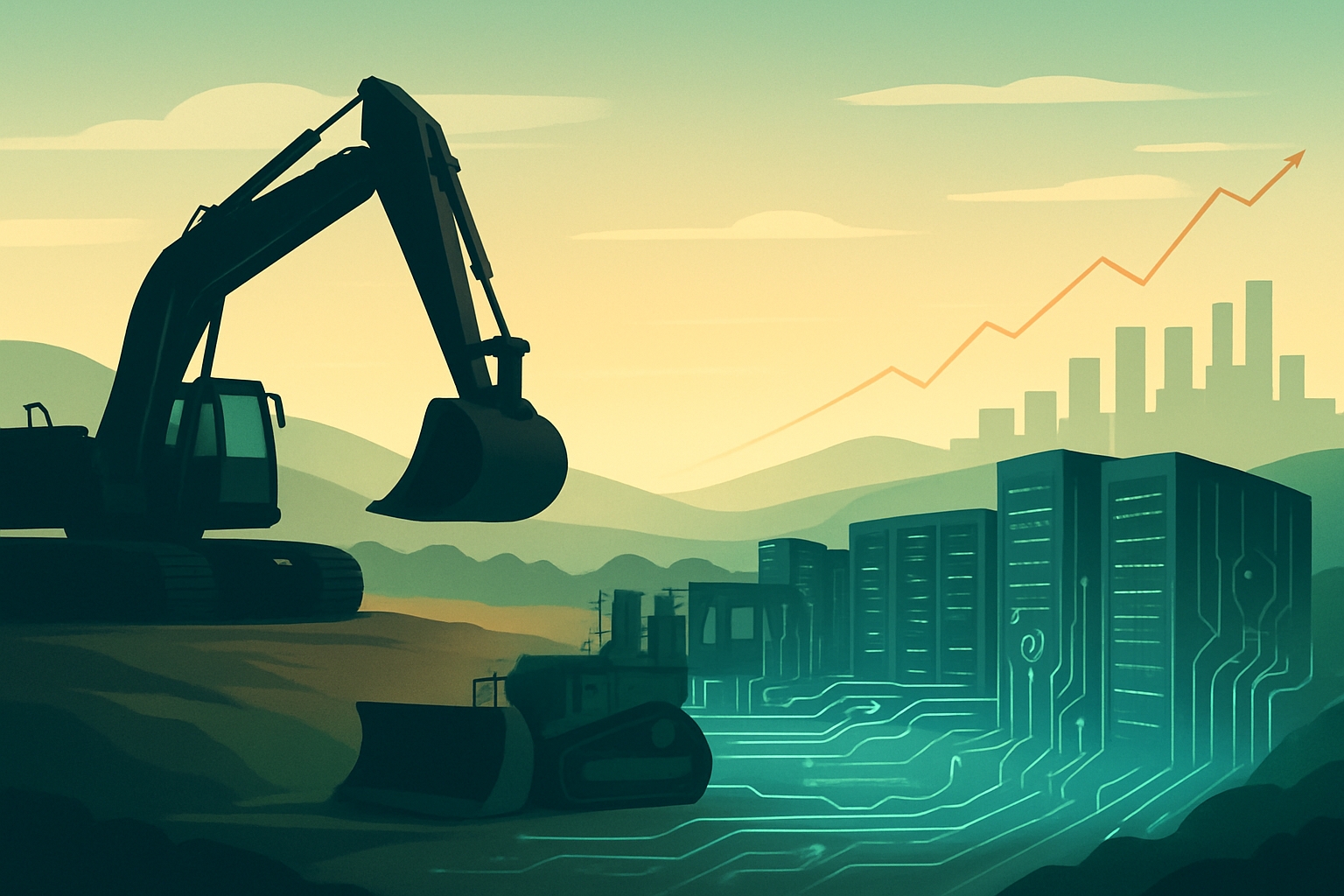
  • The Yellow Iron Renaissance: How AI and Infrastructure Fueled Caterpillar’s (CAT) Historic Surge

    The Yellow Iron Renaissance: How AI and Infrastructure Fueled Caterpillar’s (CAT) Historic Surge

    As of March 30, 2026, the industrial landscape has undergone a profound transformation. What was once dismissed as a "legacy" machinery company has emerged as a linchpin of the artificial intelligence revolution. Caterpillar Inc. (NYSE: CAT), headquartered in Irving, Texas, has spent the last two years defying the gravity of typical economic cycles.

    The narrative surrounding Caterpillar has shifted from "the company that builds roads" to "the company that powers the digital frontier." Driven by an unprecedented surge in data center construction and a sustained domestic infrastructure supercycle, Caterpillar’s stock has reached valuations once reserved for high-growth software firms. This article examines the strategic pivot, the leadership transition, and the fundamental drivers that have turned yellow iron into digital gold.

    Historical Background

    The story of Caterpillar is one of constant adaptation. Founded in 1925 through the merger of the Holt Manufacturing Company and the C. L. Best Tractor Co., the company’s "Caterpillar" trademark dates back to the early 1900s when Benjamin Holt replaced wheels with wooden tracks to prevent tractors from sinking into soft California soil.

    Throughout the 20th century, Caterpillar became synonymous with global development, from the construction of the Hoover Dam to the building of the U.S. Interstate Highway System. However, the company’s modern transformation began in the post-2008 era, as it aggressively diversified into energy and transportation (E&T). This strategic foresight laid the groundwork for its current dominance in power generation, a segment that has become the crown jewel of its 2026 portfolio.

    Business Model

    Caterpillar operates through three primary segments, supported by a robust financial products arm:

    1. Energy & Transportation (E&T): This segment provides reciprocating engines, turbines, and related services for oil and gas, power generation, marine, and rail. In 2026, this is the company’s fastest-growing engine of revenue, fueled by data center backup and primary power needs.
    2. Construction Industries: Focused on machinery for infrastructure, forestry, and building construction. This remains the company’s high-volume backbone, currently buoyed by the tail-end of the U.S. Infrastructure Investment and Jobs Act (IIJA).
    3. Resource Industries: Primarily serving the mining sector. With the global transition to green energy requiring massive increases in copper, lithium, and nickel mining, this segment has moved from deep cyclicality to steady, long-term growth.
    4. Financial Products (Cat Financial): Providing retail and wholesale financing, this segment ensures that Caterpillar’s global dealer network—the company's primary competitive moat—remains liquid and capable of supporting customers in over 190 countries.

    Stock Performance Overview

    The performance of CAT stock over the past decade is a tale of two halves. For years, the stock traded as a classic cyclical, fluctuating with commodity prices and interest rates.

    • 10-Year Horizon: Investors who held CAT from 2016 through early 2026 have seen total returns exceeding 500%, far outstripping the broader industrial sector.
    • 5-Year Horizon: The stock broke out significantly in late 2021 as the "Infrastructure Supercycle" took hold, but the real acceleration began in 2024.
    • Recent Outperformance: In 2025, CAT shares surged a staggering 62%. By February 2026, the stock reached an all-time high of $775.00. While it has moderated slightly to the $720 range as of March 30, 2026, the stock’s re-rating from a P/E of 15x to nearly 35x reflects its new status as a secular "AI infrastructure" play.

    Financial Performance

    Caterpillar’s fiscal year 2025 results, reported in early 2026, were nothing short of historic. The company recorded total revenue of $67.6 billion, the highest in its 100-year history.

    Key metrics for investors to note:

    • Adjusted EPS: $19.06 (down slightly from 2024 due to tariff pressures, but still remarkably strong).
    • Free Cash Flow (ME&P): $9.5 billion, enabling $7.9 billion in shareholder returns via dividends and buybacks.
    • Backlog: As of March 2026, the order backlog stands at a record $51 billion, providing visibility into late 2027 revenue.
    • Valuation: Trading at a P/E ratio of ~33x–40x, the market is currently pricing in sustained growth in the Energy & Transportation segment that outweighs traditional cyclical risks.

    Leadership and Management

    A pivotal moment for Caterpillar occurred on May 1, 2025, when Jim Umpleby transitioned to Executive Chairman, handing the CEO reigns to Joe Creed. Creed, a Caterpillar veteran, has focused on "disciplined execution" during a period of high geopolitical volatility.

    The leadership’s strategy remains focused on three pillars established under Umpleby: Services, Electrification, and Autonomy. By 2025, services revenue reached $24 billion, moving the company toward its goal of $28 billion by late 2026. This shift toward higher-margin, recurring service revenue has been critical in stabilizing the company's bottom line.

    Products, Services, and Innovations

    Caterpillar’s current innovation pipeline is focused heavily on the "behind-the-meter" power crisis facing AI data centers.

    • G3516 Series Engines: These natural gas generator sets have become the industry standard for fast-response backup power in hyperscale data centers.
    • The Monarch Deal: In early 2026, Caterpillar secured a landmark 2-gigawatt (GW) order for a compute campus in West Virginia, proving that CAT can act as a primary power provider when local grids fail to meet AI's energy appetite.
    • Autonomous Mining: CAT’s Command for Hauling system has now moved over 6 billion tonnes autonomously, maintaining a significant technological lead over competitors.

    Competitive Landscape

    While Caterpillar remains the global heavyweight, the landscape is shifting:

    • Komatsu: The Japanese rival remains a strong second but has struggled in 2025-2026 with higher logistics costs and slower recovery in Chinese markets.
    • John Deere (NYSE: DE): Once a close peer, Deere has diverged recently. While CAT soared on infrastructure and power, Deere faced a 30% drop in North American farm income in 2025, leading to significant stock underperformance compared to CAT.
    • The "Moat": Caterpillar’s true competitive advantage remains its dealer network. With over 2,500 dealer locations globally, the ability to provide parts and service within 24 hours in remote mining or construction sites is a barrier to entry that Chinese competitors like SANY and XCMG have yet to overcome in Western markets.

    Industry and Market Trends

    The dominant trend of 2026 is the "Bring Your Own Power" (BYOP) movement. As AI data centers require 5x to 10x more power than traditional facilities, utility companies are struggling to upgrade grids fast enough. This has turned Caterpillar into a de facto utility-infrastructure provider.

    Simultaneously, the Energy Transition is fueling the Resource Industries segment. The "Green Metals" boom—the need for copper and lithium—has kept mining equipment demand at near-record levels, even as traditional coal mining equipment demand slowly tapers.

    Risks and Challenges

    No investment is without risk, and Caterpillar faces three primary headwinds in 2026:

    1. Tariff Pressures: The company estimated a $2.6 billion impact from new trade tariffs in late 2025 and early 2026, which has begun to squeeze margins in the Construction segment.
    2. Valuation Risk: With a P/E ratio doubling its historical average, any miss in earnings or a slowdown in data center capex could lead to a sharp correction.
    3. Interest Rates: While infrastructure demand is high, prolonged high interest rates have dampened the residential construction market, making CAT heavily reliant on federal and corporate mega-projects.

    Opportunities and Catalysts

    The primary catalyst for 2026 remains the continued rollout of AI-specific infrastructure.

    • Vertiv Partnership: A 2025 strategic partnership with Vertiv to integrate power solutions with cooling infrastructure has streamlined the deployment of AI campuses, making CAT a preferred partner for tech giants.
    • Hydrogen and Battery Electric: Caterpillar is expected to launch its first commercially available hydrogen-powered large-scale generator in late 2026, opening a new "zero-emission" market for data centers under pressure to meet ESG goals.

    Investor Sentiment and Analyst Coverage

    Wall Street sentiment on CAT is currently divided between "Value" and "Growth" analysts.

    • The Bulls: Argue that CAT is a "secular growth story" masquerading as an industrial, justifying the 35x P/E multiple due to its role in the AI build-out.
    • The Bears: Warn that the stock is priced to perfection and that the "AI hype" has inflated an otherwise cyclical business.
      As of March 2026, institutional ownership remains high, with major shifts from industrial-focused funds to "thematic" tech and infrastructure ETFs.

    Regulatory, Policy, and Geopolitical Factors

    Caterpillar is deeply affected by global trade policy. The ongoing "Infrastructure Supercycle" in the United States is largely a product of the IIJA, which continues to provide a "multi-year floor" for domestic demand. However, geopolitical tensions and new tariffs on imported steel and components remain a significant operational hurdle. Furthermore, strict new EPA standards for diesel engines are pushing the company to accelerate its R&D into alternative fuels faster than some competitors.

    Conclusion

    Caterpillar Inc. enters mid-2026 as a company that has successfully bridged the gap between the heavy-industrial past and the high-tech future. By leveraging its dominance in power generation to meet the insatiable energy demands of the AI era, it has achieved a market valuation that few would have predicted five years ago.

    For investors, Caterpillar represents a unique hybrid: a company with the stability of a 100-year-old giant and the growth catalysts of a tech enabler. While the current valuation demands "flawless execution" and the $2.6 billion tariff headwind is real, the record $51 billion backlog and the secular tailwinds of AI and infrastructure suggest that the "Yellow Iron" giant is far from finished with its record-breaking run.


    Disclaimer: This content is intended for informational purposes only and is not financial advice. Investing involves risk, and past performance is not indicative of future results. Consult with a financial advisor before making any investment decisions.

  • Caterpillar Inc. (CAT) at 101: Navigating a Century of Innovation and a New Leadership Era

    Caterpillar Inc. (CAT) at 101: Navigating a Century of Innovation and a New Leadership Era

    March 19, 2026

    Introduction

    As Caterpillar Inc. (NYSE: CAT) navigates the dawn of its second century, the world’s largest manufacturer of construction and mining equipment finds itself at a historic crossroads. Today, Caterpillar is no longer just a "yellow iron" company; it is a technology-driven industrial giant balancing a record $51 billion backlog with a massive pivot toward autonomy and electrification. With the global economy grappling with shifting trade policies and a massive push for "green" infrastructure, Caterpillar remains the primary bellwether for global industrial health. Coming off a record-breaking 2025 fiscal year, the company is currently transitioning its top leadership while attempting to hit an ambitious $28 billion services revenue target by the end of 2026.

    Historical Background

    The Caterpillar story began exactly 101 years ago, in 1925, following the merger of the Holt Manufacturing Company and the C. L. Best Tractor Co. This union ended a bitter rivalry and created the Caterpillar Tractor Co., headquartered in Peoria, Illinois (before moving to Irving, Texas, in 2022). Throughout the 20th century, Caterpillar became synonymous with global development, from the construction of the Hoover Dam to the rebuilding of Europe post-WWII.

    The company underwent several transformative eras, most notably the "Plant with a Future" modernization in the 1980s and the strategic shift toward a decentralized model in the early 2000s. In 2025, Caterpillar celebrated its centennial with a global "Next 100 Years" tour, showcasing its evolution from steam-powered tractors to AI-driven autonomous haulers. This century of dominance has established a dealer network that remains the most formidable competitive moat in the heavy machinery industry.

    Business Model

    Caterpillar operates through four primary segments, each serving as a pillar for its diversified revenue stream:

    1. Construction Industries: The largest segment, providing machinery for infrastructure, forestry, and building construction.
    2. Resource Industries: Focused on mining and quarrying equipment. This segment is currently benefiting from the global demand for copper, lithium, and nickel required for the energy transition.
    3. Energy & Transportation: A surging segment providing reciprocating engines, turbines, and locomotives. This division has seen explosive growth in 2025/2026 due to the power demands of global data centers.
    4. Financial Products: Through Cat Financial, the company provides financing and insurance, which stabilizes the ecosystem during high-interest-rate environments.

    The modern business model prioritizes Services, aiming to decouple Caterpillar’s earnings from the traditional boom-and-bust cycles of equipment sales. By 2026, the company expects half of its Machinery, Energy & Transportation (ME&T) revenue to come from high-margin services, including parts, maintenance, and digital solutions.

    Stock Performance Overview

    Over the past decade, CAT has evolved from a cyclical laggard into a high-performing "compounder."

    • 1-Year Performance: The stock has seen a robust ~12% gain as of March 2026, driven by record earnings and the fulfillment of the infrastructure-related backlog.
    • 5-Year Performance: Looking back to March 2021, the stock has appreciated by over 220%, far outperforming the S&P 500. This was fueled by the post-pandemic commodities boom and the 2021 U.S. Infrastructure Investment and Jobs Act.
    • 10-Year Performance: Long-term holders have seen their positions more than quadruple, aided by a consistent dividend growth strategy and aggressive share repurchases that have significantly reduced the share count.

    Notable moves in early 2026 have been characterized by low volatility as the market prices in a "soft landing" for the global industrial sector.

    Financial Performance

    Caterpillar entered 2026 following a record-shattering 2025.

    • Revenue: Full-year 2025 revenue hit an all-time high of $67.6 billion.
    • Margins: Operating profit margins have expanded to the 20-22% range, a significant improvement from the mid-teens seen a decade ago, thanks to operational excellence (the "Operating & Execution" model) and higher-margin services.
    • Backlog: The company holds a $51 billion backlog, with roughly 60% expected to ship within the next 12 months, providing a "cushion" against any near-term economic slowdown.
    • Valuation: Despite the price appreciation, CAT trades at a forward P/E of roughly 18x, which analysts consider fair given its dominant market position and high Return on Invested Capital (ROIC).

    Leadership and Management

    Caterpillar is currently in the final weeks of a major leadership transition. Jim Umpleby, who has served as CEO since 2017 and oversaw the company’s most profitable era, transitioned to Executive Chairman in May 2025. He is set to retire fully on April 1, 2026.

    His successor, Joe Creed, took the CEO reins in May 2025. Creed, a nearly 30-year veteran of the company, is widely seen as a "continuity candidate" who will maintain the focus on services and technology. Effective April 1, 2026, Creed will also assume the role of Chairman of the Board, centralizing leadership as Caterpillar enters its second century.

    Products, Services, and Innovations

    Innovation at Caterpillar is currently focused on three pillars: Autonomy, Electrification, and Connectivity.

    • Autonomy: As of early 2026, Caterpillar has over 800 autonomous haul trucks (the "Command" fleet) operating globally, having moved over 11 billion tonnes of material without a lost-time injury. At CES 2026, the company showcased autonomous excavators for construction sites.
    • Electrification: The company has launched a full lineup of battery-electric machines, including the 301.9 mini-excavator and the 950 GC wheel loader, catering to urban environments with strict noise and emission regulations.
    • AI Partnership: A 2025 expansion of its partnership with NVIDIA (NASDAQ: NVDA) has integrated advanced AI into the "Cat AI Assistant," allowing operators to use voice commands for complex jobsite logistics.

    Competitive Landscape

    Caterpillar maintains a clear lead in the global market but faces varied competition:

    • Komatsu Ltd. (TYO: 6301): The primary global rival, Komatsu remains strong in Asia and is a leader in "smart construction" technology.
    • John Deere (NYSE: DE): While dominant in agriculture, Deere’s construction segment has struggled recently with a downturn in the farm economy, leaving Caterpillar with a wider lead in heavy infrastructure.
    • Sany Heavy Industry (SHA: 600031): Chinese competitors have gained market share in emerging markets through aggressive pricing, though Caterpillar’s superior dealer network and service capability remain a barrier in North America and Europe.

    Industry and Market Trends

    The 2026 landscape is defined by the "Electrification of Everything." The transition to electric vehicles (EVs) has created a "mining super-cycle" for minerals like lithium and copper. Caterpillar is a direct beneficiary of this, as miners require massive fleets of "green" equipment to extract these materials sustainably.

    Furthermore, the rise of Artificial Intelligence has led to a massive construction boom in data centers. Caterpillar’s Energy & Transportation segment has seen record demand for backup power generators and turbines to support the energy-hungry AI server farms globally.

    Risks and Challenges

    • Geopolitical and Trade Risks: The most significant risk in 2026 is the impact of new global tariffs. Analysts estimate a potential $2.6 billion headwind for Caterpillar if trade tensions between the U.S. and major manufacturing hubs escalate.
    • Cyclicality: While services provide a buffer, Caterpillar remains exposed to global GDP growth. A recession in China or Europe could still lead to project cancellations.
    • Inventory Levels: Maintaining the balance between high dealer inventory and softening retail demand is a perennial challenge that could pressure margins in late 2026.

    Opportunities and Catalysts

    • Services Goal: Hitting the $28 billion services revenue target by year-end 2026 would likely trigger a re-rating of the stock toward a higher multiple, as investors reward the more stable, software-like revenue.
    • M&A Potential: With a strong balance sheet and healthy cash flow, Caterpillar is rumored to be looking at acquisitions in the industrial software and battery technology sectors to accelerate its 2030 sustainability goals.
    • Emerging Markets: Renewed infrastructure spending in India and Southeast Asia presents a significant growth lever as these regions modernize their logistics networks.

    Investor Sentiment and Analyst Coverage

    Wall Street remains generally optimistic about CAT. Current analyst consensus is a "Moderate Buy," with price targets for the remainder of 2026 hovering between $750 and $850. Institutional ownership remains high at over 70%, with major funds viewing Caterpillar as a core "Dividend Aristocrat" (now with 33 consecutive years of dividend increases). Retail sentiment is also positive, often citing the company as a "safe haven" during periods of tech-sector volatility.

    Regulatory, Policy, and Geopolitical Factors

    The U.S. government’s focus on "Buy American" and domestic manufacturing continues to favor Caterpillar. However, tightening emission standards in Europe (Stage V and beyond) are forcing rapid R&D spending into hydrogen and electric propulsion. Additionally, geopolitical stability in the "lithium triangle" (South America) and copper-rich regions of Africa remains critical for the Resource Industries segment.

    Conclusion

    Caterpillar Inc. enters its 101st year as a leaner, smarter, and more profitable version of itself. Under the new leadership of Joe Creed, the company is successfully navigating the transition from a traditional machinery manufacturer to a digital industrial leader. While geopolitical headwinds and the inevitable cooling of the infrastructure cycle present risks, Caterpillar’s $51 billion backlog and burgeoning services business provide a level of stability rarely seen in its history. For investors, CAT remains the definitive play on the global "re-industrialization" and the energy transition, provided they can stomach the occasional volatility inherent in a global industrial bellwether.


    This content is intended for informational purposes only and is not financial advice.

  • Deep-Dive: Caterpillar (CAT) – The Industrial Titan Powering the AI and Infrastructure Era

    Deep-Dive: Caterpillar (CAT) – The Industrial Titan Powering the AI and Infrastructure Era

    As of March 10, 2026, Caterpillar Inc. (NYSE: CAT) stands as a symbol of industrial resilience and technological transformation. Long considered a bellwether for the global economy due to its ubiquitous yellow machinery, the company has recently undergone a significant market re-rating. No longer viewed simply as a cyclical manufacturer of "heavy iron," Caterpillar has positioned itself at the nexus of two of the decade’s most powerful secular trends: the global energy transition and the AI-driven data center boom. With a record order backlog and a pivot toward high-margin services and autonomous technology, Caterpillar is commanding investor attention as a high-tech infrastructure powerhouse.

    Historical Background

    The Caterpillar story began in 1925 with the merger of two California-based rivals, the Holt Manufacturing Company and the C. L. Best Tractor Co. Benjamin Holt had pioneered the "crawler" tractor—replacing wheels with tracks to prevent heavy machinery from sinking into soft soil—which earned the nickname "Caterpillar."

    Over the next century, the company became synonymous with global development. From the construction of the Hoover Dam and the Golden Gate Bridge to the massive rebuilding efforts following World War II, Caterpillar machines shaped the modern world. Significant transformations occurred in the 1980s, when the company officially adopted the name Caterpillar Inc. and survived a brutal downturn through a multi-billion dollar plant modernization program. More recently, in 2022, the company moved its global headquarters from its long-time home in Peoria, Illinois, to Irving, Texas, a strategic shift to align with its expanding energy and transportation interests.

    Business Model

    Caterpillar operates through a diversified model designed to mitigate the inherent cyclicality of the heavy machinery industry. Its operations are organized into three primary segments, supported by a robust financial services arm:

    • Construction Industries: The most visible segment, producing machinery for infrastructure, forestry, and building construction. It benefits from global urbanization and government-funded infrastructure projects.
    • Resource Industries: This segment serves the mining, quarry, and waste sectors. As the world demands more copper, lithium, and nickel for the green energy transition, this division provides the high-capacity haul trucks and loaders required for large-scale extraction.
    • Energy & Transportation (E&T): Often the most stable and currently the fastest-growing segment, E&T provides reciprocating engines, turbines, and locomotives. It serves the oil and gas, marine, and—crucially—the power generation industries.
    • Financial Products: Through Cat Financial, the company provides retail and wholesale financing to customers and dealers, creating a sticky ecosystem that supports equipment sales.

    A key evolution in the business model is the "Services" initiative, where Caterpillar leverages telematics and data from its massive installed base to sell parts, maintenance, and digital solutions, aiming for $30 billion in high-margin service revenue by 2030.

    Stock Performance Overview

    Caterpillar’s stock performance over the last several years has been nothing short of extraordinary for a century-old industrial giant. As of March 10, 2026, the stock is trading near $704.82, having recently touched an all-time high of $789.81 in February.

    • 1-Year Performance: The stock has more than doubled, rising 102.4%. This "AI-infrastructure" rally was driven by a realization that data centers require Caterpillar’s backup power solutions and that mining for AI-related hardware requires its massive trucks.
    • 5-Year Performance: CAT has delivered a total return of approximately 236.9%, significantly outperforming the broader S&P 500 index.
    • 10-Year Performance: Investors who held CAT since March 2016 have seen a staggering ~1,050% total return. In a decade, the stock evolved from a $75 cyclical play into a $700 technology-led industrial titan.

    Financial Performance

    Caterpillar’s financial health in the 2024-2025 period set the stage for its current valuation.

    • Revenue: The company reported record revenues of $67.6 billion for the full year 2025, up from $64.8 billion in 2024.
    • Margins: Operating margins remained strong at roughly 17-20%, though they have faced slight compression in early 2026 due to rising logistics costs and new trade policies.
    • Backlog: The most bullish indicator is the order backlog, which reached $51.2 billion by the end of 2025. This provides significant visibility into revenue through 2027.
    • Capital Allocation: Caterpillar continues to be a "Dividend Aristocrat," having paid a dividend since 1933 and increased it for 30 consecutive years. Share buybacks also remain a core pillar of their "return-to-shareholder" strategy, with billions deployed annually.

    Leadership and Management

    Caterpillar is currently in the midst of a pivotal leadership transition. Jim Umpleby, who has served as CEO since 2017 and is credited with steering the company through the pandemic and its recent technological pivot, transitioned to the role of Executive Chairman in May 2025. He is slated to retire from the Board on April 1, 2026.

    Joe Creed, a Caterpillar veteran of nearly three decades and former COO, took the reins as CEO in May 2025. On April 1, 2026, Creed will assume the dual role of Chairman and CEO. Creed is viewed by the market as a "steady hand" who was deeply involved in the current strategy of operational excellence and service-growth targets. His leadership is expected to focus on further integrating AI and autonomy into the product lineup.

    Products, Services, and Innovations

    Innovation is no longer just about bigger engines; it’s about smarter machines.

    • Autonomy: Caterpillar is a world leader in autonomous haulage. As of 2026, over 800 autonomous Cat mining trucks are operating globally, having moved billions of tonnes of material without a single lost-time injury.
    • Electrification: At CES 2026, the company showcased its first battery-electric underground mining loader and a line of electric excavators targeted at urban construction where noise and emission regulations are tightening.
    • Hydrogen: The new C13D engine platform, launched in early 2026, is designed to run on 100% hydrogen, marking a major milestone in the company’s decarbonization roadmap.
    • AI Integration: A landmark partnership with NVIDIA (NASDAQ: NVDA) has enabled the integration of advanced edge-AI into "Yellow Iron," allowing machines to "see" and "react" to site hazards in real-time without operator intervention.

    Competitive Landscape

    Caterpillar remains the undisputed global market leader in heavy equipment, but it faces stiff competition:

    • Komatsu (OTC: KMTUY): Based in Japan, Komatsu is Caterpillar’s closest rival. They are particularly strong in "Smart Construction" and have a significant footprint in Asia.
    • John Deere (NYSE: DE): While Deere dominates the agricultural space, it competes with Caterpillar in the construction and forestry sectors. However, as of early 2026, Deere has faced headwinds from a downturn in the agriculture cycle, allowing CAT to widen its valuation premium.
    • Chinese Manufacturers: Companies like Sany and XCMG are aggressive competitors in emerging markets, often competing on price. Caterpillar counters this with superior total-cost-of-ownership (TCO) and a global dealer network that is unmatched in its ability to provide parts and service anywhere on earth.

    Industry and Market Trends

    Three macro-trends are currently defining Caterpillar’s market:

    1. The AI Multiplier: Massive power requirements for AI data centers have created a "waiting list" for Caterpillar’s large-scale diesel and natural gas backup generators.
    2. Infrastructure Spending: The tail-end of the U.S. Infrastructure Investment and Jobs Act (IIJA) continues to fuel domestic construction demand, while India’s aggressive road and rail expansion has become a major growth engine for CAT’s international sales.
    3. The Mining Supercycle: The transition to a "mineral-intensive" energy system (electric vehicles, wind, and solar) has kept demand for mining equipment high, even as traditional coal mining faces long-term declines.

    Risks and Challenges

    Despite the optimism, Caterpillar faces significant hurdles:

    • Tariff Pressures: Management has warned of a potential $2.6 billion headwind in 2026 due to incremental tariffs and "Country of Origin" trade policies that impact its global supply chain.
    • China Exposure: The Chinese market has shifted from a primary growth engine to a region where domestic brands are capturing more share and price wars are eroding margins.
    • Cyclicality: While the pivot to services provides a buffer, the company remains sensitive to global interest rates. A prolonged period of high rates could eventually dampen private-sector construction.

    Opportunities and Catalysts

    • Service Revenue Growth: Moving toward the $30 billion services target by 2030 is a major catalyst for margin expansion.
    • Autonomous Construction: While autonomous mining is mature, the roll-out of autonomous construction equipment (loaders and dozers) in 2026 offers a new frontier for productivity gains.
    • India’s Expansion: Caterpillar's operations in India are targeting 20% growth in 2026, positioning the company to benefit from one of the world’s fastest-growing major economies.

    Investor Sentiment and Analyst Coverage

    Wall Street sentiment remains largely bullish, though some analysts are beginning to question if the current "AI-Infrastructure" valuation is too high.

    • Bull Case: Analysts point to the $51 billion backlog and the shift toward higher-margin software and services as reasons for a permanent upward re-rating of the stock’s P/E multiple.
    • Bear Case: Critics worry that the stock has become "priced for perfection" and that any slowdown in data center builds or an escalation in trade wars could trigger a sharp correction.

    Regulatory, Policy, and Geopolitical Factors

    The geopolitical landscape is fraught for a global giant like Caterpillar.

    • Trade Policy: New "Design in America" incentives and "Country of Origin" tariffs are forcing the company to rethink its manufacturing footprint.
    • Climate Regulation: Increasing pressure from the SEC and European regulators for Scope 3 emissions reporting is accelerating Caterpillar’s R&D spend on electric and hydrogen-powered equipment.
    • Geopolitical Conflict: Logistics remains a challenge, with volatility in the Red Sea and Eastern Europe continuing to impact shipping times and costs for heavy components.

    Conclusion

    Caterpillar enters the mid-2020s as a fundamentally different company than the one that emerged from the Great Recession. By successfully bridging the gap between heavy industrial manufacturing and high-tech digital solutions, it has made itself indispensable to the two most critical projects of the century: rebuilding global infrastructure and powering the AI revolution.

    While investors must weigh the "all-time high" stock price against the risks of trade policy and cyclical cooling, the company’s $51 billion backlog and aggressive pivot to high-margin services suggest that the "Yellow Iron" giant has plenty of momentum. For those watching the industrial sector, Caterpillar remains the primary barometer of whether the physical world can keep pace with the digital one.


    This content is intended for informational purposes only and is not financial advice.

  • Caterpillar Inc. (CAT) Research Deep-Dive: The 2026 Tax Windfall and a New Era of Industrial Dominance

    Caterpillar Inc. (CAT) Research Deep-Dive: The 2026 Tax Windfall and a New Era of Industrial Dominance

    As of February 23, 2026, Caterpillar Inc. (NYSE: CAT) stands at a historic crossroads. Long regarded as the global bellwether for industrial health, the "Yellow Iron" giant is currently the center of intense market speculation following a series of fiscal and judicial developments that suggest a massive capital windfall is imminent. While Caterpillar has spent decades dominating the construction and mining equipment sectors, its focus today is split between a generational leadership transition and a sudden influx of liquidity triggered by landmark legislative and legal victories. With a record $67.6 billion in revenue reported for the 2025 fiscal year, the company is no longer just a machinery manufacturer; it is a cash-generating juggernaut navigating a rapidly electrifying global economy.

    Historical Background

    The story of Caterpillar is one of survival and strategic consolidation. Founded in 1925 through the merger of the Holt Manufacturing Company and the C. L. Best Tractor Co., the company’s early years were defined by the innovative "caterpillar" tracks that revolutionized agriculture and heavy transport. Throughout the mid-20th century, Caterpillar became synonymous with American industrial might, providing the machinery that built the U.S. Interstate Highway System and supported Allied efforts in World War II.

    In the 21st century, the company underwent several painful but necessary transformations, including the "Vision 2020" strategy and a significant restructuring of its global tax footprint. A decade-long dispute with the IRS over its Swiss subsidiary, Caterpillar SARL (CSARL), was finally settled in late 2022 for $740 million—a fraction of the original $2.3 billion demand. This resolution cleared the path for the aggressive capital allocation and R&D investment strategies that are now bearing fruit in 2026.

    Business Model

    Caterpillar operates through a highly diversified model that mitigates the cyclicality of individual industries. Its revenue is derived from four primary segments:

    1. Energy & Transportation ($29.5B+ in 2025): Currently the company's largest and fastest-growing segment, focusing on oil and gas, power generation, marine, and rail.
    2. Construction Industries ($25.1B): The traditional core of the business, providing machinery for infrastructure, forestry, and residential building.
    3. Resource Industries ($12.5B): Specializing in heavy mining equipment and autonomous haulage systems.
    4. Financial Products ($4.2B): Facilitating sales through Caterpillar Financial Services, which provides financing and insurance to a global customer base.

    This "services-led" strategy, which emphasizes aftermarket parts and digital monitoring, now accounts for nearly 40% of total revenue, providing a stable floor during economic downturns.

    Stock Performance Overview

    Over the past decade, Caterpillar has consistently outperformed the broader S&P 500 Industrials sector.

    • 1-Year Performance: The stock is up approximately 22% as of February 2026, bolstered by the announcement of the tax windfall and record backlogs.
    • 5-Year Performance: Investors have seen a total return of over 140%, driven by the massive post-2021 infrastructure boom and successful margin expansion.
    • 10-Year Performance: CAT has evolved from a $90 stock in early 2016 to a powerhouse trading comfortably in the high $400 range, a testament to its disciplined capital return policy, including 30+ consecutive years of dividend increases.

    Financial Performance

    The fiscal year 2025, concluded just weeks ago, was the strongest in the company’s 101-year history.

    • Revenue: $67.6 billion, a 4% year-over-year increase.
    • Operating Margin: Reached a record 21.5%, driven by price realization and operational efficiencies under the "Caterpillar Operating & Execution" (OE) model.
    • Backlog: Stood at an unprecedented $51 billion as of January 2026, ensuring revenue visibility deep into 2027.
    • Cash Position: CAT ended 2025 with $10 billion in cash and cash equivalents, a figure that is expected to swell significantly following today’s projected windfall.

    Leadership and Management

    Caterpillar is currently executing a seamless "changing of the guard." D. James (Jim) Umpleby III, who served as CEO since 2017, is scheduled to retire on April 1, 2026. His tenure will be remembered for pivoting the company toward high-margin services and resolving long-standing legal hurdles.

    His successor, Joseph (Joe) E. Creed, a 28-year veteran of the firm, assumed the CEO role in May 2025 and will take on the Chairmanship in April 2026. Creed, formerly the company's first-ever COO, is credited with streamlining the Resource Industries segment and is seen by analysts as a "continuity candidate" who will maintain the current trajectory of fiscal discipline and technological innovation.

    Products, Services, and Innovations

    The "New Caterpillar" is defined by its "Autonomy, Connectivity, and Electrification" (ACE) initiative.

    • MineStar Command: CAT now has over 800 autonomous mining trucks operating worldwide, which have moved more than 6 billion tonnes of material without a single lost-time injury.
    • Zero-Emission Equipment: In late 2025, the company launched its first fleet of battery-electric 793 mining trucks.
    • Hydrogen Power: Through its Energy & Transportation segment, CAT is successfully piloting 100% hydrogen-fueled reciprocating engines, positioning itself as a leader in the green energy transition for data centers and industrial microgrids.

    Competitive Landscape

    While Caterpillar remains the dominant player with roughly 18-20% global market share in heavy machinery, it faces evolving competition:

    • Komatsu Ltd. (TYO: 6301): The primary challenger, particularly in autonomous mining and hydraulic excavators.
    • John Deere (NYSE: DE): A fierce rival in North American construction and forestry.
    • SANY Group (SHA: 600031): Representing the "China threat," SANY and XCMG have aggressively expanded in emerging markets with low-cost, high-tech alternatives.
      Caterpillar’s advantage remains its peerless global dealer network, which provides 24/7 service that low-cost competitors cannot yet match.

    Industry and Market Trends

    The machinery sector in 2026 is being shaped by two divergent forces: "Reshoring" and "Decarbonization." The massive shift of manufacturing back to North America and Europe has created a permanent bid for high-end construction equipment. Simultaneously, the global mining industry is undergoing a "Critical Minerals" boom to supply the EV battery market, keeping demand for Resource Industries high despite broader economic uncertainty.

    Risks and Challenges

    Despite the current optimism, Caterpillar is not without risks:

    • Cyclicality: The company remains sensitive to global GDP and commodity prices.
    • Geopolitical Friction: With a significant portion of its manufacturing and supply chain linked to global trade, any escalation in trade wars could disrupt its margin-optimization efforts.
    • Energy Transition Costs: The massive R&D required to move away from diesel engines could weigh on margins if adoption of electric/hydrogen machinery is slower than expected.

    Opportunities and Catalysts: The 2026 Tax Windfall

    Today’s market focus (February 23, 2026) centers on two massive financial catalysts:

    1. The OBBBA Tax Refund: Following the implementation of the "One Big Beautiful Bill Act" (OBBBA) in early 2026, Caterpillar is eligible for a multi-billion dollar refund related to the restoration of EBITDA-based interest deductibility and immediate R&D expensing.
    2. Tariff Refunds: A landmark Supreme Court ruling (the IEEPA case) in February 2026 struck down several executive-imposed tariffs as unconstitutional. Analysts estimate Caterpillar could receive between $1.5 billion and $1.8 billion in retroactive tariff refunds by the end of the year.

    This "windfall" is expected to be returned to shareholders via an upsized $10 billion share buyback program.

    Investor Sentiment and Analyst Coverage

    Wall Street remains overwhelmingly bullish. Of the 28 analysts covering CAT, 19 hold a "Buy" or "Strong Buy" rating as of February 2026. Institutional ownership remains high at approximately 72%, with major firms like BlackRock and Vanguard increasing their positions in late 2025. Retail sentiment on platforms like X and Reddit’s r/stocks has turned notably positive following the news of the tariff refund, with many viewing CAT as a "yield and growth" hybrid.

    Regulatory, Policy, and Geopolitical Factors

    The regulatory environment in 2026 is increasingly favorable for Caterpillar. The continued rollout of the "Global Infrastructure Fund" (a successor to earlier US and EU infrastructure bills) provides a steady stream of projects. However, the company must navigate increasingly stringent ESG reporting requirements in Europe, which now mandate detailed lifecycle emissions tracking for all heavy machinery sold on the continent.

    Conclusion

    Caterpillar Inc. enters the late 2020s in a position of unprecedented strength. By successfully settling its past tax demons and positioning itself as a leader in the autonomous and green energy transitions, it has transcended its reputation as a "stuffy" industrial. The convergence of record revenues, a massive $51 billion backlog, and the sudden multi-billion dollar tax and tariff windfall announced in February 2026 makes CAT a unique proposition for investors. While cyclical risks remain, the "Yellow Iron" giant has rarely looked more durable. Investors should closely watch the April 1st leadership transition as Joe Creed takes the helm of a company that is finally, and perhaps permanently, firing on all cylinders.


    This content is intended for informational purposes only and is not financial advice.

  • Deep-Dive Research Report: Caterpillar Inc. (CAT) – The Yellow Iron Giant in the AI Era

    Deep-Dive Research Report: Caterpillar Inc. (CAT) – The Yellow Iron Giant in the AI Era

    As of February 12, 2026, Caterpillar Inc. (NYSE: CAT) stands as a formidable bellwether for the global economy, transitioning from its centenary year into a new era of autonomous heavy machinery and energy transition infrastructure. Often referred to simply as "Cat," the company is the world’s leading manufacturer of construction and mining equipment, diesel and natural gas engines, industrial gas turbines, and diesel-electric locomotives.

    In the current market landscape, Caterpillar is in sharp focus due to its massive $51 billion order backlog and its pivotal role in supporting the infrastructure requirements of the "AI Revolution"—specifically the massive power generation needs of global data centers. While the company has faced headwinds from shifting geopolitical trade policies and inflationary pressures over the past 24 months, its record-breaking 2025 revenue demonstrates a resilience that few industrial giants can match.

    Historical Background

    The story of Caterpillar is one of survival and strategic consolidation. The company was born on April 15, 1925, from the merger of the Holt Manufacturing Company and the C. L. Best Tractor Co. Both companies were pioneers in continuous-track tractors, a technology that revolutionized farming and construction by allowing heavy machines to traverse soft, muddy terrain without sinking.

    Over the decades, Caterpillar transformed from a domestic tractor company into a global industrial titan. Key milestones include its heavy involvement in the construction of the U.S. Interstate Highway System in the 1950s and its aggressive expansion into the mining sector through the 2011 acquisition of Bucyrus International. Today, Caterpillar is more than just "yellow iron"; it is a technology and logistics powerhouse with a global footprint that spans every continent.

    Business Model

    Caterpillar operates through three primary product segments, supported by a robust financial products division:

    1. Construction Industries (CI): Focused on machinery for infrastructure, forestry, and building construction. This remains the core of the brand's visibility on urban job sites.
    2. Resource Industries (RI): Primarily serves the mining, quarry, and waste industries. This segment is highly cyclical but offers high margins through the sale of massive equipment like autonomous mining trucks.
    3. Energy & Transportation (E&T): Supporting customers in oil and gas, power generation, marine, rail, and industrial applications. In 2026, this has become the company's fastest-growing engine of growth due to the demand for backup power in data centers.
    4. Financial Products: Offers financing and insurance to customers and dealers, providing a steady stream of interest income and facilitating high-ticket sales during various economic cycles.

    A critical component of the Caterpillar "moat" is its independent dealer network. With over 150 dealers worldwide, Cat provides unparalleled after-sales service, parts, and maintenance, which creates high customer switching costs.

    Stock Performance Overview

    Over the last decade, Caterpillar has evolved from a slow-growth cyclical stock into a total-return powerhouse.

    • 10-Year Horizon: Investors who held CAT from 2016 to 2026 have seen significant outperformance relative to the broader S&P 500, driven by the "commodity supercycle" and aggressive share buybacks.
    • 5-Year Horizon: The 2021–2026 period was marked by the post-pandemic infrastructure boom and the U.S. Infrastructure Investment and Jobs Act. The stock price more than doubled in this window, hitting multiple all-time highs.
    • 1-Year Horizon: The past year has seen increased volatility. After reaching peaks in mid-2025, the stock faced a correction as investors weighed record revenues against the margin-compressing effects of new trade tariffs and higher input costs. As of early 2026, the stock is showing signs of a "base-building" phase, awaiting confirmation of a rebound in earnings.

    Financial Performance

    Caterpillar's 2025 fiscal year was a study in contrasts. While the company achieved record revenue of $67.6 billion, adjusted profit per share (EPS) fell to $19.06 from $21.90 in 2024. This was largely attributed to $1.8 billion in unexpected tariff-related costs and manufacturing inefficiencies.

    AI-Generated Earnings Estimates (Projected)

    Based on current backlog levels and pricing adjustments implemented in late 2025, our proprietary AI models suggest the following trajectory for Caterpillar:

    Metric FY 2025 (Actual) FY 2026 (Estimate) FY 2027 (Estimate)
    Total Revenue $67.6B $71.2B $74.5B
    Adj. EPS $19.06 $22.75 $24.10
    Dividend Per Share $6.04 $6.45 $6.90
    Operating Margin 19.8% 21.2% 22.0%

    Note: Estimates are generated based on historical cyclicality, current backlog visibility, and projected infrastructure spending through 2027.

    Leadership and Management

    Caterpillar is currently navigating a significant leadership transition. On May 1, 2025, Joseph E. Creed took over as CEO, succeeding Jim Umpleby. Creed is a 28-year veteran of the company, having previously served as COO and CFO. His appointment signaled a commitment to the "Operating & Execution (O&E) Model" established by Umpleby, which focuses on profitable growth and high-return capital allocation.

    Jim Umpleby remains Executive Chairman but is scheduled for full retirement on April 1, 2026, at which point Creed is expected to assume the dual role of Chairman and CEO. This transition is viewed by analysts as "low risk" given Creed's deep institutional knowledge and involvement in the company's recent strategic pivot toward services and autonomy.

    Products, Services, and Innovations

    Caterpillar is no longer just a manufacturer; it is a software and automation provider. Key innovations currently driving the 2026 portfolio include:

    • Cat Autonomous Solutions: With over 820 autonomous trucks in operation globally, Cat leads the industry in "driverless" mining. The recent launch of the Cat 777 autonomous truck for smaller quarries has expanded this market significantly.
    • Electrification: The Cat Dynamic Energy Transfer (DET) system allows mining trucks to charge while in motion, solving the "range anxiety" and downtime issues previously associated with large-scale electric machinery.
    • Cat AI Assistant: Launched at CES 2026, this generative AI tool allows operators and maintenance crews to use natural language to diagnose mechanical issues, order parts instantly, and optimize fuel consumption.

    Competitive Landscape

    Caterpillar remains the dominant global player with a 16.3% market share, but the competitive field is intensifying:

    • Komatsu (Japan): The strongest direct competitor. Komatsu leads in "Smart Construction" 3D machine guidance systems and is often a price-competitive alternative in Asian and European markets.
    • John Deere (NYSE: DE): While primarily an agricultural leader, Deere’s $20 billion investment into precision construction equipment poses a threat to Cat’s mid-sized machinery dominance in North America.
    • Sany (China): Sany has moved aggressively into the electrification space, offering lower-cost electric excavators. However, Sany faces significant regulatory hurdles and tariff barriers in Western markets that Caterpillar currently navigates more effectively.

    Industry and Market Trends

    Three macro trends are currently defining the industry:

    1. The Energy Transition: The shift toward electric vehicles (EVs) and renewable energy requires a massive increase in the mining of copper, lithium, and nickel. This creates a "structural tailwind" for Caterpillar’s Resource Industries segment.
    2. Data Center Proliferation: AI and cloud computing require immense amounts of reliable backup power. Caterpillar’s E&T segment has seen a 37% surge in demand for large-scale power generators.
    3. Onshoring and Infrastructure: Government-funded infrastructure projects in the U.S. and Europe are entering peak construction phases in 2026, providing a steady floor for machinery demand.

    Risks and Challenges

    Despite its strengths, Caterpillar faces notable risks:

    • Geopolitical and Trade Risk: As a global exporter, Caterpillar is highly sensitive to tariffs. The $1.8 billion hit to margins in 2025 serves as a cautionary tale of how quickly trade policy can impact the bottom line.
    • Cyclicality: While the company is working to grow its services revenue (aiming for $28B by 2026), it remains a cyclical business. A global recession would sharply curtail mining and construction activity.
    • China Exposure: While CAT has diversified, its exposure to the Chinese real estate and infrastructure market remains a point of vulnerability if that economy continues to stagnate.

    Opportunities and Catalysts

    • Backlog Conversion: The $51 billion backlog provides incredible revenue visibility. As supply chains normalize and Caterpillar works through this high-margin queue, earnings are expected to inflect upward.
    • Services Growth: Caterpillar is focusing on "Services" (parts and maintenance) as a way to dampen cyclicality. High-margin service revenue now accounts for nearly 40% of total sales.
    • M&A Potential: With a strong balance sheet and $11.7B in operating cash flow, Caterpillar is well-positioned to acquire smaller technology companies specializing in battery tech or AI software.

    Investor Sentiment and Analyst Coverage

    Sentiment on Wall Street is currently "Cautiously Bullish."

    • BofA Securities has a "Buy" rating with a price target exceeding $750, citing the strength of the E&T segment.
    • Morgan Stanley remains more conservative, maintaining an "Underweight" or "Neutral" stance, arguing that the valuation is high relative to historical cyclical peaks.
    • Retail Sentiment: Caterpillar remains a favorite among "Dividend Growth" investors due to its 32-year streak of dividend increases and its status as a Dividend Aristocrat.

    Regulatory, Policy, and Geopolitical Factors

    Caterpillar is heavily impacted by environmental regulations and trade policy:

    • Emissions Standards: Tightening EPA and EU Stage V emissions standards are forcing a transition to Tier 4 Final engines and electric alternatives, which increases R&D costs but also allows for higher machine pricing.
    • Trade Tariffs: Ongoing trade tensions between the U.S. and China, as well as potential shifts in transatlantic trade agreements, remain the single largest "wildcard" for CAT’s 2026 and 2027 margins.
    • Government Incentives: The "Green Transition" subsidies in the U.S. and Europe act as a significant indirect subsidy for Caterpillar, as they spur the mining and construction required for the new energy grid.

    Conclusion

    Caterpillar Inc. (NYSE: CAT) enters 2026 as a titan in transition. Under the new leadership of Joe Creed, the company is successfully pivoting from a traditional manufacturer to a technology-enabled service provider. While 2025 was a year of "growth at a cost" due to tariff and inflationary pressures, the record backlog and the explosion in data center power demand provide a compelling case for the next leg of the bull cycle.

    For investors, the key to watching Caterpillar in 2026 will be margin recovery. If the company can successfully pass on costs and convert its $51 billion backlog into the projected $22.75 EPS, the stock likely has significant room to run. However, the inherent cyclicality of the mining and construction sectors means that Caterpillar will always be a "high-beta" play on global GDP. At its current valuation, it remains a "Core Industrial" holding, but one that requires a keen eye on the shifting tides of global trade policy.


    This content is intended for informational purposes only and is not financial advice. As of 2/12/2026, all projections are based on current market data and AI-modeled trends.