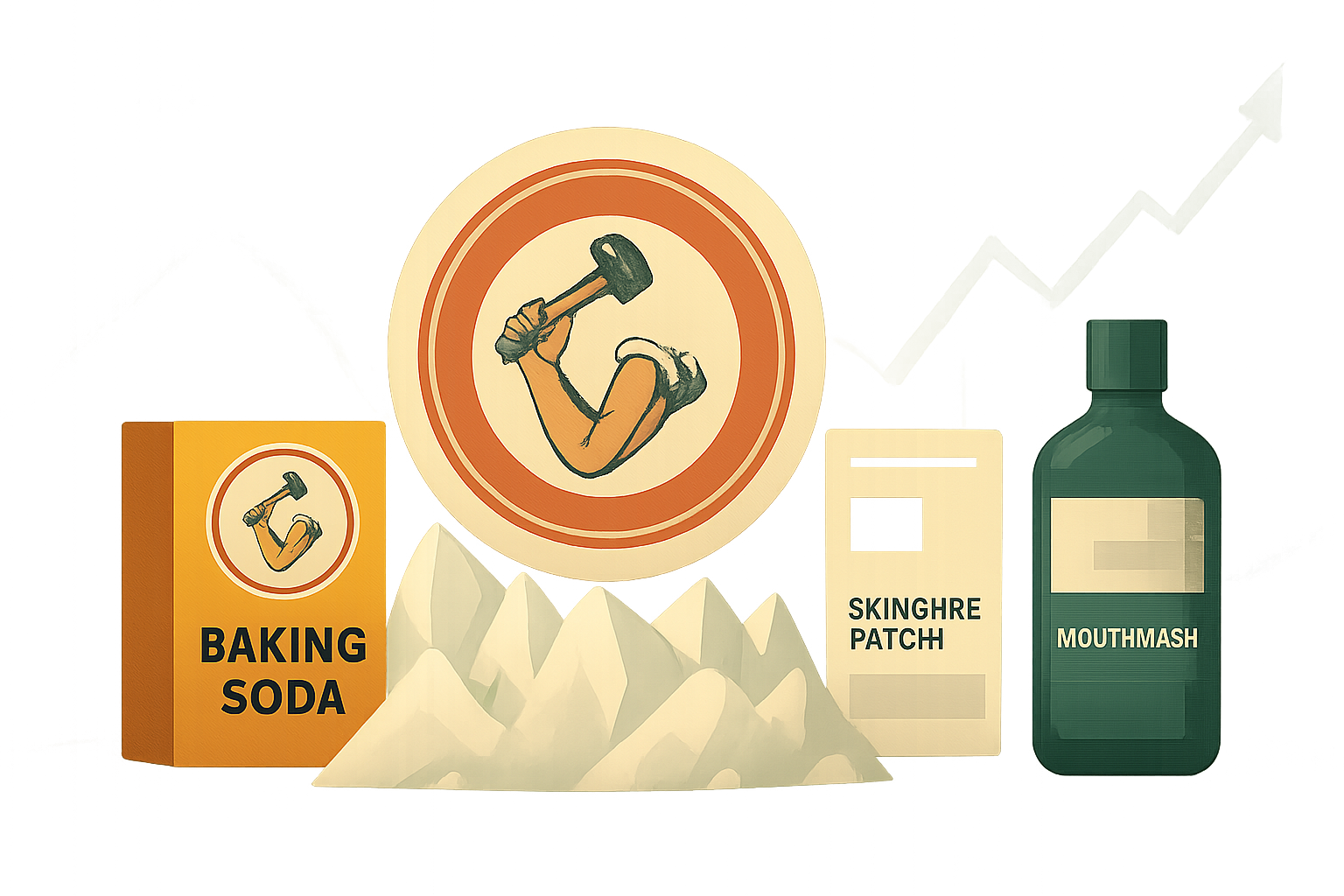
As of April 3, 2026, the global consumer landscape remains defined by a stark bifurcation. On one side, persistent price sensitivity drives consumers toward value; on the other, a burgeoning "wellness-prestige" segment continues to spend on high-efficacy personal care. Standing at the intersection of these two worlds is Church & Dwight Co., Inc. (NYSE: CHD).
Historically known for its iconic Arm & Hammer baking soda, Church & Dwight has undergone a quiet but radical transformation over the last two decades. No longer just a commodity chemical firm, it has evolved into a sophisticated brand incubator. By April 2026, CHD has solidified its position as a "defensive growth" leader, successfully navigating the post-inflationary environment of 2024 and 2025 through a strategy of aggressive portfolio pruning and the acquisition of high-growth, social-media-savvy brands like Hero Cosmetics and Touchland. This article explores the mechanics of this consumer staples giant and whether its "premium" valuation remains justified for long-term investors.
Historical Background
The story of Church & Dwight begins in 1846, when John Dwight and Dr. Austin Church began packaging and selling sodium bicarbonate (baking soda) in Dwight’s kitchen. By the late 19th century, their "Arm & Hammer" brand had become a household staple across America. For over a century, the company operated as a reliable, if somewhat unexciting, commodity business focused on the versatile uses of baking soda—from baking to cleaning.
The modern era of Church & Dwight was ushered in by a pivot toward a multi-brand strategy starting in 2001. Under the leadership of successive management teams, the company realized that its core competency was not just chemistry, but the ability to manage "under-loved" or niche brands. This led to a string of strategic acquisitions, including Trojan (2001), OxiClean (2006), WaterPik (2017), and TheraBreath (2021). By early 2026, the company’s history is best defined by its "Evergreen Model"—a disciplined approach to M&A that prioritizes brands with #1 or #2 market positions in categories that larger rivals like Procter & Gamble (NYSE: PG) might overlook.
Business Model
Church & Dwight operates an "asset-light" business model centered on its 14 Power Brands, which account for approximately 85% of its total revenue. The company’s revenue is diversified across three primary segments:
- Consumer Domestic (~76% of Revenue): This is the core engine, encompassing household products (laundry detergent, cat litter) and personal care (condoms, oral care, skin care).
- Consumer International (~18% of Revenue): This segment is the primary growth lever for 2026, as CHD scales its newer acquisitions into European and Asian markets.
- Specialty Products (~6% of Revenue): A specialized division that leverages the company’s sodium bicarbonate expertise for industrial and animal nutrition applications.
The brilliance of the CHD model lies in its Value-to-Premium Bridge. When the economy slows, consumers trade down to the value-priced Arm & Hammer laundry detergent. When consumers feel flush, they spend on premium offerings like Hero Cosmetics’ "Mighty Patch" or TheraBreath mouthwash. This "heads-I-win, tails-I-win" positioning provides a rare level of revenue stability.
Stock Performance Overview
Over the last decade, Church & Dwight has been a standout performer in the Consumer Staples (XLP) sector.
- 10-Year Performance: CHD has consistently outperformed the broader S&P 500 Consumer Staples index, driven by steady earnings growth and a relentless focus on shareholder returns.
- 5-Year Performance: The stock saw significant volatility during the 2022 inflationary spike but recovered strongly in 2024 and 2025 as gross margins expanded following the divestiture of its struggling Vitamin (VMS) business.
- 1-Year Performance (2025-2026): In the past 12 months, the stock has traded in the $93–$105 range. It recently touched new highs in early 2026 as investors rewarded the successful integration of the Touchland acquisition and the company's 30th consecutive year of dividend increases.
Financial Performance
In its most recent reporting cycles leading into April 2026, Church & Dwight has demonstrated a robust financial profile.
- Revenue Growth: 2025 revenue reached approximately $6.2 billion. While headline growth was tempered by the divestiture of the Flawless and Vitamin divisions, organic growth remained healthy at 3.5%.
- Margins: A key story for 2026 is the expansion of gross margins to roughly 45.5%. By shedding low-margin, high-complexity businesses like the WaterPik showerhead and vitamin lines, management has focused on "higher-octane" personal care products.
- Debt and Liquidity: The company maintains a conservative leverage ratio, with total debt at approximately $2.4 billion. Its high free cash flow conversion (typically over 100% of net income) allows it to pay down acquisition debt rapidly.
- Valuation: CHD currently trades at a forward P/E of ~31x. While this is a premium compared to its peers, bulls argue it is a "consistency premium" for a company that rarely misses earnings targets.
Leadership and Management
The leadership narrative in 2026 is focused on Rick Dierker, who succeeded long-time CEO Matthew Farrell in March 2025. Dierker, formerly the CFO, has spent his first year at the helm executing a "portfolio refinement" strategy.
The transition has been viewed as seamless by the street, as Dierker was the architect of many of the company’s recent financial successes. His strategy emphasizes "Total Shareholder Return" (TSR), combining modest organic growth, margin expansion, and opportunistic M&A. The governance reputation of Church & Dwight remains high, characterized by a disciplined, no-nonsense corporate culture that prioritizes cash flow over "vanity" metrics.
Products, Services, and Innovations
Innovation at CHD is less about lab-based breakthroughs and more about consumer-centric adaptation.
- Hero Cosmetics: Since its acquisition in 2022, Hero has been the crown jewel. In 2026, CHD has successfully moved the brand beyond acne patches into a full-suite Gen Z skincare line.
- TheraBreath: This brand has revolutionized the "premium oral care" aisle, with new clinical-strength formulations introduced in late 2025 that have captured market share from traditional antiseptic rinses.
- Arm & Hammer "Green" Initiatives: Innovation in laundry has focused on concentrated "Power Sheets," reducing plastic waste and appealing to the eco-conscious 2026 consumer.
- Touchland: Acquired in 2025, this premium hand-sanitizer brand has been integrated into CHD’s distribution network, expanding its presence from high-end boutiques to mainstream retailers like Target and Ulta.
Competitive Landscape
Church & Dwight operates in an environment dominated by titans. However, its competitive advantage lies in its "Niche Dominance" strategy.
- Vs. Procter & Gamble (NYSE: PG): While P&G dominates the premium laundry market with Tide, CHD’s Arm & Hammer is the undisputed "Value" king. This prevents CHD from being crushed in price wars.
- Vs. The Clorox Company (NYSE: CLX): CHD has shown better supply chain resilience than Clorox over the past three years, allowing it to gain permanent shelf space in categories like cat litter and cleaning.
- Weaknesses: CHD’s smaller scale compared to global conglomerates means it has less bargaining power with giant retailers like Walmart (NYSE: WMT), and it lacks the massive R&D budgets of its larger peers.
Industry and Market Trends
Three key trends are shaping CHD’s trajectory in 2026:
- Premiumization of Personal Care: Consumers are increasingly viewing skincare and oral hygiene as "affordable luxuries." CHD’s pivot toward Hero and TheraBreath perfectly captures this trend.
- The "DTC-to-Retail" Pipeline: CHD has perfected the art of taking digitally native brands (like Hero and Touchland) and scaling them through traditional retail distribution.
- E-commerce Maturity: As of 2026, nearly 24% of CHD’s sales occur online. The company’s products—often heavy or bulky like cat litter and laundry detergent—have become staples of "subscription" shopping models.
Risks and Challenges
Despite its strengths, Church & Dwight faces several headwinds:
- Valuation Risk: Trading at 31x earnings leaves little room for error. Any slowdown in organic volume growth could lead to a significant price correction.
- Integration Risk: While the company is an M&A specialist, the 2025 divestitures and the 2026 push into international markets carry execution risks.
- Commodity Volatility: As a major buyer of resins and chemicals for packaging and product formulas, any resurgence in raw material inflation could squeeze margins.
- Competition in Skincare: The "acne patch" market is becoming crowded as private labels and competitors launch their own versions of the Hero Mighty Patch.
Opportunities and Catalysts
- International Scaling: The most significant near-term catalyst is the global rollout of Hero and TheraBreath. These brands currently have much lower penetration outside the US than legacy brands like Arm & Hammer.
- Further M&A: With a strengthened balance sheet post-divestiture, CHD is rumored to be looking for another "Power Brand" acquisition in 2026, likely in the "clean beauty" or "home wellness" space.
- Margin Accretion: As the company finishes exiting lower-margin legacy businesses, the overall margin profile of the company is expected to shift higher, potentially leading to earnings beats in the second half of 2026.
Investor Sentiment and Analyst Coverage
Wall Street sentiment on CHD remains cautiously optimistic. As of April 2026, the consensus rating is a "Moderate Buy."
- Institutional Support: The stock remains a favorite of "Quality" and "Low Volatility" institutional funds.
- Retail Sentiment: CHD is often overlooked by retail "meme" traders, but it has a loyal following among dividend-growth investors who appreciate its 30-year track record of raises.
- Analyst View: Many analysts have raised price targets to the $105–$115 range, citing the "cleaner" post-divestiture portfolio as a primary reason for multiple expansion.
Regulatory, Policy, and Geopolitical Factors
- Environmental Regulations: In 2026, new regulations regarding "forever chemicals" (PFAS) and plastic packaging are a focus. CHD’s move toward laundry sheets and recycled packaging is a proactive response to these tightening standards.
- Geopolitical Stability: Unlike rivals with massive manufacturing footprints in China, CHD’s domestic focus (76% of sales) shields it from much of the current US-China trade friction.
- Healthcare Policy: Regulatory scrutiny on health claims in the "Wellness" sector remains a risk, though the divestiture of the Vitamin business has mitigated this exposure significantly.
Conclusion
By April 2026, Church & Dwight Co., Inc. has effectively shed its "boring baking soda" image to become a high-performance brand steward. Through disciplined M&A and a ruthless focus on high-margin niches, the company has created a resilient portfolio that thrives in both inflationary and deflationary environments.
For the conservative investor, CHD offers a rare combination of defensive stability and "hidden" growth potential through its skincare and international expansion. While the high valuation requires a "pay for quality" mindset, the company’s 30-year history of dividend growth and its successful leadership transition suggest that it remains a core holding for those seeking reliable compounding in an uncertain world. Investors should watch the upcoming Q2 2026 earnings for confirmation that the "Touchland" integration and the "Hero" international rollout are proceeding as planned.
This content is intended for informational purposes only and is not financial advice.