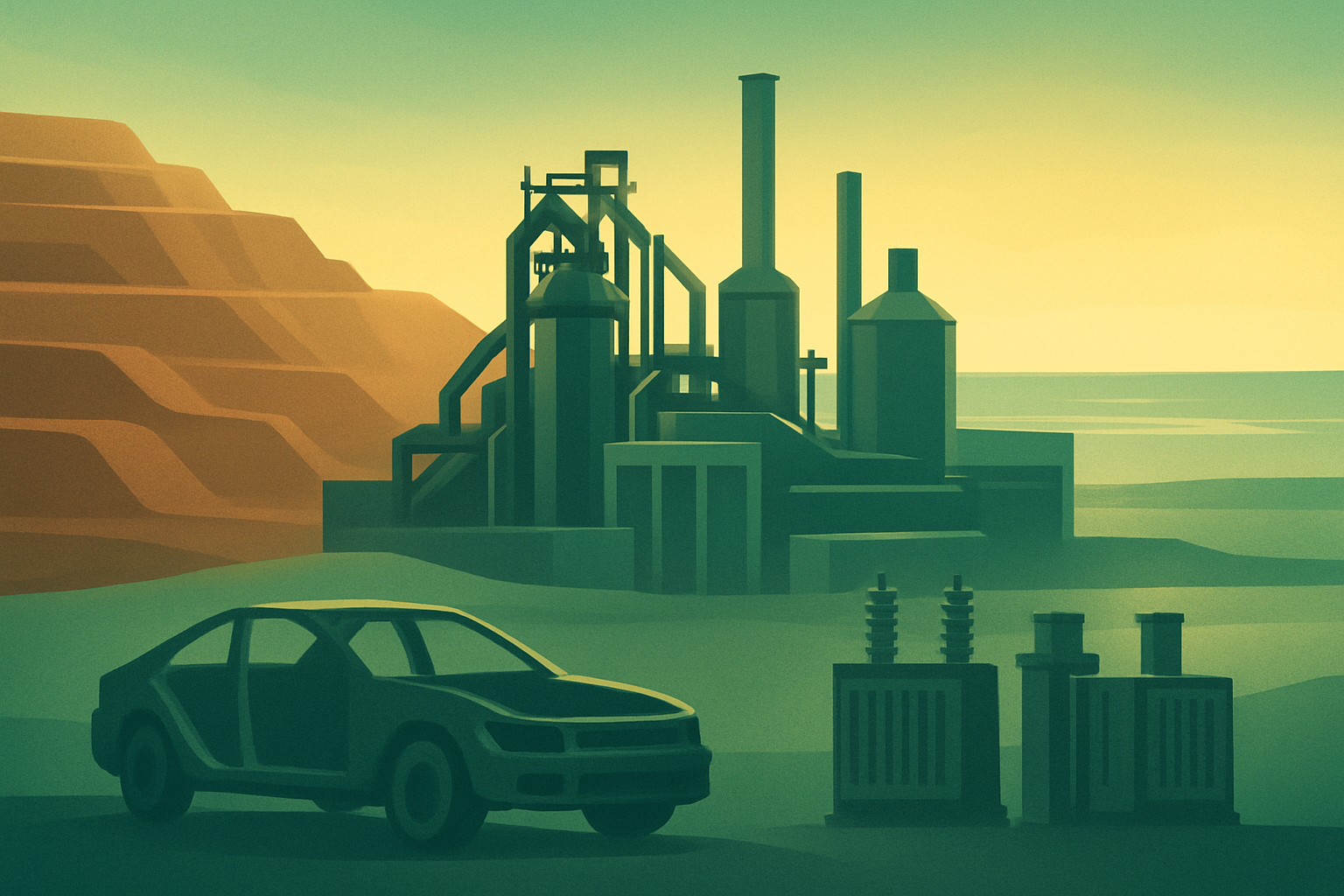
As of February 10, 2026, Cleveland-Cliffs Inc. (NYSE: CLF) stands as a titan of the North American industrial landscape. Once a merchant iron ore miner, the company has completed a decade-long metamorphosis into the continent’s largest producer of flat-rolled steel and its leading supplier to the automotive industry. Today, Cleveland-Cliffs is in sharp focus for investors as it emerges from a challenging "reset year" in 2025, buoyed by strategic partnerships and a "Fortress America" trade environment that has fundamentally reshaped the domestic steel market.
The company's relevance in 2026 is driven by its unique vertical integration—owning the process from the iron ore mine to the finished steel coil—and its aggressive stance on trade protectionism. With the global steel industry grappling with decarbonization and the shifting alliances of major players like United States Steel (NYSE: X) and Nippon Steel (OTC: NPSCY), Cleveland-Cliffs remains a bellwether for American manufacturing and a controversial, yet undeniable, leader in industrial strategy.
Historical Background
Founded in 1847, Cleveland-Cliffs’ history is synonymous with the industrialization of the United States. For over 170 years, it operated primarily as a merchant iron ore producer, supplying the blast furnaces of the Great Lakes region. However, the 21st century brought existential threats as the domestic steel industry consolidated and global competition intensified.
The modern era of the company began in 2014 with the appointment of Lourenco Goncalves as Chairman and CEO. Goncalves initiated a radical transformation, moving away from international ventures and doubling down on North American assets. The most pivotal moments occurred in 2020, when Cliffs acquired AK Steel for $1.1 billion and the U.S. assets of ArcelorMittal (NYSE: MT) for $1.4 billion. These moves turned a mining company into an integrated steel giant overnight.
In late 2024, the company further expanded its empire by acquiring the Canadian steelmaker Stelco Holdings Inc. for $2.5 billion. This acquisition secured Cliffs’ dominance in the Great Lakes basin and added significant low-cost capacity, marking the final major piece of the vertical integration puzzle that Goncalves envisioned over a decade ago.
Business Model
Cleveland-Cliffs operates an "integrated" business model that distinguishes it from its primary "mini-mill" competitors. While rivals like Nucor Corporation (NYSE: NUE) and Steel Dynamics, Inc. (NASDAQ: STLD) primarily use electric arc furnaces (EAFs) to melt scrap metal, Cliffs relies on a hybrid approach centered around its own iron ore pellets and Hot Briquetted Iron (HBI).
The company’s revenue is primarily derived from four key segments:
- Steelmaking: Producing flat-rolled products, including hot-rolled, cold-rolled, and coated steel.
- Automotive: Cliffs is the largest supplier of steel to the North American auto sector, providing advanced high-strength steels (AHSS) for vehicle frames and bodies.
- Iron Ore: Self-sufficient mining operations that produce taconite pellets for its own blast furnaces.
- Raw Materials & Scrap: Through its ownership of Ferrous Processing and Trading (FPT), Cliffs controls a significant portion of the prime scrap supply in the U.S.
This "mine-to-mill" model allows the company to capture margins at every stage of production and provides a buffer against the volatility of external raw material prices.
Stock Performance Overview
Over the last decade, CLF has been a roller-coaster for shareholders, reflecting both the cyclical nature of steel and the high-stakes maneuvers of its management.
- 10-Year View: From 2016 to 2026, the stock has significantly outperformed its early lows during the commodity crash, driven by the massive expansion of the company’s asset base.
- 5-Year View: The stock saw a meteoric rise in 2021-2022, peaking near $30 as post-pandemic demand soared. However, 2023 and 2024 were periods of stagnation and volatility as the company unsuccessfully bid for U.S. Steel and faced rising interest rates.
- 1-Year View: The stock hit a multi-year low of $5.63 in May 2025 due to record-high steel imports and a "value-destructive" legacy contract. However, since the start of 2026, the stock has rebounded sharply, currently trading around $14.73, fueled by a new strategic alliance with South Korean giant POSCO (NYSE: PKX) and improved pricing power.
Financial Performance
The financial narrative of 2025 was one of "bottoming out." Cleveland-Cliffs reported a GAAP net loss of $1.4 billion for the full year 2025, following a $708 million loss in 2024. These losses were primarily attributed to the expiration of lucrative pandemic-era contracts and a surge in low-priced imports that depressed the Hot-Rolled Coil (HRC) index.
However, the outlook for 2026 is markedly different. Management has issued guidance for shipments between 16.5 million and 17.0 million net tons. The termination of a low-margin slab supply contract with ArcelorMittal in late 2025 is expected to add $500 million to EBITDA in 2026 by allowing Cliffs to sell finished steel instead of raw slabs.
Furthermore, the company has aggressively reduced its net debt, which spiked following the Stelco acquisition. As of February 2026, Cliffs is focused on using free cash flow for share buybacks, signaling a pivot from growth-by-acquisition to returning value to shareholders.
Leadership and Management
CEO Lourenco Goncalves remains the central figure in the Cleveland-Cliffs story. Known for his combative earnings calls and fierce "Buy American" advocacy, Goncalves has cultivated a reputation as a protector of domestic manufacturing. His strategy has focused on three pillars: vertical integration, debt discipline (post-merger), and maintaining a strong relationship with the United Steelworkers (USW) union.
In early 2026, Goncalves secured a landmark strategic alliance with POSCO. This deal, which involves POSCO taking a 10% minority stake in Cliffs for approximately $700 million, provides Cliffs with access to advanced coating technologies and a stable partner in the global market. This move is seen as a masterstroke of diplomacy, balancing foreign investment with Cliffs’ domestic-first mandate.
Products, Services, and Innovations
Innovation at Cleveland-Cliffs is currently focused on two high-growth areas:
- Electrical Steels: With the ongoing expansion of the U.S. electrical grid and the proliferation of data centers, demand for Grain-Oriented Electrical Steel (GOES) and Non-Oriented Electrical Steel (NOES) for transformers and EV motors has reached record levels. Cliffs is the only North American producer of these specialized steels.
- Green Steel & HBI: The company’s HBI plant in Toledo, Ohio, allows it to produce "cleaner" steel by using natural gas to reduce iron ore, significantly lowering the carbon footprint compared to traditional coal-based coke production. This is a key competitive edge as automakers look to decarbonize their supply chains.
Competitive Landscape
The North American steel market is essentially a triopoly between Cleveland-Cliffs, Nucor, and the now-combined entity of Nippon Steel and U.S. Steel.
- VS. Nucor (NYSE: NUE): Nucor remains the efficiency leader with its EAF-based model. However, Cliffs maintains an advantage in the high-end automotive and electrical steel markets, where blast furnace purity is often preferred.
- VS. Nippon/U.S. Steel: The 2025 finalization of Nippon Steel’s acquisition of U.S. Steel has created a formidable global competitor. However, Cliffs has positioned itself as the "pure-play" American champion, often using its domestic status to win government-linked infrastructure contracts.
Industry and Market Trends
The "Fortress America" trend is the dominant macro driver in 2026. Following years of trade friction, Section 232 tariffs on many imported steel products have reached 50%. This has created a domestic price floor, with HRC prices stabilizing above $900 per ton.
Additionally, the "reshoring" boom—where manufacturers move production back to North America to avoid supply chain disruptions—has provided a steady tailwind for domestic steel demand. The growth of the electric vehicle (EV) market and the ongoing implementation of the Bipartisan Infrastructure Law continue to absorb the company’s specialized output.
Risks and Challenges
Despite the current optimism, Cleveland-Cliffs faces significant risks:
- Labor Costs: As a heavily unionized shop, the company is susceptible to rising labor costs. Its partnership with the USW is a strength but also a source of fixed-cost pressure that EAF competitors do not face to the same degree.
- Decarbonization Capital Expenditure: Transitioning older blast furnaces to more sustainable technologies requires massive capital investment. While the HBI plant is a head start, the long-term cost of "Green Steel" remains an overhang.
- Economic Sensitivity: Steel remains a cyclical industry. Any slowdown in the automotive sector or a housing market crash would immediately impact Cliffs’ bottom line.
Opportunities and Catalysts
- The POSCO Synergy: The 2026 partnership is expected to lower R&D costs and provide a conduit for Cliffs to sell into Asian supply chains operating within North America.
- Data Center Expansion: The AI-driven data center boom requires a massive amount of electrical steel for power infrastructure. As the sole domestic producer, Cliffs is uniquely positioned to capture this high-margin market.
- Capital Allocation: With major M&A likely paused, the potential for a "massive" share buyback program in the second half of 2026 is a significant catalyst for stock price appreciation.
Investor Sentiment and Analyst Coverage
Analyst sentiment has turned bullish in early 2026. Following the 2025 slump, several major banks, including Morgan Stanley and Goldman Sachs, have upgraded CLF to "Overweight." The consensus is that the company has finally "cleansed" its balance sheet and is now a cash-flow machine in a protected trade environment.
Institutional ownership remains high, though some ESG-focused funds remain cautious due to the carbon intensity of integrated steelmaking. Among retail investors, Goncalves has a cult-like following, often referred to as a "CEO who fights for his shareholders."
Regulatory, Policy, and Geopolitical Factors
The regulatory environment in 2026 is highly favorable for Cleveland-Cliffs. The U.S. government’s stance on trade has shifted toward a permanent "Buy American" framework. Furthermore, the national security agreement governing the Nippon-U.S. Steel deal has limited the ability of foreign-owned domestic assets to compete on price, effectively giving Cleveland-Cliffs more breathing room.
However, stricter EPA regulations regarding air quality and carbon emissions continue to pose a compliance challenge. The company’s ability to secure government subsidies for its decarbonization projects will be a critical factor in its 2027-2030 strategy.
Conclusion
Cleveland-Cliffs Inc. is a company that has successfully navigated the "Valley of Death" of 2025 to emerge as a leaner, more strategically aligned organization in 2026. The acquisition of Stelco and the partnership with POSCO have solidified its market position, while the termination of low-margin contracts has set the stage for a dramatic financial recovery.
For investors, CLF represents a high-conviction play on the continued "reshoring" of the American economy and the build-out of the electrical grid. While its cyclical nature and labor-heavy cost structure require a high risk tolerance, the company’s vertical integration and leadership under Lourenco Goncalves provide a defensive moat that few peers can match. As the 2026 "rebound year" unfolds, the key metrics to watch will be HRC price stability and the pace of debt reduction.
This content is intended for informational purposes only and is not financial advice.