Tag: Consumer Staples

  • Sweet Recovery: Why Hershey (HSY) Surged 9% and What it Means for 2026

    Sweet Recovery: Why Hershey (HSY) Surged 9% and What it Means for 2026

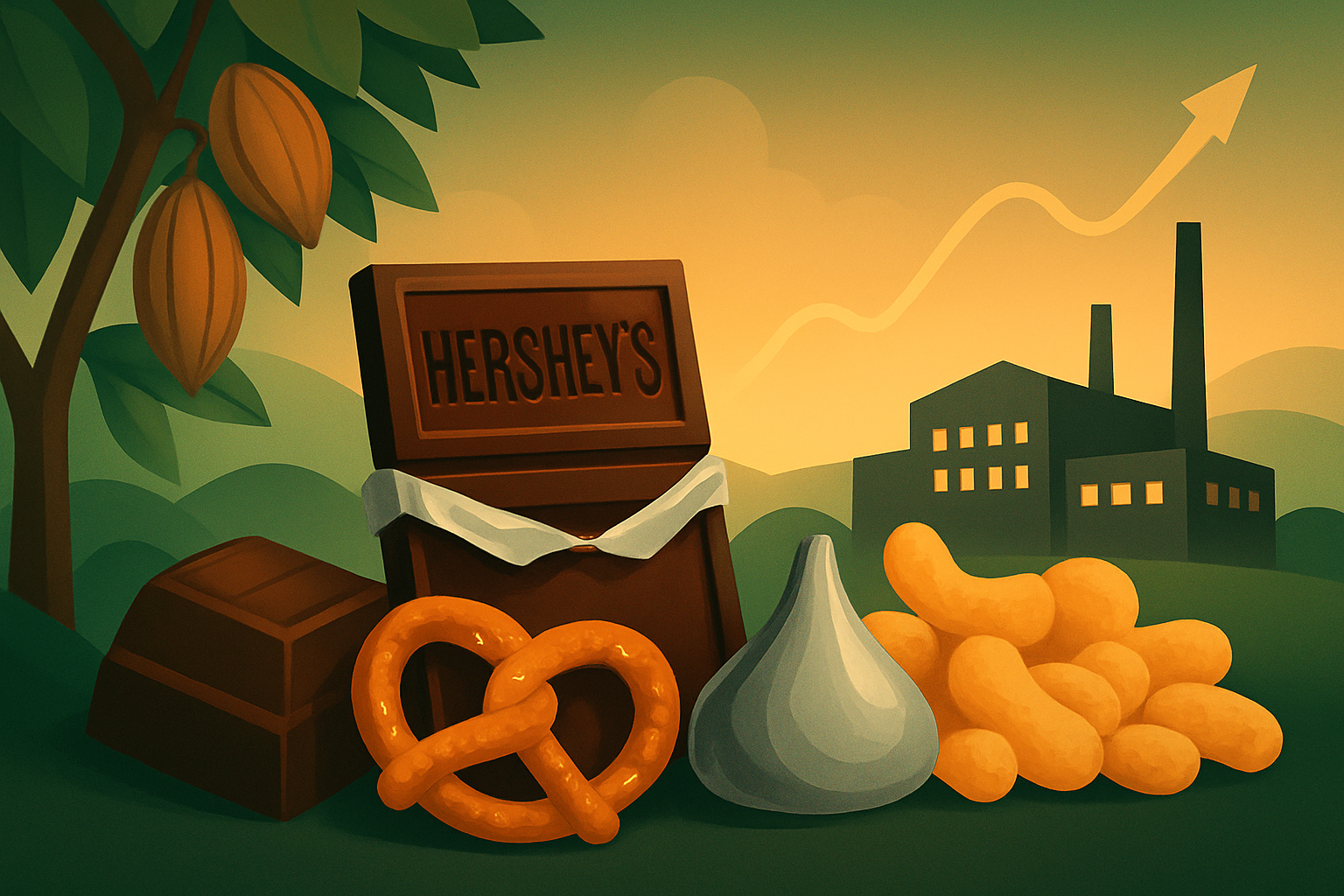
    On February 6, 2026, the global consumer staples market is buzzing with a singular name: The Hershey Company (NYSE: HSY). Following its fiscal results reported yesterday, the legendary chocolatier saw its stock price surge by over 9%, marking its most significant single-day gain in years. For a company often viewed as a "slow and steady" dividend play, such a jump suggests a profound shift in market sentiment.

    Hershey has spent the last two years navigating a "perfect storm" of record-high cocoa prices, shifting consumer health trends, and a leadership transition. However, the February 2026 earnings report signaled that the clouds are finally parting. With a massive earnings beat and an optimistic outlook for 2026, Hershey is proving that its pivot into a "Snacking Powerhouse" is not just a marketing slogan, but a robust financial reality.

    Historical Background

    The Hershey Company’s story is synonymous with the American Dream. Founded by Milton S. Hershey in 1894, the company began as the Hershey Chocolate Company, a subsidiary of his Lancaster Caramel Company. Milton’s vision was to make milk chocolate—then a luxury item—affordable for the masses. In 1903, he began construction of the world's largest chocolate manufacturing plant in Derry Township, Pennsylvania, which eventually became the town of Hershey.

    Throughout the 20th century, Hershey became a cultural icon. From the launch of the Hershey’s Kiss in 1907 to providing "Ration D" bars for soldiers in World War II, the company solidified its place in the American pantry. Over the decades, it evolved through strategic acquisitions, most notably the 1963 acquisition of the H.B. Reese Candy Company. In recent years, under the leadership of Michele Buck, the company underwent a "Great Transformation," diversifying beyond the candy aisle into salty snacks and "better-for-you" categories to ensure relevance in a health-conscious 21st century.

    Business Model

    Hershey’s business model is built on the pillars of brand equity, massive distribution scale, and manufacturing excellence. The company operates through three primary segments:

    1. North America Confectionery: This remains the crown jewel, accounting for the lion's share of revenue. It includes iconic brands like Hershey’s, Reese’s (the #1 candy brand in the U.S.), Kit Kat (under license), and Jolly Rancher.
    2. North America Salty Snacks: This is Hershey's high-growth engine. Through the acquisitions of Dot’s Homestyle Pretzels, SkinnyPop, and most recently LesserEvil (2025), Hershey has captured a significant portion of the "permissible indulgence" market.
    3. International: While smaller than its domestic business, this segment focuses on high-potential markets like Mexico, Brazil, and India, where the company is scaling its core brands to meet a rising global middle class.

    The company leverages a "hub-and-spoke" distribution model and is currently in the late stages of a massive digital transformation aimed at automating supply chains and optimizing retail shelf space through AI-driven analytics.

    Stock Performance Overview

    Over the last decade, HSY has been a hallmark of stability, though recent years have been volatile.

    • 10-Year Horizon: Investors have enjoyed a total return that generally outperformed the broader consumer staples sector, bolstered by consistent dividend growth.
    • 5-Year Horizon: The stock reached all-time highs in 2023 before a significant "cocoa correction" in 2024 and 2025 dragged the price down as commodity costs pressured margins.
    • 1-Year Horizon: Leading up to early 2026, the stock traded sideways as investors waited for evidence of margin recovery. The 9% jump on February 5, 2026, effectively erased a year of underperformance, pushing the stock back toward the $230 level.

    Financial Performance

    The Q4 2025 results were the primary catalyst for the recent stock surge. Hershey reported an Adjusted EPS of $1.71, crushing Wall Street’s expectations of $1.40.

    • Revenue Growth: Net sales rose 7.0% year-over-year to $3.09 billion, driven by price increases and a surprising resilience in volume.
    • Margins: Adjusted gross margins, which had dipped to the high 30s during the cocoa crisis, are projected to rebound to 41% in 2026.
    • Dividends: Demonstrating high confidence, the board announced a 6% increase in the quarterly dividend to $1.452 per share.
    • Debt: Total debt stands at approximately $5 billion, a manageable level (Debt-to-Equity ~1.24) that allows the company to continue its M&A strategy without over-leveraging.

    Leadership and Management

    Hershey is currently navigating a pivotal leadership transition. Michele Buck, the architect of the snacking powerhouse strategy and CEO since 2017, stepped down in August 2025. She remains a Senior Advisor through mid-2026.

    Taking the reins is Kirk Tanner, an industry veteran who previously held senior roles at PepsiCo and Wendy’s. Tanner’s appointment was seen as a strategic move to double down on the salty snacks and "impulse buy" channels. His focus on "operational excellence" and scaling the food-service side of the business has already begun to bear fruit, as evidenced by the efficient cost-cutting measures highlighted in the latest earnings call.

    Products, Services, and Innovations

    Innovation at Hershey is no longer just about new candy bar flavors. The company’s R&D pipeline is focused on three areas:

    1. Salty-Sweet Cross-overs: Products like Reese’s dipped pretzels and popcorn.
    2. Better-for-You (BFY): Expanding the Lily’s sweets brand (sugar-free) and LesserEvil popcorn to cater to health-conscious consumers and those on GLP-1 weight-loss medications.
    3. Packaging Innovation: Utilizing "seasonal" packaging and AI-driven shelf-ready designs to maximize visibility during holidays like Halloween and Easter, which account for a massive portion of annual sales.

    Competitive Landscape

    Hershey operates in a "land of giants." Its primary competitors include:

    • Mars, Inc.: A private behemoth that remains the global leader in chocolate. Mars has the advantage of a massive pet care business to offset food commodity swings.
    • Mondelez International (MDLZ): A fierce rival in the snacking space. Mondelez has a larger international footprint and a dominant position in biscuits (Oreo).
    • Ferrero Group: The Italian giant has been aggressively acquiring U.S. brands, challenging Hershey in the premium and "kid-focused" confectionery segments.

    Despite this, Hershey maintains a near 45% share of the U.S. chocolate market, a "moat" that is difficult for any competitor to breach.

    Industry and Market Trends

    The confectionery industry is currently defined by commodity deflation. After cocoa prices nearly tripled in 2024 due to supply shortages in West Africa, prices dropped 27% by early 2026. This "deflationary tailwind" is the single biggest factor driving Hershey’s 2026 guidance.

    Additionally, the rise of GLP-1 weight-loss drugs has forced the industry to adapt. Hershey has responded by pivoting toward "permissible indulgence"—smaller portion sizes and snack options that provide high flavor impact with lower caloric density.

    Risks and Challenges

    While the recent surge is positive, Hershey is not without risks:

    • Commodity Volatility: While cocoa prices have dropped, they remain higher than historical averages. Any further supply disruption in West Africa (Ivory Coast/Ghana) could squeeze margins again.
    • Health Trends: A long-term shift away from sugar remains a structural headwind for the core confectionery business.
    • Tariffs and Trade Policy: As an importer of sugar and cocoa, Hershey is sensitive to changes in U.S. trade policy and international tariffs.

    Opportunities and Catalysts

    The primary catalyst for the stock is the 2026 Guidance. Management projected adjusted EPS growth of 30–35% for the coming year.

    • M&A Potential: With a solid balance sheet, Hershey is widely expected to acquire more "Salty Snack" brands in 2026 to further diversify away from chocolate.
    • Digital Savings: The ongoing digital transformation is expected to unlock $300 million in annual savings by the end of 2026, which can be reinvested into brand building.

    Investor Sentiment and Analyst Coverage

    Wall Street has turned decidedly more bullish following the February report.

    • UBS raised its price target to $236, citing the "clearing of the clouds" regarding cocoa costs.
    • Goldman Sachs maintained a Buy rating, highlighting Kirk Tanner’s "refreshing focus on execution."
    • Institutional Sentiment: Large funds have begun rotating back into Hershey as a defensive play that now offers high-growth momentum.

    Regulatory, Policy, and Geopolitical Factors

    Geopolitical stability in West Africa is crucial for Hershey, as the region produces over 70% of the world's cocoa. Hershey has invested heavily in the "Cocoa For Good" program to address child labor and deforestation, partly to stay ahead of stricter European and U.S. supply chain regulations. Domestically, the company faces ongoing scrutiny regarding sugar content and labeling, requiring constant legal and compliance vigilance.

    Conclusion

    The 9% surge in Hershey’s stock on February 5, 2026, marks the end of a painful era of commodity-driven uncertainty and the beginning of a new chapter under CEO Kirk Tanner. By successfully integrating salty snacks and navigating a historic cocoa crisis, Hershey has proven the resilience of its brand and the agility of its business model.

    For investors, Hershey now represents a rare combination: a "Dividend King" with a 6% payout hike, and a "Momentum Play" with 30%+ projected earnings growth. While risks like sugar regulation and commodity swings remain, the "sweet spot" for Hershey appears to be back in 2026.


    This content is intended for informational purposes only and is not financial advice.

  • The Great Pivot: Kimberly-Clark’s High-Stakes Transformation in 2026

    The Great Pivot: Kimberly-Clark’s High-Stakes Transformation in 2026

    As of January 28, 2026, Kimberly-Clark Corporation (NYSE: KMB) stands at the most consequential crossroads in its 154-year history. Traditionally viewed as the "steady Eddie" of the consumer staples sector—a defensive powerhouse known for its Dividend King status and iconic brands like Huggies and Kleenex—the company is currently in the midst of a radical structural metamorphosis. Under the leadership of CEO Mike Hsu, Kimberly-Clark is shedding its legacy as a broad-based paper products company to become a high-margin, agile, pure-play personal care giant.

    This transition comes at a time of significant market volatility. While the broader S&P 500 has navigated the shifting tides of the mid-2020s, KMB has been an outlier of activity, recently reporting a surprise earnings beat for the fourth quarter of 2025 that has sent ripples through the analyst community. With a massive $40 billion-plus acquisition of Kenvue (the former consumer health division of Johnson & Johnson) looming and a strategic joint venture with Brazilian pulp titan Suzano finalized, Kimberly-Clark is no longer just a "diaper and tissue" stock—it is a transformation story that investors are watching with bated breath.

    Historical Background

    The origins of Kimberly-Clark trace back to 1872 in Neenah, Wisconsin. Founded by John A. Kimberly, Charles B. Clark, Joseph Babcock, and Franklyn C. Shattuck, the company began as a small regional paper mill. However, its trajectory changed forever during World War I. The company’s scientists developed Cellucotton, a creped cellulose wadding that was five times more absorbent than cotton and significantly cheaper. Used as surgical bandages on the front lines, Cellucotton laid the foundation for the company’s consumer-facing future.

    In 1920, utilizing surplus material from the war, Kimberly-Clark launched Kotex, the first disposable feminine hygiene product. Four years later, it introduced Kleenex facial tissue. Originally marketed as a way to remove cold cream, the brand became a cultural phenomenon when consumers began using it as a disposable handkerchief. By 1929, the company was public on the New York Stock Exchange.

    The latter half of the 20th century was defined by the introduction of Huggies in 1978, which revolutionized the diaper market with its patented "hourglass" shape, and the 1995 acquisition of Scott Paper Company for $9.4 billion. This move cemented Kimberly-Clark as a leader in both consumer tissue and personal care, a dual-engine model that lasted until the current "Powering Care" era.

    Business Model

    Kimberly-Clark’s business model is currently undergoing a structural "de-risking" and simplification. Historically, the company operated through three segments:

    1. Personal Care: Includes Huggies, Pull-Ups, Kotex, and Depend.
    2. Consumer Tissue: Includes Kleenex, Scott, and Cottonelle.
    3. K-C Professional: Focusing on workplace solutions (wipers, soaps, and dispensers).

    In 2026, the company is pivoting toward a "Pure-Play Personal Care" model. By forming a $3.4 billion joint venture with Suzano (the world’s largest hardwood pulp producer), Kimberly-Clark has deconsolidated a large portion of its International Family Care business. This strategic move allows the company to offload the volatile commodity risks associated with pulp production while retaining a 49% stake in the profits.

    Revenue is now increasingly concentrated in high-margin, non-discretionary personal care products in North America and emerging markets like China and Latin America. The pending acquisition of Kenvue is expected to further tilt the model toward health-related consumer products, effectively making Kimberly-Clark a hybrid of a consumer staples firm and a healthcare auxiliary.

    Stock Performance Overview

    The last 12 to 24 months have been a roller-coaster for KMB shareholders:

    • 1-Year Performance: Throughout 2025, the stock was a victim of its own transition. After hitting an all-time high of $142.87 in March 2025, the share price underwent a sharp correction, falling nearly 23% to end the year near $100.89. This was largely due to investor anxiety regarding the complexity of the Suzano JV and the potential debt burden of the Kenvue acquisition.
    • 5-Year and 10-Year Performance: On a long-term basis, KMB has lagged behind the broader market (S&P 500) but has outperformed many peers in the consumer staples index during periods of high inflation. Its 5-year CAGR remains modest, reflecting its "defensive" nature rather than high-growth characteristics.
    • Recent Movement: Following the Q4 2025 earnings release on January 27, 2026, the stock has shown signs of life, recovering to the $101–$102 range as of today. The market appears to be rewarding the company's shift from "price-led" growth to "volume-led" growth.

    Financial Performance

    Kimberly-Clark’s fiscal year 2025 results, released yesterday, indicate that the "Powering Care" strategy is beginning to bear fruit:

    • Revenue: Full-year net sales reached $16.4 billion, a slight reported decline of 2.1% due to divestitures of the PPE business. However, organic sales grew 1.7%, fueled by a 2.5% increase in volume and mix.
    • Profitability: Adjusted EPS for 2025 came in at $7.53, up 3.2% year-over-year. Most impressively, the Q4 adjusted EPS of $1.86 beat the Wall Street consensus of $1.81.
    • Margins: Adjusted gross margins improved to 37.0% in late 2025, driven by a massive 7.2% productivity saving (via the FORCE program).
    • Dividend: Kimberly-Clark remains a Dividend King, having raised its dividend for 53 consecutive years. The current yield hovers around 4.8%, making it a top pick for income-seeking investors.

    Leadership and Management

    Mike Hsu, Chairman and CEO, is the architect of the current transformation. Since taking the helm, Hsu has been vocal about moving away from the "cost-cutting only" mindset of his predecessors. His strategy focuses on:

    • Agility: Breaking the company into three streamlined business segments.
    • Innovation: Using digital tools and AI to optimize manufacturing and consumer insights.
    • Portfolio Re-shaping: The bold Kenvue and Suzano deals define his legacy.

    Hsu’s management team is generally well-regarded for their transparency, though some analysts have criticized the timing of the Kenvue deal, citing high interest rates as a headwind for the necessary debt financing.

    Products, Services, and Innovations

    Innovation in 2026 is centered on "Skin Health" and "Sustainability."

    • Huggies & Goodnites: The company has successfully launched "Skin Health" tiers, partnering with high-profile figures like NBA star Giannis Antetokounmpo to market premium diapers that prevent irritation.
    • Digital Transformation: KMB is now utilizing advanced data analytics to predict when parents will need their next diaper subscription, boosting e-commerce loyalty.
    • Sustainable Fibers: At its Loudon, Tennessee facility, the company has pioneered recycled fiber technologies that have allowed the Scott brand to maintain its value position while meeting new environmental standards.

    Competitive Landscape

    Kimberly-Clark remains locked in a perpetual battle with Procter & Gamble (NYSE: PG).

    • Volume Battle: In 2025, KMB managed to grow volumes by 2.5%, whereas P&G struggled with flat-to-negative volumes as consumers resisted price hikes.
    • Market Share: While Pampers (P&G) still leads the North American diaper market with ~44% share, Huggies (KMB) has clawed back territory, reaching approximately 37% share as of early 2026.
    • Private Label: The decision to exit private-label diaper manufacturing has allowed KMB to focus solely on its premium brands, though it leaves the "value" end of the market open to smaller, nimble competitors.

    Industry and Market Trends

    The consumer staples sector in 2026 is defined by:

    1. Volume Recovery: After years of price-driven growth (due to post-COVID inflation), consumers are now looking for "value" through larger pack sizes and tiered pricing.
    2. Health-Staple Convergence: The line between a cleaning product and a health product is blurring, which is the primary driver behind the Kenvue merger.
    3. Digital-First Retail: E-commerce now accounts for over 20% of Kimberly-Clark’s sales in key markets.

    Risks and Challenges

    • Debt and Integration: The Kenvue acquisition is a "bet the farm" move. Integrating a $40 billion business while carrying significant debt in a mid-interest-rate environment is a major execution risk.
    • PFAS Litigation: KMB faces ongoing legal challenges regarding "forever chemicals." A significant class-action lawsuit in Connecticut regarding legacy manufacturing could result in billion-dollar settlements.
    • Demographics: Declining birth rates in developed markets and China continue to put long-term pressure on the diaper (Personal Care) segment.

    Opportunities and Catalysts

    • The Kenvue Synergy: If successfully integrated, Kenvue provides KMB with world-class R&D in skin health and a massive footprint in the OTC (over-the-counter) medicine market.
    • Emerging Market Personal Care: As middle-class populations grow in Latin America and Southeast Asia, the adoption of premium diapers and feminine care products offers a decades-long growth runway.
    • Suzano JV Closing: The final regulatory approval of the Suzano JV in mid-2026 will serve as a major catalyst, potentially freeing up cash flow for debt reduction or share buybacks.

    Investor Sentiment and Analyst Coverage

    The consensus on Wall Street is currently a "Hold."

    • The Bulls: Argue that KMB is undervalued at its current $101 price point, with a median price target of $136.78 (representing ~34% upside). They see the Suzano JV as a masterstroke in margin protection.
    • The Bears: Are concerned about the "structural fragility" of the pulp supply chain and the complexity of the Kenvue integration.
    • Institutional Activity: Major hedge funds have slightly increased their positions in early 2026, viewing the Q4 volume growth as a sign that the company has finally found its footing in the "new normal" economy.

    Regulatory, Policy, and Geopolitical Factors

    • EU Packaging and Packaging Waste Directive (PPWD): Effective August 2026, this law will require KMB to fund the recycling costs of its packaging across the EU, putting pressure on European margins.
    • EUDR (Deforestation Regulation): Starting in early 2026, KMB must prove all pulp imported into the EU is "deforestation-free." This adds an administrative burden to their Brazilian supply chain.
    • Geopolitics: Trade friction between the U.S. and Brazil could potentially impact the cost of pulp, though the Suzano JV is designed to mitigate these fluctuations through localized profit sharing.

    Conclusion

    Kimberly-Clark is no longer the predictable, slow-moving company it was a decade ago. It is a business in the middle of a high-stakes pivot. The recent Q4 2025 earnings beat proves that the core brands—Huggies, Kleenex, and Scott—remain incredibly resilient and are capable of driving volume growth even in a saturated market.

    However, the road ahead is fraught with "integration risk." The acquisition of Kenvue and the divestiture of international tissue assets are massive shifts that will take years to fully digest. For the income-focused investor, KMB’s 4.8% yield and 53-year dividend growth streak remain a beacon of safety. For the growth-oriented investor, the "new" Kimberly-Clark offers a unique opportunity to own a pure-play personal care leader at a transitional valuation. Investors should keep a close eye on the mid-2026 closure of the Suzano deal and the progress of the Kenvue integration as the primary barometers for the stock’s future performance.


    This content is intended for informational purposes only and is not financial advice.