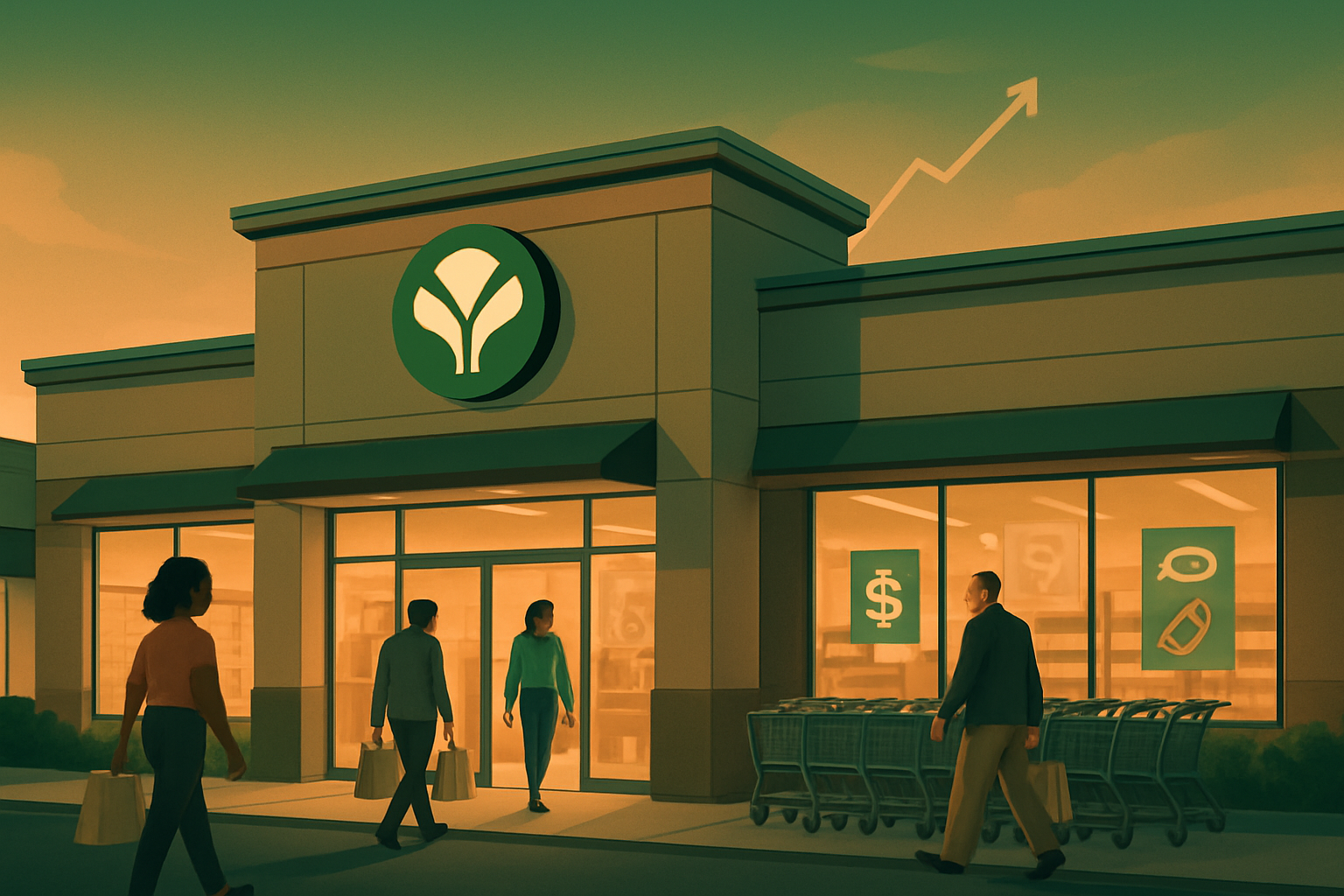
As of March 20, 2026, the retail landscape has undergone a seismic shift, and few companies embody this transformation more than Dollar Tree, Inc. (NASDAQ: DLTR). Once tethered to a struggling subsidiary and a rigid $1.00 price point, the Chesapeake, Virginia-based retailer has emerged in 2026 as a leaner, multi-price "pure-play" powerhouse. Following the landmark divestiture of the Family Dollar banner in late 2025, Dollar Tree has refocused its identity, successfully courting a higher-income demographic while maintaining its core value proposition. This feature explores the strategic pivot that saved the company from a multi-year slump and what the "New Dollar Tree" means for investors today.
Historical Background
The story of Dollar Tree is a classic tale of American retail evolution. Founded in 1986 by K.R. Perry, Doug Perry, and Macon Brock as "Only $1.00," the company initially focused on a simple, fixed-price model that resonated deeply with bargain hunters. By the early 2000s, it had grown into a national chain, eventually acquiring competitors like Deal$ and Dollar Giant.
However, the most significant inflection point occurred in 2015, when Dollar Tree acquired Family Dollar for $8.5 billion. The merger was intended to create a retail giant capable of rivaling Dollar General (NYSE: DG) and Walmart (NYSE: WMT). Instead, it became a decade-long anchor. While the Dollar Tree banner remained profitable and beloved, the Family Dollar segment struggled with dilapidated stores, supply chain inefficiencies, and intense competition in rural markets. After years of activist pressure and management turnover, the "merger of equals" was officially dismantled in July 2025 when the Family Dollar business was sold to a private equity consortium, allowing Dollar Tree to return to its roots as a high-growth, single-banner entity.
Business Model
In 2026, Dollar Tree’s business model is defined by its "Multi-Price 3.0" strategy. For decades, the company’s primary constraint was its $1.00 (later $1.25) price ceiling. Today, the model has shifted to a curated mix of value tiers:
- The Core ($1.25): Approximately 80-85% of the store assortment remains at the $1.25 price point, preserving the "entry-level" value that drives foot traffic.
- The Tiers ($3, $5, $7): Known as "Dollar Tree Plus," these sections offer discretionary goods, electronics, and expanded frozen foods that were previously impossible to stock under the old pricing regime.
- Segment Focus: The company operates over 9,000 stores across the U.S. and Canada, primarily in suburban and urban markets. Unlike its rivals, Dollar Tree leans heavily into "seasonal" and "treasure hunt" inventory, encouraging impulse buys of home décor, party supplies, and stationery.
Stock Performance Overview
The last five years have been a volatile journey for DLTR shareholders.
- 1-Year Performance: Over the past 12 months (March 2025 – March 2026), the stock has rallied approximately 28%. This surge was catalyzed by the formal completion of the Family Dollar sale in July 2025, which unlocked significant shareholder value.
- 5-Year Performance: On a five-year horizon, the stock shows a cumulative gain of roughly 15%. This reflects a "U-shaped" recovery; the stock peaked near $175 in early 2022, crashed to the $60 range in 2024 amid multi-billion dollar impairment charges, and has since recovered to the $110–$115 range.
- 10-Year Performance: Long-term investors have seen a total return of approximately 55%, underperforming the broader S&P 500 but outperforming direct peers like Dollar General, which struggled with similar operational headwinds in 2023-2024.
Financial Performance
Dollar Tree’s FY2025 results, reported in early 2026, signal a financial renaissance.
- Revenue and Growth: On a continuing operations basis, net sales rose 10.4% to $19.4 billion in FY2025. Comparable store sales (comps) grew 5.3%, a healthy figure for the discount sector.
- Margins: Gross margins expanded significantly to 39.1%, up 150 basis points year-over-year. This expansion is directly attributed to the higher-margin "Plus" items and the elimination of the loss-making Family Dollar logistics network.
- Debt and Cash Flow: Following the sale of Family Dollar for $1.007 billion, the company used the ~$680 million in net proceeds to pay down high-interest debt and fund the rollout of its new Arizona distribution center.
- Valuation: Trading at approximately 16x forward earnings, DLTR is priced at a premium compared to its 2024 lows but remains attractive relative to its projected 12% EPS growth rate.
Leadership and Management
The current leadership team is led by CEO Michael (Mike) Creedon Jr., who took the helm in December 2024 following the retirement of Rick Dreiling. Creedon, formerly the company's COO, is viewed by the market as a pragmatic operator. While Dreiling was the visionary who broke the $1.00 price barrier, Creedon is the architect of the "post-divestiture" era.
The board, chaired by Edward (Ned) J. Kelly III, has focused on governance reform and capital allocation. The reputation of management has shifted from "embattled" to "disciplined," particularly as the company met or exceeded all quarterly guidance metrics throughout 2025.
Products, Services, and Innovations
Innovation at Dollar Tree is focused on "Basket Size Expansion."
- Chilled and Frozen: The most successful innovation of 2025 was the expansion of the "Multi-Price Frozen" section. By offering frozen proteins and meals at $3 to $5, Dollar Tree has become a viable "fill-in" grocery destination.
- Private Label Strength: The company has revamped its private label brands (like Home Collection and Cravn) to offer aesthetics that rival higher-end retailers like Target (NYSE: TGT).
- Digital Integration: While e-commerce remains a small part of the business, the "Buy Online, Pick Up in Store" (BOPIS) program for seasonal items saw 40% growth in late 2025, driving additional foot traffic.
Competitive Landscape
The discount retail market in 2026 is a three-way battle for the "Value Consumer."
- Dollar General (DG): DG remains the dominant force in rural America. However, Dollar Tree’s pivot toward suburban, higher-income "treasure hunters" has allowed it to avoid direct price wars with DG in many regions.
- Walmart (WMT): Walmart’s aggressive rollbacks and superior delivery network remain the biggest threat. Dollar Tree competes by offering a faster, "15-minute" shopping experience and a $1.25 entry price that Walmart’s larger pack sizes often cannot match.
- The "Temu Effect": Ultra-low-cost e-commerce players like Temu and Shein have pressured the discretionary side of the business. Dollar Tree has countered this by focusing on heavy, fragile, or immediate-need items (like glassware and party supplies) that are difficult to ship cheaply from overseas.
Industry and Market Trends
Three macro trends are currently defining the sector:
- The "Trade-Down" Consumer: In 2025, nearly 60% of Dollar Tree’s new customer growth came from households earning over $100,000. These consumers are seeking value on "small luxuries" and household essentials as they navigate a plateauing but high-cost economy.
- Consumable Dominance: There is a secular shift toward consumables (food, paper products) over discretionary goods. Dollar Tree has adapted by increasing its shelf space for pantry staples.
- The "Convenience Gap": As traditional pharmacies and mid-tier grocers close stores due to high rents and labor costs, Dollar Tree is filling the void in urban neighborhoods.
Risks and Challenges
Despite its recovery, Dollar Tree faces several headwinds:
- Tariff Exposure: With a significant portion of its discretionary inventory sourced globally, any escalation in universal tariffs (a hot topic in 2026 policy circles) could squeeze margins or force unpopular price hikes.
- Labor Costs: Minimum wage increases in key states continue to pressure store-level EBITDA.
- Shrink and Security: Retail theft ("shrink") remains a persistent issue, particularly in urban locations. The company has invested in AI-driven checkout monitoring, but the costs of these systems impact short-term profitability.
Opportunities and Catalysts
- Real Estate Optimization: With the Family Dollar "distraction" gone, management can focus on opening 600+ new Dollar Tree stores annually, targeting underserved suburban pockets.
- The $7 Price Point: The continued rollout of the $7 tier provides a massive runway for margin expansion, as it allows for the sale of small appliances and larger household goods.
- M&A Potential: Now that the balance sheet is cleaner, there is speculation that Dollar Tree could acquire a smaller specialty value player (such as a regional craft or party supply chain) to bolster its discretionary segment.
Investor Sentiment and Analyst Coverage
Sentiment toward NASDAQ: DLTR is the most bullish it has been in half a decade. Most Wall Street analysts moved the stock from "Underperform" or "Neutral" to "Buy" following the Q3 2025 earnings call.
- Institutional Moves: Several large hedge funds re-entered positions in late 2025, viewing DLTR as a "cleaner" story than the multi-banner complexity of the past.
- Retail Sentiment: On social trading platforms, DLTR is often discussed as a "defensive growth" play—a stock that provides safety during economic downturns but has the "kicker" of the multi-price margin expansion.
Regulatory, Policy, and Geopolitical Factors
- SNAP and Welfare Policy: Changes to SNAP (Supplemental Nutrition Assistance Program) work requirements in 2026 have created some volatility in consumable sales. Investors are monitoring state-level "processed food" restrictions that could impact what recipients can buy at discount stores.
- ESG and Sustainability: The company is under increasing pressure to reduce plastic waste, leading to a new "Eco-Value" initiative aimed at introducing more sustainable private-label packaging by 2027.
Conclusion
Dollar Tree’s journey from a rigid, single-price retailer to a diversified value platform in 2026 is a masterclass in corporate evolution. By finally severing ties with the Family Dollar experiment, the company has cleared the path for a more profitable and predictable future. While challenges like tariffs and labor costs remain, the "Dollar Tree 3.0" model—which blends the thrill of the $1.25 hunt with the utility of the $5 grocery run—has successfully future-proofed the brand. For the 2026 investor, DLTR offers a compelling mix of defensive stability and margin-driven growth, provided management can maintain its newfound operational discipline.
This content is intended for informational purposes only and is not financial advice.