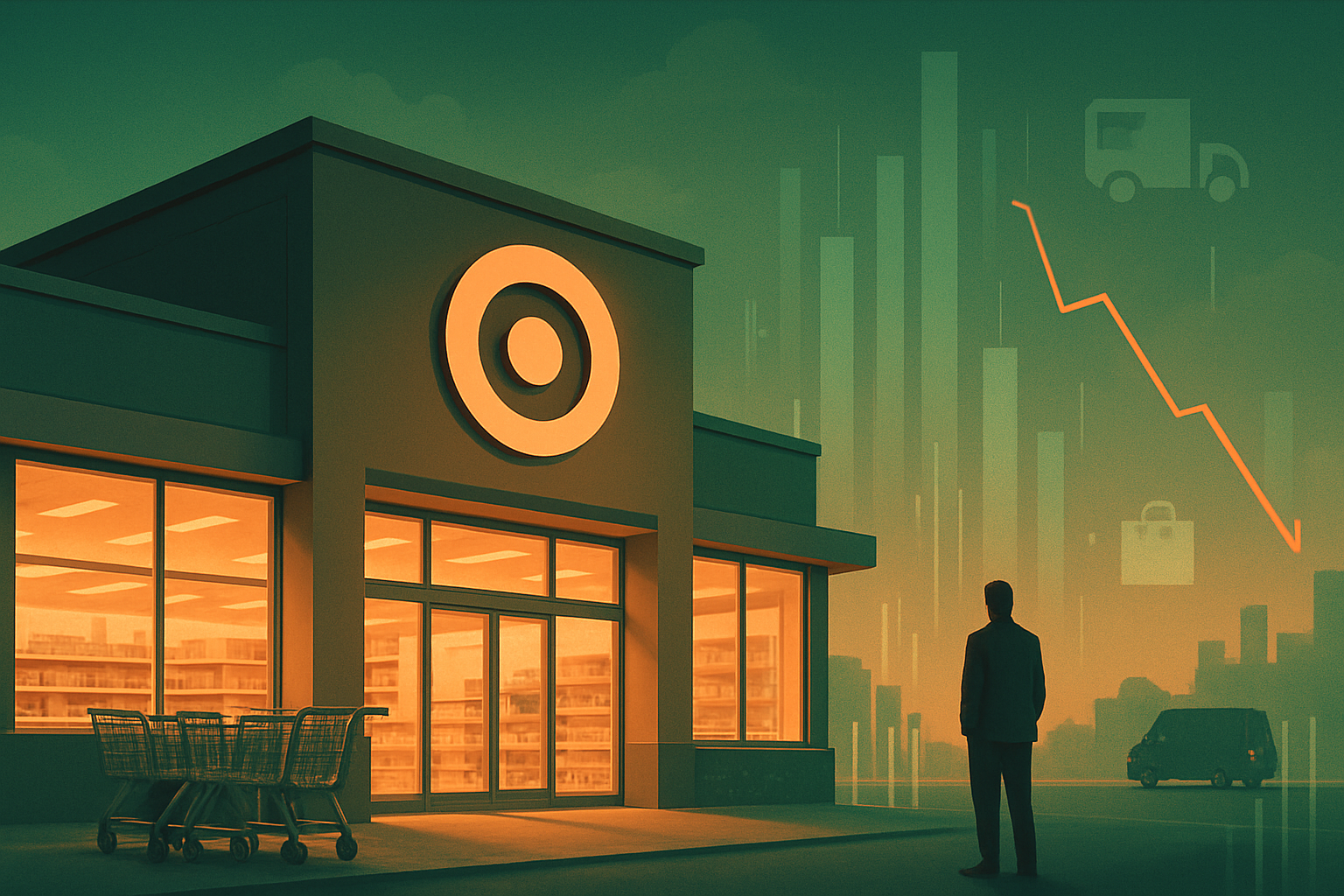
Tag: Earnings Miss

  • Target’s Bullseye Under Fire: Analyzing Today’s 7% Slide and the Retailer’s Identity Crisis

    Target’s Bullseye Under Fire: Analyzing Today’s 7% Slide and the Retailer’s Identity Crisis

    Today’s date is March 24, 2026.

    Introduction

    The "Target Effect"—that inexplicable retail magic where a consumer enters for a gallon of milk and leaves with a $200 cart of home décor and seasonal apparel—appears to be losing its spell. On Tuesday, shares of Target Corporation (NYSE: TGT) plummeted 7.0%, a sharp correction that wiped billions from the retailer's market capitalization. The catalyst was a disheartening preliminary Q1 update that signaled a deeper-than-expected contraction in discretionary spending and an persistent struggle with operating margins.

    For years, Target has been the darling of the "middle-class splurge," successfully positioning itself between the rock-bottom pricing of discount giants and the premium experience of specialty boutiques. However, today’s sell-off suggests that the "cheap chic" pioneer is facing a structural identity crisis in a 2026 economic landscape defined by cautious consumers and fierce digital competition. As new CEO Michael Fiddelke marks his first major quarterly update since taking the helm in February, the market is asking a difficult question: Can Target still win in an era where "value" is no longer just about style, but survival?

    Historical Background

    Target’s journey began in 1902 when George Draper Dayton founded Goodfellow Dry Goods in Minneapolis. After several name changes, it became The Dayton Company, a premier department store operator. However, the true transformation occurred in 1962—the same year Walmart and Kmart were born—when the company launched the first Target store in Roseville, Minnesota. The goal was to create a "discount" store that didn't feel like one.

    By the 1990s, Target had perfected its "Expect More. Pay Less." slogan, focusing on design-led partnerships with high-end designers like Isaac Mizrahi and Michael Graves. This strategy allowed Target to differentiate itself from the "sea of sameness" in the discount sector. In 2000, the parent Dayton-Hudson Corporation officially renamed itself Target Corporation, shedding its department store roots to focus entirely on its bullseye-branded growth engine. Despite a disastrous foray into Canada in 2013 and a massive 2014 data breach, the company staged a historic comeback under Brian Cornell, who retired earlier this year, leaving the reins to Fiddelke.

    Business Model

    Target operates as a massive general merchandise retailer with nearly 2,000 stores across the United States. Unlike its primary competitor, Walmart (NYSE: WMT), which derives more than half of its revenue from groceries, Target’s business model is heavily tilted toward discretionary categories: apparel, home furnishings, and beauty.

    Key pillars of their model include:

    • Owned Brands: Target manages a portfolio of more than 45 private labels, such as Good & Gather and All in Motion, which generate over $30 billion in annual sales. These brands offer higher margins than national brands and serve as a primary loyalty driver.
    • Stores-as-Hubs: Target fulfills roughly 96% of its total sales—including digital orders—directly from its physical stores. This logistical strategy minimizes last-mile costs and powers its highly successful "Drive Up" curbside service.
    • Shop-in-Shop: To increase foot traffic, Target has integrated "mini-stores" from partners like Ulta Beauty (NASDAQ: ULTA), Starbucks (NASDAQ: SBUX), and Apple (NASDAQ: AAPL) within its aisles.

    Stock Performance Overview

    The last decade has been a rollercoaster for TGT shareholders. After the 2020-2021 pandemic boom, which saw the stock surge to an all-time high of approximately $268, the company spent 2023 and 2024 in a painful "recalibration" phase.

    • 1-Year Performance: Before today's drop, Target had been staging a modest recovery, up 12% year-over-year as investors hoped for a discretionary spending rebound.
    • 5-Year Performance: TGT has largely underperformed the broader S&P 500, as the company grappled with inventory gluts in 2022 and rising operational costs in 2025.
    • 10-Year Performance: Despite recent volatility, long-term investors have seen respectable gains, though the stock has lagged behind Amazon (NASDAQ: AMZN) and Costco (NASDAQ: COST) by significant margins over the same period.

    Financial Performance

    The data released today for the preliminary Q1 2026 update was the primary driver of the 7% sell-off. Target reported that comparable store sales (comps) fell 1.8% year-over-year, missing analyst estimates of a 0.5% gain.

    • Revenue & Margins: Total revenue grew slightly due to new store openings, but gross margins contracted to 26.5% from 27.2% a year ago. The company cited "markdown pressure" to clear inventory in home and apparel categories.
    • Guidance: Most damaging was the revision of full-year EPS guidance. Target now expects earnings of $8.10–$9.10 per share, down from previous estimates of $9.40.
    • Cash Flow: While free cash flow remains healthy at roughly $4 billion annually, the company’s capital expenditure on its "300-store expansion plan" is eating into the cash available for accelerated share buybacks.

    Leadership and Management

    This morning’s decline is a "baptism by fire" for CEO Michael Fiddelke. Having served as CFO and COO under Brian Cornell, Fiddelke was seen as the "continuity candidate." However, today's market reaction suggests investors are looking for more than just steady hands; they want a visionary shift.

    The board, led by independent directors with deep retail and tech backgrounds, remains supportive of Fiddelke’s operational focus. However, some activists have begun whispering that the management team has been "too defensive" regarding the threat of Walmart’s growing dominance in the grocery and high-income demographic.

    Products, Services, and Innovations

    Target’s competitive edge has always been its ability to turn a mundane chore into an "experience." Recent innovations include:

    • Target Circle 360: The paid membership program, launched in 2024, has reached 15 million members but still trails significantly behind Amazon Prime and Walmart+.
    • AI-Enhanced Inventory: The company has invested heavily in generative AI to predict local demand, yet today’s inventory-driven margin miss suggests these tools are still in their refining stages.
    • Drive Up Returns: Allowing customers to return items without leaving their cars has become a major service differentiator, though it adds to the logistical complexity of the store-hub model.

    Competitive Landscape

    Target is caught in a "pincer movement" between two retail giants:

    • Walmart (WMT): Walmart’s aggressive push into fashion and beauty is directly stealing "Target guests." Furthermore, Walmart’s superior grocery supply chain makes it the preferred destination for consumers battling food inflation.
    • Amazon (AMZN): Amazon’s "Same Day" delivery capabilities have neutralized much of the convenience advantage Target once held with its physical store locations.
    • Costco (COST): For the suburban families that make up Target’s core, Costco is increasingly winning the battle for "bulk" essentials, leaving Target to fight for the "top-off" trips.

    Industry and Market Trends

    Retail in 2026 is grappling with a "bifurcated consumer." High-income households continue to spend on luxury and experiences, while the middle-and-lower income brackets—Target’s bread and butter—are retreating.

    • The "Experience" Shift: Consumers are prioritizing travel and dining over "things," a trend that disproportionately hurts Target’s home and apparel segments.
    • Digital Saturation: E-commerce growth has leveled off, forcing retailers to focus on "omnichannel" efficiency rather than just "clicks."

    Risks and Challenges

    The most pressing risk for Target remains "Retail Shrink." Organized retail crime and theft have significantly impacted the bottom line. Despite closing underperforming stores in high-crime urban centers in 2024 and 2025, the company noted today that theft-related losses are still nearly 100 basis points higher than historical averages.

    Additionally, Target faces discretionary exposure. With 50% of its sales coming from non-essential categories, it is the first to feel the pain of a cooling economy. Any delay in interest rate cuts by the Federal Reserve further pressures the household budgets of Target’s target demographic.

    Opportunities and Catalysts

    Despite today’s gloom, catalysts remain:

    • Small-Format Expansion: Target is opening dozens of smaller-format stores in college towns and dense urban areas where big-box competitors can't fit.
    • Partnership Pipeline: Rumors of a new "shop-in-shop" partnership with a leading home-improvement or wellness brand could re-energize foot traffic in late 2026.
    • Private Label Export: There is long-term potential for Target to wholesale its most popular owned brands (like All in Motion) to international retailers, creating a new high-margin revenue stream.

    Investor Sentiment and Analyst Coverage

    Wall Street's reaction has been swift. Several major banks, including JPMorgan and Goldman Sachs, moved their ratings from "Buy" to "Neutral" following the update. The consensus view is that Target is in a "show-me" period.

    Institutional ownership remains high (over 80%), but hedge funds have been trimming positions in favor of Walmart’s more defensive profile. Retail sentiment on social platforms like Reddit’s r/stocks is overwhelmingly bearish today, with many users citing "high prices" and "messy aisles" as signs of a brand in decline.

    Regulatory, Policy, and Geopolitical Factors

    Target is navigating a tightening regulatory environment:

    • Labor Laws: Ongoing debates over a federal minimum wage increase and unionization efforts at several Minnesota locations pose a risk to SG&A expenses.
    • Trade Policy: With a significant portion of its apparel and home goods sourced from Southeast Asia and China, any shift in tariff policy under the current administration could immediately impact gross margins.

    Conclusion

    Target’s 7% drop on March 24, 2026, is a sobering reminder that "Cheap Chic" is not a bulletproof strategy. While the company’s "stores-as-hubs" model is a logistical masterpiece, it cannot overcome a fundamental shift in consumer demand.

    For investors, Target currently represents a classic "value trap" vs. "value opportunity" debate. The stock is trading at a significant discount to its historical P/E multiple, but until Michael Fiddelke can prove that Target can grow its grocery share and curb the margin-eroding effects of theft and markdowns, the bullseye will likely remain under pressure. Investors should closely watch the official Q1 earnings call in May for specific details on the "Circle 360" membership growth and inventory turnover rates.


    This content is intended for informational purposes only and is not financial advice.

  • The Campbell’s Co. (CPB): An Iconic Brand at a 23-Year Crossroads

    The Campbell’s Co. (CPB): An Iconic Brand at a 23-Year Crossroads

    The Campbell’s Co. (NYSE: CPB), a cornerstone of the American pantry for over 150 years, is currently facing one of the most existential crises in its corporate history. Following a disappointing Q2 FY26 earnings report on March 11, 2026, which saw revenue slide 4.5% and a significant guidance cut, the stock has plummeted to a 23-year low. Once viewed as a "defensive" staple during market volatility, the company is now struggling to balance its legacy soup business with its ambitious push into premium sauces and salty snacks. With shifting consumer health priorities and a leveraged balance sheet, investors are left questioning whether the current valuation represents a generational entry point or a classic "value trap" in a rapidly evolving food landscape.

    Historical Background

    Founded in 1869 by Joseph Campbell and Abraham Anderson, the company revolutionized the food industry in 1897 when Dr. John T. Dorrance invented the process for condensing soup. This innovation allowed for smaller packaging, lower shipping costs, and an affordable price point for the masses. For much of the 20th century, Campbell’s was synonymous with American domesticity, immortalized by Andy Warhol’s pop art and the "M’m! M’m! Good!" slogan.

    In the 21st century, the company underwent several strategic transformations. After a period of stagnation in the early 2010s, it aggressively pivoted toward snacks, acquiring Snyder’s-Lance in 2018 for $6.1 billion. In late 2024, the company officially dropped "Soup" from its corporate name, rebranding as The Campbell’s Co. to reflect a portfolio where snacks and premium sauces (notably Rao’s, acquired via Sovos Brands in 2024) now play a leading role.

    Business Model

    The Campbell’s Co. operates under two primary segments:

    1. Meals & Beverages: This includes the iconic Campbell’s soup portfolio, Swanson broths, Prego pasta sauces, V8 beverages, and the high-growth Rao’s Homemade brand. This segment focuses on "center-of-the-store" staples and premium cooking components.
    2. Snacks: Comprising roughly half of total revenue, this segment features "Power Brands" such as Goldfish crackers, Snyder’s of Hanover pretzels, Late July chips, and Kettle Brand.

    The revenue model relies on high-volume distribution through retail grocery, mass merchandisers, and club stores. In recent years, the company has attempted to shift its mix toward "distinctive" premium products to command higher margins and insulate itself from the rise of private-label competitors.

    Stock Performance Overview

    As of March 12, 2026, CPB is trading at approximately $22.94 per share. This level marks a "round-trip" back to prices last seen in 2003 on a split-adjusted basis.

    • 1-Year Performance: Down roughly 32%, fueled by consistent volume declines and the Q2 FY26 earnings miss.
    • 5-Year Performance: Down 45%, significantly underperforming the S&P 500 and the Consumer Staples Select Sector SPDR Fund (XLP).
    • 10-Year Performance: A lost decade for shareholders; the stock is trading nearly 60% below its 2016 highs.

    While the dividend yield has swelled due to the price decline, the total return for long-term holders has been severely eroded by inflation and capital depreciation.

    Financial Performance

    The Q2 FY26 results were the catalyst for the latest sell-off. Key metrics include:

    • Revenue: $2.56 billion, a 4.5% year-over-year decline. Organic sales fell 3%, indicating that even price hikes could not offset volume losses.
    • Earnings: Adjusted EPS of $0.51 missed analyst estimates of $0.57.
    • Margins: Gross margins compressed to 27.7%, pressured by increased promotional spending and higher logistics costs following severe winter storms.
    • Debt & Leverage: Following the $2.7 billion Rao’s acquisition, total debt sits at approximately $7.08 billion. The Net Debt/EBITDA ratio of 3.8x is a point of concern for credit agencies, which currently maintain a BBB- rating on the company’s paper.
    • Guidance: Management lowered full-year FY26 EPS guidance to $2.15–$2.25, down from previous expectations of $2.42.

    Leadership and Management

    The company is currently in a leadership transition. Following the departure of Mark Clouse in early 2025, Mick Beekhuizen took the helm as CEO on February 1, 2025. Beekhuizen, the former CFO, is tasked with executing the "Set the Standard" strategy.

    His management style is characterized by fiscal discipline and a focus on "16 Leadership Brands." However, critics argue that the leadership team has been slow to react to the disruptive impact of weight-loss medications on snack consumption. The recent appointment of Todd Cunfer as CFO suggests a focus on aggressive cost-cutting to defend the dividend.

    Products, Services, and Innovations

    Campbell’s innovation pipeline is currently bifurcated:

    • Premiumization: The "Rao’s" brand remains a bright spot, recently surpassing $1 billion in annual sales. Management is leveraging Rao’s brand equity to expand into frozen entrees and premium soups.
    • Health & Wellness: To combat the "GLP-1 effect," Campbell’s is introducing "portion-mindful" packaging—smaller 100-calorie snack packs—and reformulated soups with higher protein and fiber content to appeal to users of appetite-suppressant drugs.
    • Goldfish Expansion: Goldfish remains the "crown jewel" of the snack portfolio, with continuous flavor innovations (e.g., Spicy Dill Pickle, Old Bay) keeping the brand relevant among Gen Z and Alpha consumers.

    Competitive Landscape

    Campbell’s faces intense pressure from several fronts:

    • Legacy Peers: Kraft Heinz (NASDAQ: KHC) and General Mills (NYSE: GIS) have been more aggressive in promotional discounting, sparking a "price war" in the soup and snack aisles.
    • Snack Giants: In the salty snacks space, PepsiCo (NASDAQ: PEP) dominates the shelf space and distribution logistics, making it difficult for Campbell’s smaller snack brands to gain incremental share.
    • Private Label: As food inflation remains sticky, retailers like Walmart (NYSE: WMT) and Kroger (NYSE: KR) are aggressively pushing their own store brands. Private label soup and snacks have gained nearly 200 basis points of market share at the expense of branded players like Campbell’s over the last 18 months.

    Industry and Market Trends

    The CPG industry is navigating a "Perfect Storm" in 2026:

    • The GLP-1 Factor: The widespread adoption of Ozempic and Wegovy has led to a measurable 5-6% decrease in grocery spending among participating households. Salty snacks and high-sodium canned goods are among the categories most impacted.
    • Snackification Slowdown: The decade-long trend of consumers replacing meals with snacks is stalling as health-conscious consumers pivot toward whole foods and nutrient-dense options.
    • Input Volatility: While some raw material costs have stabilized, labor and energy costs remain elevated, squeezing the "middle-aisle" food companies that lack significant pricing power.

    Risks and Challenges

    • Leverage Risk: With a 3.8x leverage ratio and a high dividend payout ratio (~80%), Campbell’s has little margin for error. A further credit downgrade could significantly increase interest expenses.
    • Volume Erosion: If the company cannot stem the tide of volume declines, the "price-over-volume" strategy will eventually reach a breaking point, leading to further revenue contraction.
    • Consumer Shift: A permanent shift in eating habits driven by GLP-1 drugs could render portions of the snack portfolio obsolete.

    Opportunities and Catalysts

    • Rao’s Synergy: There is still significant "runway" for Rao’s to expand into new categories like frozen pizza and dry pasta, which could offset declines in legacy soup.
    • Cost Savings: The company is targeting $375 million in annual savings by 2028. If achieved ahead of schedule, this could provide the necessary capital to reinvest in marketing or pay down debt faster.
    • M&A or Divestiture: Analysts have speculated that Campbell’s could become an acquisition target for a larger conglomerate like Mondelez (NASDAQ: MDLZ) or may choose to divest its struggling lower-tier snack brands to focus purely on "Meals & Beverages."

    Investor Sentiment and Analyst Coverage

    Wall Street sentiment is decidedly bearish. Most analysts maintain "Underweight" or "Sell" ratings, with price targets clustered between $23 and $25.

    • Institutional Moves: Several large hedge funds reduced their stakes in CPB during Q4 2025, citing the lack of a clear growth catalyst.
    • Retail Sentiment: On social media and retail trading platforms, CPB is often discussed as a "yield trap"—a stock with an attractive dividend (currently ~6.8%) that is offset by the consistent decline in principal value.

    Regulatory, Policy, and Geopolitical Factors

    • Sodium Regulations: The FDA is considering stricter voluntary sodium reduction targets for processed foods, which could require expensive reformulations for the core Campbell’s soup line.
    • Labeling Laws: New "Front-of-Package" (FOP) labeling requirements in the U.S. could highlight high sodium and sugar content, potentially deterring health-conscious shoppers.
    • Supply Chain Resilience: As seen in Q2 FY26, the company’s centralized distribution model remains vulnerable to extreme weather events, which are becoming more frequent and severe.

    Conclusion

    The Campbell’s Co. finds itself at a historic low, both in terms of stock price and institutional confidence. While the acquisition of Rao’s provides a modern, premium growth engine, it has come at the cost of a strained balance sheet and a distraction from the deteriorating core snacks business.

    For investors, the 6.8% dividend yield is enticing, but it remains a "wait-and-see" story. The company must prove it can stabilize volumes in its legacy brands and successfully navigate the GLP-1 health shift before the stock can find a sustainable floor. As of March 2026, the primary question is whether Mick Beekhuizen can stir the pot enough to create a recipe for growth, or if this iconic brand will continue to simmer at multi-decade lows.


    This content is intended for informational purposes only and is not financial advice

  • AeroVironment (AVAV): Navigating the Growing Pains of a Defense Tech Giant

    AeroVironment (AVAV): Navigating the Growing Pains of a Defense Tech Giant

    Today’s Date: March 12, 2026

    Introduction

    AeroVironment, Inc. (NASDAQ: AVAV) has long been the poster child for the "democratization of the skies." For decades, it dominated the niche for small, hand-launched tactical drones. However, following its Q3 FY2026 earnings report on March 10, the company finds itself at a critical crossroads. Despite a massive 143% year-over-year surge in revenue, AeroVironment missed consensus analyst expectations for both the top and bottom lines, leading to a sharp ~6.3% decline in share price.

    The current focus on AVAV is driven by a paradox: the company has never seen higher demand—boasting a record $1.1 billion funded backlog—yet it is struggling with the "growing pains" of scaling into a full-spectrum defense prime. This deep dive explores whether the recent sell-off is a temporary setback in a secular growth story or a sign of deeper structural challenges as the company integrates its massive BlueHalo acquisition and faces stiff competition from "Silicon Valley" defense startups.

    Historical Background

    Founded in 1971 by the legendary aeronautical engineer Paul MacCready, AeroVironment began not as a weapons manufacturer, but as a laboratory for human-powered and solar-powered flight. MacCready’s Gossamer Condor won the first Kremer prize in 1977, proving that human-powered flight was possible. This heritage of extreme efficiency and lightweight engineering became the DNA of the company’s military transition.

    In the late 1980s and 1990s, the company pivoted toward the U.S. military’s growing interest in Unmanned Aircraft Systems (UAS). The breakthrough came with the Raven, a small drone that could be carried in a backpack and hand-launched by a single soldier. The conflicts in Iraq and Afghanistan cemented AeroVironment’s role as the primary provider of "organic" surveillance for the infantry. The 2010s saw the development of the Switchblade, a "loitering munition" (kamikaze drone) that redefined precision strikes on the modern battlefield. Today, the company has transformed from a hardware vendor into a multi-domain defense technology firm.

    Business Model

    AeroVironment’s business model has shifted significantly over the last 24 months. While historically reliant on selling drone "units," the company now operates across two primary pillars:

    1. Autonomous Systems (68% of Revenue): This includes the legacy UAS (Unmanned Aircraft Systems) and LMS (Loitering Munition Systems). Revenue here is derived from hardware sales, long-term maintenance contracts, and training services.
    2. Space, Cyber, and Directed Energy: Formed largely through the May 2025 acquisition of BlueHalo, this segment focuses on high-end defense tech including laser weapon systems, satellite communications, and "electronic warfare" (EW).

    The customer base is heavily concentrated in the U.S. Department of Defense (DoD), which accounts for roughly 70-75% of sales, with the remainder coming from over 50 allied international governments.

    Stock Performance Overview

    Despite the recent 6.3% post-earnings dip, AVAV’s long-term trajectory remains impressive:

    • 1-Year Performance: Up approximately 70%, driven by the global realization of drone importance in the Ukraine and Taiwan Strait contexts.
    • 5-Year Performance: Up ~124%, representing a solid 14.7% CAGR. The stock saw a massive rerating following the 2022 invasion of Ukraine.
    • 10-Year Performance: Up a staggering 761%, vastly outperforming the S&P 500.

    However, the stock is currently trading nearly 47% below its 52-week high, reflecting a valuation "reset" as investors move from rewarding growth-at-any-cost to demanding margin stability.

    Financial Performance

    The Q3 FY2026 results released on March 10 were a tale of two cities. Revenue hit $408 million—a record—but missed the $484 million consensus. Adjusted EPS came in at $0.64, missing the $0.72 target.

    Crucially, gross margins compressed to 27%, down from 40% a year prior. This was attributed to a higher mix of lower-margin service revenue from the BlueHalo integration and a $151.3 million goodwill impairment charge in the Space unit. Management subsequently lowered FY2026 revenue guidance to $1.85B–$1.95B. While the company remains cash-flow positive, the "lumpy" nature of government defense contracts continues to inject volatility into its quarterly reports.

    Leadership and Management

    CEO Wahid Nawabi has been at the helm since 2016 and is credited with the company’s aggressive M&A strategy. Under his leadership, AVAV has moved from a "niche" player to a "disruptive prime" competitor to giants like Lockheed Martin.

    However, the leadership team is facing a transition. Long-time CFO Kevin McDonnell announced his retirement for July 2026. For investors, this creates a period of "execution risk" as the company looks for a new financial steward to manage the complex balance sheet post-BlueHalo.

    Products, Services, and Innovations

    AeroVironment’s product portfolio is the gold standard in tactical UAS:

    • Switchblade 300/600: These loitering munitions are the company’s "stars." They are being scaled to a production rate of 1,200 units per month.
    • Puma AE/LE: The workhorse of maritime and land surveillance, benefiting from a massive $874 million IDIQ contract.
    • LOCUST Laser System: A directed-energy weapon designed to shoot down enemy drones at a fraction of the cost of traditional missiles.
    • JUMP 20: A vertical take-off and landing (VTOL) drone that eliminates the need for runways.

    The company’s R&D focus is currently on "autonomy in contested environments," ensuring drones can fly and strike even when GPS and radio signals are jammed.

    Competitive Landscape

    The competitive environment has shifted from traditional defense primes (like Northrop Grumman and RTX) to agile, software-first startups.

    • Anduril Industries: The most formidable threat. Anduril’s "Lattice OS" software and its recent $30.5 billion valuation allow it to compete for the same "low-cost attritable" contracts that AVAV targets.
    • The "Big Primes": Lockheed Martin (NYSE: LMT) and General Atomics have recently entered the small-drone space with their own loitering munition prototypes.
    • Kratos Defense (NASDAQ: KTOS): Competes in the high-speed jet drone market, though AVAV remains the leader in small tactical systems.

    Industry and Market Trends

    Three macro trends are defining the sector:

    1. The "Replicator" Initiative: The Pentagon’s plan to field thousands of cheap, autonomous systems to counter China’s mass. AVAV is a primary beneficiary.
    2. Attrition-Based Warfare: Modern conflict has shown that expensive platforms (tanks, ships) are vulnerable to cheap drones. This shift favors AVAV’s product price points.
    3. Electronic Warfare (EW): As jamming becomes standard, the "intelligence" of the drone’s software is becoming more important than its airframe.

    Risks and Challenges

    • The "Lumpy" Revenue Trap: Government contract timing is notoriously unpredictable, leading to quarters like the recent Q3 miss.
    • Integration Risk: BlueHalo was a massive acquisition. Melding the two corporate cultures and tech stacks remains a work in progress.
    • Supply Chain: Reliance on specialized sensors and batteries makes the company vulnerable to global semiconductor shortages and regional instability.
    • Space Force Shift: The U.S. Space Force recently moved the SCAR program from sole-source to competitive bidding, which led to AVAV’s $151 million impairment charge.

    Opportunities and Catalysts

    • Backlog Conversion: With $1.1 billion in the funded backlog, the revenue "miss" in Q3 is largely a matter of when, not if, the money arrives.
    • International NATO Expansion: As European nations rush to modernize, AVAV is seeing record interest for the Switchblade 600.
    • New Facility: The upcoming Salt Lake City manufacturing plant is expected to triple production capacity by late 2026.

    Investor Sentiment and Analyst Coverage

    Wall Street remains divided. Bulls point to the record backlog and the "essential" nature of AVAV’s tech in modern warfare. Bears point to the compressed margins and the "Defense Tech" premium the stock trades at compared to more profitable legacy primes.
    Institutional ownership remains high (~85%), with major positions held by BlackRock and Vanguard, signaling long-term confidence in the sector.

    Regulatory, Policy, and Geopolitical Factors

    Geopolitics is the ultimate tailwind for AVAV. The ongoing conflict in Ukraine has acted as a multi-year live-fire demonstration of their products. Furthermore, the U.S. government’s ITAR (International Traffic in Arms Regulations) acts as a high barrier to entry, protecting AVAV from Chinese and other foreign drone competitors in the Western market. However, any shift toward a "de-escalation" policy in global hotspots could dampen the immediate urgency for rapid drone procurement.

    Conclusion

    AeroVironment is currently suffering from a "success crisis." It has transitioned from a small, high-margin niche provider to a large-scale defense prime with lower, more complex margins. The 6.3% drop following the earnings miss reflects the market’s realization that this transition will be bumpy.

    Investors should watch the Q4 FY2026 results closely for signs of margin stabilization. If AVAV can prove it can successfully integrate BlueHalo and convert its $1.1 billion backlog into high-margin revenue, the current dip may look like a generational buying opportunity. However, with Anduril breathing down their neck, execution—not just innovation—is now the name of the game.


    This content is intended for informational purposes only and is not financial advice.