Tag: Electric Vehicles

  • Rivian’s 2026 Breakthrough: Analyzing the 26.6% Surge and the Path to Mass-Market Dominance

    Rivian’s 2026 Breakthrough: Analyzing the 26.6% Surge and the Path to Mass-Market Dominance

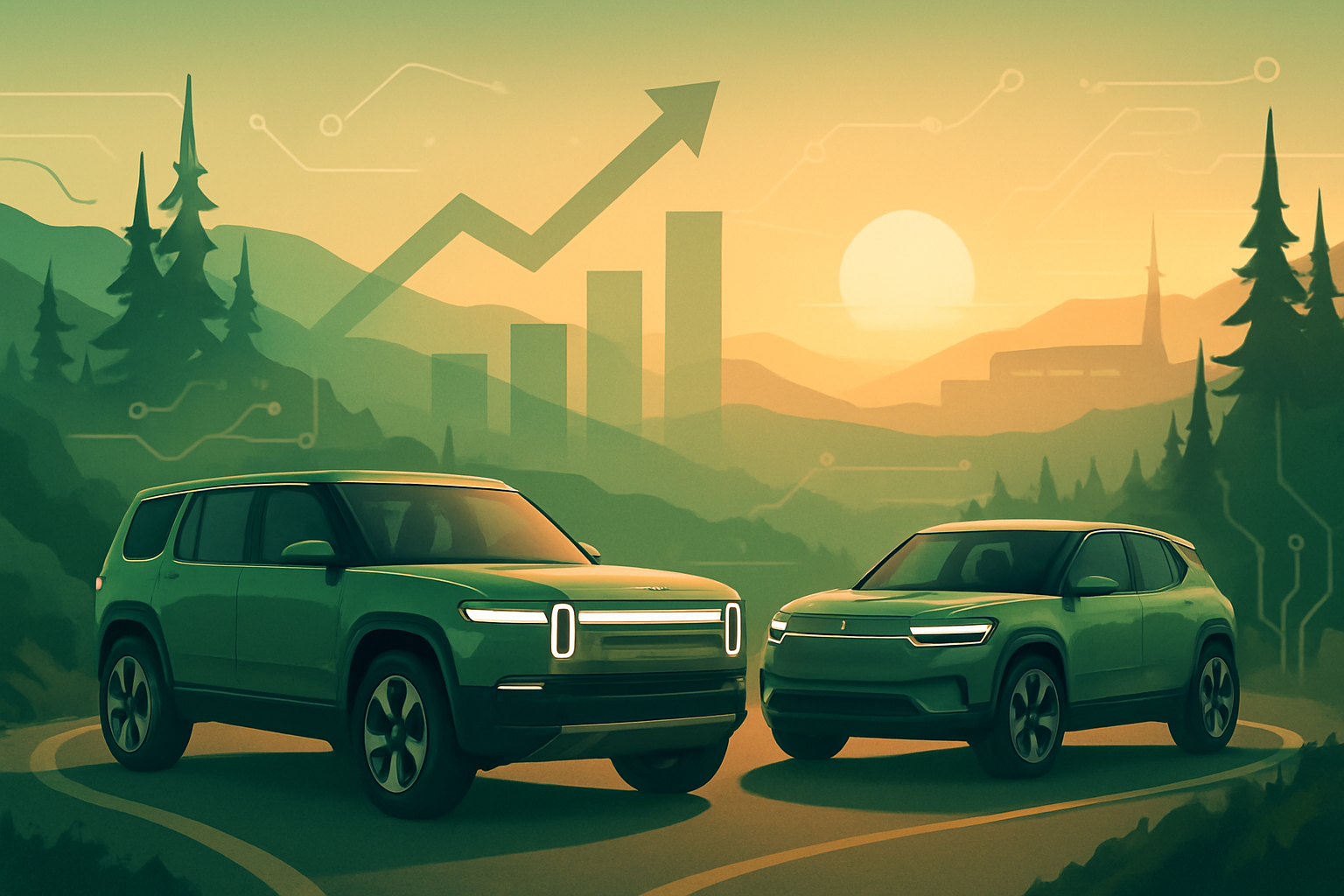
    On February 16, 2026, the electric vehicle (EV) sector witnessed a seismic shift in investor sentiment as Rivian Automotive (NASDAQ: RIVN) surged by 26.6% in a single trading session. This dramatic rally, which pushed the stock to $17.73, followed a blockbuster 2026 outlook and a series of strategic partnership headlines that have effectively silenced long-standing concerns regarding the company’s liquidity and path to profitability. For an industry that has spent the last two years grappling with high interest rates and cooling consumer demand, Rivian’s recent performance serves as a potential bellwether for the "Second Wave" of EV adoption.

    The surge was precipitated by the company’s Q4 2025 earnings report, which confirmed that Rivian has not only achieved sustained positive gross margins but is also on the cusp of launching its mass-market R2 platform. With the backing of a multi-billion dollar joint venture with Volkswagen Group (OTC: VWAGY) and a renewed focus on software-defined vehicle (SDV) architecture, Rivian is no longer viewed merely as a luxury boutique automaker but as a legitimate platform provider for the global automotive industry.

    Historical Background

    Founded in 2009 by Dr. RJ Scaringe, Rivian spent its first decade in "stealth mode," focusing on the development of a versatile "skateboard" platform that could underpin a variety of electric vehicles. Initially targeting a mid-engine hybrid sports car, Scaringe pivoted the company’s focus to the underserved luxury truck and SUV market—a move that eventually attracted massive pre-IPO investments from Amazon (NASDAQ: AMZN) and Ford (NYSE: F).

    Rivian’s public debut in November 2021 was one of the largest IPOs in U.S. history, with a valuation briefly exceeding $100 billion despite having delivered only a handful of vehicles. However, the subsequent years were characterized by "growing pains," including supply chain bottlenecks, inflationary pressures, and a difficult manufacturing ramp-up at its Normal, Illinois, facility. The 2024 partnership with Volkswagen proved to be the pivotal turning point, providing the capital and scale necessary to survive the "EV winter" of 2024-2025 and transition toward high-volume production.

    Business Model

    Rivian operates a vertically integrated business model, controlling everything from vehicle design and software development to direct-to-consumer sales and service. Its revenue streams are increasingly diversified across three primary pillars:

    1. Consumer Vehicles: The R1T (pickup) and R1S (SUV) serve the premium market, while the upcoming R2 and R3 models target high-volume segments.
    2. Commercial Vans: The Electric Delivery Van (EDV) program, anchored by an initial 100,000-unit order from Amazon, has now expanded to other third-party logistics providers.
    3. Software and Services: Rivian generates high-margin recurring revenue through its "Rivian Cloud" ecosystem, over-the-air (OTA) software updates, insurance products, and the Rivian Adventure Network (charging).
    4. Technology Licensing: Following the 2024 Volkswagen JV, Rivian now earns licensing fees and milestone payments for its zonal electrical architecture and software stack.

    Stock Performance Overview

    Rivian’s stock history has been a rollercoaster of extreme volatility.

    • Post-IPO to 2024: After hitting highs near $170 in late 2021, the stock plummeted over 90% as the market soured on unprofitable "pre-revenue" tech companies. By early 2024, shares were trading in the low double digits.
    • The 1-Year Horizon (2025-2026): Over the past 12 months, RIVN has outperformed the broader EV index by nearly 40%. The recovery began in late 2024 with the VW announcement and accelerated as the company demonstrated a clear reduction in "cost-per-vehicle."
    • The 5-Year Horizon: Since its Nov 2021 IPO, the stock remains significantly below its debut price, reflecting the massive derating of the EV sector. However, the current 2026 rally marks the first time since the IPO that the company’s valuation is backed by positive gross profits rather than pure speculation.

    Financial Performance

    The 26.6% surge in early 2026 was underpinned by fundamental financial improvements. Rivian’s Q4 2025 results revealed:

    • Gross Margin: Consolidated gross profit became positive in late 2024 and has expanded to the mid-single digits by Q4 2025, driven by a 65% reduction in parts count for the "Gen 2" R1 vehicles.
    • Revenue Growth: 2025 revenue grew by 22% year-over-year, despite a deliberate production slowdown to retool the Normal plant.
    • Liquidity: Between the $5.8 billion VW investment, a $6.6 billion DOE loan, and an ending cash balance of approximately $8.2 billion, Rivian has secured a capital runway that extends into late 2027.
    • Valuation: Currently trading at roughly 4.1x Price-to-Sales, Rivian is valued as a hybrid between a traditional automaker and a high-growth tech platform.

    Leadership and Management

    Founder and CEO RJ Scaringe remains the central figure in Rivian’s leadership, praised for his technical depth and long-term vision. However, the "institutionalization" of Rivian's management has been equally important.

    • Claire McDonough (CFO): Often cited as the architect of the VW deal, she has successfully managed the company’s capital-light strategy.
    • Javier Varela (COO): Since joining from Volvo, Varela has brought disciplined automotive manufacturing expertise, helping to stabilize production and reduce waste.
      The board of directors includes heavyweights from the tech and retail sectors, reflecting the company’s dual identity.

    Products, Services, and Innovations

    Rivian’s product strategy is shifting from "niche luxury" to "mass-market utility."

    • R1 Platform: The flagship R1T and R1S remain the gold standard for electric adventure vehicles, featuring industry-leading quad-motor setups and off-road capability.
    • R2 Platform: The R2, scheduled for mid-2026 deliveries, is the "Tesla Model Y fighter" priced at $45,000. It features a simplified manufacturing process and 4695-format battery cells.
    • Zonal Architecture: Rivian’s proprietary software-heavy architecture allows for fewer ECUs and significantly less wiring, a competitive edge that attracted Volkswagen's interest.
    • R3 and R3X: These compact crossovers represent the company’s long-term play for the European and urban markets.

    Competitive Landscape

    Rivian occupies a unique space between Tesla (NASDAQ: TSLA) and legacy OEMs like Ford and General Motors (NYSE: GM).

    • vs. Tesla: While Tesla dominates in volume and charging infrastructure, Rivian has captured the "lifestyle/outdoor" brand identity that Tesla lacks.
    • vs. Legacy OEMs: Rivian's advantage lies in its lack of "technical debt." Unlike Ford, which must manage a complex transition from internal combustion engines, Rivian is "electric-native." However, legacy players have deeper pockets and existing dealer networks.
    • Emerging Threats: Competition from Chinese OEMs like BYD and Xiaomi remains a looming threat in global markets, though trade barriers currently protect Rivian’s primary U.S. market.

    Industry and Market Trends

    The EV industry in 2026 is defined by a "flight to quality." After a period of cooling demand in 2024, the market has bifurcated. Companies with proprietary tech and strong balance sheets are gaining share, while those reliant on third-party software are struggling.

    • Lower Battery Costs: Continued declines in lithium-ion battery prices have aided Rivian’s margin expansion.
    • Charging Standardization: The industry-wide shift to the NACS (North American Charging Standard) has integrated Rivian vehicles into the Tesla Supercharger network, alleviating "range anxiety" for new buyers.

    Risks and Challenges

    Despite the recent surge, Rivian is not without risks:

    • Execution Risk: The R2 ramp-up at the Normal plant is a "make or break" moment. Any delays could burn through cash rapidly.
    • Georgia Factory Capex: Resuming construction on the multi-billion dollar Georgia facility in 2026 will put renewed pressure on the balance sheet.
    • Macro Factors: High interest rates still make vehicle financing expensive for the average consumer, potentially dampening R2 pre-orders.
    • Political Risk: Changes in federal EV tax credits or emissions regulations could impact the company’s bottom line.

    Opportunities and Catalysts

    • Software Licensing: The VW JV could be a template for further partnerships with other global OEMs, providing high-margin licensing fees.
    • Fleet Diversification: Now that the Amazon exclusivity period has ended, Rivian has a massive opportunity to sell EDVs to giants like DHL, FedEx, or UPS.
    • International Expansion: The R3 platform is specifically designed with global dimensions, opening doors to the European and Asian markets in late 2027.

    Investor Sentiment and Analyst Coverage

    Wall Street has turned decidedly bullish on Rivian in early 2026. Following the 26.6% surge, several analysts upgraded the stock to "Strong Buy."

    • Institutional Support: Major institutions like Vanguard and BlackRock have maintained significant positions, and there has been a notable uptick in "tech-growth" hedge funds entering the stock.
    • Retail Sentiment: Rivian maintains a cult-like following among retail investors, who often compare the company’s current trajectory to Tesla’s 2017-2018 era.

    Regulatory, Policy, and Geopolitical Factors

    Rivian is a primary beneficiary of the Inflation Reduction Act (IRA), though its reliance on federal subsidies is a double-edged sword.

    • Domestic Content: Rivian has aggressively localized its battery supply chain to ensure its vehicles qualify for the full $7,500 consumer tax credit.
    • Trade Policy: Potential tariffs on Chinese EV components could increase production costs but also protect Rivian from low-cost international competition.

    Conclusion

    The 26.6% surge on February 16, 2026, marks the end of Rivian’s "existential crisis" phase and the beginning of its "scaling" phase. By achieving gross profitability and securing a global technology partner in Volkswagen, Rivian has proven that it has the staying power to compete in the brutal automotive industry.

    However, the road ahead remains steep. The successful launch of the R2 platform is the final piece of the puzzle; if Rivian can deliver a high-quality, $45,000 vehicle at scale, it will solidify its position as the clear #2 in the North American EV market. Investors should remain focused on production ramp milestones and margin stability as the company marches toward its first full year of GAAP net profitability.


    This content is intended for informational purposes only and is not financial advice.
  • The Great Pivot: Analyzing Tesla’s Transformation from Automaker to AI Powerhouse (2026 Research Report)

    The Great Pivot: Analyzing Tesla’s Transformation from Automaker to AI Powerhouse (2026 Research Report)

    As of January 23, 2026, Tesla, Inc. (NASDAQ: TSLA) stands at a crossroads that few could have predicted just eighteen months ago. Once viewed strictly as a high-growth electric vehicle (EV) manufacturer, the company has spent the last year aggressively rebranding itself as an artificial intelligence and robotics conglomerate. This transformation was ignited by the pivotal Q3 2024 earnings report, which saw a surprising expansion in automotive margins and a record-breaking performance in the energy sector.

    Today, Tesla is no longer just fighting for market share in the sedan and SUV segments; it is vying for dominance in autonomous transport, humanoid robotics, and distributed energy storage. With a market capitalization hovering around $1.4 trillion, the "Elon Musk premium" remains as contentious as ever, as the company balances maturing automotive hardware with the speculative upside of its "unsupervised" Full Self-Driving (FSD) and Optimus initiatives.

    Historical Background

    Founded in 2003 by Martin Eberhard and Marc Tarpenning, with Elon Musk joining shortly thereafter as the lead investor, Tesla's journey has been defined by "production hell" and radical pivots. The 2008 release of the Roadster proved that EVs could be aspirational. However, it was the Model S (2012) and the mass-market Model 3 (2017) that truly disrupted the global automotive industry.

    The company's history is characterized by a "master plan" approach: start with low-volume, high-price vehicles to fund high-volume, lower-priced offerings. Over the last decade, Tesla scaled from a niche California automaker to a global titan with "Gigafactories" in Nevada, New York, Shanghai, Berlin, and Texas. The late 2010s saw the company teetering on the edge of bankruptcy during the Model 3 ramp, only to emerge as the world's most valuable automaker by 2020. The 2021-2023 period saw rapid expansion, but by 2024, the narrative shifted from growth at all costs to efficiency, cost reduction, and the pursuit of general AI.

    Business Model

    Tesla’s business model is vertically integrated to a degree rarely seen in modern manufacturing. It generates revenue through three primary segments:

    1. Automotive: The core revenue driver, encompassing the sale and lease of the Model 3, Y, S, X, and Cybertruck. This includes regulatory credits sold to other manufacturers—a high-margin "pure profit" stream that has historically propped up earnings.
    2. Energy Generation and Storage: This segment has become the company’s most consistent growth engine. It involves the production and installation of the Powerwall (residential), Megapack (utility-scale), and solar products.
    3. Services and Other: This includes FSD software subscriptions, Supercharger network access, insurance, and vehicle service. This segment is critical for Tesla’s long-term goal of shifting toward a high-margin software-as-a-service (SaaS) model.

    By owning its sales channels (direct-to-consumer) and much of its supply chain, Tesla captures margins that traditional OEMs often lose to dealerships and third-party suppliers.

    Stock Performance Overview

    Tesla's stock remains one of the most volatile large-cap equities in the world.

    • 1-Year Performance: Over the past twelve months (Jan 2025 – Jan 2026), TSLA has seen a gain of approximately 7%, though this masks a roller-coaster ride that saw the stock dip to $320 in early 2025 before peaking at $485 in late December 2025.
    • 5-Year Performance: Investors who held since early 2021 have seen a roughly 100% gain, though the path was marred by the 2022 tech wreck and 2024's "valuation reset."
    • 10-Year Performance: TSLA has been a legendary performer, returning over 1,500% to long-term shareholders who navigated the various production crises and controversies.

    The current trading range of $430–$450 reflects a market that has priced in the success of the automotive business but remains skeptical of the multi-trillion-dollar valuations Musk attributes to Robotaxis and Optimus.

    Financial Performance

    The Q3 2024 earnings report served as a financial "restoration" for Tesla. Following a period of declining margins due to aggressive price cuts, Tesla reported an automotive gross margin (ex-credits) of 17.1%. This was achieved through a relentless focus on lowering the "cost per vehicle," which hit a record low of approximately $35,100.

    In the most recent 2025 fiscal year, Tesla showed:

    • Revenue Growth: While automotive revenue slowed to single digits in mid-2025, the Energy segment grew by over 50% year-over-year, achieving gross margins of 30.5%.
    • Debt and Cash Flow: Tesla maintains a fortress-like balance sheet with over $30 billion in cash and negligible debt. Free cash flow remains positive, though heavily reinvested into AI compute (Dojo and Nvidia H100/H200 clusters).
    • Valuation: Trading at a forward P/E ratio of approximately 75x, Tesla remains significantly more expensive than rivals like Toyota (NYSE: TM) or BYD (OTC: BYDDF), reflecting its status as an "AI play" rather than a traditional car company.

    Leadership and Management

    Elon Musk remains the singular face of Tesla. While his focus is split between SpaceX, X (formerly Twitter), and xAI, his influence on Tesla’s engineering culture is undeniable. However, the management team has seen significant turnover. The 2024 departure of Drew Baglino (SVP Powertrain) was viewed as a blow to the "engineering soul" of the company.

    By early 2026, the leadership has transitioned. The new guard consists largely of AI and software engineers rather than automotive manufacturing veterans. This reflects Musk’s directive that Tesla is "not an auto company" but a "robotics and AI company." Governance remains a concern for institutional investors, particularly regarding Musk’s controversial compensation packages and his board's perceived lack of independence.

    Products, Services, and Innovations

    Tesla’s current lineup is spearheaded by the Model Y, which remains the world’s best-selling vehicle. The Cybertruck has moved past its initial production hurdles, achieving a run rate of 125,000 units by mid-2025, though its high price point ($50k-$100k) has limited it to a premium-niche role.

    The true innovation pipeline is focused on:

    • Robotaxi (Cybercab): Launched as a pilot in Austin in June 2025, this dedicated autonomous vehicle has no steering wheel.
    • Full Self-Driving (FSD): Now in version 13.x, FSD has moved to "end-to-end neural networks," significantly improving its ability to handle complex urban environments.
    • Optimus: Approximately 1,000 Optimus bots are currently deployed in Tesla's own factories, performing simple battery sorting and logistics tasks. This is the "alpha test" for what Musk claims will be a multi-billion unit market.

    Competitive Landscape

    The competitive landscape in 2026 is bifurcated. In China, BYD (OTC: BYDDF) has surpassed Tesla in total EV volume, offering a wider range of affordable models. In the West, traditional OEMs like Ford (NYSE: F) and General Motors (NYSE: GM) have significantly scaled back their EV ambitions, focusing instead on hybrids, which has ironically allowed Tesla to regain market share in the pure-EV space.

    Tesla’s primary competitive edge is its Supercharger network—now the industry standard (NACS) in North America—and its massive data moat for training AI models. Rivals struggle to match Tesla’s software integration and its ultra-low manufacturing costs.

    Industry and Market Trends

    The "EV Winter" of 2024 gave way to a "Hybrid Spring" in 2025, but Tesla resisted the hybrid trend, betting entirely on the transition to autonomy. Macro drivers include the continued fall in battery metal prices (Lithium, Nickel), which has benefited Tesla’s margins. However, the cyclical nature of high-interest rates in the U.S. continues to put pressure on monthly car payments, forcing Tesla to offer aggressive financing incentives (as low as 0.99% APR) throughout 2025 to sustain volume.

    Risks and Challenges

    Tesla faces several existential and operational risks:

    1. Execution Risk: The valuation is tied to FSD and Optimus. If full autonomy is not achieved within the next 24 months, a massive valuation reset is likely.
    2. Regulatory Scrutiny: The NHTSA continues to investigate FSD-related accidents. In January 2026, a high-profile case regarding "unsupervised" mode has created a legal bottleneck for the Robotaxi rollout.
    3. Key Person Risk: Musk’s involvement in politics and other ventures creates a distraction risk and potential brand erosion among certain demographics.
    4. Chinese Geopolitics: Tesla’s dependence on Giga Shanghai makes it vulnerable to escalating trade tensions between Washington and Beijing.

    Opportunities and Catalysts

    • The $25,000 EV: Rumors of a "Model 2" or "Model Q" have evolved into the "Model 3/Y Standard" variants, but a dedicated sub-$30k platform remains the holy grail for global volume.
    • Licensing FSD: Tesla is in late-stage talks with a major legacy automaker (rumored to be a Japanese or German OEM) to license its FSD software, which would create a high-margin recurring revenue stream.
    • Energy Arbitrage: As more Megapacks are deployed, Tesla is beginning to act as a distributed utility, selling software to manage grid stability.

    Investor Sentiment and Analyst Coverage

    Wall Street remains deeply divided.

    • Bulls: Analysts like Dan Ives (Wedbush) maintain price targets in the $600 range, arguing that Tesla is an "AI and Robotics play" that should not be valued on P/E multiples but on "sum-of-the-parts" for its software and energy businesses.
    • Bears: Traditional analysts, such as those at JP Morgan, maintain targets as low as $150, citing the slow-down in vehicle delivery growth (which saw its first-ever annual decline in 2025) and the "unrealistic" timeline for Optimus commercialization.

    Retail sentiment remains high, with a loyal "X-based" investor community that views every dip as a buying opportunity.

    Regulatory, Policy, and Geopolitical Factors

    The regulatory landscape in early 2026 is dominated by the Inflation Reduction Act (IRA). Tesla remains the primary beneficiary of battery production credits in the U.S. However, new "Foreign Entity of Concern" (FEOC) rules have complicated its supply chain for Chinese-sourced materials.

    In Europe, the imposition of tariffs on Chinese-made EVs (including those from Giga Shanghai) has forced Tesla to shift more production to Giga Berlin. Geopolitically, Tesla is walking a tightrope between its massive manufacturing footprint in China and its reliance on U.S. government subsidies and defense-adjacent AI development.

    Conclusion

    Tesla enters 2026 as a company in the middle of a high-stakes metamorphosis. The Q3 2024 margin expansion proved that the automotive core is still healthy and capable of generating the cash flow needed to fund Elon Musk’s grander visions. However, the "Great Pivot" to AI and robotics has fundamentally changed the investment thesis.

    Investors must now decide if they are buying a car company that is slightly overvalued or a robotics company that is vastly undervalued. The success of the Austin Robotaxi pilot and the ability to bring a truly affordable EV to market will be the defining themes of the coming year. While the risks are substantial, Tesla’s ability to defy the skeptics—and its own past—remains its most enduring characteristic.


    This content is intended for informational purposes only and is not financial advice.
  • Tesla (TSLA) 2026 Deep-Dive: From Automaker to AI Powerhouse

    Tesla (TSLA) 2026 Deep-Dive: From Automaker to AI Powerhouse

    As of January 22, 2026, Tesla, Inc. (NASDAQ: TSLA) remains the most scrutinized and debated entity in the global financial markets. After a tumultuous 2025 that saw the company officially yield its crown as the world’s largest battery electric vehicle (BEV) manufacturer to China’s BYD, Tesla has pivoted its narrative from automotive dominance to artificial intelligence and robotics leadership. With its market capitalization hovering at $1.43 trillion, the company stands at a critical juncture: transitioning from a high-growth car manufacturer into a diversified technology conglomerate centered on autonomous transport, energy storage, and humanoid robotics.

    Historical Background

    Founded in 2003 by Martin Eberhard and Marc Tarpenning, and later steered to global prominence by Elon Musk, Tesla’s journey is one of the most improbable success stories in industrial history. From the niche, high-end Roadster in 2008 to the mass-market Model 3 and Model Y, Tesla effectively forced the global automotive industry into the electric age. Key milestones include the opening of the Nevada Gigafactory, the achievement of sustained profitability in 2020, and the company's inclusion in the S&P 500. Over the last decade, Tesla transitioned from a "struggling startup" to a global benchmark, though it now faces the challenge of maintaining that status amidst maturing markets and fierce global competition.

    Business Model

    Tesla’s business model is vertically integrated, encompassing three primary segments:

    1. Automotive: Sales of the Model S, 3, X, Y, and Cybertruck, alongside the forthcoming affordable "Model 2" and "Cybercab."
    2. Energy Generation and Storage: The production and installation of solar energy systems and large-scale battery storage (Powerwall and Megapack), which has become the company's fastest-growing segment by percentage.
    3. Services and AI: This includes Full Self-Driving (FSD) software subscriptions, Supercharging network access, and the nascent licensing of AI technologies and the Optimus humanoid robot.
      Unlike traditional OEMs (Original Equipment Manufacturers), Tesla maintains a direct-to-consumer sales model, bypassing dealerships to capture higher margins and control the brand experience.

    Stock Performance Overview

    Tesla’s stock performance has been a roller coaster for long-term investors.

    • 1-Year Performance: Over the past twelve months, TSLA has seen a significant recovery, rising from the sub-$200 levels of early 2024 to its current range of $430–$440.
    • 5-Year Performance: On a five-year horizon, the stock remains a top performer in the tech sector, though it has faced massive drawdowns of 50% or more during periods of high interest rates and slowing EV demand.
    • 10-Year Performance: For the decade-long holder, Tesla has been a "generational" investment, returning thousands of percent as it scaled from a niche player to a trillion-dollar giant.
      Recent volatility in early 2026 is attributed to a Q4 2025 delivery miss and investor uncertainty regarding the timeline for the "Cybercab" rollout.

    Financial Performance

    Tesla’s financial profile in early 2026 reveals a "margin-for-growth" trade-off. In Q3 2025, the company reported record revenue of $28.1 billion, but operating margins have compressed to approximately 5.8%. This compression is the result of aggressive price cuts implemented throughout 2024 and 2025 to ward off competition. While the Energy segment is high-margin and growing at nearly 50% annually, the capital expenditure required for AI compute and the "Optimus" program has weighed on earnings per share (EPS). The company maintains a fortress balance sheet with significant cash reserves, though it no longer benefits from the massive regulatory credit revenue that once padded its bottom line.

    Leadership and Management

    The leadership of Tesla remains synonymous with CEO Elon Musk. While Musk’s dual roles at SpaceX and X (formerly Twitter) continue to draw criticism regarding "CEO dilution," his strategic pivot toward AI and Robotics is the primary driver of Tesla’s current valuation. The management team has seen some stabilization after high-profile departures in 2024, with a renewed focus on engineering excellence and manufacturing scale. The Board of Directors, however, remains under pressure from institutional investors to provide more transparent succession planning and governance oversight.

    Products, Services, and Innovations

    Tesla’s product pipeline is currently focused on three pillars:

    • The Cybercab (Robotaxi): A dedicated autonomous vehicle without a steering wheel or pedals, slated for production in April 2026.
    • Model 2 (Project Redwood): A $25,000 mass-market vehicle currently in pilot production, intended to recapture market share from low-cost Chinese rivals.
    • Optimus Gen 3: Tesla’s humanoid robot, which has reached "human-equivalent" dexterity and is being deployed within Tesla’s own factories to perform repetitive tasks.
      Innovation remains Tesla’s competitive edge, particularly in its Dojo supercomputer and FSD v14 software, which proponents claim is the closest any company has come to achieving Level 4/5 autonomy.

    Competitive Landscape

    For the first time in its history, Tesla is no longer the undisputed leader in volume. BYD (HKG: 1211) surpassed Tesla in BEV sales in 2025, leveraging its vertical battery integration and lower cost structure. Meanwhile, legacy automakers like Ford (NYSE: F) and General Motors (NYSE: GM) have shifted their focus toward hybrids, inadvertently leaving Tesla as the primary target for any consumer seeking a pure-BEV in the North American market. In the premium space, Rivian (NASDAQ: RIVN) and Lucid (NASDAQ: LCID) continue to compete for high-end market share, though they struggle with the scale and profitability that Tesla has already mastered.

    Industry and Market Trends

    The global EV market in 2026 is characterized by "pragmatic electrification." Consumers have become more price-sensitive, leading to a surge in demand for affordable EVs and hybrids. Macro trends, including fluctuating lithium prices and a shifting interest rate environment, have impacted consumer financing. Furthermore, the industry is witnessing a "software-defined vehicle" revolution, where the value of a car is increasingly tied to its autonomous capabilities and in-car entertainment rather than its mechanical specifications—a trend Tesla pioneered.

    Risks and Challenges

    Tesla faces several existential and operational risks:

    • Execution Risk: The April 2026 Robotaxi launch is a "binary event"; a delay could lead to a significant valuation reset.
    • Margin Pressure: Continuous price wars with BYD and other Chinese manufacturers may keep margins suppressed for years.
    • Key-Man Risk: The company’s valuation is heavily tied to Elon Musk; any change in his status or focus remains a primary concern for shareholders.
    • Regulatory Scrutiny: Increased oversight from the NHTSA and international regulators regarding FSD safety remains a constant threat to its software revenue.

    Opportunities and Catalysts

    The primary catalysts for TSLA in 2026 include:

    • Robotaxi Revenue: The potential for a high-margin, recurring revenue stream from a Tesla-owned autonomous fleet.
    • Energy Scaling: The expansion of Megapack production to meet the global demand for grid-scale storage.
    • FSD Licensing: The possibility of other automakers licensing Tesla’s FSD software, which would provide pure software margins.
    • Optimus Commercialization: If Optimus can be successfully sold to third-party manufacturers, it opens a multi-trillion dollar TAM (Total Addressable Market) in industrial automation.

    Investor Sentiment and Analyst Coverage

    Wall Street remains deeply divided. Bulls, such as those at Cantor Fitzgerald and RBC, maintain price targets above $500, viewing Tesla as the "undisputed leader in the AI-robotics age." Conversely, bears at firms like JPMorgan maintain "Sell" ratings, arguing that the automotive business is a "broken growth story" and the AI valuation is speculative. Retail sentiment remains high, with a loyal base of individual investors who view any dip as a buying opportunity based on the long-term potential of the "Musk ecosystem."

    Regulatory, Policy, and Geopolitical Factors

    Geopolitics play a massive role in Tesla's 2026 outlook. High tariffs on Chinese EVs in the U.S. and Europe act as a protective moat for Tesla's domestic sales. However, Tesla’s heavy reliance on its Shanghai Gigafactory makes it vulnerable to shifts in U.S.-China relations. Additionally, changes in federal EV subsidies and carbon credit policies in a shifting political landscape continue to impact the company’s quarterly profitability.

    Conclusion

    Tesla in January 2026 is a company in the midst of a grand metamorphosis. It has moved past its "low-hanging fruit" phase of early EV adoption and is now tackling the significantly harder challenges of mass-market affordability and full autonomy. While the 2025 decline in vehicle deliveries was a wake-up call, the company’s pivots into Energy and AI suggest that its story is far from over. Investors should watch the April 2026 Cybercab launch and the Model 2 production ramp as the definitive indicators of whether Tesla will remain a trillion-dollar leader or become a victim of its own ambitious roadmap.


    This content is intended for informational purposes only and is not financial advice.
  • The Tesla Metamorphosis: Navigating Volatility, AI, and the Semi Production Ramp in 2026

    The Tesla Metamorphosis: Navigating Volatility, AI, and the Semi Production Ramp in 2026

    Today’s Date: January 16, 2026

    Introduction

    Tesla, Inc. (NASDAQ: TSLA) enters 2026 at a critical crossroads. Long the poster child for the electric vehicle (EV) revolution, the company is now aggressively rebranding itself as an artificial intelligence and robotics powerhouse. This transition comes at a time of significant stock volatility and a fundamental shift in its core automotive business. While 2025 was marked by slowing delivery growth and increased competition from Chinese rivals like BYD, Tesla’s narrative is increasingly dominated by the "trinity" of its future: the fully autonomous Cybercab, the Optimus humanoid robot, and the long-awaited volume production of the Tesla Semi. As of mid-January 2026, Tesla remains one of the most polarizing and heavily traded stocks in the world, valued not just on the cars it sells today, but on the autonomous future it promises for tomorrow.

    Historical Background

    Founded in 2003 by Martin Eberhard and Marc Tarpenning—and famously led to global prominence by Elon Musk—Tesla's journey is a saga of near-bankruptcies and industry-disrupting triumphs. The 2008 Roadster proved EVs could be desirable; the Model S in 2012 proved they could be luxury leaders; and the Model 3 in 2017 brought EVs to the mass market. The company’s "Production Hell" period between 2017 and 2019 eventually gave way to a massive scaling phase, leading to the establishment of Gigafactories in Shanghai, Berlin, and Texas. By 2021, Tesla joined the exclusive trillion-dollar market cap club, forever altering the trajectory of the global automotive industry and forcing every major legacy manufacturer to pivot toward electrification.

    Business Model

    Tesla’s business model is a vertically integrated ecosystem that spans three primary segments:

    1. Automotive: The core revenue driver, encompassing the sale and leasing of the Model 3, Y, S, X, Cybertruck, and the newly ramping Semi. This also includes the growing "Automotive Services" segment, which features the Supercharger network—now the de facto charging standard in North America.
    2. Energy Generation and Storage: A high-growth segment focusing on Powerwall (residential), Megapack (utility-scale), and solar deployments. In 2025, this segment saw record margins as grid-scale storage demand surged globally.
    3. AI and Software (The "High-Margin" Future): This includes Full Self-Driving (FSD) subscriptions, which recently pivoted to a $99/month recurring model, and the projected licensing of FSD software to other automakers. This segment also houses the development of Optimus and Tesla’s Dojo supercomputer.

    Stock Performance Overview

    Tesla’s stock performance continues to be a "tale of two timelines." Over a 10-year horizon, TSLA has been a generational wealth creator, up over 1,500%. Over the last 5 years, it has outperformed the S&P 500 significantly, though with massive drawdowns. However, the last 12 months (2025–early 2026) have been a rollercoaster. After hitting a local bottom in early 2025, the stock rallied toward the $450 level as excitement for the Cybercab launch grew. Yet, volatility remains high; in just the first two weeks of 2026, the stock has swung between $430 and $447, sensitive to macro news regarding interest rates and Nvidia’s competitive AI announcements.

    Financial Performance

    In its most recent reporting cycles of late 2025, Tesla revealed a more mature, albeit pressured, financial profile. Total deliveries for 2025 reached approximately 1.64 million units—an 8.5% decline from 2024—marking a rare period of cooling demand. Consequently, automotive gross margins have stabilized around 16%–17%, down from the 25%+ peaks of 2021. Despite this, the company’s "fortress balance sheet" remains intact, with cash reserves exceeding $35 billion. Investors are currently focused on the Q4 2025 earnings call (slated for late January 2026), looking for signs that the higher-margin Energy and Software segments are beginning to offset the narrower margins on vehicle hardware.

    Leadership and Management

    Elon Musk remains the central figure of Tesla’s leadership, serving as CEO and "Technoking." However, his attention is famously divided between X (formerly Twitter), SpaceX, xAI, and Neuralink. This "key person risk" remains a primary concern for institutional investors. Supporting Musk is a lean executive team, including Tom Zhu (Automotive) and Vaibhav Taneja (CFO), who have been credited with maintaining operational discipline during the 2025 downturn. The board of directors continues to face scrutiny regarding governance, particularly following the high-profile legal battles over Musk’s compensation package, which remains a focal point for activist shareholders.

    Products, Services, and Innovations

    Innovation at Tesla is currently focused on three pillars:

    • The Semi Truck: Production at the Nevada Gigafactory expansion is finally hitting its stride in early 2026. The production-intent Semi is achieving efficiency rates of 1.72 kWh per mile, a figure that currently leads the industry for heavy-duty electric transport.
    • Optimus (Humanoid Robot): Now in its third generation, Optimus is being deployed within Tesla’s own factories for simple logistics tasks, serving as a live testbed for what Musk believes will eventually be Tesla’s most valuable product.
    • Cybercab: Revealed in late 2025 and slated for an April 2026 operational pilot, the Cybercab is Tesla’s purpose-built robotaxi, devoid of steering wheels or pedals, representing the ultimate goal of the company’s AI efforts.

    Competitive Landscape

    Tesla no longer operates in a vacuum. In the EV space, BYD Company Limited (OTC: BYDDY) surpassed Tesla in total volume in 2025, leveraging a massive cost advantage in battery production. In the luxury and truck segments, Rivian Automotive (NASDAQ: RIVN) and Hyundai Motor Company (OTC: HYMTF) have carved out significant niches. More critically, the competitive threat has shifted to AI. Nvidia Corporation (NASDAQ: NVDA) recently unveiled a "turn-key" autonomous driving platform at CES 2026, threatening to commoditize the very software advantage Tesla has spent a decade building.

    Industry and Market Trends

    The "EV Winter" of 2024–2025 has transitioned into a "Pragmatic Era." Global demand for pure EVs has plateaued in some markets as consumers wait for cheaper models and better infrastructure. Conversely, the AI boom has created a secondary market for Tesla’s expertise. We are seeing a massive trend toward "Software-Defined Vehicles" (SDV), where the car's value is determined by its digital capabilities rather than its horsepower. Additionally, the industrial sector is rapidly shifting toward autonomous logistics, creating a tailwind for the Tesla Semi.

    Risks and Challenges

    • Regulatory Scrutiny: Tesla’s FSD remains under intense investigation by the NHTSA and international regulators following several high-profile incidents in late 2025.
    • Product Delays: Tesla has a history of missing timelines; any delay in the April 2026 Cybercab launch or the rumored $25,000 "Model 2" could lead to a sharp valuation correction.
    • Margin Erosion: Ongoing price wars in China continue to eat into the profitability of Giga Shanghai, Tesla’s most productive plant.
    • FSD Commoditization: If Nvidia or Waymo successfully license their tech broadly, Tesla’s "moat" could evaporate.

    Opportunities and Catalysts

    • Semi Volume Ramp: The transition of the Semi from "pilot" to "volume" in Nevada could unlock a massive new revenue stream in the $700 billion trucking industry.
    • FSD Licensing: Rumors persist that a major legacy automaker (potentially Ford or VW) may finally sign a deal to license Tesla’s FSD software in 2026.
    • The "Model 2": A sub-$25,000 vehicle expected to be teased in Q2 2026 could reignite the mass-market growth story.
    • Optimus Commercialization: Any update on the external sale of Optimus units would likely trigger a massive shift in how the stock is valued by Wall Street.

    Investor Sentiment and Analyst Coverage

    Investor sentiment on Tesla is highly fragmented. "AI Bulls" like Dan Ives of Wedbush see a path to a $3 trillion market cap, viewing Tesla as the only AI company that also owns a massive physical manufacturing footprint. Conversely, "Valuation Bears" at firms like JPMorgan point to a P/E ratio that remains disconnected from current automotive earnings. Retail sentiment remains fiercely loyal, often viewing Tesla as a tech conglomerate rather than a car company. Institutional ownership has stabilized, but many funds have reduced their weightings due to the volatility seen in late 2025.

    Regulatory, Policy, and Geopolitical Factors

    Geopolitics play a massive role in Tesla’s 2026 outlook. The expiration of the $7,500 federal EV tax credit in the U.S. at the end of 2025 has created a temporary "delivery hangover" in early 2026. Furthermore, escalating trade tensions between the EU and China have forced Tesla to re-strategize its exports from Giga Shanghai to Europe. Domestically, the regulatory path for Level 4 autonomy (no driver required) remains a patchwork of state-by-state approvals, which could slow the nationwide rollout of the Cybercab.

    Conclusion

    As of January 16, 2026, Tesla is a company in the midst of its most daring transformation yet. The traditional business of selling cars has slowed, but the seeds of its AI and autonomous future are beginning to sprout. The success of the Tesla Semi production ramp in Nevada and the upcoming Cybercab launch will likely determine if 2026 is the year Tesla reclaims its undisputed crown or if it becomes a victim of its own lofty ambitions. For investors, Tesla remains a high-beta bet on the future of robotics and autonomy—one that requires a high tolerance for volatility and a long-term belief in Elon Musk’s overarching vision.


    This content is intended for informational purposes only and is not financial advice.
  • Tesla (TSLA) Research Feature: The 2026 Pivot to AI and Robotics

    Tesla (TSLA) Research Feature: The 2026 Pivot to AI and Robotics

    As of January 14, 2026, Tesla, Inc. (NASDAQ: TSLA) finds itself at a historic crossroads. For over a decade, the narrative surrounding the Austin-based giant was defined by its mission to accelerate the world’s transition to sustainable energy through mass-market electric vehicles (EVs). Today, that mission has evolved into something far more complex and high-stakes: a pivot toward becoming an artificial intelligence and robotics powerhouse.

    Following a volatile 2025—a year marked by the first significant multi-year decline in vehicle deliveries and the loss of its title as the world’s top EV seller to China’s BYD—Tesla is aggressively rebranding. The focus has shifted from high-volume manufacturing to the "AI Chapter," led by the impending launch of the Cybercab robotaxi and the deployment of the Optimus humanoid robot. With the stock trading in the $430–$447 range and carrying a valuation that defies traditional automotive metrics, Tesla remains the most debated company on Wall Street.

    Historical Background

    Founded in 2003 by Martin Eberhard and Marc Tarpenning, with Elon Musk joining as the lead investor shortly after, Tesla’s journey began with the Roadster in 2008. The company’s "Master Plan" was famously simple: build a low-volume, expensive car; use that money to build a mid-volume car at a lower price; and use that money to build an affordable high-volume car.

    The successful launches of the Model S (2012), Model X (2015), and the transformational Model 3 (2017) and Model Y (2020) turned Tesla from a niche startup into a global titan. Along the way, Tesla navigated "production hell," built a global network of Gigafactories from Shanghai to Berlin, and disrupted the century-old internal combustion engine industry. By the early 2020s, Tesla had achieved sustained profitability, was added to the S&P 500, and peaked at a market capitalization of over $1 trillion.

    Business Model

    Tesla’s business model is vertically integrated and increasingly diversified across four primary segments:

    1. Automotive: Designing and manufacturing EVs (Model 3, Y, S, X, Cybertruck). Revenue is driven by unit sales and leasing.
    2. Software & Services: This includes Full Self-Driving (FSD) subscriptions, insurance, and the Supercharger network. Notably, as of January 2026, Tesla has moved FSD to a $99/month subscription-only model to build recurring revenue.
    3. Energy Generation & Storage: Selling Megapacks for utilities and Powerwalls for homes. This segment saw a 50% year-over-year growth in 2025, deploying 47 GWh of storage.
    4. AI & Robotics: A nascent but high-potential segment involving the sale of humanoid robots (Optimus) and autonomous taxi services (Cybercab).

    Stock Performance Overview

    Tesla’s stock performance continues to be a roller coaster that rewards long-term believers and punishes short-term bears.

    • 1-Year Performance: In 2025, TSLA delivered a shareholder return of roughly 11%–13%, outperforming several legacy rivals but trailing the broader AI-driven tech sector.
    • 5-Year Performance: Over the last five years, the stock has seen massive gains, fueled by the scaling of the Model Y and the entry into the S&P 500, though it has faced several "drawdowns" of 40% or more during periods of high interest rates.
    • 10-Year Performance: TSLA remains one of the best-performing assets of the decade, with an appreciation exceeding 1,500%, reflecting its transition from a speculative venture to a dominant global industrial force.

    As of today, January 14, 2026, the stock is showing resilience despite a 4% dip earlier this month, as investors price in the April production start of the Cybercab.

    Financial Performance

    The 2025 fiscal year was financially "sobering" for Tesla's automotive wing. The company delivered 1.64 million vehicles, an 8.5% decline from 1.79 million in 2024.

    • Margins: Automotive gross margins have stayed under pressure, hovering around 16–17% due to aggressive price cuts to fight off Chinese competition.
    • Earnings: Consensus estimates for the upcoming Q4 2025 earnings report (Jan 28, 2026) suggest an EPS of $0.32–$0.45, a notable drop from the $0.73 seen in late 2024.
    • Valuation: Tesla trades at a trailing P/E of approximately 297x. This premium is nearly unique among trillion-dollar companies, justified by bulls as a valuation of Tesla’s Dojo supercomputer and its 7-billion-mile FSD database rather than its car sales.

    Leadership and Management

    The leadership team in early 2026 is streamlined for the AI transition.

    • Elon Musk (CEO): Musk remains the central figure, though his time is increasingly split between Tesla, X (formerly Twitter), and government advisory roles.
    • Tom Zhu (SVP, Automotive): Recently granted a massive 5-year contract extension in January 2026, Zhu is the operational engine behind the company’s global production.
    • Vaibhav Taneja (CFO): Taneja oversees a balance sheet that remains cash-rich, allowing Tesla to invest billions in AI hardware despite slowing car sales.
    • Board Dynamics: The addition of John "Jack" Hartung (former CFO of Chipotle) in mid-2025 has brought much-needed retail and operational governance to the Audit Committee.

    Products, Services, and Innovations

    Tesla’s current R&D is focused on three pillars:

    1. The Cybercab: A purpose-built robotaxi without a steering wheel or pedals, set for mass production in April 2026.
    2. Optimus Gen 3: Tesla's humanoid robot has moved past the prototype stage. Several thousand units are already working in Tesla’s own factories, with a production goal of 50,000 units by year-end 2026.
    3. FSD v14: The latest software iteration is being touted as "quasi-Level 4," with Tesla seeking regulatory approval to launch it in Europe and China by March 2026.

    Competitive Landscape

    The competitive landscape has shifted dramatically.

    • BYD (SZ: 002594): The Chinese giant officially surpassed Tesla in total EV sales in 2025, leveraging a lower cost structure and rapid battery innovation.
    • Waymo (Alphabet): In the autonomy race, Waymo remains the primary rival, having logged millions of driverless miles. Tesla’s advantage remains its "vision-only" scale, while Waymo relies on expensive Lidar-mapped cities.
    • Legacy OEMs: Companies like Ford (NYSE: F) and GM (NYSE: GM) have scaled back their EV ambitions, inadvertently giving Tesla more breathing room in the U.S. luxury EV market.

    Industry and Market Trends

    The "Autonomy Boom" of 2026 is the defining trend. Governments are moving from skepticism to a race for adoption. The transition to "software-defined vehicles" means that hardware margins are shrinking, while software margins (FSD subscriptions) are becoming the primary goal for the entire industry. Additionally, the stabilizing of lithium prices in 2025 has helped keep battery costs down, though supply chain localization remains a hurdle.

    Risks and Challenges

    Tesla faces several existential risks:

    • Execution Risk: If the Cybercab production ramp (scheduled for April) hits delays, the high P/E ratio could see a massive "de-rating."
    • The "Elon Risk": Musk’s controversial public persona and multiple ventures continue to create "headline risk" for the stock.
    • Chinese Geopolitics: With a large portion of production and demand based in China, any escalation in trade tensions could devastate Tesla’s margins.

    Opportunities and Catalysts

    • Next-Gen Platform: The unveiling of a $25,000 consumer vehicle (Model 2) in Q2 2026 could reignite volume growth.
    • FSD Licensing: If Tesla successfully licenses FSD to other automakers, it could become the "Android of Autonomy."
    • Tesla Energy: The Megapack business is currently growing faster than the automotive business and provides a high-margin floor for the company’s earnings.

    Investor Sentiment and Analyst Coverage

    Wall Street is polarized.

    • Bulls: Firms like Wedbush maintain a $600 price target, viewing Tesla as the "ultimate AI play." They argue the current car sales decline is a temporary "trough" before the robotaxi explosion.
    • Bears: Critics like GLJ Research maintain "Sell" ratings, arguing that Tesla is a "broken growth story" whose AI claims are overhyped and years away from meaningful revenue.
    • Retail Sentiment: Tesla remains the most popular stock among retail investors, though some "Musk fatigue" has been noted in recent sentiment surveys.

    Regulatory, Policy, and Geopolitical Factors

    The regulatory environment is turning favorable.

    • U.S. Federal Policy: The proposed "SELF DRIVE Act of 2026" seeks to allow up to 90,000 autonomous vehicles per manufacturer to operate without traditional controls, a massive win for the Cybercab.
    • China’s 15th Five-Year Plan: Prioritizing "Smart Mobility," this plan has opened the door for Tesla to receive FSD approval in China by late Q1 2026, provided they meet strict data-security standards.

    Conclusion

    Tesla enters 2026 as a company in the midst of a metamorphosis. The data from 2025 confirms that the era of hyper-growth in car sales has ended, but the "AI Chapter" has only just begun. For investors, the question is no longer "How many cars can Tesla sell?" but rather "Can Tesla solve autonomy and scale humanoid labor?"

    The coming six months will be the most critical in the company’s history. With the Cybercab launch in April and the Model 2 reveal in June, 2026 will determine whether Tesla justifies its massive valuation premium or finally succumbs to the gravitational pull of being "just a car company."


    This content is intended for informational purposes only and is not financial advice.
  • Rivian at the Crossroads: A 2026 Deep-Dive into RIVN’s Mass-Market Transition

    Rivian at the Crossroads: A 2026 Deep-Dive into RIVN’s Mass-Market Transition

    As of January 14, 2026, Rivian Automotive, Inc. (NASDAQ: RIVN) stands at the most critical juncture in its young history. Once the darling of the 2021 IPO boom, the Irvine-based electric vehicle (EV) manufacturer has spent the last year transforming from a boutique producer of high-end adventure trucks into a leaner, software-driven enterprise eyeing the mass market. With its upcoming "R2" mid-size SUV slated for launch in the first half of 2026, Rivian is attempting to bridge the gap between "niche enthusiast brand" and "global automotive powerhouse." However, this transition is occurring against a backdrop of significant macroeconomic shifts and a radically altered regulatory environment in the United States.

    Historical Background

    Founded in 2009 by Dr. RJ Scaringe, Rivian spent over a decade in "stealth mode," focusing on the engineering of its flexible "skateboard" platform. The company’s trajectory shifted permanently in 2019 when it secured a massive $700 million investment round led by Amazon, followed by a landmark order for 100,000 electric delivery vans (EDVs).

    Rivian’s initial public offering in November 2021 was a historic event, briefly making it one of the world’s most valuable automakers by market cap before it had even achieved significant production. Since then, the company has navigated a grueling "production hell" period, a global supply chain crisis, and the complex task of scaling manufacturing at its plant in Normal, Illinois. By 2024 and 2025, Rivian pivoted toward cost-efficiency, redesigning its R1 flagship vehicles to reduce complexity and paving the way for the more affordable R2 platform.

    Business Model

    Rivian operates an integrated business model encompassing vehicle design, manufacturing, direct-to-consumer sales, and comprehensive after-sales services. Its revenue streams are currently categorized into three primary segments:

    1. Consumer Vehicles: The R1T (pickup) and R1S (SUV) serve the luxury "adventure" market. The forthcoming R2 and R3 platforms are designed to capture the $35,000–$50,000 price segment.
    2. Commercial Vehicles: The Electric Delivery Van (EDV) and the "Rivian Commercial Van" (RCV) platform, which is now available to non-Amazon customers.
    3. Software and Services: This is the fastest-growing segment, including Rivian’s proprietary autonomy software, infotainment subscriptions, and telematics for fleet management. In late 2025, this segment surged to represent nearly 27% of total revenue.

    Stock Performance Overview

    Rivian’s stock performance has been a rollercoaster for long-term holders. After peaking near $179 shortly after its 2021 IPO, the stock spent much of 2023 and 2024 in a downward drift as losses mounted.

    In late 2025, the stock experienced a significant rally, climbing over 40% on the back of a successful "Autonomy Day" and optimism surrounding the Volkswagen joint venture. However, as of mid-January 2026, RIVN is trading between $18.00 and $19.50. While this is an improvement from its 2024 lows, the stock remains down nearly 90% from its all-time high. The recent dip in early January 2026 is largely attributed to a major safety recall and the removal of federal EV tax credits.

    Financial Performance

    Rivian’s financial health is a tale of two narratives: improving unit economics vs. massive capital requirements.

    • Q3 2025 Highlights: Rivian achieved a major milestone by reporting its first consolidated gross profit of $24 million, driven by a 78% year-over-year increase in revenue to $1.56 billion.
    • 2025 Full Year: The company produced 42,284 vehicles and delivered 42,247. While deliveries fell year-over-year compared to 2024, the average selling price (ASP) rose due to a higher mix of premium trims and software additions.
    • 2026 Outlook: Analysts project 2026 revenue of approximately $6.9 billion to $7.0 billion. However, free cash flow burn remains a concern; estimates suggest a burn exceeding $4 billion in 2026 as the company ramps up for the R2 launch and begins construction on its Georgia plant.

    Leadership and Management

    Founder and CEO RJ Scaringe remains the central figure and strategic visionary. In early 2026, his leadership has focused on "vertical integration" and software. Following the departure of the Chief Commercial Officer in 2024, Scaringe continues to serve as the Interim Chief Marketing Officer, underscoring his hands-on approach to the brand's identity.

    Key recent appointments include Greg Revelle as Chief Customer Officer, tasked with leading the go-to-market strategy for the R2. The board also saw the departure of Rose Marcario in January 2026, reflecting a tightening of the leadership circle as the company prepares for its largest-ever manufacturing ramp.

    Products, Services, and Innovations

    Rivian’s competitive edge lies in its "software-defined vehicle" (SDV) architecture.

    • The R1 Refresh: The second-generation R1 vehicles (released in mid-2025) featured a completely redesigned electrical architecture that removed miles of wiring and reduced the number of ECUs.
    • R2 Platform: The R2 is the "make-or-break" product. Currently in the "production-intent" prototype phase, it promises a 300+ mile range at a $45,000 price point.
    • RAP1 Processor: Unveiled in December 2025, Rivian’s in-house AI processor powers its "Autonomy Platform," which the company aims to monetize through monthly subscriptions.
    • VW Joint Venture: The "RV Tech" JV with Volkswagen Group (OTC: VWAGY) allows Rivian to license its zonal architecture and software to one of the world’s largest automakers, providing a steady stream of licensing revenue.

    Competitive Landscape

    Rivian faces a "pincer movement" from two sides:

    1. The EV Leader: Tesla (NASDAQ: TSLA) continues to dominate the price war with its Model Y, which directly competes with the upcoming Rivian R2.
    2. Legacy Powerhouses: Ford (NYSE: F) and General Motors (NYSE: GM) have slowed their EV transitions but remain formidable with their electric truck offerings and established dealer networks.
    3. Luxury Rivals: Lucid Group (NASDAQ: LCID) competes in the high-end luxury space, though Rivian has successfully carved out a unique "outdoor adventure" niche that separates it from Lucid’s "executive luxury" branding.

    Industry and Market Trends

    The EV industry in 2026 is navigating a "chasm" between early adopters and the mass market. High interest rates in 2024-2025 dampened consumer demand for expensive vehicles, leading many manufacturers to pivot toward hybrids. Rivian’s refusal to build hybrids makes it a "pure play" EV bet, which carries higher risk in the current environment. Additionally, the shift toward "Software Defined Vehicles" is now the primary battleground, where Rivian holds a perceived lead over traditional legacy manufacturers.

    Risks and Challenges

    • Regulatory Headwinds: The most significant recent blow came from the elimination of the $7,500 federal EV consumer tax credit in late 2025. This effectively increases the price for consumers, making Rivian’s push into the $45,000 segment more difficult.
    • Safety Recalls: A January 8, 2026 recall of nearly 20,000 vehicles due to a steering-related defect has dented consumer confidence and added unexpected costs.
    • Capital Intensity: The construction of the Georgia plant is a multi-billion dollar bet. If the R2 launch faces delays, Rivian could face a liquidity crunch by 2027.

    Opportunities and Catalysts

    • The R2 Launch (H1 2026): This is the primary catalyst for 2026. A successful, high-quality launch could re-rate the stock as a volume manufacturer.
    • Monetization of Autonomy: If Rivian can achieve high attachment rates for its $100+/month autonomous driving features, its margin profile will shift closer to a software company than a traditional hardware company.
    • International Expansion: The VW partnership provides a potential bridge for Rivian to enter the European market using VW's logistical support.

    Investor Sentiment and Analyst Coverage

    Wall Street remains divided. The consensus rating as of mid-January 2026 is a "Hold," with a median 12-month price target of $16.15.

    • Bulls point to the first-ever gross profit in Q3 2025 as proof that the business model is scalable.
    • Bears focus on the "funding gap" and the loss of government subsidies, which they argue will prevent Rivian from reaching net profitability before its cash reserves dwindle.

    Regulatory, Policy, and Geopolitical Factors

    The U.S. political landscape has turned more challenging for EVs. Beyond the loss of consumer tax credits, the current administration has shifted focus away from strict emissions mandates. On the positive side, Rivian has been able to leverage Section 232 tariff offsets for some auto parts, helping to keep production costs down. However, the loss of over $100 million in expected revenue from the sale of regulatory credits—due to changes in federal enforcement—remains a notable drag on the balance sheet.

    Conclusion

    Rivian enters 2026 as a company that has proven it can build world-class vehicles, but has yet to prove it can build a world-class, self-sustaining business. The progress made in software revenue and the landmark Volkswagen partnership provide a safety net that did not exist two years ago. However, the removal of the $7,500 tax credit and the looming capital expenditures for the Georgia plant mean there is no room for error.

    Investors should watch the R2 launch in early 2026 as the definitive indicator of Rivian's future. If the company can maintain its brand prestige while scaling to high-volume production, it may finally fulfill the promise that drove its IPO. For now, it remains a high-beta, high-conviction play in a cooling EV market.


    This content is intended for informational purposes only and is not financial advice.