
Tag: Finance

  • Jefferies Financial Group (JEF): The Rise of a Pure-Play Investment Banking Powerhouse

    Jefferies Financial Group (JEF): The Rise of a Pure-Play Investment Banking Powerhouse

    As of March 25, 2026, Jefferies Financial Group Inc. (NYSE: JEF) stands as one of the most compelling and scrutinized players on Wall Street. Having successfully shed its "conglomerate" skin to emerge as a pure-play investment banking powerhouse, Jefferies has navigated a decade of radical transformation. Today, the firm finds itself at a critical juncture: it is grappling with a volatile market environment and recent litigation, yet it remains bolstered by a massive strategic partnership with Japan’s Sumitomo Mitsui Banking Corporation (NYSE: SMFG), or SMBC. With a market position that bridges the gap between the massive bulge-bracket banks and the nimble advisory boutiques, Jefferies’ trajectory serves as a bellwether for the health of global capital markets and the shifting landscape of corporate finance.

    Historical Background

    The story of Jefferies is a three-act play of evolution. Founded in 1962 by Boyd Jefferies with just $30,000, the firm initially carved a niche in the "Third Market," facilitating off-floor trading for institutional investors who sought anonymity. This DNA of disruption and client-centricity remained even as the firm expanded into a full-service platform.

    The second act began in 2012 with a landmark merger with Leucadia National Corporation, a diversified holding company often dubbed "Baby Berkshire." For several years, Jefferies operated under the Leucadia umbrella, alongside assets ranging from beef processing to timber. However, the "simplification" era began in 2018. Under the leadership of Rich Handler and Brian Friedman, the firm methodically divested non-core assets—selling National Beef and Idaho Timber—to refocus all capital and energy on financial services. By early 2024, the transition to Jefferies Financial Group was complete, marking the firm’s emergence as a dedicated global investment bank.

    Business Model

    Jefferies operates a diversified, full-service financial model across three primary segments:

    • Investment Banking (IB): This is the firm’s primary growth engine, providing advisory services for mergers and acquisitions (M&A), restructuring, and capital raising (Equity and Debt Capital Markets). Jefferies is particularly dominant in the global middle market and has seen significant gains in large-cap mandates.
    • Capital Markets: This segment facilitates sales and trading in equities, fixed income, and foreign exchange for over 3,000 institutional clients worldwide. It provides the liquidity and market intelligence that supports the firm’s advisory business.
    • Asset Management: A smaller but stable contributor, this segment manages alternative investment platforms and private equity strategies, generating consistent fee-based revenue.

    Crucially, Jefferies lacks the massive retail deposit base of peers like JPMorgan Chase & Co. (NYSE: JPM), which allows it to operate with a different regulatory profile while relying on its partnership with SMBC for balance-sheet-heavy activities like bridge lending and leveraged finance.

    Stock Performance Overview

    The last decade has been a rollercoaster for JEF shareholders. Between 2016 and 2019, the stock largely traded sideways as investors waited for the Leucadia simplification to bear fruit. The post-pandemic "deal boom" of 2021 sent shares to record highs as the firm captured a massive slice of the IPO and SPAC craze.

    Following a cooling period in 2022 and 2023 due to rising interest rates, the stock saw a meteoric recovery in 2024, nearly doubling in value as M&A activity returned. However, the first quarter of 2026 has been challenging. Trading currently between $38 and $40, the stock is down from its 52-week high of approximately $71. This recent volatility is attributed to broader sector headwinds and specific litigation concerns, representing a significant drawdown for investors who entered at the 2025 peak.

    Financial Performance

    Financial results for the fiscal year 2025 showcased the firm's resilience, even amidst shifting macro conditions. Jefferies reported net revenues of $7.34 billion, a modest increase from 2024’s $7.03 billion. Adjusted Diluted EPS for 2025 came in at approximately $4.41, reflecting strong performance in debt underwriting and M&A advisory.

    The firm’s Return on Equity (ROE) stands at roughly 7.65% on a trailing-twelve-month basis. While this remains below the double-digit targets of some bulge-bracket rivals, it reflects the firm's heavy reinvestment in talent. A notable metric is the total debt-to-equity ratio, which climbed to roughly 3.1x in early 2026. This increase reflects higher leverage used to support trading inventory and the expansion of lending facilities in collaboration with SMBC.

    Leadership and Management

    Jefferies is led by one of the most stable and longest-tenured duos on Wall Street. CEO Rich Handler has held the top spot since 2001, making him the dean of investment banking CEOs. Handler is known for his "culture-first" approach and his active presence on social media, which he uses as a transparent tool for recruitment and client engagement.

    President Brian Friedman, who joined in 2001, is the primary architect of the firm’s strategic expansion. Together, they have fostered a "counter-cyclical" philosophy: aggressively hiring top-tier managing directors during market downturns when other firms are cutting staff. Between 2023 and 2025 alone, Jefferies added over 110 Managing Directors, positioning itself to gain market share as competitors retrenched.

    Products, Services, and Innovations

    Jefferies distinguishes itself through its "bridge" model—offering the sophistication of a global giant with the focus of a boutique. Recent innovations have centered on its strategic alliance with SMBC. In late 2025, the firms announced a joint venture in Japanese Equities and Equity Capital Markets (ECM), expected to be fully operational by 2027.

    The firm has also expanded its capabilities in the "Secondaries" market—facilitating the sale of private equity stakes—where it now holds a leading global position. Furthermore, the Jefferies Finance joint venture has become a critical tool for syndicating large-cap leveraged buyout (LBO) loans, allowing Jefferies to compete for deals that were previously the exclusive domain of banks with multi-trillion-dollar balance sheets.

    Competitive Landscape

    Jefferies currently occupies the #6 spot in global investment banking revenue rankings. This puts it in a unique competitive position:

    • Vs. Bulge Brackets: It competes directly with Goldman Sachs Group Inc. (NYSE: GS) and Morgan Stanley (NYSE: MS) but lacks their heavy regulatory burdens and retail banking complexities.
    • Vs. Boutiques: Unlike Evercore Inc. (NYSE: EVR) or Lazard Inc. (NYSE: LAZ), which are primarily advisory-focused, Jefferies offers full underwriting and trading capabilities. This "one-stop-shop" approach for mid-market and large-cap clients is its primary competitive edge.

    Industry and Market Trends

    The investment banking sector in 2026 is defined by a massive rebound in M&A as private equity firms work through "dry powder" accumulated during the high-rate years of 2022-2023. Additionally, the rise of Private Credit has changed the landscape; Jefferies has adapted by acting as an intermediary and syndicator for these non-bank lenders. The firm is also benefiting from a resurgence in cross-border deals, particularly between the U.S. and Asia, facilitated by its Japanese partnerships.

    Risks and Challenges

    Despite its growth, Jefferies faces significant hurdles:

    • Litigation Risk: In early 2026, a high-profile lawsuit involving Western Alliance Bancorp (NYSE: WAL) over a $126 million loan tied to a bankruptcy case has weighed on sentiment and created "headline risk."
    • Margin Compression: The firm’s massive hiring binge has significantly increased its fixed cost base. If deal flow fails to keep pace with these costs, margins will suffer.
    • Macro Sensitivity: As a pure-play investment bank, Jefferies is highly sensitive to interest rate volatility. Any sudden "shock" that closes the IPO window or freezes M&A would disproportionately impact JEF compared to diversified universal banks.

    Opportunities and Catalysts

    The most significant catalyst for JEF remains the deepening of the SMBC relationship. SMBC is expected to increase its economic stake in Jefferies to 20% by the end of 2026, providing a "fortress" level of capital support. Furthermore, the anticipated "exit wave" of private equity-backed companies via IPOs in late 2026 represents a massive revenue opportunity for Jefferies’ ECM desk. Any resolution to current litigation could also serve as a relief rally trigger for the stock.

    Investor Sentiment and Analyst Coverage

    Wall Street sentiment on Jefferies is currently characterized as "cautious optimism." The consensus rating is a Hold / Moderate Buy. While analysts at Oppenheimer remain bullish with price targets reaching into the $70s, others, like BMO Capital, have lowered targets toward $42 citing short-term litigation and macro uncertainty. Institutional ownership remains high at nearly 90%, with Vanguard and BlackRock holding major stakes alongside SMBC’s strategic investment.

    Regulatory, Policy, and Geopolitical Factors

    As Jefferies has grown, it has faced increased scrutiny. However, by remaining an investment bank rather than a traditional bank holding company, it avoids some of the most stringent capital requirements imposed on "systemically important" institutions. Geopolitically, the firm’s expansion into Japan and Europe makes it vulnerable to shifts in global trade policy, but its partnership with SMBC provides a stable "home base" in the Asian markets.

    Conclusion

    Jefferies Financial Group has successfully completed its transformation from a sprawling conglomerate into a top-tier global investment banking force. Under the steady hand of Handler and Friedman, the firm has positioned itself to capture market share from larger, more sluggish rivals. While the stock’s early 2026 performance has been hampered by litigation and volatility, the underlying engine—driven by the SMBC alliance and a robust deal-making pipeline—remains potent. Investors should watch for the integration of the Japanese JV and the firm's ability to maintain margins in a high-cost talent environment. For those looking for a high-beta play on the recovery of global capital markets, Jefferies remains a premier, albeit volatile, candidate.


    This content is intended for informational purposes only and is not financial advice.

  • The Global Energy Architect: A Deep-Dive Analysis of SLB (NYSE: SLB) in 2026

    The Global Energy Architect: A Deep-Dive Analysis of SLB (NYSE: SLB) in 2026

    Date: March 20, 2026

    Introduction

    As the global energy landscape navigates a complex intersection of energy security and decarbonization, SLB (NYSE: SLB) stands as the preeminent architect of the modern oilfield. Formerly known as Schlumberger, the company’s 2022 rebranding was more than a cosmetic update; it signaled a fundamental shift from a traditional oilfield services (OFS) provider to a global technology firm. In early 2026, SLB finds itself at a critical juncture. While it continues to dominate the high-margin international and offshore markets, it is simultaneously aggressive in its pursuit of "New Energy" ventures, ranging from carbon capture to geothermal heat. This article examines SLB’s position as of March 20, 2026, following a year of major acquisitions and amidst a shifting geopolitical climate in the Middle East.

    Historical Background

    The SLB story began in 1927 when brothers Conrad and Marcel Schlumberger performed the first-ever electrical resistivity survey in a well in Pechelbronn, France. This invention of "wireline logging" revolutionized the industry, allowing geologists to "see" what was beneath the earth's surface without physical core samples. Over the next century, the company grew through relentless innovation and strategic expansion, moving its headquarters from Paris to Houston and eventually establishing a global footprint in over 120 countries.

    The 20th century saw SLB become synonymous with technical excellence, surviving the oil gluts of the 1980s and the Great Recession of 2008. However, the most significant transformation occurred post-2019 under CEO Olivier Le Peuch. Recognizing that the "old" model of capital-intensive fracking was maturing, Le Peuch pivoted the company toward digital transformation and low-carbon technologies, culminating in the 2022 rebranding to SLB.

    Business Model

    SLB operates a diversified technology-led business model structured around four primary segments, each designed to capture different phases of the energy lifecycle:

    1. Production Systems: Following the landmark acquisition of ChampionX in 2025, this has become SLB’s largest segment. It focuses on well completions, artificial lift, and production chemicals, providing the tools necessary to keep oil and gas flowing efficiently from existing wells.
    2. Well Construction: This remains the backbone of SLB's drilling operations, encompassing everything from drill bits to high-tech automated drilling systems.
    3. Reservoir Performance: This segment focuses on intervention and stimulation, particularly in high-stakes deepwater environments like the Guyana-Suriname Basin and offshore Brazil.
    4. Digital & Integration: The "crown jewel" of SLB’s margins. This segment includes the Delfi cognitive E&P environment and the recently launched "Tela" AI assistant. It provides cloud-based data analytics that help energy companies optimize their entire portfolio.

    Stock Performance Overview

    The last decade has been a volatile "U-shaped" journey for SLB shareholders. From 2016 to 2019, the stock languished as the "lower for longer" oil price environment dampened investment. The 2020 pandemic crash saw the stock hit generational lows in the $13–$15 range.

    However, the 2021–2024 period marked a period of resilience. As SLB divested its North American fracking business to focus on international offshore markets, the stock steadily recovered. In early March 2026, SLB hit a 52-week high of $52.45. Following recent geopolitical tensions in the Red Sea and logistical delays in the Middle East, the stock has recently retraced to the $45–$48 range as of today, March 20, 2026. While significantly above its pandemic lows, it still trades well below its mid-2014 highs of $85, reflecting a market that is still cautious about the long-term terminal value of fossil fuel services.

    Financial Performance

    In the full year 2025, SLB reported a total revenue of $35.71 billion. While this was a slight 2% decline year-over-year on a reported basis, it reflected a strategic pruning of low-margin contracts. The integration of ChampionX added vital recurring revenue, particularly in the chemicals sector.

    • EPS: Adjusted EPS for 2025 stood at $2.93, showing strong execution despite headwinds in North American land markets.
    • Margins: The Digital & Integration segment maintained an industry-leading operating margin of approximately 34%.
    • Cash Flow: Free Cash Flow (FCF) reached a robust $4.11 billion in 2025.
    • Shareholder Returns: Management has remained committed to a "returns-focused" strategy, returning $4 billion to shareholders in 2025 through a combination of dividends and aggressive share buybacks.

    Leadership and Management

    CEO Olivier Le Peuch, now in his seventh year at the helm, is widely credited with modernizing SLB’s culture. His strategy emphasizes capital efficiency over raw volume. Under his leadership, the executive team has been bolstered by tech-centric appointments, such as Mamatha Chamarthi to the Board, signaling an intent to compete with big tech in the data-solutions space. CFO Stephane Biguet has been instrumental in maintaining a fortress balance sheet, ensuring SLB can self-fund its transition to "New Energy" while maintaining high payouts to investors.

    Products, Services, and Innovations

    Innovation remains SLB’s competitive moat. Key current offerings include:

    • The Delfi Platform: A cloud-based ecosystem that integrates subsurface data with AI to reduce drilling risks.
    • SLB Capturi: Formed through the 80% acquisition of Aker Carbon Capture, this entity is now the world leader in modular carbon capture systems.
    • OneSubsea: A joint venture with Aker Solutions and Subsea7, focusing on the "Offshore Renaissance" and making deepwater extraction more cost-effective.
    • New Energy Portfolio: SLB is currently piloting hydrogen production technologies and advanced geothermal drilling techniques in Southeast Asia and Canada.

    Competitive Landscape

    In the "Big Three" of oilfield services, SLB remains the tech leader.

    • Halliburton (NYSE: HAL): While HAL dominates the North American shale market, SLB has outperformed it in the international arena where technical complexity is higher and margins are fatter.
    • Baker Hughes (NASDAQ: BKR): BKR has successfully pivoted into an industrial technology and LNG equipment company. In some respects, BKR is SLB's closest rival in the "energy transition" race, though SLB maintains a larger footprint in the core subsurface technology.

    SLB’s primary advantage is its global scale and its "unbundled" service model, which allows it to sell software and high-end tech independently of traditional rig services.

    Industry and Market Trends

    The "International Renaissance" is the defining trend of 2026. As US shale production reaches a plateau, global exploration has shifted back to offshore and conventional reservoirs.

    • Offshore Growth: Deepwater activity in the Atlantic Margin (Brazil/Guyana/West Africa) is at a 10-year high.
    • Energy Security: Geopolitical tensions have forced nations to prioritize local production, benefiting SLB's global footprint.
    • Digitalization: The industry is moving toward "autonomous drilling," where SLB’s AI algorithms control the drill bit in real-time, reducing human error and emissions.

    Risks and Challenges

    Despite its strengths, SLB faces significant headwinds in early 2026:

    • Geopolitical Instability: Recent logistical bottlenecks in the Red Sea have delayed equipment deliveries, leading to a negative Q1 2026 preannouncement.
    • Middle East Spending: Tactical recalibrations by Saudi Aramco and ADNOC (Abu Dhabi National Oil Company) regarding their maximum sustainable capacity targets have introduced uncertainty into SLB’s largest regional market.
    • Cyclicality: Despite its "tech" rebrand, SLB’s revenue remains tied to global CAPEX cycles. Any significant global recession would hit the stock hard.

    Opportunities and Catalysts

    Several near-term catalysts could drive the stock higher in 2026:

    1. Venezuela Reopening: SLB is the best-positioned service company to lead the revitalization of Venezuela’s aging oil infrastructure if sanctions continue to ease.
    2. Digital ARR: If Annual Recurring Revenue (ARR) from the Digital segment exceeds the $1.5 billion mark in 2026, it could lead to a valuation re-rating closer to a software company than a service company.
    3. M&A Value: The full integration of ChampionX is expected to yield significant cost synergies in late 2026.

    Investor Sentiment and Analyst Coverage

    Wall Street remains "cautiously bullish" on SLB. The consensus rating is a Moderate Buy.

    • High Target: Susquehanna has a $70 target, citing the offshore boom.
    • Low Target: Piper Sandler maintains a $41 target, expressing concern over the maturity of Middle Eastern contracts.
    • Institutional Sentiment: Large asset managers like BlackRock and Vanguard remain major holders, increasingly viewing SLB as the "safe" way to play the energy transition due to its CCUS (Carbon Capture, Utilization, and Storage) exposure.

    Regulatory, Policy, and Geopolitical Factors

    Regulatory pressure is both a risk and an opportunity.

    • Methane Fees: New US and EU regulations on methane emissions have created a massive market for SLB’s "End-to-End Emissions Solutions" (SEES).
    • Carbon Credits: The evolution of the global carbon credit market is directly tied to the success of SLB Capturi.
    • Geopolitics: The company’s exit from Russia in 2023–2024 has cleared a significant compliance hurdle, though the assets remain "stranded" on the books.

    Conclusion

    As of March 20, 2026, SLB is no longer a simple barometer for the price of oil. It is a sophisticated technology play on the global energy mix. For investors, the bull case rests on the "International Renaissance" and the company’s ability to monetize its digital AI platforms. The bear case is rooted in the inherent cyclicality of the energy sector and the recent logistical disruptions in the Middle East.

    Investors should watch the Q1 2026 earnings call closely for updates on the Red Sea impact. If SLB can prove that the current disruption is merely a "tactical pause" rather than a structural decline in global spending, the current stock price in the mid-$40s may represent a compelling entry point for those seeking exposure to the high-tech future of energy.


    This content is intended for informational purposes only and is not financial advice.

  • The Netflix Metamorphosis: From Streaming Pioneer to Diversified Media Giant (2026 Update)

    The Netflix Metamorphosis: From Streaming Pioneer to Diversified Media Giant (2026 Update)

    As of March 19, 2026, Netflix Inc. (NASDAQ: NFLX) stands as a testament to the power of corporate reinvention. Once a disruptor of the video rental industry, Netflix has successfully navigated its most difficult transition yet: moving from a pure-play subscription video-on-demand (SVOD) service to a multifaceted global media powerhouse.

    In a landscape where competitors are struggling with profitability and legacy debt, Netflix has emerged as the clear victor of the "Streaming Wars." With a market capitalization nearing $400 billion and a business model that now integrates high-margin advertising, live global sports, and immersive physical experiences, the company has silenced critics who once predicted its growth had hit a ceiling. Today, Netflix is no longer just a "tech-heavy" media company; it is the primary destination for the world’s attention.

    Historical Background

    Founded in 1997 by Reed Hastings and Marc Randolph, Netflix began as a DVD-by-mail service, famously offering a flat-fee subscription model that eliminated late fees—a direct challenge to the then-dominant Blockbuster. The company's first major transformation occurred in 2007 with the launch of its streaming service, which capitalized on improving internet speeds to deliver content directly to screens.

    The next pivotal shift came in 2013 with the debut of House of Cards, marking Netflix’s entry into original programming. This "Originals" strategy allowed the company to own its library rather than rely solely on licensed content. Over the next decade, Netflix expanded globally, reaching nearly every country on Earth. By 2022, however, the company faced its first major crisis: a decline in subscribers and a plummeting stock price. This prompted the "Third Act" of Netflix: the 2023 launch of an advertising-supported tier and a rigorous crackdown on password sharing, which fundamentally reset the company’s growth trajectory for the mid-2020s.

    Business Model

    Netflix’s revenue model has evolved from a simple monthly fee into a sophisticated, tiered structure designed to maximize Average Revenue per Member (ARM).

    • Subscription Tiers: The company offers Standard with Ads, Standard, and Premium tiers. The ad-supported tier has become the primary growth engine, offering a lower entry price while generating high-margin revenue from advertisers.
    • Advertising: Utilizing its proprietary Netflix Ads Suite, the company monetizes over 190 million monthly active users (MAUs) as of early 2026, leveraging deep viewer data to provide targeted advertising that commands premium rates.
    • Live Events and Sports: By securing multi-year deals with the NFL, WWE, and major combat sports promoters, Netflix has integrated "appointment viewing" into its model, driving ad revenue and reducing churn.
    • Ancillary Streams: Netflix Games (cloud-based gaming) and Netflix House (physical retail and dining venues) represent emerging segments aimed at deepening intellectual property (IP) engagement and diversifying revenue away from digital subscriptions.

    Stock Performance Overview

    Over the last decade, NFLX has been one of the top-performing stocks in the S&P 500, though its path has been anything but linear.

    • 10-Year Performance: Investors who held Netflix since March 2016 have seen gains of over 800%. The stock transitioned from a high-growth "FAANG" darling to a mature cash-flow powerhouse.
    • 5-Year Performance: The 5-year window highlights the "V-shaped" recovery from the 2022 crash. After falling below $200 in mid-2022, the stock rallied to new all-time highs in late 2025 and early 2026, currently trading in the $920–$950 range.
    • 1-Year Performance: Over the past 12 months, NFLX has outperformed the broader Nasdaq 100, up approximately 35%. This surge was driven by the successful scaling of the ad-tier and the 2025 launch of WWE Raw, which proved the platform's stability for massive live audiences.

    Financial Performance

    Netflix’s financial profile in 2026 reflects a company focused on "quality over quantity."

    • Revenue and Growth: For the full year 2025, Netflix reported revenue of $45.2 billion, a 16% year-over-year increase. Analysts project 2026 revenue to exceed $51 billion as the ad-tier matures.
    • Margins: Operating margins reached a record 29.5% in 2025, up from 21% just two years prior. This expansion is attributed to the high-margin nature of ad sales and the stabilization of content spending at roughly $18–$20 billion annually.
    • Free Cash Flow (FCF): In 2025, the company generated $9.2 billion in FCF. This liquidity has allowed Netflix to aggressively buy back shares and maintain a fortress balance sheet, even after paying down significant tranches of its legacy debt.
    • Valuation: Trading at a forward P/E of approximately 32x, Netflix carries a premium valuation relative to legacy media peers like Disney (DIS) or Warner Bros. Discovery (WBD), reflecting its superior growth and profitability profile.

    Leadership and Management

    The transition from founder-led to executive-led has been remarkably smooth.

    • Ted Sarandos (Co-CEO): The creative architect of Netflix’s content strategy, Sarandos continues to steer the "quality first" mandate, shifting away from high-volume production to franchise-building.
    • Greg Peters (Co-CEO): The technical and operational lead, Peters was instrumental in the ad-tier rollout and the password-sharing crackdown. His focus on "product-market fit" and ad-tech innovation is central to the current strategy.
    • Reed Hastings (Executive Chairman): While no longer in day-to-day operations, Hastings provides long-term strategic guidance and maintains the company’s unique "freedom and responsibility" corporate culture.

    Products, Services, and Innovations

    Netflix’s product suite is no longer limited to a scrolling grid of movies.

    • Cloud Gaming: In 2026, Netflix finalized its "Netflix Games" cloud initiative, allowing subscribers to play triple-A titles like GTA and FIFA directly on their smart TVs using their smartphones as controllers—removing the need for expensive consoles.
    • Interactive Content 2.0: Building on Bandersnatch, Netflix now uses generative AI to offer personalized, interactive narratives where viewers can influence the outcome of unscripted and scripted shows in real-time.
    • Netflix House: These permanent physical locations in cities like Tokyo, New York, and Paris offer immersive "Squid Game" challenges and themed dining, turning digital fans into real-world consumers.

    Competitive Landscape

    While the "Streaming Wars" have cooled, the competition for attention remains fierce.

    • Disney (DIS): The primary rival, Disney has narrowed its losses but still trails Netflix in global operating margins. Disney’s strength remains its century of IP, though Netflix has countered by building its own franchises (Bridgerton, Stranger Things).
    • Amazon (AMZN) and Apple (AAPL): These tech giants view streaming as a feature of their larger ecosystems. While they outspend Netflix on individual sports rights, they lack the same singular focus on entertainment engagement.
    • YouTube and TikTok: Netflix management explicitly identifies these platforms as their biggest competitors for the "attention of the youth." Netflix’s push into short-form "Fast Laughs" and mobile gaming is a direct response to this threat.

    Industry and Market Trends

    The media sector in 2026 is defined by consolidation and bundling.

    • The Return of the Bundle: To combat churn, Netflix has participated in "soft bundles" with telecommunications providers (e.g., T-Mobile, Verizon) and even rivals, such as the "StreamPass" bundle in select international markets.
    • AI Integration: Generative AI is being used across the production pipeline to lower costs in VFX, dubbing, and localization, allowing Netflix to launch global hits simultaneously in over 40 languages with near-perfect lip-syncing.
    • Ad-Supported Dominance: The industry has fully pivoted back to advertising. In most mature markets, ad-supported streaming now reaches more households than traditional cable television ever did.

    Risks and Challenges

    Despite its dominance, Netflix faces significant headwinds:

    • Content Inflation: Even as Netflix seeks efficiency, the price for top-tier sports rights and "A-list" talent continues to rise, putting pressure on margins.
    • Ad-Tier Saturation: While initial growth was explosive, the "low-hanging fruit" of ad-tier sign-ups in the U.S. and Europe has been picked. Future growth must come from emerging markets with lower ad-rates (CPM).
    • Technical Scale: Transitioning to live sports has introduced technical risks. Any major outage during a high-profile NFL game or a WWE event could lead to significant brand damage and advertiser clawbacks.

    Opportunities and Catalysts

    • Emerging Markets: India and Southeast Asia remain the final frontiers for subscriber growth. Netflix’s investment in local-language content in these regions is expected to yield high returns through 2028.
    • Ad-Tech Monetization: As Netflix moves more of its ad-tech in-house, it captures a larger share of the "ad-tax," bypassing third-party fees and improving data privacy.
    • M&A Potential: After walking away from a bid for Warner Bros. Discovery in late 2025 due to valuation concerns, Netflix remains a "disciplined predator," likely looking for smaller studio acquisitions or gaming companies.

    Investor Sentiment and Analyst Coverage

    Wall Street sentiment is currently "Strong Buy" to "Overweight."

    • Institutional Backing: Major firms like Vanguard and BlackRock have increased their positions throughout 2025, viewing Netflix as the "utility of entertainment."
    • Analyst View: Analysts highlight Netflix’s "Free Cash Flow inflection" as the key differentiator. While they previously focused on subscriber counts, the focus has shifted to Operating Margin expansion and Revenue per Member.
    • Retail Sentiment: On social media and retail platforms, sentiment is positive, bolstered by the success of live events which generate significant "social buzz" compared to traditional binge-releases.

    Regulatory, Policy, and Geopolitical Factors

    • EU Content Quotas: Netflix continues to navigate strict European regulations requiring 30% of content to be European-made, a hurdle it has cleared by leaning into local production hubs in Spain and Poland.
    • Antitrust Scrutiny: As Netflix enters the live sports and gaming space, it faces increased scrutiny from the FTC and global regulators regarding its dominance in the digital advertising market.
    • Data Sovereignty: Tightening data privacy laws in regions like India and Brazil require Netflix to store user data locally, increasing operational complexity and costs.

    Conclusion

    As of mid-March 2026, Netflix (NFLX) has transitioned from a risky growth stock to a "Blue Chip" media staple. By successfully pivoting to advertising and live sports, the company has diversified its revenue streams and proven its ability to generate massive free cash flow. While the high valuation requires near-perfect execution, the company’s data-driven leadership and unmatched global scale provide a significant moat. Investors should watch the continued scaling of the ad-tier and the company’s ability to turn its "Netflix House" and gaming ventures into meaningful contributors to the bottom line. Netflix has moved beyond the "streaming wars" and is now in a league of its own, redefining what a modern media company looks like in the late 2020s.


    This content is intended for informational purposes only and is not financial advice.

  • United Airlines (UAL): The Rise of a Premium Powerhouse in the ‘United Next’ Era

    United Airlines (UAL): The Rise of a Premium Powerhouse in the ‘United Next’ Era

    As of March 17, 2026, United Airlines Holdings, Inc. (NASDAQ: UAL) stands at a pivotal junction in its storied century-long history. Once viewed as a perennial laggard behind industry darling Delta Air Lines, United has spent the last five years executing a scorched-earth transformation strategy known as "United Next." This initiative has fundamentally reshaped the carrier from a traditional legacy airline into a premium-focused global powerhouse. With a record-breaking 2025 fiscal year in the rearview mirror and a massive influx of widebody aircraft scheduled for 2026, United is no longer just participating in the global aviation market—it is increasingly dictating its terms. However, this aggressive expansion comes against a backdrop of heightened regulatory scrutiny, volatile energy markets, and a complex labor landscape that continues to test the resolve of its leadership.

    Historical Background

    The United story began on April 6, 1926, when a small Swallow biplane operated by Varney Air Lines took flight from Pasco, Washington, carrying the first contract airmail. This humble beginning laid the foundation for what would eventually become a massive aviation conglomerate under pioneer William Boeing. By the late 1920s, Boeing had merged various carriers into the United Aircraft and Transport Corporation (UATC).

    The trajectory of the company was forever altered by the "Air Mail Scandal" of 1930, which led to the Air Mail Act of 1934. The U.S. government, fearing a monopoly, forced the breakup of UATC into three distinct entities: Boeing Airplane Company (manufacturing), United Aircraft (now RTX), and United Air Lines (transportation). Over the following decades, United became a dominant force, though it struggled with the deregulation of the late 1970s. The modern iteration of the carrier was forged in 2010 through a $3.2 billion all-stock merger with Continental Airlines, a move that integrated Continental’s lucrative New York/Newark hub and its culture of service into United’s massive domestic network. Most recently, the airline navigated the COVID-19 pandemic with a unique "no-layoff" pilot strategy, positioning it for the rapid, high-margin recovery seen today.

    Business Model

    United operates a sophisticated global hub-and-spoke business model, with major operations centered in Chicago (ORD), Denver (DEN), Houston (IAH), Los Angeles (LAX), Newark (EWR), San Francisco (SFO), and Washington D.C. (IAD). Unlike its peers, United leans heavily into international long-haul travel, which accounted for nearly 60% of its total revenue in 2025.

    The revenue mix is split across four primary geographic regions:

    • Domestic (~40.7%): The operational core, serving as the feeder for high-margin international routes.
    • Atlantic (~19.7%): Benefiting from the "United Next" widebody expansion and strong transatlantic demand.
    • Pacific (~11.6%): A strategic growth area, bolstered by recent slot gains at Tokyo-Haneda.
    • Latin America (~9.4%): A stable, year-round revenue contributor.

    Crucially, United has shifted its focus from volume to yield. By aggressively expanding its "Polaris" business class and "Premium Plus" offerings, the airline saw an 11% surge in premium cabin revenue in 2025. This "premiumization" strategy allows United to compete with Delta for high-spending corporate and leisure travelers while using "Basic Economy" to maintain market share against low-cost carriers.

    Stock Performance Overview

    Over the past decade, UAL stock has been a roller coaster for investors. As of March 13, 2026, the stock trades at approximately $86.60.

    • 1-Year Performance: The stock is up approximately 17.5% from March 2025, driven by record earnings and a pivot toward higher-margin international travel.
    • 5-Year Performance: A 44.8% gain reflects the steady climb from the pandemic lows of 2021.
    • 10-Year Performance: A 49.5% increase tells a story of lost years. The stock hit an all-time high of nearly $118 in January 2026 before a recent pullback linked to rising jet fuel costs and Boeing delivery concerns. Compared to ten years ago, the airline is a significantly more efficient and higher-revenue entity, but the valuation has been tempered by the industry's inherent capital intensity and macro sensitivity.

    Financial Performance

    United entered 2026 coming off its most successful year on record. In 2025, the company reported $59.1 billion in total operating revenue, a record for the carrier.

    • Profitability: The airline achieved a full-year 2025 pre-tax margin of 7.3%, with a net income of $3.4 billion.
    • Earnings: Adjusted EPS for 2025 was $10.62. Management has issued aggressive guidance for 2026, targeting an EPS between $12 and $14, assuming fuel prices remain stable and international demand persists.
    • Balance Sheet: Perhaps the most impressive feat has been the deleveraging process. After taking on massive debt during the pandemic, United has reduced its total debt to approximately $25 billion, achieving a net leverage ratio of 2.2x—a level that has caught the attention of credit rating agencies for potential upgrades.

    Leadership and Management

    The architect of the modern United is CEO Scott Kirby. Known for his data-driven and often provocative approach, Kirby has been a polarizing figure but is widely credited with the airline’s aggressive post-pandemic positioning. He is supported by President Brett J. Hart, who oversees regulatory, labor, and public affairs. Hart, a University of Chicago-educated attorney, has been instrumental in navigating the complex labor environment.

    The financial helm is held by Michael Leskinen, EVP and CFO. Leskinen, a former J.P. Morgan asset manager, has earned Wall Street’s respect for his creative financing solutions—most notably using the MileagePlus loyalty program as collateral to secure liquidity during the 2020 crisis. Together, this trio has focused on a "United Next" philosophy: upgauging aircraft, improving the customer experience, and maximizing the utility of United’s massive hubs.

    Products, Services, and Innovations

    Innovation at United is currently defined by the "Signature Interior." By early 2026, the majority of the mainline fleet has been retrofitted with 4K seatback entertainment, Bluetooth connectivity, and larger overhead bins.

    • The Fleet Surge: In 2026, United expects to take delivery of 20 Boeing 787-9 Dreamliners, the largest widebody intake in the industry in decades.
    • Technological Edge: The "ConnectionSaver" technology and "virtual gates" have significantly reduced passenger stress during tight connections, a key differentiator in hub-and-spoke operations.
    • Future Tech: Through United Airlines Ventures (UAV), the company has invested heavily in Archer Aviation and Eve Air Mobility, with plans to launch electric vertical takeoff and landing (eVTOL) shuttle services in major cities like New York and Chicago by late 2026 or 2027.

    Competitive Landscape

    The U.S. "Big Three"—United, Delta (NYSE: DAL), and American Airlines (NASDAQ: AAL)—continue to dominate the skies. In 2025, United and Delta were estimated to account for nearly 100% of the industry’s total profits, as smaller low-cost carriers struggled with rising labor costs and lack of scale.

    • United vs. Delta: United has successfully challenged Delta’s "premium" crown, matching or exceeding Delta’s international reach and profitability on long-haul routes.
    • United vs. American: United has widened its lead over American, which has struggled with higher debt levels and a network more concentrated in domestic and short-haul markets.
    • The LCC Threat: While Southwest and JetBlue remain competitors, United’s "United Next" strategy focuses on flying larger aircraft with more premium seats, effectively moving the battleground away from the price-sensitive bottom of the market.

    Industry and Market Trends

    Three trends are currently defining the airline sector in 2026:

    1. Premiumization: The "bleisure" (business + leisure) traveler continues to grow, with passengers willing to pay more for comfort. Premium seat revenue is growing at twice the rate of economy.
    2. Capacity Constraint: Between Boeing manufacturing delays and airport slot limits, the supply of available seats is constrained, which has helped keep airfares elevated despite higher costs.
    3. The SAF Race: Sustainable Aviation Fuel (SAF) has moved from a PR talking point to a core operational necessity. United’s leadership in SAF sourcing via pipelines to its Newark and Houston hubs has given it a "green" competitive advantage in corporate contract bidding.

    Risks and Challenges

    Despite the momentum, United is not without significant risks:

    • Safety Audits: Following several high-profile incidents in 2024—including a wheel loss and a gear collapse—the FAA has placed United under "enhanced oversight." A February 2026 audit highlighted inspector shortages, which could lead to operational constraints or fines.
    • Boeing Delivery Delays: United has had to repeatedly adjust its schedule due to certification delays of the Boeing 737 MAX 10. While the pivot to Airbus A321neos has helped, any further delays in 787 deliveries could hamper 2026 international growth.
    • Labor Costs: While a landmark flight attendant contract is expected in mid-2026, the cost of labor across the industry has risen 30-40% over the last three years, permanently raising the airline's "break-even" load factor.

    Opportunities and Catalysts

    • International Hub Dominance: The expansion at Newark (EWR) and the acquisition of new Tokyo Haneda (HND) slots provide high-yield growth levers that competitors cannot easily replicate.
    • MileagePlus Valuation: Some analysts believe the MileagePlus loyalty program alone is worth nearly $20 billion, nearly half the company's enterprise value, suggesting the airline's core transportation business is undervalued.
    • EPS Upside: If United meets the high end of its $12–$14 EPS guidance for 2026, the stock’s current P/E ratio would suggest significant room for capital appreciation.

    Investor Sentiment and Analyst Coverage

    Wall Street remains broadly bullish on UAL. Institutional heavyweights like The Vanguard Group (11.5% stake) and BlackRock (6.6% stake) have maintained or increased their positions throughout 2025.

    • Analyst Ratings: The consensus remains a "Strong Buy" to "Moderate Buy."
    • Price Targets: Median targets for late 2026 hover around the $135 mark, with bulls pointing to the company’s ability to generate significant free cash flow as it moves past the peak of its aircraft capital expenditure cycle.

    Regulatory, Policy, and Geopolitical Factors

    The regulatory landscape is fraught with uncertainty. Under the Inflation Reduction Act (IRA), United had benefited from high SAF tax credits. However, the "One Big Beautiful Bill Act" (OBBBA) of 2025 capped those credits at $1.00 per gallon starting in 2026. This legislative shift has increased operating costs, though United is currently lobbying for a reinstatement of the higher credit.
    Geopolitically, ongoing tensions in the Middle East and Eastern Europe have led to circuitous routing for certain international flights, increasing fuel burn and operational complexity. Furthermore, the FAA's decision to limit operations at Newark through summer 2026 to manage congestion acts as a "soft cap" on United’s near-term growth in its most profitable hub.

    Conclusion

    United Airlines has successfully transitioned from a legacy carrier in recovery to a sophisticated global enterprise. Its "United Next" strategy is bearing fruit in the form of record revenues and expanding margins, particularly in the premium and international sectors. While the stock has seen volatility in early 2026 due to macro headwinds and regulatory oversight, the underlying fundamentals suggest a carrier that has finally found its competitive stride.

    Investors should closely monitor two factors over the coming months: the finalization of the flight attendant contract and the pace of 787 Dreamliner deliveries. If United can navigate these hurdles while maintaining its 2026 EPS guidance, the airline is well-positioned to remain the "premium" choice for both travelers and shareholders alike.


    This content is intended for informational purposes only and is not financial advice.

  • The Digital Renaissance of News Corp: From Print Legacy to AI Powerhouse

    The Digital Renaissance of News Corp: From Print Legacy to AI Powerhouse

    Date: March 17, 2026

    Introduction

    As the global media landscape undergoes its most profound transformation since the advent of the internet, News Corporation (NASDAQ: NWSA, NWS) stands at a critical inflection point. Long perceived as a legacy "newspaper company" tethered to the waning fortunes of print, the conglomerate has spent the last decade executing a calculated pivot toward high-margin digital services, B2B data, and real estate technology. In 2026, News Corp is increasingly viewed not just as a media house, but as a vital "input provider" for the artificial intelligence (AI) economy. With its premium content fueling the world's most advanced Large Language Models (LLMs) and its digital real estate holdings dominating the Australian market, News Corp has emerged as a complex, diversified powerhouse that defies simple categorization. This report explores the company’s evolution, its strategic embrace of AI, and the "sum-of-the-parts" valuation gap that continues to fascinate Wall Street.

    Historical Background

    The modern iteration of News Corp was born out of the 2013 corporate "Big Bang" that split the original News Corporation into two distinct entities: 21st Century Fox (entertainment) and the "new" News Corp (publishing and education). While Fox was eventually largely absorbed by Disney, News Corp embarked on a grueling journey to modernize assets that many analysts considered "dinosaur" businesses at the time.

    The company’s DNA is inextricably linked to the Murdoch family. Founded by Rupert Murdoch and now chaired by his son, Lachlan Murdoch, the firm grew from a single Australian newspaper, The Adelaide News, into a global empire. Over the decades, it acquired iconic titles like The Wall Street Journal, The Times of London, and The New York Post. However, the last five years have seen the most radical shift in its history—moving away from a reliance on volatile advertising toward a subscription-heavy, data-centric model led by CEO Robert Thomson.

    Business Model

    News Corp operates a diversified portfolio across four primary segments, each contributing differently to the bottom line:

    1. Dow Jones: The crown jewel. This segment includes The Wall Street Journal, Barron’s, and MarketWatch. More importantly, it houses the Professional Information Business (PIB), which provides high-value B2B data and compliance tools (Risk & Compliance) to financial institutions.
    2. Digital Real Estate Services: Comprising a 61% stake in the Australian market leader REA Group (ASX: REA) and an 80% stake in Move, Inc. (operator of Realtor.com). This is a high-margin, technology-driven segment sensitive to housing market cycles.
    3. Book Publishing: HarperCollins, one of the "Big Five" global publishers, benefits from a massive backlist of perennial sellers and a growing digital audiobook market.
    4. News Media: Includes News UK, News Corp Australia, and the New York Post. This segment is the most legacy-heavy but has transitioned to a digital-first subscription model with significant scale.

    Stock Performance Overview

    As of March 2026, News Corp's stock performance reflects a company that has successfully decoupled itself from the broader decline of the newspaper industry:

    • 1-Year Performance (2025–2026): The stock has seen a robust ~18% gain, driven by the realization of AI licensing revenues and the completion of a $1 billion share buyback program.
    • 5-Year Performance (2021–2026): News Corp has outperformed many of its pure-play media peers, nearly doubling in value as the "conglomerate discount" began to narrow.
    • 10-Year Performance (2016–2026): The decade-long view shows a total return exceeding 150%, largely fueled by the exponential growth of REA Group in Australia and the transformation of Dow Jones into a digital subscription leader.

    Despite these gains, the stock often trades at a discount compared to the combined value of its individual parts—a point of constant contention for activist investors.

    Financial Performance

    In the fiscal year ending June 2025, News Corp reported total revenues of approximately $10.1 billion. While top-line growth has been modest (averaging 3-5% annually), the quality of earnings has shifted dramatically. Digital revenue now accounts for over 60% of total revenue, up from just 20% a decade ago.

    • EBITDA Margins: Segment EBITDA for Dow Jones reached record highs in late 2025, bolstered by the high-margin Risk & Compliance business.
    • Cash Flow: The company maintains a strong free cash flow position, which supported the $1 billion buyback authorized in 2025.
    • Debt: Management has maintained a conservative balance sheet, especially after the 2025 sale of its stake in the Subscription Video segment (Foxtel), which removed significant capital expenditure requirements.

    Leadership and Management

    Robert Thomson, the CEO since the 2013 split, has been the architect of the "digital-first" strategy. Known for his acerbic wit and journalistic roots, Thomson has been a vocal advocate for publishers' rights in the age of Big Tech. His contract extension through 2030 signals stability.

    Lachlan Murdoch serves as Executive Chair, maintaining the family’s strategic oversight via the Murdoch Family Trust, which controls roughly 40% of the voting (Class B) shares. While this dual-class structure has occasionally drawn criticism regarding corporate governance, supporters argue it allows the company to focus on long-term value over short-term quarterly pressures.

    Products, Services, and Innovations

    Innovation at News Corp is currently centered on the "AI Input Strategy."

    • AI Licensing: The company signed landmark deals with OpenAI (valued at over $250M) and Meta ($50M/year) to license its archives for LLM training and real-time news retrieval.
    • B2B Data: Dow Jones is expanding its "Risk & Compliance" tools, using AI to scan global databases for money laundering and sanctions risks—a service now essential for global banks.
    • Realtor.com Next-Gen: Move, Inc. has integrated AI-driven predictive search and virtual staging to compete more aggressively with Zillow (NASDAQ: Z) in the U.S. market.

    Competitive Landscape

    News Corp operates in a crowded arena:

    • News & Data: Competes with The New York Times (NYSE: NYT) for digital subscribers and Thomson Reuters (NYSE: TRI) and Bloomberg in the B2B data space.
    • Real Estate: Faces intense competition from Zillow and CoStar Group (NASDAQ: CSGP). In Australia, REA Group remains the dominant player, holding a near-monopoly on high-intent real estate traffic.
    • Publishing: HarperCollins competes with Penguin Random House and Amazon’s (NASDAQ: AMZN) Kindle ecosystem.

    News Corp’s competitive edge lies in the prestige and trust of the Wall Street Journal brand, which commands higher ARPU (Average Revenue Per User) than generic news outlets.

    Industry and Market Trends

    Three macro trends are currently shaping News Corp’s trajectory:

    1. The Decline of Search Traffic: As AI "Search Generative Experiences" (SGE) provide direct answers, traditional "click-through" traffic to news sites is under threat. News Corp’s response—direct licensing deals—is becoming the industry blueprint.
    2. B2B Data Resilience: Unlike advertising, corporate compliance and data subscriptions are non-discretionary, providing a "moat" during economic downturns.
    3. Global Real Estate Volatility: Fluctuating interest rates in Australia and the U.S. continue to impact listing volumes, making the Digital Real Estate segment the most "cyclical" part of the business.

    Risks and Challenges

    • AI Cannibalization: If AI platforms successfully bypass news sites without fair compensation, the "ad-supported" part of the business could collapse.
    • Interest Rate Sensitivity: A prolonged period of high rates would suppress the real estate transactions that drive REA Group’s revenue.
    • Succession and Governance: Any future changes in the Murdoch Family Trust’s control could lead to internal friction or a sudden change in strategic direction.
    • Regulatory Backlash: Dependence on government-mandated "link taxes" (like Australia’s News Media Bargaining Code) is risky if tech giants decide to exit those markets entirely.

    Opportunities and Catalysts

    • The "SOTP" Unlock: Activist investors like Starboard Value have pushed for a spin-off of REA Group or the Dow Jones segment. Any movement toward a structural split would likely cause a significant rerating of the stock.
    • India Expansion: REA Group’s aggressive moves into the Indian market via REA India (PropTiger) represent a massive long-term growth lever as the Indian middle class expands.
    • Vertical AI Models: Building proprietary, "walled garden" AI tools for financial professionals using Dow Jones’ exclusive 40-year archive.

    Investor Sentiment and Analyst Coverage

    The analyst community is currently "Decidedly Bullish." Goldman Sachs and JPMorgan maintain "Overweight" ratings, with price targets in the high $30s. The consensus view is that the market is effectively getting the "News Media" and "Book Publishing" businesses for free, given that the value of the REA Group stake alone often approaches the company’s total market capitalization.

    Institutional ownership remains high (~67%), with Vanguard and BlackRock holding major positions. However, the presence of active value investors like Dodge & Cox suggests a belief in the fundamental underlying asset value.

    Regulatory, Policy, and Geopolitical Factors

    News Corp is at the forefront of the global "Tech vs. Publisher" war.

    • UK Digital Markets Act: The implementation of the DMCCA in 2025 has given UK regulators the power to force "Big Tech" into fair-trading agreements, a major tailwind for News UK.
    • US Policy: While the California Journalism Preservation Act (CJPA) was watered down in 2024, federal discussions around AI copyright and "fair use" remain a critical wildcard for the company's licensing revenue.
    • Geopolitical Risk: Given its footprint in the UK, US, and Australia, News Corp is highly sensitive to changes in trade policy and digital sovereignty laws between these jurisdictions.

    Conclusion

    As of March 2026, News Corp is no longer the "newspaper company" of the 20th century. It has successfully navigated the digital transition by leaning into the high-value niches of financial data and real estate technology. While the Murdoch family's control remains a point of debate, the operational results—led by the surging Dow Jones segment—speak to a company that has found its footing in a volatile era.

    For investors, the key to News Corp remains the "valuation gap." If management continues to aggressively buy back shares and successfully scales its AI licensing model, the market may finally be forced to value the company as the diversified technology and data giant it has become. Investors should closely watch the growth of the B2B Professional Information Business and any signs of a structural spin-off of the real estate assets.


    This content is intended for informational purposes only and is not financial advice.

  • The Credit Titan: A Deep-Dive into Ares Management (NYSE: ARES) and the Private Credit 2.0 Era

    The Credit Titan: A Deep-Dive into Ares Management (NYSE: ARES) and the Private Credit 2.0 Era

    As of March 16, 2026, the global financial landscape is undergoing a structural realignment. The "Great Rotation" of the 2020s—where institutional and retail capital shifted from traditional public equities and fixed income into alternative assets—has reached a fever pitch. At the epicenter of this transformation sits Ares Management Corporation (NYSE: ARES).

    Once viewed primarily as a specialist in private credit, Ares has evolved into a diversified global powerhouse with over $622 billion in assets under management (AUM). In a year defined by the "Private Credit 2.0" movement and the massive buildout of AI-driven infrastructure, Ares is no longer just an alternative manager; it is a critical pillar of the modern credit system, effectively serving as a "shadow bank" with permanent capital. This article explores how Ares leveraged its credit DNA to dominate the real assets and wealth management sectors, positioning itself as a primary beneficiary of the current market cycle.

    Historical Background

    Ares Management was founded in 1997 by a group of seasoned professionals, most notably Antony Ressler and John Kissick (formerly of Apollo Global Management) and Bennett Rosenthal. The firm’s name, an acronym for its founders' initials, initially belied its ambitious trajectory.

    From its inception, Ares focused on the underserved middle market, providing flexible capital where traditional banks were retreating. A pivotal moment came in 2004 with the launch of Ares Capital Corporation (NASDAQ: ARCC), which grew to become the largest business development company (BDC) in the United States. This provided a stable, permanent capital vehicle that shielded the firm from the "run on the bank" risks that crippled many competitors during the 2008 financial crisis.

    Over the next two decades, Ares expanded horizontally. It added private equity capabilities, real estate, and infrastructure, but it always maintained its "credit-first" lens. The firm went public on the NYSE in 2014, and in the decade that followed, it successfully transitioned from a founder-led boutique into a global institution managed by a deep bench of professional leadership.

    Business Model

    Ares operates a high-margin, fee-heavy business model that prioritizes Fee-Related Earnings (FRE) over volatile performance fees. This strategy provides a predictable earnings stream that the market values at a premium. The business is organized into five primary segments:

    1. Credit Group: The crown jewel, managing approximately $315 billion. It spans direct lending, alternative credit, and liquid credit.
    2. Real Assets Group: Greatly expanded in 2025, this segment manages over $110 billion in real estate and infrastructure assets.
    3. Private Equity Group: Focused on "all-weather" opportunistic investments in North America and Europe.
    4. Secondary Solutions: One of the world’s largest investors in the secondary market for private equity and credit, providing liquidity to other institutional investors.
    5. Strategic Initiatives: This includes the firm's insurance platform, Aspida, and its burgeoning wealth management arm.

    Ares makes money through management fees (typically 1–1.5% of AUM) and carried interest (performance fees). However, as of early 2026, nearly 96% of its realized income is derived from management fees, a metric that provides significant stability during market downturns.

    Stock Performance Overview

    Over the past decade, ARES has been one of the top-performing financial stocks on the NYSE.

    • 10-Year Performance: Investors who bought at the 2014 IPO or early secondary offerings have seen total returns exceeding 900%, vastly outperforming the S&P 500.
    • 5-Year Performance: The stock surged during the post-pandemic recovery as interest rates rose, which benefited its floating-rate credit portfolios.
    • 1-Year Performance: In the last 12 months (March 2025 – March 2026), ARES shares have appreciated by 38%. This outperformance was driven by the successful integration of GLP Capital Partners (GCP) and the rapid scaling of its retail wealth channel.

    The stock currently trades at a price-to-earnings multiple that reflects its "growth-plus-yield" status, often trading at a premium to peers like Apollo Global Management (NYSE: APO) due to its higher concentration of recurring fee income.

    Financial Performance

    Ares entered 2026 with a balance sheet of unprecedented strength. In its February 2026 earnings report, the firm disclosed:

    • AUM: $622.5 billion, up 29% year-over-year.
    • FRE: $1.775 billion for the full year 2025, representing a 33% increase from 2024.
    • Dividend: The quarterly dividend was raised to $1.35 per share, a 20% hike, signaling management's confidence in future cash flows.
    • Dry Powder: $156 billion in uncalled capital ready to be deployed into a recovering deal-making environment.

    The firm’s margins have remained robust at approximately 40%, even as it invested heavily in its technology platform and global offices in London, Tokyo, and Sydney.

    Leadership and Management

    The leadership transition at Ares has been a model of corporate governance. While Co-Founder Antony Ressler remains Executive Chairman, the firm is led by CEO Michael Arougheti. Arougheti is widely credited with the aggressive expansion into real assets and the firm's early move into the retail wealth channel.

    The management team is known for a "one-firm" culture, which encourages cross-collaboration between the credit and real estate teams. This is particularly evident in the "Private Credit 2.0" strategy, where the firm uses its real estate expertise to underwrite complex asset-backed loans.

    Products, Services, and Innovations

    Innovation at Ares is currently centered on two fronts: Asset-Backed Finance (ABF) and Retail Accessibility.

    • Marq Logistics: Following the GCP acquisition, Ares launched Marq Logistics, now the third-largest industrial real estate platform globally. By combining credit and physical asset management, Ares offers specialized financing for the logistics "last mile."
    • Ada Infrastructure: This new brand focuses on the physical infrastructure required for Artificial Intelligence. Ares is currently developing a $15 billion pipeline of data centers in Japan and Brazil, utilizing private credit to fund the construction and private equity to capture the operational upside.
    • Ares Wealth Management Solutions (AWMS): Ares has built a suite of "evergreen" funds (such as the Ares Diversified Credit Fund) specifically for individual investors. These funds offer lower minimums and partial liquidity, tapping into a multi-trillion-dollar retail market that was previously locked out of private equity.

    Competitive Landscape

    Ares operates in a "winner-take-all" environment alongside giants like Blackstone (NYSE: BX), KKR & Co. (NYSE: KKR), and Blue Owl Capital (NYSE: OWL).

    • Ares vs. Blackstone: While Blackstone is the "King of Real Estate," Ares is arguably the "King of Credit." Ares’ ability to provide "mega-unitranche" loans ($5B+) allows it to compete directly with investment banks for large-cap LBO financing.
    • Ares vs. Apollo: Apollo has a deeper focus on its insurance arm (Athene). Ares’ insurance strategy (Aspida) is smaller but growing, focusing more on capital-light management rather than heavy balance-sheet risk.

    Ares' competitive edge lies in its Origination Engine. With over 2,000 employees globally, the firm has the boots on the ground to find deals that aren't on the public radar, providing a proprietary deal flow that many smaller rivals cannot match.

    Industry and Market Trends

    The "Private Credit 2.0" era is the dominant trend of 2026. As traditional banks (hampered by Basel III endgame regulations) retreat from balance-sheet lending, firms like Ares have stepped in to provide Significant Risk Transfers (SRT). In these deals, Ares partners with banks like SMBC or Barclays to take on the risk of their loan portfolios, allowing the banks to optimize their capital while Ares earns high-teens returns for its investors.

    Furthermore, the "AI Capex Cycle" is providing a massive tailwind for Ares' infrastructure and real estate arms. The sheer amount of power and land required for AI data centers exceeds what public markets can easily fund, creating a "perfect storm" for private capital deployment.

    Risks and Challenges

    Despite its growth, Ares faces significant risks:

    • Interest Rate Volatility: While high rates benefit floating-rate credit, a sudden and deep recession could lead to rising default rates among middle-market borrowers.
    • Regulatory Scrutiny: As the "shadow banking" sector grows, the SEC and global regulators are increasing transparency requirements. New rules implemented in 2025 regarding fee disclosures and "secondary" liquidity have increased compliance costs.
    • Valuation Risks: In the race to acquire real assets like data centers, there is a risk of overpaying. If the "AI hype" cools, Ares could find itself with expensive infrastructure assets that have lower-than-expected utilization rates.

    Opportunities and Catalysts

    • The 401(k) Frontier: The biggest prize for Ares is the U.S. defined contribution market. As 2026 progresses, more 401(k) plans are including "target-date funds" that allocate 5-10% to private assets. Ares is perfectly positioned to be a primary provider for these allocations.
    • Japanese Expansion: With the Japanese yen stabilizing and the country seeing a corporate governance resurgence, Ares’ newly scaled Japanese team is a major growth catalyst for its Asian AUM.

    Investor Sentiment and Analyst Coverage

    Wall Street remains overwhelmingly bullish on ARES. As of March 2026, over 85% of analysts covering the stock maintain a "Buy" or "Strong Buy" rating. Institutional ownership stands at over 70%, with major holdings by Vanguard and BlackRock.

    Retail sentiment has also shifted; once a "complex" stock for sophisticated investors only, the clarity of Ares’ FRE-based earnings and its consistent dividend growth has made it a favorite among "yield-plus-growth" retail portfolios.

    Regulatory, Policy, and Geopolitical Factors

    Geopolitics are playing a surprising role in Ares’ 2026 strategy. The firm has positioned itself as a partner to "near-shoring" initiatives, providing the credit for manufacturing plants in Mexico and Southeast Asia as Western companies diversify away from China.

    Domestically, the implementation of ELTIF 2.0 in Europe has opened the floodgates for Ares’ wealth products across the EU, providing a standardized framework that did not exist three years ago.

    Conclusion

    Ares Management Corporation has successfully navigated the transition from a specialized credit manager to a global financial titan. By anchoring its business in the high-predictability world of Fee-Related Earnings and aggressively expanding into the "critical infrastructure" of the AI era, it has become indispensable to the global capital markets.

    For investors, Ares offers a unique combination: the defensive characteristics of a credit-heavy portfolio and the explosive growth potential of a data-center developer. While risks regarding defaults and regulatory shifts remain, the firm’s $156 billion in "dry powder" and its dominant position in the wealth channel suggest that the rotation into alternative assets still has significant runway. As we look toward the remainder of 2026, Ares stands not just as an alternative, but as the new standard for asset management.


    This content is intended for informational purposes only and is not financial advice.

  • Apple Inc. (AAPL): Decoding the Era of the ‘Platform Fee’ as App Store Commissions Recede

    Apple Inc. (AAPL): Decoding the Era of the ‘Platform Fee’ as App Store Commissions Recede

    As of March 16, 2026, Apple Inc. (NASDAQ: AAPL) stands at a defining crossroads. For over a decade, the "Walled Garden" strategy—anchored by a strict 30% commission on the App Store—fueled the company’s transformation into a Services powerhouse. However, following a landmark voluntary commission reduction in China announced yesterday, March 15, 2026, and a series of regulatory defeats in the EU and US, that garden's walls are being lowered. Investors are now forced to weigh Apple’s unprecedented hardware momentum against the potential erosion of its highest-margin revenue stream. This article explores the company’s strategic pivot, its financial resilience, and the "platform fee" era that is reshaping its future.

    Historical Background

    Apple was founded in a garage in 1976 by Steve Jobs, Steve Wozniak, and Ronald Wayne. Its early history was marked by the revolution of the personal computer with the Apple II and the Macintosh. After a period of decline and the subsequent return of Steve Jobs in 1997, the company launched a series of era-defining products: the iPod (2001), the iPhone (2007), and the iPad (2010).

    Under the leadership of Tim Cook, who took the helm in 2011, Apple transitioned from a hardware-centric company to a diversified ecosystem. The launch of the App Store in 2008 created a multibillion-dollar economy that became the backbone of Apple’s "Services" segment. By 2026, the company has evolved from a niche computer maker into a $3.7 trillion global titan, influencing everything from finance (Apple Card) to entertainment (Apple TV+) and personal health (Apple Watch).

    Business Model

    Apple’s business model is a masterclass in ecosystem lock-in. It operates through five primary segments:

    1. iPhone: The core hardware driver, contributing roughly 50% of total revenue.
    2. Services: Including the App Store, iCloud, Apple Music, Apple Pay, and Apple Intelligence subscriptions. This is the highest-margin segment (approx. 76% gross margin).
    3. Wearables, Home, and Accessories: Apple Watch, AirPods, and the growing Vision Pro line.
    4. Mac: High-end computing hardware powered by proprietary Apple Silicon.
    5. iPad: The dominant tablet in the global market.

    The central pillar of this model is the seamless integration between hardware and software, creating high switching costs for users. The current shift toward a "Core Technology Commission" model reflects a move toward monetizing the platform itself rather than just the transaction, as regulators force the decoupling of the App Store from Apple’s payment systems.

    Stock Performance Overview

    Apple’s stock has been a cornerstone of the modern "Magnificent Seven" era. As of March 16, 2026, AAPL is trading in the $250–$265 range, reflecting a significant rally over the past 24 months.

    • 1-Year Performance: Up approximately 40%, driven by the "AI Supercycle" and the successful launch of the iPhone 17 series.
    • 5-Year Performance: Up over 110%, weathering the high-interest-rate environment of 2022-2023 and the subsequent recovery.
    • 10-Year Performance: Up over 900% (split-adjusted), outperforming the S&P 500 by a massive margin.

    While the stock experienced volatility in early 2024 due to regulatory fears, the market has since priced in the "orderly transition" of the App Store fee structure, focusing instead on the company's massive cash flow and buyback programs.

    Financial Performance

    In its latest earnings report for Q1 2026 (ended late December 2025), Apple posted all-time record revenue of $143.8 billion.

    • Revenue Growth: FY2025 saw annual revenue of $416.2 billion, up 6% year-over-year.
    • Net Income: $112 billion in FY2025, a 19% increase, reflecting improved operational efficiencies.
    • Margins: Services margins remain robust at 76.5%, though analysts are watching for a 100–150 basis point compression in 2026 due to the new commission structures in China and the EU.
    • Cash Position: Apple continues to hold a fortress balance sheet with over $160 billion in cash and marketable securities, allowing for an aggressive $90 billion annual share buyback program.

    Leadership and Management

    Tim Cook (CEO) has successfully navigated the company through the most intense regulatory scrutiny in its history. His tenure is characterized by operational excellence and a focus on privacy and environmental sustainability.

    • Jeff Williams (COO): Often seen as the "heir apparent," Williams oversees the Apple Watch and health initiatives.
    • Greg "Joz" Joswiak (SVP Worldwide Marketing): A key figure in the hardware roadmap.
    • Strategy: The leadership team is currently focused on "Spatial Computing" (Vision Pro) and the deep integration of "Apple Intelligence" (AI) across all OS platforms. Governance remains a strength, with Apple consistently ranking high in ESG (Environmental, Social, and Governance) metrics.

    Products, Services, and Innovations

    The March 2, 2026, launch of the iPhone 17e ($599) signaled Apple's intent to dominate the mid-range market. However, the true innovation lies in:

    • Apple Intelligence (AI): A tiered subscription model for advanced AI features has started contributing to Services revenue.
    • Vision Pro 2 / Vision Air: While the $3,499 headset remains a niche product, rumors of a cheaper "Vision Air" model and an upgraded "Vision Pro 2" with the M5 chip (expected late 2026) keep the spatial computing narrative alive.
    • Apple Silicon: The transition to the 2-nanometer process in the M5 and A20 chips (slated for 2027) promises continued performance leads over rivals.

    Competitive Landscape

    Apple faces fierce competition across all segments:

    • Hardware: Samsung and Huawei continue to challenge Apple in the premium and foldable smartphone markets. Huawei’s resurgence in China has specifically pressured Apple's high-end market share.
    • Services: Google (Alphabet Inc.) and Spotify remain vocal critics and competitors in the mobile ecosystem.
    • AI and Spatial Computing: Meta Platforms Inc. (META) is the primary rival in the headset space, with its Quest series offering a more affordable alternative to Vision Pro. Microsoft and Amazon are the chief rivals in the broader AI cloud infrastructure.

    Industry and Market Trends

    The three major trends defining the tech sector in 2026 are:

    1. AI Monetization: Moving beyond the hype to actual revenue generation through software-as-a-service (SaaS) features on hardware.
    2. Platform Decoupling: Global regulations are forcing "Gatekeepers" to open their ecosystems, leading to the rise of alternative app stores and payment processors.
    3. The Shift to India: As China’s growth slows, Apple is rapidly expanding its manufacturing and retail footprint in India, which is now its fastest-growing market.

    Risks and Challenges

    The "App Store Commission Reduction" is the most visible risk. The voluntary 25% cap in China (down from 30%) and the "Reasonable Commission" ruling in the US could lead to a "death by a thousand cuts" for Services margins.

    • Regulatory Risk: The US Department of Justice (DOJ) antitrust lawsuit is headed for trial in 2027, posing a structural threat to the company’s business model.
    • Geopolitical Risk: Dependence on China for both manufacturing and revenue remains a vulnerability, especially amid shifting trade policies.
    • Innovation Risk: If the "iPhone Fold" (rumored for late 2026) or the Vision Pro fails to achieve mass-market appeal, Apple may struggle to find its next multi-billion dollar hardware category.

    Opportunities and Catalysts

    • The "iPhone Fold": Expected in September 2026, this product could re-energize the premium segment and command prices above $2,000.
    • India Expansion: Continued growth in India’s middle class provides a massive runway for iPhone adoption and Services expansion.
    • AI Subscriptions: Monetizing "Apple Intelligence" via a monthly fee could more than offset the losses from App Store commission reductions.
    • M&A Potential: With $160B in cash, Apple is well-positioned to acquire AI startups or media properties to bolster its ecosystem.

    Investor Sentiment and Analyst Coverage

    Wall Street remains "Moderately Bullish" on AAPL.

    • Institutional Investors: Major funds like Berkshire Hathaway and Vanguard maintain significant positions, viewing Apple as a "defensive growth" play.
    • Analyst Ratings: Most major banks (Goldman Sachs, Morgan Stanley, J.P. Morgan) have price targets in the $295–$310 range.
    • The Bear Case: Focuses on the "peak Services margin" theory and the threat of alternative payment systems in the US and EU.

    Regulatory, Policy, and Geopolitical Factors

    The regulatory landscape in 2026 is unrecognizable from five years ago:

    • EU DMA: Apple now operates under the "Core Technology Commission" (CTC) model in Europe, allowing alternative stores like SetApp (though some have struggled to scale under Apple's fees).
    • China Settlement: The March 2026 reduction to 25%/12% commissions is seen as a strategic move to prevent a more aggressive "Super App" law in China that could have favored Tencent's WeChat.
    • US Litigation: The 2026 "Reasonable Commission" ruling from the Ninth Circuit has effectively created a temporary 0% link-out fee, forcing Apple to negotiate new terms with developers like Epic Games and Netflix.

    Conclusion

    Apple Inc. enters the second half of the decade as a company in the midst of a profound transformation. The legendary 30% "Apple Tax" is gradually being replaced by a more complex, regionalized "Platform Fee" structure. While this transition creates headwinds for Services margins, the company's record-breaking revenue and the imminent arrival of the "AI Supercycle" and foldable devices suggest that its fundamental growth engine remains intact.

    For investors, the key metric to watch over the next 12 months will not be iPhone units alone, but the blended margin of the Services segment as it navigates these new regulatory waters. If Apple can successfully transition its users to AI-driven subscriptions while defending its platform fees, it will likely maintain its status as the world’s premier value-creator.


    This content is intended for informational purposes only and is not financial advice.

  • Deutsche Bank 2026: Record Profits Meet the Shadow of Private Credit Risk

    Deutsche Bank 2026: Record Profits Meet the Shadow of Private Credit Risk

    As of March 13, 2026, Deutsche Bank (NYSE: DB) finds itself at a critical juncture, navigating a landscape where record-breaking financial success collides with emerging systemic anxieties. After nearly a decade of restructuring, the German lender entered 2026 boasting its most profitable year in history. However, the release of its 2026 Annual Report has reignited investor caution, specifically concerning the bank’s burgeoning exposure to the private credit market and a suite of lingering litigation risks. While the "Global Hausbank" strategy has largely succeeded in stabilizing the firm, the market's recent reaction—a 22% year-to-date decline in share price—suggests that the ghost of "shadow banking" risk and legacy legal battles continue to haunt the halls of Frankfurt’s Twin Towers.

    Historical Background

    Founded in 1870 to promote and facilitate trade relations between Germany and international markets, Deutsche Bank has long been the financial backbone of the German economy. Its early history was marked by financing the Northern Pacific Railroad and the Baghdad Railway, cementing its status as a global powerhouse.

    However, the 21st century brought existential challenges. Following the 2008 financial crisis, the bank struggled with an bloated investment banking arm, a series of multi-billion dollar fines for misconduct (ranging from Libor rigging to AML failures), and a share price that touched record lows in 2019. The appointment of Christian Sewing as CEO in 2018 marked a definitive pivot. Sewing initiated a radical transformation, exiting equities trading, slashing costs, and creating a "Capital Release Unit" (the so-called "bad bank") to wind down non-core assets. By 2025, this transformation was declared complete, with the bank returning to sustainable profitability and high-single-digit returns.

    Business Model

    Deutsche Bank operates as a diversified global financial services provider through four core segments:

    1. The Corporate Bank: The center of the "Global Hausbank" strategy, providing risk management, cash management, and trade finance to German and international corporations.
    2. The Investment Bank: Focused on fixed income and currencies (FIC) and advisory services. While smaller than in its pre-2008 heyday, it remains a top-tier global player in debt capital markets.
    3. The Private Bank: Serving retail and affluent clients, primarily in Germany and Italy. This segment includes the integrated Postbank business.
    4. Asset Management (DWS): A majority-owned subsidiary (ETR: DWS) that ranks as one of Europe’s largest asset managers, focusing on active, passive, and alternative investments.

    The 2026 strategy emphasizes a shift toward fee-based, capital-light revenue streams to reduce sensitivity to interest rate fluctuations.

    Stock Performance Overview

    The stock performance of Deutsche Bank has been a tale of two halves.

    • 10-Year Horizon: Investors have seen a significant erosion of value, with the stock still trading well below its pre-2015 levels as it spent years in "recovery mode."
    • 5-Year Horizon: The stock showed a remarkable recovery starting in 2021, driven by rising interest rates in the Eurozone and the successful execution of the Sewing turnaround. At its 2025 peak, the stock outperformed many European peers.
    • 1-Year Horizon (2025-2026): Performance has turned sharply negative. After finishing 2025 on a high, the stock has plummeted 22% in the first quarter of 2026. This "March Correction" followed the disclosure of the bank's €25.9 billion private credit exposure, which triggered a broader sell-off in European financials wary of "black box" risks.

    Financial Performance

    The 2025 fiscal year was a landmark for Deutsche Bank.

    • Net Profit: €7.1 billion, nearly doubling the previous year and marking the highest profit in the bank’s history.
    • Net Revenues: €32.1 billion, a 7% year-on-year increase.
    • Profitability: Return on Tangible Equity (RoTE) reached 10.3%, hitting the bank's long-held target.
    • Efficiency: The cost/income ratio improved to 64%, down from the high 70s during the restructuring years.
    • Capital Distribution: For 2026, the bank has authorized €2.9 billion in shareholder returns, including a €1.00 per share dividend and a €1.0 billion share buyback program.

    However, the "shadow" in these numbers is the rising provision for credit losses as the credit cycle turns, particularly in the U.S. commercial real estate and private debt sectors.

    Leadership and Management

    Christian Sewing remains the architect of the bank's current identity. His contract extension through April 2029 provides a sense of continuity that the bank lacked for decades. Under his leadership, the bank has transitioned from a defensive posture to a growth-oriented one.

    A major transition is underway in the finance department. Long-time CFO James von Moltke is set to step down in June 2026. He is being succeeded by Raja Akram, a veteran from Morgan Stanley. Akram’s appointment is seen as a strategic move to bring more Wall Street-style rigor to the bank's capital management as it seeks to hit an ambitious >13% RoTE target by 2028.

    Products, Services, and Innovations

    Deutsche Bank is leaning heavily into digital transformation and sustainable finance:

    • Digital Assets: The bank has expanded its institutional-grade digital asset custody services, aiming to bridge traditional finance with blockchain-based markets.
    • ESG Integration: As of 2026, DB is a leading underwriter of green and social bonds, aiming for a cumulative €500 billion in sustainable financing by year-end.
    • Fee-Based Advisory: The bank has invested heavily in its M&A and sector-specialist teams (particularly in tech and healthcare) to capture higher-margin advisory fees as European corporate consolidation accelerates.

    Competitive Landscape

    Deutsche Bank faces fierce competition on two fronts:

    1. Global Investment Banking: It competes with U.S. giants like Goldman Sachs (NYSE: GS) and JP Morgan (NYSE: JPM), particularly in the FIC space. While DB lacks the scale of the U.S. banks, it remains the dominant European "bridge" for transatlantic trade.
    2. European Rivals: Within Europe, Barclays (LON: BARC) and a revitalized UBS (NYSE: UBS)—now integrated with Credit Suisse—are its primary competitors. UBS’s massive wealth management scale remains a hurdle for DB’s Private Bank ambitions.
    3. Private Credit: The bank is increasingly competing with, and lending to, private equity and private debt firms like Blackstone (NYSE: BX) and Apollo Global Management (NYSE: APO).

    Industry and Market Trends

    The dominant trend in early 2026 is the "Shadow Banking Interconnectedness." As traditional bank lending became more regulated and expensive, the private credit market swelled to nearly $2 trillion. Major banks like Deutsche have responded by lending to these private credit funds. This creates a "layering" of risk; if mid-market companies default on their private loans, the stress flows back to the banks that financed the lenders.

    Additionally, the Eurozone is entering a period of "rate normalization," where the tailwinds from high interest rates are fading, forcing banks to rely more on volume growth and fee income.

    Risks and Challenges

    The 2026 Annual Report highlighted two primary "Red Flag" areas:

    1. Private Credit Exposure: The bank disclosed €25.9 billion in private credit exposure. While DB notes that 73% of this is "investment grade equivalent" with conservative collateral buffers, the lack of transparency in the underlying mid-market loans has spooked investors. The risk is that a "correlated default" event in the private markets could hit the bank’s capital ratios.
    2. Litigation Persistence: Despite settling with 70% of plaintiffs in the decade-long Postbank takeover dispute, the bank still faces roughly $1 billion in potential remaining litigation costs. This includes holdout shareholders and emerging regulatory investigations into the bank’s use of AI in credit underwriting.
    3. Commercial Real Estate (CRE): Like many peers, DB remains exposed to the U.S. office market, which continues to struggle with high vacancy rates and refinancing hurdles.

    Opportunities and Catalysts

    • Capital Efficiency: The bank’s transition to a >13% RoTE target by 2028 suggests significant room for share price appreciation if targets are met.
    • Consolidation: With a strong capital position (CET1 ratio of 13.8%), Deutsche Bank is rumored to be looking at bolt-on acquisitions in the European fintech or wealth management space.
    • Middle East Expansion: DB has aggressively expanded its presence in Saudi Arabia and the UAE, positioning itself to finance the massive infrastructure and energy transition projects in the region.

    Investor Sentiment and Analyst Coverage

    Investor sentiment is currently "Cautiously Bearish." While long-term value investors point to the bank's low price-to-book ratio (roughly 0.45x) as a sign of deep value, hedge funds have increased short positions in early 2026, betting on further volatility in the private credit space.

    Wall Street analysts are divided:

    • Bulls: Emphasize the €2.9 billion capital return and the bank's successful exit from its "bad bank" era.
    • Bears: Point to the CFO transition and the "unknown unknowns" within the private credit portfolio.

    Regulatory, Policy, and Geopolitical Factors

    The regulatory environment remains stringent. The German federal financial supervisor, BaFin, has placed Deutsche Bank under intensified oversight regarding its shadow banking ties. Furthermore, the "Basel III Endgame" regulations are forcing the bank to hold more capital against its trading books, slightly dampening its ability to compete on price with less-regulated entities.

    Geopolitically, the bank’s heavy reliance on the German industrial base makes it sensitive to energy prices and trade tensions between the EU and China. A slowdown in German exports directly impacts the Corporate Bank’s bottom line.

    Conclusion

    Deutsche Bank’s 2026 outlook is a study in contrasts. On one hand, the bank has successfully navigated a decade of crisis to emerge as a profitable, simplified "Global Hausbank" with a robust capital return policy. On the other hand, the €25.9 billion in private credit exposure and the stubborn $1 billion litigation tail suggest that the path to a higher valuation is fraught with risks that are difficult to quantify.

    For investors, the key metric to watch in 2026 will be the "Cost of Risk" associated with the private debt portfolio. If the bank can demonstrate that its conservative lending standards hold up during a mid-market credit squeeze, it could trigger a massive re-rating of the stock. Until then, Deutsche Bank remains a high-conviction play for those who believe in the management’s ability to finally bury the ghosts of its past.


    This content is intended for informational purposes only and is not financial advice.
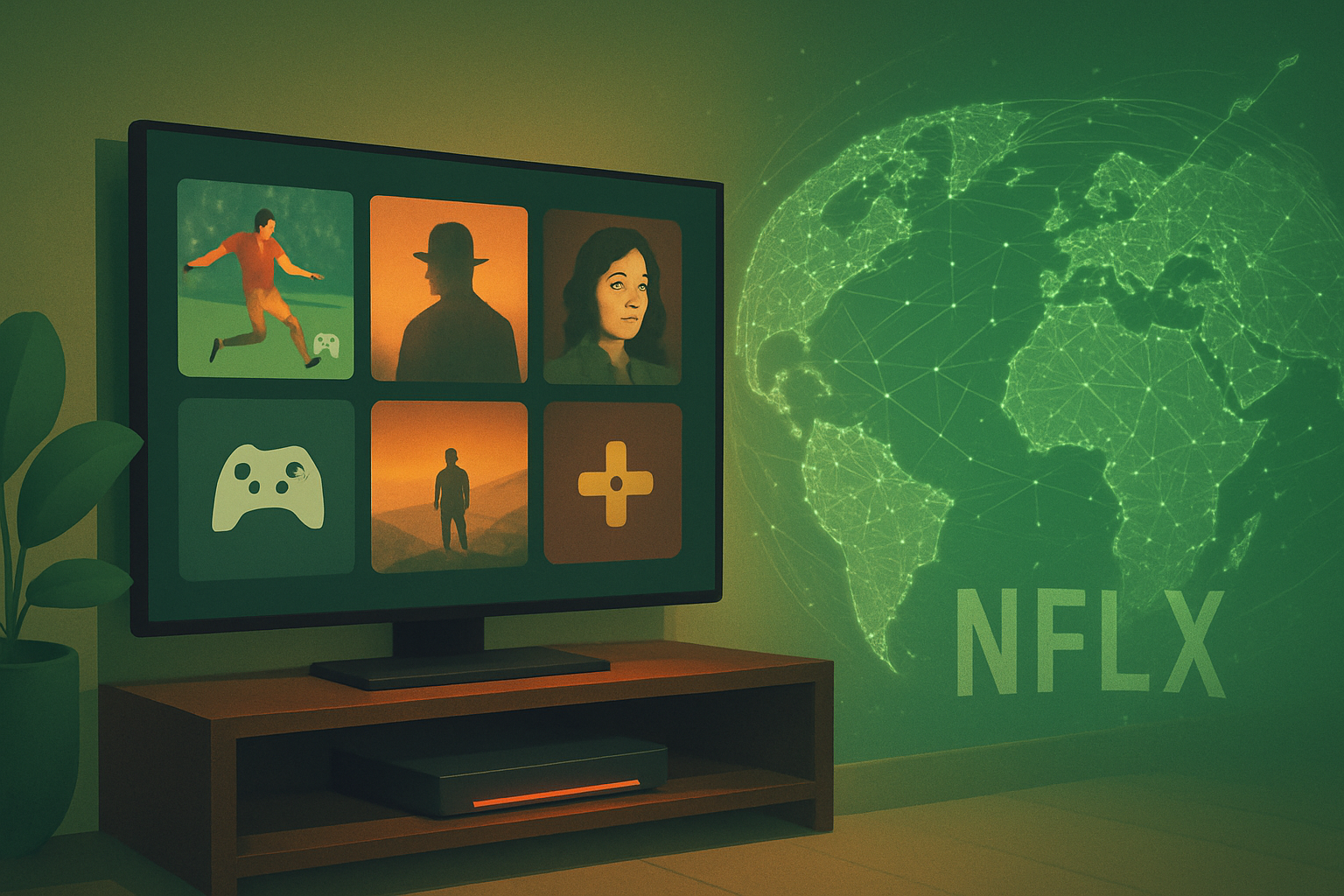
  • Netflix (NFLX): From Streaming Pioneer to Diversified Entertainment Titan (2026 Analysis)

    Netflix (NFLX): From Streaming Pioneer to Diversified Entertainment Titan (2026 Analysis)

    As of March 10, 2026, the streaming landscape has evolved from a frantic race for subscribers into a disciplined battle for profitability and "share of time." At the center of this transformation stands Netflix, Inc. (NASDAQ: NFLX), a company that has successfully reinvented itself multiple times over three decades. No longer just a library of on-demand films and series, Netflix has matured into a diversified entertainment ecosystem spanning live sports, cloud gaming, immersive physical retail, and a high-margin advertising business.

    With a market capitalization hovering near $350 billion and a global reach exceeding 345 million paying members, Netflix remains the undisputed benchmark for the digital media age. This article examines the company’s strategic pivots, financial resilience, and the competitive hurdles it faces in a consolidating global market.

    Historical Background

    Founded in 1997 by Reed Hastings and Marc Randolph as a DVD-by-mail service, Netflix’s history is defined by its ability to cannibalize its own successful business models before competitors can. Its first major pivot in 2007—from physical discs to streaming—disrupted the home video industry and eventually led to the downfall of giants like Blockbuster.

    The second era began in 2013 with House of Cards, marking Netflix’s transition into an original content studio. However, the most critical period of transformation occurred between 2022 and 2025. Following a "streaming recession" in early 2022, where the company saw its first subscriber loss in a decade, Netflix executed a radical strategic shift. It abandoned its long-standing opposition to advertising, launched a massive crackdown on password sharing, and aggressively moved into live programming. By 2026, the company has completed its transition from a pure-play subscription service to a multi-revenue stream media titan.

    Business Model

    Netflix’s business model in 2026 rests on four primary pillars:

    • Streaming Video on Demand (SVOD): The core "Standard" and "Premium" tiers remain the largest revenue drivers, localized into dozens of languages.
    • Advertising (AVOD): The "Standard with Ads" tier has become the fastest-growing segment, attracting price-sensitive consumers and high-spending advertisers.
    • Live Events & Sports: Through multi-billion dollar deals for WWE and NFL games, Netflix has moved into "appointment viewing," creating high-value ad inventory.
    • Ancillary Ventures: This includes Netflix Games (a retention tool), Netflix House (physical retail and dining experiences), and consumer products/merchandise.

    By diversifying its income, Netflix has mitigated the "churn" associated with traditional streaming, ensuring that even if a user pauses their subscription, they might still engage via the ad-tier or physical experiences.

    Stock Performance Overview

    As of March 2026, Netflix remains a "Darling of Wall Street," though its valuation metrics have shifted to reflect its maturity. Following a 10-for-1 stock split in late 2025, the stock trades in the $85–$105 range (post-split).

    • 1-Year Performance: Up approximately 13.4%, outperforming many of its direct media peers as the ad-tier scaled faster than anticipated.
    • 5-Year Performance: Up ~94%, a remarkable recovery from the 2022 lows when the stock plummeted below $200 (pre-split).
    • 10-Year Performance: A staggering ~903% return, cementing its status as one of the best-performing large-cap stocks of the last decade.

    Investors now value Netflix less on raw subscriber additions and more on Average Revenue Per Member (ARM) and Free Cash Flow (FCF) growth.

    Financial Performance

    Netflix’s fiscal 2025 results showcased a company in peak operational form.

    • Revenue: Reached $45.2 billion in 2025, with projections for 2026 sitting between $51 billion and $52 billion.
    • Operating Margin: Expanded to 29.5% in 2025, with a target of 31.5% for 2026, driven by the high-margin nature of ad sales.
    • Free Cash Flow: Reported at $9.5 billion in 2025, nearly doubling from 2023 levels. This liquidity allowed the company to walk away from a potential $83 billion acquisition of Warner Bros. Discovery in early 2026, choosing instead to focus on organic growth and share buybacks.
    • Debt: Netflix maintains an investment-grade credit rating, with a disciplined debt-to-EBITDA ratio that remains the envy of debt-laden rivals like Disney or the newly merged Paramount-Max.

    Leadership and Management

    The "Co-CEO" model, once viewed with skepticism, has proven highly effective. Ted Sarandos, the creative architect, oversees the $17 billion+ annual content budget, while Greg Peters, the operational mind, has successfully scaled the ad-tech and gaming infrastructure.

    The board remains under the influential gaze of Reed Hastings, who serves as Executive Chairman. Recent key appointments include Dan Lin as Chairman of Netflix Film, who has steered the studio toward a "quality over quantity" approach, and Elizabeth Stone, Chief Product and Technology Officer, who is currently leading the integration of Generative AI into the platform’s recommendation and production workflows.

    Products, Services, and Innovations

    Innovation in 2026 is focused on the "Netflix Ecosystem."

    • Ad-Tech: In 2025, Netflix launched its proprietary ad-tech platform, moving away from its partnership with Microsoft (MSFT). This allows for hyper-targeted advertising based on viewing habits and household data.
    • Cloud Gaming: Netflix has officially rolled out its cloud gaming service to smart TVs, allowing members to play AAA titles like Grand Theft Auto and Red Dead Redemption using their smartphones as controllers.
    • Netflix House: These 100,000-square-foot permanent entertainment complexes in cities like Philadelphia and Dallas offer fans a way to "live" their favorite shows, featuring Squid Game challenges and themed dining at Netflix Bites.

    Competitive Landscape

    The "Streaming Wars" have entered a phase of consolidation. Netflix’s primary rivals in 2026 are:

    • YouTube (GOOGL): Netflix’s biggest competitor for "share of time." YouTube’s massive reach in user-generated content and short-form video remains a constant threat to long-form engagement.
    • Disney+ (DIS): While Disney dominates in franchise IP (Marvel, Star Wars), it continues to struggle with the transition from linear TV to full digital profitability.
    • Max-Paramount: Following the merger of Warner Bros. Discovery assets with Paramount-Skydance in early 2026, this entity represents Netflix’s most direct rival in prestige drama and library depth.

    Netflix’s competitive edge lies in its global production engine. It is the only streamer that can create a local hit in Korea (e.g., Squid Game) or Spain (e.g., Money Heist) and turn it into a global cultural phenomenon overnight.

    Industry and Market Trends

    The streaming industry in 2026 is defined by three macro trends:

    1. Bundling 2.0: Streamers are increasingly partnering with telcos and even rival platforms to offer "super-bundles" to reduce churn.
    2. The Live Pivot: With scripted content costs rising, platforms are turning to live sports and unscripted "event" television to keep users engaged daily.
    3. Local Content Quotas: Governments, particularly in the EU and India, are mandating that a significant percentage of content must be produced locally, forcing Netflix to shift from an "export" model to a "local-first" production strategy.

    Risks and Challenges

    Despite its dominance, Netflix faces significant headwinds:

    • Content Inflation: Even with a $20 billion budget, the cost of top-tier talent and sports rights (like the NFL) is escalating rapidly.
    • Regulatory Scrutiny: Increased focus on data privacy and local content quotas in Europe and Asia could increase operational costs.
    • Saturation: In North America and Western Europe, Netflix has reached near-peak penetration. Growth must now come from price hikes or lower-margin emerging markets like India and Southeast Asia.
    • AI Disruption: While AI can lower production costs, it also lowers the barrier to entry for new competitors to create high-quality content.

    Opportunities and Catalysts

    • Ad-Tier Scaling: Analysts project that by 2027, advertising could account for 15-20% of Netflix's total revenue.
    • FIFA World Cup 2026: Netflix’s partnership for a massive documentary series and mobile game around the 2026 World Cup in North America is expected to drive a surge in summer subscriptions.
    • Gaming Monetization: While games are currently "free" with subscriptions, the potential for in-game purchases or standalone gaming tiers remains a massive untapped revenue lever.

    Investor Sentiment and Analyst Coverage

    Wall Street sentiment remains overwhelmingly "Buy" or "Strong Buy." Analysts at firms like Goldman Sachs and Morgan Stanley have praised the company's "surgical execution" of the password-sharing crackdown. Institutional ownership remains high, with major positions held by Vanguard and BlackRock. Retail sentiment, tracked via social platforms, has improved as the "content drought" of the strike-impacted years (2023-2024) has been replaced by a consistent slate of blockbusters.

    Regulatory, Policy, and Geopolitical Factors

    Geopolitics remains a minefield for Netflix. In South Korea, the government is investigating whether Netflix's dominance is stifling local broadcasters. In India, strict new regulations regarding cultural and religious depictions have forced Netflix to be more conservative in its local originals. Meanwhile, in the European Union, the 30% local content quota is strictly enforced, compelling Netflix to maintain massive production hubs in Madrid, Paris, and Berlin.

    Conclusion

    Netflix enters mid-2026 as a significantly more complex and resilient company than it was just four years ago. By embracing advertising and live events, it has solved the "subscriber plateau" problem that once haunted its valuation. While the competition from YouTube and the newly merged Max-Paramount is formidable, Netflix’s data-driven approach to content and its growing ad-tech prowess provide a formidable moat.

    For investors, the key metrics to watch over the next 12 months will be the growth of the ad-supported monthly active users (MAUs) and the successful scaling of the cloud gaming initiative. If Netflix can continue to prove that it is not just a TV network, but a global entertainment utility, its stock likely has further room to run in the second half of the decade.


    This content is intended for informational purposes only and is not financial advice.

  • Apple in 2026: The $3.8 Trillion AI Powerhouse Navigating a New Era

    Apple in 2026: The $3.8 Trillion AI Powerhouse Navigating a New Era

    Date: March 10, 2026

    Introduction

    As of March 10, 2026, Apple Inc. (NASDAQ: AAPL) stands not just as a technology company, but as a global economic pillar with a market capitalization hovering near $3.8 trillion. For decades, the narrative surrounding Apple was defined by its hardware prowess—the Macintosh, the iPod, and the ubiquitous iPhone. Today, however, the company is in the midst of its most significant metamorphosis since the 2007 debut of the smartphone.

    Apple is currently at the center of an "AI-driven super-cycle," fueled by the maturation of Apple Intelligence and a strategic pivot toward spatial computing via the Vision Pro lineup. With a massive installed base of over 2.5 billion active devices, Apple remains the gold standard for ecosystem "stickiness." Yet, the company faces unprecedented headwinds from global regulators and a shifting leadership bench. This article explores the intricate machinery of the world’s most valuable brand and its trajectory in an increasingly autonomous and regulated world.

    Historical Background

    Apple’s journey is one of the most storied in corporate history. Founded in 1976 by Steve Jobs, Steve Wozniak, and Ronald Wayne in a California garage, the company’s early years were defined by the Apple II and the revolutionary Macintosh (1984). After a period of decline and the ousting of Jobs in 1985, the company teetered on the brink of bankruptcy in the late 1990s.

    The "Second Coming of Jobs" in 1997 initiated a golden age of industrial design and consumer electronics. The iMac G3, the iPod (2001), and the iPhone (2007) fundamentally changed how humans interact with technology. Following Jobs’ passing in 2011, Tim Cook took the helm, shifting the company’s focus toward operational excellence, global supply chain optimization, and the expansion of the Services segment. Under Cook, Apple transitioned from a high-growth hardware disruptor into a high-margin services juggernaut and a dividend-paying blue chip.

    Business Model

    Apple’s business model is built on a "walled garden" philosophy, where hardware, software, and services are tightly integrated to create a seamless user experience.

    1. iPhone: Remains the primary revenue driver, accounting for roughly 50-55% of total sales. The iPhone acts as the "gateway" to the rest of the ecosystem.
    2. Services: The fastest-growing and highest-margin segment (over 75% gross margin). This includes the App Store, iCloud, Apple Music, Apple Pay, and the burgeoning Apple Intelligence subscription tiers.
    3. Wearables, Home, and Accessories: Includes the Apple Watch, AirPods, and the Vision Pro. This segment has become larger than some Fortune 500 companies on its own.
    4. Mac and iPad: While more mature markets, these remain critical for professionals and students, now powered by Apple’s industry-leading proprietary silicon (M-series chips).

    The core of the model is lock-in: once a user is invested in the iCloud ecosystem and owns multiple devices, the switching costs (both financial and cognitive) become prohibitively high.

    Stock Performance Overview

    Over the past decade, AAPL has been a cornerstone of wealth creation for institutional and retail investors alike.

    • 10-Year Performance: Apple has delivered a staggering total return, significantly outperforming the S&P 500. A decade ago, the stock split-adjusted price was a fraction of today’s levels, reflecting the massive scale-up of the Services business and aggressive share buybacks.
    • 5-Year Performance: Despite pandemic-induced supply chain disruptions and geopolitical tensions, the stock surged as the "work from home" era boosted Mac and iPad sales, followed by the AI-led rally of 2024-2025.
    • 1-Year Performance: Over the last 12 months, the stock has risen approximately 35%, recently trading between $257 and $260. This rally was largely driven by the successful launch of the iPhone 17 series and the rollout of Apple Intelligence in European and Asian markets.

    Financial Performance

    Apple’s financial health remains robust, characterized by record-breaking revenue and disciplined capital allocation.

    • Fiscal 2025 Recap: Apple reported a record $416.2 billion in annual revenue with a net income of $112 billion.
    • Latest Earnings (Q1 2026): For the holiday quarter ended December 2025, Apple reported revenue of $143.8 billion, a 16% year-over-year increase.
    • Margins: Gross margins have remained resilient in the 45-46% range, bolstered by the shift toward Services and the cost efficiencies of in-house silicon.
    • Balance Sheet: With over $160 billion in cash and marketable securities (partially offset by debt), Apple continues to be a "cash cow," returning billions to shareholders every quarter through dividends and buybacks.

    Leadership and Management

    Apple is currently navigating a generational leadership transition. While Tim Cook remains firmly in control as CEO, the retirement of several "old guard" executives has introduced new faces to the C-suite.

    • Tim Cook (CEO): Continues to lead with a focus on privacy, environment, and shareholder value.
    • Eddy Cue (SVP of Services and Health): Following the retirement of COO Jeff Williams in late 2025, Cue’s role expanded to include Health and Fitness, signaling the convergence of services and wellness.
    • Jennifer Newstead (General Counsel): Joined from Meta in early 2026 to lead Apple’s legal defense against mounting global antitrust challenges.
    • Craig Federighi (SVP of Software Engineering): Now a central figure as the face of Apple Intelligence, overseeing the integration of generative AI across all operating systems.

    Products, Services, and Innovations

    The 2025-2026 product cycle has been defined by two major themes: Thinness and Intelligence.

    • iPhone 17 Air: Launched in late 2025, this ultra-thin model represents a bold experiment in design, though early adoption in Western markets has been slower than the traditional Pro models.
    • Apple Intelligence: By March 2026, the "New Siri" is fully operational, featuring on-screen awareness and deep app integration. The partnership with Google Gemini provides a secondary engine for general knowledge, while Apple’s private cloud compute handles sensitive personal data.
    • Vision Pro (M5 Refresh): The latest iteration of Apple’s "spatial computer" features the M5 chip, improving refresh rates and weight distribution. While still a luxury item at $3,499, it serves as the R&D platform for future "Apple Glass" products.

    Competitive Landscape

    Apple operates in a "co-opetition" environment, where rivals are often also suppliers or partners.

    • Samsung Electronics (KSE: 005930): Remains the primary rival in the premium smartphone space and a key supplier of display technology.
    • Alphabet/Google (NASDAQ: GOOGL): A competitor in mobile OS (Android) but a partner in search and AI.
    • Huawei: Has staged a significant comeback in the Chinese market, challenging Apple’s market share in a critical growth region.
    • Meta Platforms (NASDAQ: META): The primary competitor in the burgeoning AR/VR and "Metaverse" space.

    Apple’s competitive edge lies in its vertical integration—owning the chip, the hardware, and the software allows for optimization that rivals struggle to match.

    Industry and Market Trends

    The tech industry in 2026 is dominated by the "Edge AI" revolution. Instead of relying solely on massive data centers, companies are racing to put AI processing directly on consumer devices. Apple’s M-series and A-series silicon give it a distinct advantage here, providing the power-per-watt efficiency needed for complex AI tasks without compromising battery life.

    Additionally, the trend toward "Silicon Self-Sufficiency" continues. Apple’s transition away from third-party modems and components (moving toward in-house Wi-Fi and Bluetooth chips) is nearing completion, further protecting its margins.

    Risks and Challenges

    Despite its dominance, Apple is not without significant risks:

    1. Regulatory Scrutiny: The US Department of Justice (DOJ) antitrust lawsuit is in a critical discovery phase. Simultaneously, the European Union’s Digital Markets Act (DMA) has already led to hundreds of millions in fines and forced Apple to allow third-party app stores, threatening the App Store’s lucrative commission model.
    2. China Concentration: While Apple is diversifying manufacturing to India and Vietnam, its reliance on China for both production and as a major consumer market remains a geopolitical vulnerability.
    3. Hardware Saturation: With smartphone replacement cycles lengthening, Apple must constantly innovate to justify its premium pricing.

    Opportunities and Catalysts

    • The "AI Super-Cycle": As older iPhones become incompatible with Apple Intelligence, analysts expect a massive wave of upgrades over the next 18 months.
    • Health Tech: Rumors of non-invasive blood glucose monitoring and advanced cardiac sensors in the Apple Watch Series 12 could open up new revenue streams in the medical sector.
    • Services Monetization: The potential for a "Premium AI" subscription tier could further expand Services revenue and ARPU (Average Revenue Per User).

    Investor Sentiment and Analyst Coverage

    Wall Street remains generally bullish on Apple. Wedbush Securities analyst Dan Ives has maintained a "Strong Buy" rating with a price target of $350, citing the "monetization of the AI era." However, more cautious analysts at firms like Piper Sandler highlight the stock’s high P/E ratio relative to historical norms, suggesting that much of the AI optimism may already be priced in.

    Institutional ownership remains high, with Vanguard, BlackRock, and Berkshire Hathaway continuing to hold significant positions, though Warren Buffett’s firm has slightly trimmed its stake in recent periods to manage concentration.

    Regulatory, Policy, and Geopolitical Factors

    The geopolitical landscape for Apple is increasingly complex. In the US, the "Right to Repair" movement and labor unionization efforts at Apple Stores are growing. Internationally, the US-China trade relationship remains the single largest external variable for the company. Any escalation in tariffs or export controls on high-end silicon could disrupt Apple’s production schedules.

    Furthermore, Apple’s commitment to "Apple 2030"—a goal to make its entire footprint carbon neutral—is a major policy driver, influencing everything from product packaging to its investments in renewable energy credits.

    Conclusion

    As of March 2026, Apple Inc. remains the quintessential "moat" company. It has successfully navigated the transition into the AI era, effectively integrating generative technology into its ecosystem without sacrificing the privacy-centric brand identity it has built over decades.

    While legal challenges in the US and EU represent a genuine threat to the App Store’s traditional economics, the company’s sheer scale and cash-generating power provide a significant buffer. For investors, Apple is no longer a high-growth "tech" stock in the traditional sense, but a high-performance utility that powers the modern digital life. The key will be watching how well the "iPhone 17 Air" and Vision Pro initiatives take hold, and whether Apple can maintain its precarious balance in the Chinese market amidst shifting global alliances.


    This content is intended for informational purposes only and is not financial advice.