Tag: INTC

  • Intel’s 2026 Crossroads: Navigating Supply Bottlenecks and the Quantum Horizon

    Intel’s 2026 Crossroads: Navigating Supply Bottlenecks and the Quantum Horizon

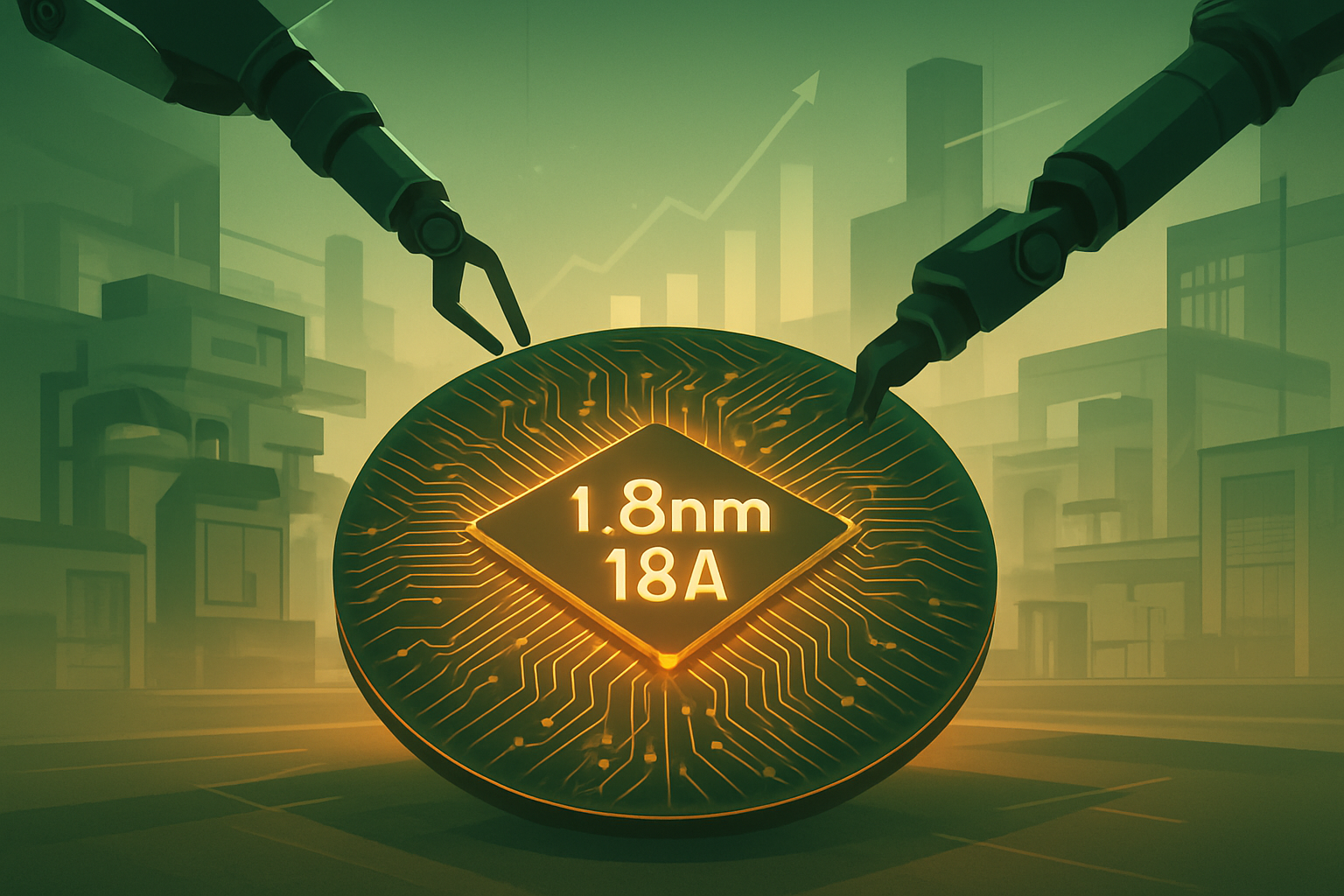
    As of January 27, 2026, Intel Corporation (Nasdaq: INTC) finds itself at the most critical juncture in its 58-year history. Once the undisputed titan of the semiconductor world, the company is now halfway through a radical, high-stakes transformation dubbed "IDM 2.0." While the Silicon Valley pioneer has successfully hit several key technical milestones in the past year, the market’s reaction remains lukewarm. Investors are currently weighing a "soft" first-quarter outlook and persistent supply constraints against the long-term promise of its 1.8nm manufacturing process (Intel 18A) and the emerging frontier of quantum computing.

    Intel is no longer just a chipmaker; it is attempting to become the Western world’s premier foundry—a "National Champion" for U.S. chip sovereignty. However, as the Q1 2026 guidance suggests, the road to redemption is paved with operational friction and intense competition from both traditional rivals and its own largest potential customers.

    Historical Background

    Founded in 1968 by Robert Noyce and Gordon Moore, Intel was the architect of the microprocessor revolution. For decades, it maintained a "tick-tock" manufacturing cadence that left competitors in the dust. The "Intel Inside" campaign of the 1990s made it a household name, and by the early 2010s, it controlled over 90% of the lucrative server and PC markets.

    However, the late 2010s saw a period of stagnation. Stumbles in transitioning to 10nm and 7nm nodes allowed Taiwan Semiconductor Manufacturing Co. (TSMC) to seize the lead in process technology, while Advanced Micro Devices (Nasdaq: AMD) surged in market share. In 2021, Pat Gelsinger returned as CEO to overhaul the company, a tenure that lasted until late 2024. Under his leadership, Intel committed to "five nodes in four years." As of early 2025, leadership passed to Lip-Bu Tan, the former Cadence CEO, who has shifted the focus toward a "Foundry First" model, emphasizing financial discipline and yield optimization over raw expansion.

    Business Model

    Intel’s business model is currently undergoing a structural divorce. The company has separated its financial reporting into two primary buckets: Intel Products and Intel Foundry.

    1. Intel Products: This includes the Client Computing Group (CCG), which focuses on PC and laptop processors (Core Ultra series); the Data Center and AI (DCAI) segment, which produces Xeon processors and Gaudi AI accelerators; and the Network and Edge (NEX) division.
    2. Intel Foundry: This is the capital-intensive manufacturing arm. It aims to manufacture chips not only for Intel but also for external "fabless" companies like Microsoft, Nvidia, and AWS.

    Additionally, Intel holds significant stakes in Mobileye (autonomous driving) and Altera (FPGA), though both have been partially spun off or moved toward independence to unlock value.

    Stock Performance Overview

    Intel’s stock performance has been a saga of volatility. Over the 10-year horizon, INTC has significantly underperformed the PHLX Semiconductor Index (SOX), as it missed the initial mobile revolution and the early AI boom.

    On a 5-year basis, the stock has traded in a wide range, often retreating to "value play" territory as manufacturing delays spooked investors. However, the 1-year performance leading into 2026 showed signs of a recovery, fueled by the official launch of the 18A node and the receipt of billions in CHIPS Act subsidies. Despite this, the recent 13–17% drop following the January 2026 earnings call has wiped out several months of gains, leaving the stock in a "show-me" state as it struggles to maintain its 2025 momentum.

    Financial Performance

    Intel’s Q4 2025 results were a "beat and fade." Revenue reached $13.7 billion, surpassing analyst estimates of $13.4 billion, with a non-GAAP EPS of $0.15. However, the Q1 2026 outlook was the primary driver of recent bearishness.

    Management guided for Q1 revenue between $11.7 billion and $12.7 billion, with a non-GAAP EPS of $0.00 (breakeven). Gross margins are also expected to contract to roughly 34.5% in the short term. This margin pressure stems from the high "start-up" costs of the 18A node and a global spike in the cost of materials. While the balance sheet has been bolstered by a $7.86 billion final payout from the U.S. CHIPS Act and a $5 billion strategic equity investment from Nvidia, Intel remains a capital-heavy business with a high burn rate as it builds out massive fabs in Ohio and Arizona.

    Leadership and Management

    The transition from Pat Gelsinger to Lip-Bu Tan in 2025 marked a shift from visionary engineering to pragmatic execution. Tan, a veteran of the EDA (Electronic Design Automation) industry, has been tasked with fixing Intel’s "Foundry" problem—specifically, making the manufacturing arm profitable as a standalone entity.

    Tan’s strategy has involved a 15% reduction in workforce and a more selective approach to R&D. While Gelsinger was the "architect" of the turnaround, Tan is the "operator" focused on yields and customer acquisition. The board remains under pressure to prove that the "Foundry First" model can eventually match the 50%+ margins seen by TSMC, a feat that many analysts believe is still several years away.

    Products, Services, and Innovations

    The crown jewel of Intel’s 2026 lineup is Panther Lake (Core Ultra Series 3), the first major consumer product built on the Intel 18A process. Early benchmarks for Panther Lake’s integrated Xe3 GPU suggest it can compete with entry-level discrete graphics cards from Nvidia, potentially revolutionizing the thin-and-light laptop market.

    In the data center, the Xeon 6 family (Granite Rapids and Sierra Forest) is Intel's primary weapon against AMD’s EPYC dominance. Furthermore, Intel is heavily marketing its AI PC vision, embedding NPUs (Neural Processing Units) across its entire product stack to handle local AI workloads.

    Competitive Landscape

    Intel faces a "war on three fronts":

    • The CPU Front: AMD continues to be a formidable rival. As of early 2026, AMD’s server market share sits near 30%, with its Zen 6 architecture challenging Intel’s Xeon 6 in power efficiency.
    • The AI Front: Nvidia (Nasdaq: NVDA) remains the king of data center AI. While Intel’s Gaudi 3 and future Falcon Shores chips offer a cost-effective alternative, Nvidia’s software moat (CUDA) remains difficult to penetrate.
    • The Foundry Front: TSMC is the "gold standard." To win over customers like Apple or Qualcomm, Intel Foundry must prove it can deliver yields and reliability on par with the Taiwanese giant.

    Industry and Market Trends

    Three macro trends are currently defining Intel’s trajectory:

    1. Sovereign Supply Chains: Governments are subsidizing domestic chip production to reduce reliance on East Asian supply chains. Intel is the primary beneficiary of this "reshoring" trend in the U.S. and Europe.
    2. The AI PC Cycle: A massive refresh cycle is expected in 2026 as businesses and consumers upgrade to hardware capable of running on-device generative AI.
    3. Advanced Packaging: As Moore’s Law slows down, "packaging" multiple chips together (chiplets) has become the new frontier. Intel’s Foveros technology is a key differentiator here.

    Risks and Challenges

    The primary headwind for Intel in early 2026 is supply constraints. Specifically:

    • Substrate Shortages: A lack of specialized substrates and "Advanced Packaging" capacity has created a bottleneck. Intel is currently unable to package chips as fast as it can print them.
    • Memory Costs: A global DRAM and HBM (High Bandwidth Memory) shortage has driven up prices by over 60% year-over-year, eating into Intel’s margins.
    • 18A Yield Risk: While 18A is in manufacturing, yields are reportedly between 55% and 75%. For the node to be truly profitable, Intel needs to push these yields above 80% by the end of 2026.

    Opportunities and Catalysts

    The Majorana-1 Factor: One of the most intriguing long-term catalysts is the progress in quantum computing. While Microsoft (Nasdaq: MSFT) made waves with its Majorana-1 quantum chip in 2025, the development has a profound secondary impact on Intel. As a lead foundry partner for Microsoft’s AI silicon, Intel is uniquely positioned to become the manufacturer of choice for the "quantum-classical hybrid" systems of the future. The development of Majorana-type topological qubits requires specialized materials and cryogenic-compatible manufacturing—areas where Intel’s research in silicon spin qubits and its "Tunnel Falls" chip have already established a technical foundation.

    If Intel can leverage its 18A node to manufacture the classical control logic required for Microsoft’s Majorana chips, it could secure a dominant position in the nascent quantum-as-a-service market.

    Investor Sentiment and Analyst Coverage

    Wall Street is currently split into two camps. The Bulls point to Intel’s low valuation (trading at a fraction of Nvidia’s P/E ratio) and its strategic importance to U.S. national security. They see the $5 billion investment from Nvidia as a "seal of approval" for Intel’s foundry capabilities.

    The Bears, however, are concerned by the "soft" Q1 guidance and the breakeven EPS. They argue that Intel is "trying to do too much at once"—rebuilding its manufacturing lead while simultaneously fighting a price war in the CPU market. Institutional sentiment has been cautious, with many hedge funds waiting for "clean" earnings reports that show expanding margins before committing long-term capital.

    Regulatory, Policy, and Geopolitical Factors

    Intel is perhaps the most "geopolitically sensitive" stock in the S&P 500.

    • CHIPS Act: The company has received nearly $20 billion in total grants and loans from the U.S. government, making it a "too big to fail" asset for the Department of Commerce.
    • Export Controls: Tightening restrictions on AI chip exports to China remain a risk for Intel’s data center business, though the company has developed "China-specific" versions of its processors to mitigate the impact.
    • Trade Policy: With potential shifts in U.S. trade policy in 2026, Intel’s massive domestic footprint provides a hedge against potential tariffs on imported chips.

    Conclusion

    Intel in 2026 is a study in "Technical Success vs. Operational Reality." On one hand, the company has achieved the "impossible" by bringing five process nodes to market in record time and securing high-profile foundry customers like Microsoft and Nvidia. On the other hand, the financial fallout of this transition—marked by soft guidance and acute supply constraints—continues to test investor patience.

    The impact of the Majorana-1 quantum development highlights a future where Intel could be the foundry for the world’s most advanced computing paradigms. However, for the stock to truly decouple from its "legacy" reputation, Intel must first solve its yield and packaging bottlenecks. Investors should watch the 18A yield reports and the Q2 2026 recovery closely. Intel is no longer a "safe" dividend stock; it is a high-stakes bet on the future of Western manufacturing.


    This content is intended for informational purposes only and is not financial advice. Today's Date: 1/27/2026.

  • Intel (INTC) Deep-Dive: 18A Triumphs, Supply Chain Crunches, and the 17% Plunge

    Intel (INTC) Deep-Dive: 18A Triumphs, Supply Chain Crunches, and the 17% Plunge

    Today, January 26, 2026, the market is still digesting a dramatic 17% plunge in Intel's share price following its Q4 2025 earnings report. Despite technical milestones that would usually signal a triumphant comeback, a "perfect storm" of supply chain bottlenecks and conservative forward guidance has left investors questioning the timing of the company's long-awaited "IDM 2.0" payoff.

    Intel Corporation (NASDAQ: INTC) remains the cornerstone of the Western semiconductor industry, yet its journey over the last several years has been nothing short of a corporate odyssey. After years of manufacturing delays and losing ground to rivals like Advanced Micro Devices (NASDAQ: AMD) and NVIDIA Corporation (NASDAQ: NVDA), Intel entered 2026 with a new CEO, a landmark manufacturing partnership with Apple Inc. (NASDAQ: AAPL), and a successful ramp-up of its 18A process node.

    However, the 17% stock collapse on January 23, 2026, served as a stark reminder that technical prowess does not always equal financial predictability. While the company beat earnings expectations for the final quarter of 2025, a dismal Q1 2026 outlook—driven by a "memory chip crunch" and depleted inventory buffers—sent shares reeling. This deep dive explores whether this plunge is a final "shakeout" before a massive recovery or a sign that the "Intel Turnaround" is still years away from fruition.

    Historical Background

    Founded in 1968 by Robert Noyce and Gordon Moore, Intel essentially created the modern computing era. From the 4004 microprocessor to the "Intel Inside" marketing blitz of the 1990s, the company maintained a near-monopoly on the PC and server markets for decades. Its "Tick-Tock" manufacturing model was the gold standard for industry progress until the mid-2010s, when Intel began to stumble on the transition to 10nm and 7nm processes.

    The late 2010s and early 2020s were characterized by "stagnation and lost leadership." Under previous leadership, Intel fell behind Taiwan Semiconductor Manufacturing Company (NYSE: TSM) in transistor density, allowing AMD to seize significant market share in both the consumer and data center segments. In 2021, Pat Gelsinger returned to the company with the ambitious "IDM 2.0" strategy, aiming to regain process leadership by 2025 and open Intel's doors as a world-class foundry. By late 2024, the slow pace of this transition led to Gelsinger's departure, ushering in the current era under CEO Lip-Bu Tan.

    Business Model

    Intel’s business model is currently undergoing its most radical shift in 50 years. Traditionally an Integrated Device Manufacturer (IDM), Intel is now splitting its operations into two distinct, but synergistic, arms:

    1. Intel Product: This includes the Client Computing Group (CCG), which focuses on PC processors like the new "Panther Lake" series; the Data Center and AI (DCAI) group; and the Network and Edge (NEX) group.
    2. Intel Foundry: This segment operates as a standalone business unit, competing directly with TSMC and Samsung. It manufactures chips for both Intel Product and external "foundry" customers.

    By separating the financial reporting of these two units, Intel aims to provide transparency into the high costs of building out its manufacturing "fabs" (fabrication plants) while protecting the margins of its design business.

    Stock Performance Overview

    The last five years have been a rollercoaster for INTC shareholders. Between 2021 and 2024, the stock lost nearly 60% of its value as the company poured tens of billions into capital expenditures while revenue growth stalled.

    In 2025, the stock saw a brief "renaissance," gaining 40% as the 18A node showed promising yields and NVIDIA took a $5 billion equity stake in the company. However, the recent 17% plunge has erased much of those gains, bringing the stock back to levels not seen since the summer of 2025. Currently, Intel remains a "underperformer" compared to the PHLX Semiconductor Index (SOX) over a 10-year horizon, highlighting the massive gap the company still needs to close to reward long-term holders.

    Financial Performance

    Intel’s Q4 2025 earnings, reported last week, showed a company in the middle of a painful transition.

    • Revenue: $13.7 billion (a 4% YoY decline, but slightly above analyst estimates).
    • Earnings Per Share (EPS): $0.15 (Non-GAAP), beating the $0.08 estimate.
    • The Guidance Shock: The catalyst for the 17% drop was the Q1 2026 revenue guidance of $11.7–$12.7 billion, significantly lower than the $12.5 billion consensus.
    • Margins: Gross margins remain under pressure near 40%, far below the 60%+ levels Intel enjoyed during its era of dominance. The high cost of ramping up new fabs in Arizona and Ohio continues to weigh on the bottom line.

    Leadership and Management

    In March 2025, Intel appointed industry veteran Lip-Bu Tan as CEO. Tan, the former CEO of Cadence Design Systems, is widely respected for his focus on execution and "engineering-first" culture.

    Under Tan, Intel has moved away from the "everything for everyone" approach. He has streamlined the product roadmap, focused on high-margin foundry wins (like the Apple 18A deal), and implemented a disciplined 15% workforce reduction to right-size the company’s cost structure. While the recent guidance was weak, many analysts credit Tan with being "brutally honest" about supply chain realities, a departure from the perceived over-optimism of previous regimes.

    Products, Services, and Innovations

    Intel’s technical roadmap is finally delivering on its promises.

    • 18A Process Node: Reaching High-Volume Manufacturing (HVM) in early 2026, 18A introduces PowerVia (backside power delivery) and RibbonFET (gate-all-around transistors). These are critical for catching up to TSMC’s 2nm process.
    • Panther Lake (Core Ultra Series 3): Launched at CES 2026, this chip is Intel’s flagship "AI PC" processor. Built on 18A, it claims a 27-hour battery life and an NPU (Neural Processing Unit) capable of 50 TOPS, making it a formidable competitor to Apple’s M-series chips.
    • Intel Foundry Services (IFS): The crowning achievement of late 2025 was securing Apple as a customer for 18A-P silicon, marking the first time the iPhone maker has utilized Intel’s manufacturing for its proprietary designs.

    Competitive Landscape

    Intel is fighting a two-front war:

    1. Manufacturing: It competes with TSMC (NYSE: TSM). While Intel has reached 18A, TSMC still holds the lion's share of the world's most advanced chip orders (including NVIDIA’s flagship AI GPUs).
    2. Design: It competes with AMD (NASDAQ: AMD) in the CPU market and NVIDIA (NASDAQ: NVDA) in AI accelerators. AMD has successfully used TSMC’s superior nodes for years to take data center market share, a trend Intel is only now starting to stabilize with its "Clearwater Forest" Xeon chips.

    Interestingly, the lines have blurred. NVIDIA’s $5 billion investment in Intel has turned a fierce rival into a "co-opetitor," as the two companies collaborate on custom x86 CPUs that integrate NVIDIA RTX graphics for the AI PC era.

    Industry and Market Trends

    The semiconductor world in 2026 is defined by "Sovereign AI" and the "AI PC."

    • AI PCs: The industry is betting that every consumer will want a laptop capable of running local Large Language Models (LLMs). Intel is at the forefront of this, aiming for 45% of the AI PC market by 2027.
    • Deglobalization: Geopolitical tensions have forced a "reshoring" of chip manufacturing. Intel is the primary beneficiary of this trend in the U.S., positioning itself as the "secure, domestic alternative" to Asian-based foundries.

    Risks and Challenges

    The 17% plunge was caused by "short-term operational friction," but the long-term risks remain significant:

    • Supply Chain Fragility: A shortage of specialized substrates and high-bandwidth memory (HBM) has prevented Intel from meeting demand, even as its factories are ready.
    • Execution Risk: Ramping up a new process node (18A) is notoriously difficult. Any yield issues in 2026 could jeopardize the Apple and Microsoft (NASDAQ: MSFT) foundry contracts.
    • Cash Flow: Intel is burning through cash to build fabs. While the U.S. government has taken a 10% stake to provide a cushion, the company’s dividend remains a distant memory.

    Opportunities and Catalysts

    • The "Whale" Customers: The Apple contract is a proof-of-concept. If Intel can successfully manufacture for Apple, other "hyperscalers" like Amazon (NASDAQ: AMZN) or Google (NASDAQ: GOOGL) may move their custom silicon to Intel Foundry.
    • NVIDIA Collaboration: The upcoming "NVIDIA-powered Intel CPUs" could redefine the gaming and workstation markets, leveraging NVIDIA’s software ecosystem with Intel’s manufacturing scale.
    • The 18A-P Ramp: If yields continue to exceed 60% through 2026, Intel will finally be able to claim "the best transistors in the world," a title it hasn't held in a decade.

    Investor Sentiment and Analyst Coverage

    Wall Street remains deeply divided on Intel.

    • Bulls: Point to the 18A success and the Apple partnership as evidence that the "hard part" is over. They view the 17% drop as a "generational buying opportunity."
    • Bears: Argue that Intel is "too little, too late" in the AI data center race and that the capital requirements of a foundry business will prevent meaningful share price appreciation for years.
    • Institutional Moves: Hedge fund activity has increased in late 2025, with several major players taking contrarian "long" positions, though retail sentiment remains scarred by years of poor performance.

    Regulatory, Policy, and Geopolitical Factors

    Intel is now a "quasi-sovereign" entity. In August 2025, the U.S. federal government acquired a 9.9% equity stake in the company. This move has fundamentally changed the risk profile.

    • Regulatory Relief: Many of the strict requirements of the initial CHIPS Act have been waived in exchange for the equity stake, giving Intel more operational flexibility.
    • Geopolitics: As the only Western company capable of leading-edge manufacturing, Intel is "too important to fail" for the U.S. Department of Defense. This provides a unique "policy floor" for the stock, though it also limits the company's ability to operate in certain international markets, particularly China.

    Conclusion

    Intel at the start of 2026 is a study in contradictions. It has finally achieved the process leadership that eluded it for a decade, yet its stock price is being punished for the "messiness" of the transition. The 17% plunge in late January is a painful reminder that the road to redemption is rarely a straight line.

    For investors, Intel is no longer a "safe" blue-chip dividend play; it is a high-stakes "turnaround" story with a government-backed safety net. The coming twelve months will be defined by one word: Execution. If Lip-Bu Tan can navigate the current supply chain "crunch" and deliver the Apple 18A orders on time, the 17% drop of January 2026 may be remembered as the final hurdle before Intel reclaimed its throne. If not, the company risks becoming a perpetual "value trap" in an industry that moves faster than ever.


    This content is intended for informational purposes only and is not financial advice.

  • The Great Re-Invention: Can Intel Reclaim the Silicon Crown?

    The Great Re-Invention: Can Intel Reclaim the Silicon Crown?

    Date: January 19, 2026
    Sector: Semiconductors
    Focus: Intel Corporation (NASDAQ: INTC)

    Introduction

    As we enter the first month of 2026, the global semiconductor landscape looks fundamentally different than it did just two years ago. At the heart of this shift is Intel Corporation (NASDAQ: INTC), a company that has spent the last five years in a high-stakes, multi-billion-dollar race against obsolescence. Once the undisputed king of silicon, Intel spent much of the early 2020s reeling from manufacturing delays, loss of market share to AMD, and a missed opportunity in the initial AI training gold rush.

    Today, however, the narrative has shifted. Intel is no longer just a chipmaker; it is a "National Champion" for the United States, a critical component of domestic economic and national security. With the imminent release of its Q4 2025 earnings and the high-volume production of its revolutionary 18A process node, Intel stands at a crossroads. This deep dive explores whether the "IDM 2.0" gamble has finally paid off and what the "AI PC" era means for the company's future.

    Historical Background

    Founded in 1968 by Robert Noyce and Gordon Moore, Intel was the architect of the digital age. Under the legendary leadership of Andy Grove, the company adopted an "only the paranoid survive" mantra, which fueled its dominance in the 1990s and early 2000s through the "Wintel" (Windows + Intel) partnership.

    However, the 2010s were marked by strategic missteps. Intel famously declined to produce the processor for the original iPhone, a decision that essentially locked them out of the mobile revolution. This was followed by a decade of manufacturing stagnation, where Intel’s "Tick-Tock" development cycle broke down at the 10nm and 7nm stages, allowing competitors like Taiwan Semiconductor Manufacturing Company (TSMC) to seize the technological lead. By the time Pat Gelsinger returned as CEO in 2021, Intel was a company in crisis—losing server market share to AMD and watching NVIDIA become the world's most valuable chipmaker.

    Business Model

    Intel has fundamentally restructured its business into two distinct, yet synergistic, arms:

    1. Intel Product: This segment focuses on the design of processors for PCs (Client Computing Group), Data Centers (Data Center and AI), and Networking. The focus here has shifted toward "AI PCs"—devices capable of running complex AI models locally.
    2. Intel Foundry: This is the manufacturing arm, now operating as a wholly-owned subsidiary with its own independent financial reporting. Intel Foundry aims to be the world’s second-largest foundry by 2030, serving external customers like Microsoft, Amazon, and even rivals like NVIDIA for advanced packaging.

    This "IDM 2.0" model allows Intel to use its own factories to build its chips (ensuring supply) while also profiting from the global demand for third-party chip manufacturing.

    Stock Performance Overview

    Intel’s stock trajectory over the last decade has been a volatile "U-shaped" curve.

    • 10-Year Horizon: Investors who held INTC for a decade have seen significant underperformance compared to the S&P 500 and the Philadelphia Semiconductor Index (SOX). The stock spent years range-bound as the company struggled with manufacturing.
    • 5-Year Horizon: The 2021–2024 period was painful, with the stock hitting multi-decade lows in late 2024 (dipping below $20) as the company slashed its dividend and laid off 15% of its workforce.
    • 1-Year Horizon (2025): 2025 was the year of the "Intel Rebound." The stock rose over 100% from its 2024 lows, reaching the $50 mark in early 2026. This recovery was fueled by successful milestones in the 18A process node and massive subsidies from the U.S. CHIPS Act.

    Financial Performance

    Intel is scheduled to report its Q4 and full-year 2025 earnings on January 22, 2026.

    • Q4 2025 Preview: Analysts expect revenue between $13.3 billion and $13.9 billion. The market is looking for an Earnings Per Share (EPS) of $0.08—modest, but a sign of stability after the heavy losses of the previous year.
    • Margin Recovery: One of the most watched metrics is gross margin. After dipping into the 20s during 2024, margins have expanded to approximately 38.2% as of late 2025, driven by higher-margin AI PC chips (Core Ultra) and improved factory utilization.
    • Balance Sheet: Intel remains capital-intensive. While it carries significant debt from factory expansions in Ohio and Arizona, its cash position has been bolstered by an $8.9 billion direct equity investment from the U.S. government in late 2025.

    Leadership and Management

    In a surprising turn of events in early 2025, Pat Gelsinger transitioned to an emeritus role, and Lip-Bu Tan—the former CEO of Cadence Design Systems and a legendary semiconductor veteran—was appointed CEO.

    Tan’s leadership has been characterized by a "Foundry-First" mentality and ruthless financial discipline. He has successfully navigated the structural separation of the Foundry business, a move that helped win over major customers like Apple, who previously hesitated to work with a direct competitor. The board’s governance has been praised for finally providing the clarity needed to execute the manufacturing roadmap.

    Products, Services, and Innovations

    Intel's competitive edge in 2026 rests on two pillars:

    1. Intel 18A (1.8nm class): This process node is the first to use RibbonFET (Gate-All-Around) and PowerVia (backside power delivery) in high-volume manufacturing. By beating TSMC to the market with backside power, Intel has reclaimed the title of "technological leader" for the first time in a decade.
    2. Panther Lake (Core Ultra Series 3): Launched at CES 2026, Panther Lake is Intel’s flagship AI PC processor. Built on the 18A node, it offers 120 TOPS (Trillions of Operations Per Second) of AI performance and battery life exceeding 25 hours.
    3. Gaudi 3 & 4: While Intel still trails NVIDIA in high-end AI training, its Gaudi accelerators have found a niche as a "price-to-performance" alternative for enterprises building private AI clouds.

    Competitive Landscape

    Intel faces a three-front war:

    • AMD (NASDAQ: AMD): In the data center, AMD is a titan. As of early 2026, AMD’s EPYC processors hold nearly 40% of the server market, and AMD's Data Center revenue recently eclipsed Intel's for the first time.
    • NVIDIA (NASDAQ: NVDA): NVIDIA owns the AI training market. Intel is not trying to beat NVIDIA at the top end but is instead partnering with them for advanced packaging services through Intel Foundry.
    • Qualcomm (NASDAQ: QCOM) & Apple (NASDAQ: AAPL): These companies lead the ARM-based efficiency race. However, Intel’s Panther Lake has largely closed the power-efficiency gap, making x86 relevant again in the thin-and-light laptop segment.

    Industry and Market Trends

    The semiconductor industry in 2026 is defined by "Silicon Sovereignty." Nations are no longer comfortable relying on a single geography (Taiwan) for advanced chips. This "China + 1" strategy has funneled billions into Intel’s US-based fabs.

    Furthermore, the AI PC Cycle is in full swing. Estimates suggest that 60% of all laptop shipments in 2026 will be "AI-capable," requiring the high-performance NPUs (Neural Processing Units) that Intel has integrated into its latest silicon.

    Risks and Challenges

    • Execution Risk: While 18A is in high-volume manufacturing, keeping yields high is difficult. Any stumble in the 14A (1.4nm) roadmap could send the stock back to 2024 levels.
    • Market Share Erosion: AMD’s momentum in the server market is difficult to stop. Intel must prove that its "Clearwater Forest" Xeon chips can stop the bleeding.
    • China Exposure: Ongoing export controls on high-end AI and manufacturing equipment to China continue to limit Intel’s total addressable market in one of the world’s largest tech hubs.

    Opportunities and Catalysts

    • Foundry Customer Wins: Rumors are swirling that Intel Foundry will officially announce a massive 18A partnership with Apple for 2027 M-series chips. If confirmed in the Q4 call, this would be a "paradigm shift" event.
    • The Windows 10 Refresh: As Windows 10 reaches the end of extended support, a massive corporate refresh cycle is expected in 2026, which will benefit Intel’s Client Computing Group.
    • Spin-off Potential: If Intel Foundry continues to gain external customers, a full IPO or spin-off of the foundry business could unlock massive shareholder value.

    Investor Sentiment and Analyst Coverage

    Wall Street is "cautiously bullish." For the first time in five years, the majority of analysts have moved from "Hold" to "Buy" on INTC. Institutional investors, including major hedge funds, have rebuilt their positions, betting on the "National Champion" thesis. Retail sentiment remains mixed, as many long-term holders are still recovering from the 2021–2024 downturn, but the "Panther Lake" benchmarks have generated significant tech-community hype.

    Regulatory, Policy, and Geopolitical Factors

    Intel is the primary beneficiary of the U.S. CHIPS and Science Act. Beyond the $8.5 billion in grants, the U.S. government’s decision to take a 9.9% equity stake in the company has effectively "de-risked" Intel from a bankruptcy or hostile takeover perspective. However, this also means Intel is subject to intense regulatory oversight and must align its strategy with U.S. national security interests, which can sometimes conflict with short-term profit maximization.

    Conclusion

    Intel enters 2026 as a company transformed. The "Dark Ages" of 2024 appear to be in the rearview mirror, replaced by a focused, dual-engine strategy that leverages both its design prowess and its newly reclaimed manufacturing leadership.

    Investors should watch the January 22nd earnings call with two questions in mind: First, are 18A yields stable enough to maintain the promised gross margin recovery? And second, can Intel Foundry land a "whale" customer that isn't the U.S. government? If the answer to both is yes, Intel may finally be ready to reclaim its crown as the bedrock of the American technology industry.


    This content is intended for informational purposes only and is not financial advice.

  • The Silicon Renaissance: A Deep-Dive into Intel’s (INTC) 2026 Turnaround

    The Silicon Renaissance: A Deep-Dive into Intel’s (INTC) 2026 Turnaround

    Date: January 14, 2026

    Introduction

    Intel Corporation (NASDAQ: INTC) enters 2026 as one of the most remarkable turnaround stories in modern corporate history. After a harrowing 2024 that saw the silicon giant’s market value plummet to decade-lows and its very survival questioned by skeptics, the company has emerged as a leaner, more focused "National Champion." Today, Intel is no longer just a processor company; it is the linchpin of the United States’ strategy to reshore semiconductor manufacturing. With its revolutionary 18A process node now in high-volume production and a new leadership team emphasizing operational rigor, Intel is at the center of the global AI infrastructure race and the burgeoning "AI PC" market.

    Historical Background

    Founded in 1968 by Robert Noyce and Gordon Moore, Intel was the pioneer of the microprocessor—the "brain" of the modern computer. Under the legendary leadership of Andy Grove in the 1980s and 90s, Intel pivoted from memory chips to CPUs, establishing the "Intel Inside" era and the "x86" dominance that powered the PC revolution. However, the 2010s were marked by stagnation. Delayed transitions to 10nm and 7nm processes allowed competitors like Taiwan Semiconductor Manufacturing Company (NYSE: TSM) and Advanced Micro Devices (NASDAQ: AMD) to seize the technological lead. In 2021, Pat Gelsinger returned as CEO to launch the "IDM 2.0" strategy—a multi-year, multi-billion-dollar bet to reclaim manufacturing parity. His retirement in early 2025 paved the way for the current "Foundry First" era under Lip-Bu Tan.

    Business Model

    Intel’s business model has undergone a fundamental split into two primary engines:

    1. Intel Product: This includes the Client Computing Group (CCG), which dominates the consumer laptop and desktop market, and the Data Center and AI (DCAI) group, which sells Xeon processors and Gaudi AI accelerators.
    2. Intel Foundry (IFS): Operating as a separate P&L, the Foundry business aims to manufacture chips for external customers, including rivals. This segment provides design services, wafer fabrication, and advanced packaging (EMIB, Foveros).
    3. NEX (Network and Edge): Focuses on edge computing and telecommunications infrastructure, a growing segment as AI processing moves closer to the end-user.

    Stock Performance Overview

    The last 12 months have been a renaissance for shareholders. Following a dismal 2024 where the stock bottomed out in the low $20s, INTC rallied 84% in 2025.

    • 1-Year Performance: As of mid-January 2026, Intel is trading in the $44.00 – $48.00 range, a levels not seen since the pre-inflationary peaks of 2021.
    • 5-Year Performance: On a five-year horizon, the stock is finally nearing a "breakeven" for long-term holders, though it still trails the broader S&P 500 and the PHLX Semiconductor Index (SOX).
    • Recent Momentum: A 10.8% surge in early January 2026 followed reports of successful 18A yields and a strategic $5 billion investment from NVIDIA (NASDAQ: NVDA) to secure future packaging capacity.

    Financial Performance

    Intel’s Q3 and Q4 2025 earnings signaled a definitive return to profitability.

    • Revenue: Q3 2025 revenue hit $13.7 billion, a 3% year-over-year increase, driven by the explosive adoption of AI PCs.
    • Profitability: The company reported a net income of $4.1 billion in Q3, a sharp recovery from the massive $16.6 billion write-down and loss recorded in late 2024.
    • Margins: Gross margins have expanded to 38.2%, up from the mid-20s during the height of the transition. This improvement is attributed to the $10 billion cost-cutting initiative implemented throughout 2025 and higher fab utilization.
    • Cash Flow: The company expects to reach full-year cash-flow positivity in 2026, supported by federal grants and capital offsets from the "Smart Capital" strategy.

    Leadership and Management

    In March 2025, industry veteran and former Cadence Design Systems CEO Lip-Bu Tan took the helm as CEO. Tan’s leadership has been defined by a "Foundry First" philosophy. While Pat Gelsinger focused on the visionary roadmap (5 nodes in 4 years), Tan has focused on execution and yield.
    His administration has:

    • Stabilized the leadership team after significant exits in 2024.
    • Secured high-profile foundry customers like Microsoft and Amazon Web Services (AWS).
    • Managed the delicate conversion of CHIPS Act grants into a government equity stake, effectively "de-risking" Intel's balance sheet from a debt spiral.

    Products, Services, and Innovations

    Innovation at Intel is currently defined by the 18A process node. This technology introduces two industry firsts: PowerVia (backside power delivery) and RibbonFET (gate-all-around transistors).

    • Panther Lake: Launched at CES 2026, this is the first consumer CPU built entirely on 18A. It offers a 30% performance-per-watt improvement over previous generations, positioning Intel to fight back against Apple (NASDAQ: AAPL) Silicon and ARM-based rivals.
    • Gaudi 3 & 4: While NVIDIA dominates the "training" market, Intel’s Gaudi accelerators have found a niche in AI inference, where they offer superior price-performance for enterprise applications.
    • High-NA EUV: Intel is currently the only firm with multiple ASML (NASDAQ: ASML) High-NA EUV lithography machines in operation, a key advantage for the upcoming 14A node.

    Competitive Landscape

    The competitive environment remains fierce but has shifted in Intel's favor in specific areas:

    • TSMC: Still the leader in total volume, TSMC’s 2nm node is expected to ramp in late 2026. Intel’s 18A, arriving earlier with backside power, gives it a temporary technological "window" of efficiency superiority.
    • AMD: AMD continues to pressure Intel in the server market with its EPYC processors. However, Intel’s Clearwater Forest Xeons (built on 18A) are beginning to reclaim market share in power-sensitive hyperscale data centers.
    • NVIDIA: No longer just a rival, NVIDIA is now a critical "frenemy." Their $5 billion investment in Intel stock highlights Intel's unique position as the only US-based provider of the advanced packaging required for H100/B200 successors.

    Industry and Market Trends

    Three macro trends are favoring Intel’s current trajectory:

    1. AI PC Adoption: The industry is shifting from cloud-only AI to "Local AI." Intel estimates that by the end of 2026, 60% of new laptop shipments will be AI-capable, a segment Intel currently leads.
    2. Sovereign AI: Governments in Europe and Asia are seeking non-Taiwan-based manufacturing to ensure supply chain resilience. Intel Foundry is the primary beneficiary of this "Sovereign AI" movement.
    3. Foundry Secular Growth: The decoupling of chip design and chip manufacturing continues to accelerate, with more "Hyper-scalers" (Google, Meta) designing their own silicon and needing a foundry to build it.

    Risks and Challenges

    Despite the recovery, Intel is not yet in the clear:

    • Execution Risk: The ramp of 18A must remain flawless. Any yield regressions could cause customers like Microsoft or AWS to revert to TSMC.
    • Debt and Liquidity: Even with government aid, Intel’s capital expenditures are massive ($20B+ annually). Maintaining a healthy balance sheet while building fabs in Ohio and Germany is a high-wire act.
    • ARM Intrusion: Qualcomm (NASDAQ: QCOM) and Apple are making aggressive gains in the Windows-on-ARM laptop space, threatening Intel's CCG margins.

    Opportunities and Catalysts

    • Intel Foundry Spinoff: Rumors persist that Lip-Bu Tan may eventually spin off the Foundry business into a separate public entity by 2027. This could unlock massive shareholder value by removing the "manufacturing drag" from the product side's valuation.
    • 18A Customer Wins: Announcements of a major mobile player (e.g., Apple or Samsung) using 18A for a specific chip line would be a massive catalyst for the stock.
    • Sustained AI PC Cycle: A faster-than-expected replacement cycle for enterprise laptops could drive CCG revenues to record highs.

    Investor Sentiment and Analyst Coverage

    Wall Street has largely shifted its consensus from "Sell" or "Underperform" to "Hold" or "Buy."

    • KeyBanc recently raised its price target to $60, citing Intel's unique "National Champion" status.
    • Institutional Holdings: Major asset managers like BlackRock and Vanguard have maintained their 8%+ stakes, while several "turnaround-focused" hedge funds increased their positions in Q4 2025.
    • Retail Sentiment: On social platforms, the narrative has shifted from mocking Intel’s "legacy" status to highlighting its role as a strategic defense asset for the US.

    Regulatory, Policy, and Geopolitical Factors

    Intel is now inextricably tied to US geopolitical interests.

    • US Government Equity: In August 2025, the U.S. Department of Commerce converted $8.9 billion of CHIPS Act grants into a 9.9% direct equity stake in Intel. This makes the US government the company's single largest shareholder, effectively guaranteeing that the company is "too big to fail."
    • The Secure Enclave: Intel has been designated the primary manufacturer for the Pentagon’s "Secure Enclave" program, providing a steady stream of high-margin, sensitive government contracts.

    Conclusion

    Intel is no longer the lumbering giant of the 2010s. By embracing its role as a foundry for the world and securing the backing of the United States government, it has stabilized its foundation. The successful high-volume manufacturing of 18A marks the first time in a decade that Intel has a legitimate claim to the "world's best transistor." For investors, Intel represents a high-stakes play on the future of US manufacturing and AI hardware. While risks of execution and heavy capital requirements remain, the "Silicon Renaissance" of 2026 suggests that Intel’s best days may not be behind it after all.


    This content is intended for informational purposes only and is not financial advice.

  • The Silicon Renaissance: A Deep Dive into Intel’s 2026 Turnaround (INTC)

    The Silicon Renaissance: A Deep Dive into Intel’s 2026 Turnaround (INTC)

    As of January 14, 2026, Intel Corporation (Nasdaq: INTC) finds itself at a pivotal "inflection point" that many industry veterans are calling the "Silicon Renaissance." After a brutal 2024 that saw the company’s valuation crater and the retirement of its visionary but beleaguered CEO, Pat Gelsinger, Intel has emerged in early 2026 as a leaner, more disciplined, and strategically vital entity.

    The narrative surrounding Intel has shifted from a question of survival to a test of execution. With its high-stakes "18A" process node now in high-volume manufacturing and a new leadership team focused on operational rigor, Intel is no longer just a chipmaker; it has become the "National Champion" of Western semiconductor manufacturing. This article explores the company’s recent financial recovery, the impact of significant government intervention, and the long-term outlook for a stock that has staged one of the most remarkable rebounds in recent market history.

    Historical Background

    Intel’s story is the story of Silicon Valley itself. Founded in 1968 by Robert Noyce and Gordon Moore—the man behind "Moore’s Law"—Intel pioneered the microprocessor, beginning with the 4004 in 1971. For decades, the company maintained a vice-like grip on the computing world through its x86 architecture and the "Intel Inside" branding campaign.

    Under the leadership of Andy Grove in the 1980s and 90s, Intel mastered the "Tick-Tock" manufacturing model, alternating between new chip architectures and smaller transistor sizes. However, this dominance bred complacency. The 2010s were marked by significant missteps: missing the mobile revolution (losing out to ARM-based designs) and facing debilitating delays in transitioning to 10nm and 7nm manufacturing. These delays allowed Advanced Micro Devices (Nasdaq: AMD) to seize market share and Taiwan Semiconductor Manufacturing Co. (Nasdaq: TSM) to claim the crown of process leadership.

    Business Model

    Intel operates a unique "IDM 2.0" (Integrated Device Manufacturer) model, which was significantly restructured in 2025 to create a firewall between its internal product groups and its manufacturing business.

    1. Intel Products: This remains the primary revenue driver, split into the Client Computing Group (CCG), which focuses on PC and laptop processors, and the Data Center and AI (DCAI) group.
    2. Intel Foundry: Rebranded as a separate reporting entity, this segment operates as a merchant foundry, manufacturing chips for Intel and external customers. By early 2026, this segment has begun to focus on high-margin, leading-edge nodes (18A) rather than high-volume, low-margin legacy chips.
    3. Altera and Mobileye: Intel has moved toward partial divestitures or IPOs of these subsidiary units (Altera for FPGAs and Mobileye for autonomous driving) to simplify its balance sheet and focus on core logic and manufacturing.

    Stock Performance Overview

    Intel’s stock performance has been a tale of two extremes. Over the 10-year horizon, INTC has significantly underperformed the S&P 500 and the PHLX Semiconductor Index (SOX), reflecting years of lost market share and manufacturing delays.

    However, the 1-year performance tells a different story. In 2025, INTC was one of the top performers in the tech sector, surging over 80% from its late-2024 lows. This rally was driven by the "de-risking" of its balance sheet and the successful "power-on" of its 18A node. As of mid-January 2026, shares are trading in the $44–$48 range, a recovery that has restored over $100 billion in market capitalization since the 2024 trough.

    Financial Performance

    Intel's late 2025 earnings signaled a dramatic turnaround in fundamental health.

    • Revenue Growth: In Q3 2025, Intel reported revenue of $13.7 billion, a 3% year-over-year increase, marking a return to growth after a period of contraction.
    • Margins: Perhaps the most critical metric, non-GAAP gross margins recovered to 40.0% in late 2025, up from the sub-20% levels seen during the height of its manufacturing transition.
    • Valuation: Despite the stock rally, Intel trades at a forward P/E ratio that is significantly lower than NVIDIA (Nasdaq: NVDA) or AMD, as the market still applies a "turnaround discount" until foundry yields reach maturity.
    • Debt and Cash Flow: The company has aggressively cut costs, including a 15% workforce reduction in 2024-2025, which has stabilized free cash flow.

    Leadership and Management

    Following the retirement of Pat Gelsinger in December 2024, the board appointed Lip-Bu Tan as CEO in early 2025. Tan, the former CEO of Cadence Design Systems, is widely respected for his operational discipline and deep understanding of the semiconductor ecosystem.

    While Gelsinger was the "architect" of the comeback plan, Tan is viewed as the "builder." His strategy has been to prioritize financial returns and foundry customer acquisition. The current leadership team has successfully shifted the culture from one of "engineering at any cost" to "manufacturing for profit," a change that has been warmly received by institutional investors.

    Products, Services, and Innovations

    The cornerstone of Intel’s 2026 product lineup is the 18A process node. This node introduced two breakthrough technologies:

    • RibbonFET: A Gate-All-Around (GAA) transistor architecture that increases performance and reduces power leakage.
    • PowerVia: The industry's first implementation of backside power delivery, which improves chip efficiency by separating power and signal wires.

    In the consumer market, Panther Lake CPUs (launched at CES 2026) are leading the "AI PC" revolution with an integrated Neural Processing Unit (NPU) capable of 120+ TOPS (Trillion Operations Per Second). In the data center, Clearwater Forest is Intel’s first high-volume 18A server chip, designed to compete with AMD’s EPYC line in cloud efficiency.

    Competitive Landscape

    Intel faces a "three-front war":

    • In Manufacturing: It competes with TSMC and Samsung. While TSMC still leads in volume and yield, Intel’s 18A has allowed it to claim a "feature lead" in power delivery for the first time in a decade.
    • In CPUs: AMD remains a fierce rival. While Intel has narrowed the gap in laptops, AMD’s "Venice" EPYC chips still hold a significant edge in data center market share.
    • In AI: NVIDIA dominates the training market. Intel has strategically pivoted, choosing to partner with NVIDIA to manufacture certain components while positioning its own Gaudi 3 accelerators as a cost-effective alternative for AI inference.

    Industry and Market Trends

    The semiconductor industry in 2026 is defined by "Sovereign AI" and "AI PCs." Countries are increasingly funding domestic manufacturing to reduce reliance on Taiwan, a trend that directly benefits Intel’s US-based fabs. Simultaneously, the shift toward edge AI—running AI models locally on PCs rather than in the cloud—is driving a major hardware refresh cycle, providing a tailwind for Intel’s Client Computing Group.

    Risks and Challenges

    Despite the recent success, Intel is not without significant risks:

    • Yield Risk: While 18A is in production, achieving the high yields (70%+) necessary for massive profitability remains a challenge.
    • Capital Intensity: Building state-of-the-art fabs requires tens of billions of dollars. If revenue growth stalls, the debt load could become unsustainable.
    • Execution Missteps: Any delay in the upcoming 14A node (planned for 2027) could erase the hard-won confidence of foundry customers.

    Opportunities and Catalysts

    • Foundry "Whale" Customer: Rumors persist that a major hyperscaler (Amazon or Google) or a consumer giant (Apple) may announce a long-term manufacturing deal for 18A/14A in 2026.
    • AI PC Supercycle: If AI-enabled software becomes a "must-have" for enterprises, the upgrade cycle for Intel-powered laptops could exceed expectations.
    • CHIPS 2.0: Potential new legislation in 2026 or 2027 could provide further operational subsidies for US-based manufacturing.

    Investor Sentiment and Analyst Coverage

    Sentiment toward Intel has transitioned from "Bearish" to "Cautiously Optimistic." As of January 2026, the consensus rating is a Hold/Buy, with many analysts upgrading the stock as gross margins stabilized. Institutional ownership has increased, with several large hedge funds taking "turnaround" positions in late 2025. However, retail sentiment remains volatile, often reacting sharply to any news regarding foundry yields or geopolitical tensions.

    Regulatory, Policy, and Geopolitical Factors

    Intel is now inextricably linked to US national security. In August 2025, the U.S. Department of Commerce converted billions in grants into a 9.9% direct equity stake in Intel. This effectively makes the U.S. government a "silent partner," ensuring that Intel will not be allowed to fail. However, this also subjects the company to intense regulatory scrutiny regarding its operations in China and its executive compensation.

    Conclusion

    Intel Corporation enters 2026 as a radically different company than it was two years ago. The "Silicon Renaissance" is real, but it is still in its early stages. By successfully launching 18A and stabilizing its leadership, Intel has moved out of the "emergency room" and into a period of "rehabilitation."

    For investors, Intel represents a unique play on the reshoring of American manufacturing and the AI PC cycle. While it lacks the explosive growth potential of NVIDIA, its "de-risked" valuation and strategic importance to the U.S. government provide a compelling narrative. The key factor to watch in 2026 will be the announcement of external foundry customers—the ultimate validation of Intel’s transition to a world-class manufacturing powerhouse.


    This content is intended for informational purposes only and is not financial advice.