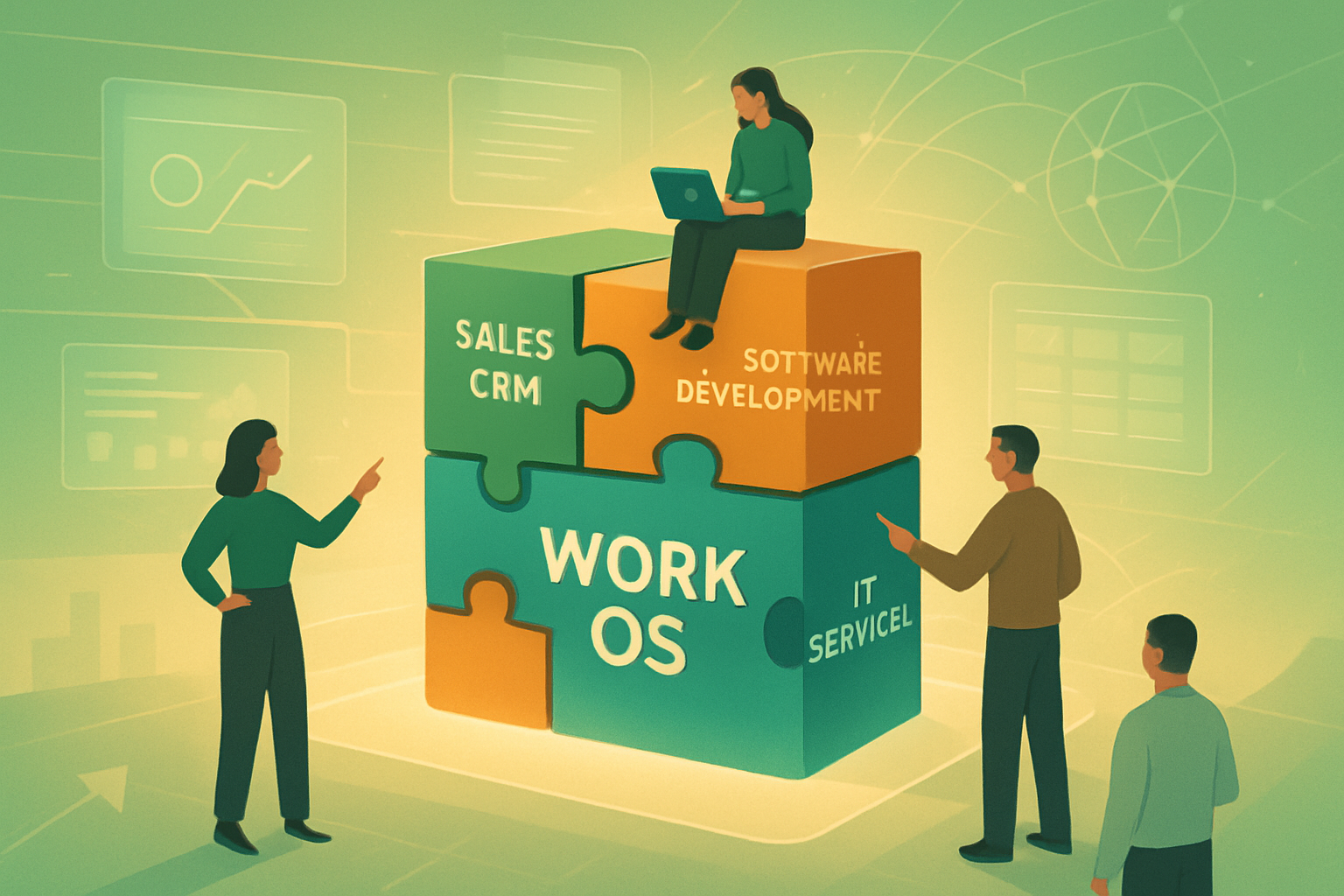
As of February 10, 2026, the software-as-a-service (SaaS) sector is undergoing a profound structural transformation, and perhaps no company better exemplifies this turbulence than monday.com Ltd. (NASDAQ: MNDY). Long heralded as the vanguard of the "Work OS" movement, monday.com is currently navigating a high-stakes pivot from a project-tracking tool to an AI-native orchestration layer for the modern enterprise.
The company is in sharp focus this week following its February 9, 2026, earnings release. Despite reporting solid fiscal year 2025 growth, the stock suffered a punishing 21% single-day collapse. This move reflects a broader market "reckoning" as investors debate whether the traditional seat-based licensing model—the bedrock of SaaS for two decades—can survive the rise of autonomous AI agents. Today, monday.com stands at a crossroads: a cash-rich, operationally efficient leader fighting to redefine the value of human "work" in a software-driven world.
Historical Background
Monday.com’s journey began in February 2012 in Tel Aviv, Israel. Founded by Roy Mann and Eran Zinman (along with early contributor Eran Kampf), the platform originated as an internal tool for Wix.com. Initially named daPulse, the software was designed to solve the transparency issues inherent in hyper-growth startups.
By 2017, the company realized that "daPulse" lacked the professional gravitas required for enterprise expansion and rebranded to monday.com. This rebranding coincided with a fundamental shift in strategy: moving away from simple project management toward a "Work Operating System" (Work OS). This concept allowed non-technical users to build their own custom applications using modular, "no-code" building blocks.
The company went public on the NASDAQ in June 2021 at an IPO price of $155, quickly becoming a darling of the pandemic-era digital transformation boom. After reaching an all-time high of approximately $450 in late 2021, the stock weathered the 2022 tech sell-off, eventually finding a stable footing by 2024 as it reached GAAP profitability—a milestone that signaled its transition from a "growth-at-all-costs" startup to a mature, disciplined enterprise.
Business Model
Monday.com operates a multi-product SaaS model designed to act as the "connective tissue" of an organization. Its revenue is derived primarily from recurring subscriptions across several specialized product lines:
- monday Work OS: The core platform for general project and task management.
- monday CRM: A rapidly growing customer relationship management tool designed for sales teams.
- monday Dev: A specialized suite for product and software development teams, competing directly with legacy players like Jira.
- monday Service: An IT and operations management tool introduced to broaden the platform's footprint.
Historically, the company utilized a "seat-based" pricing model, where revenue grows alongside a customer’s headcount. However, in late 2025, the company introduced a hybrid model featuring "AI Credits." This allows monday.com to monetize autonomous workflows and AI-driven actions, providing a hedge against potential headcount reductions in its customer base as AI takes over manual tasks.
Stock Performance Overview
The five-year trajectory of MNDY has been a rollercoaster for investors. Following its 2021 IPO at $155, the stock peaked at $450 before crashing to a low of ~$73 in late 2022. Between 2023 and 2024, the company staged a remarkable recovery, climbing back into the $230–$250 range on the back of resilient enterprise spending.
However, 2026 has been a year of extreme volatility. After hitting a 52-week high of $342 in late 2025, the stock entered a "SaaSpocalypse" period. As of February 10, 2026, the stock is trading between $76.00 and $98.00, down nearly 50% year-to-date. The primary driver of this recent move was not a financial miss, but rather conservative 2026 revenue guidance that failed to satisfy a market hungry for AI-driven hyper-growth.
Financial Performance
Despite the stock price carnage, monday.com’s financials for the fiscal year 2025 remain structurally sound.
- Revenue: The company reported total 2025 revenue of $1.232 billion, representing a healthy 27% year-over-year growth.
- Margins: Non-GAAP operating margins hit a record 14% in 2025.
- Cash Position: The company ended the year with $1.503 billion in cash and cash equivalents and no significant long-term debt.
- Free Cash Flow: Adjusted FCF for 2025 exceeded $290 million.
- Guidance: The catalyst for the recent sell-off was the 2026 revenue forecast of 18–19% growth. While still robust for many sectors, the "deceleration narrative" has spooked growth-oriented investors who are re-valuing SaaS multiples in the face of AI disruption.
Leadership and Management
Monday.com is led by its original founders, Roy Mann and Eran Zinman, who serve as Co-CEOs. This co-leadership structure is rare but has been credited with the company’s ability to balance rapid product innovation with disciplined financial execution.
Mann focuses heavily on the company's long-term vision and product-led growth (PLG) strategies, while Zinman oversees the technological architecture and the transition to an AI-first infrastructure. The management team has earned a reputation for transparency, though they are currently under pressure to prove that their "AI Agents" strategy can compensate for the slowdown in traditional seat expansion.
Products, Services, and Innovations
The year 2025 marked the "Year of the Agent" for monday.com. The company’s current product innovation is centered on four core capabilities:
- monday sidekick: An embedded generative AI assistant that can summarize meetings, draft emails, and build project boards from natural language prompts.
- monday vibe: A breakout success in 2025, this product focuses on team engagement and sentiment analysis, reaching $1 million in ARR faster than any previous release.
- monday agents: Autonomous software agents that can execute end-to-end workflows (e.g., qualifying a lead in the CRM, updating the task board, and notifying the finance team) without human intervention.
- monday workflows: An upgraded automation engine designed to replace brittle, legacy "if-this-then-that" logic with more flexible, AI-driven reasoning.
Competitive Landscape
Monday.com competes in the crowded "Work Management" and "Collaborative Applications" sector.
- Asana (ASAN): A long-time rival that has struggled more than monday.com to achieve consistent GAAP profitability.
- Smartsheet (SMAR): The preferred choice for data-heavy, spreadsheet-centric users.
- Atlassian (TEAM): The dominant force in the developer space. monday.com's "monday Dev" is a direct challenger to Atlassian’s Jira.
- Microsoft (MSFT): With the integration of Copilot into Microsoft 365 and Planner, Microsoft remains the "sleeping giant" that can bundle similar tools for free or low cost into existing enterprise agreements.
The newest and most significant "competitors" are not other SaaS companies, but the underlying AI models themselves. If a company can use a raw LLM (like OpenAI's Frontier or Anthropic's Claude 4.6) to manage its own workflows, the need for a specialized UI like monday.com may diminish—a risk the company is fighting by becoming an "aggregator" of these models.
Industry and Market Trends
The SaaS industry in early 2026 is grappling with a shift from headcount-based licensing to outcome-based pricing.
For years, SaaS companies grew by "landing and expanding"—selling a few seats and then waiting for the customer's headcount to grow. As AI improves productivity, many companies are hiring fewer people to do the same amount of work. This "productivity paradox" is forcing the industry to find new ways to charge for the "labor" performed by AI agents rather than just the humans using the software.
Risks and Challenges
- AI Cannibalization: If an AI agent allows one person to do the work of five, monday.com could lose 80% of its seat revenue from that customer unless its AI Credit system can bridge the gap.
- Geopolitical Risk: Headquartered in Tel Aviv, the company remains exposed to regional instability. While the "Israeli tech resilience" brand is strong, sustained conflict or significant currency (Shekel) volatility can impact operational costs and talent retention.
- Growth Deceleration: The drop from 27% growth in 2025 to a projected 18-19% in 2026 suggests the "low-hanging fruit" of digital transformation may have been picked.
Opportunities and Catalysts
- Upmarket Migration: The company is successfully moving into the "Enterprise" segment (customers with >$100k ARR). These large organizations are more "sticky" and less prone to churn.
- M&A Potential: With over $1.5 billion in cash and a depressed stock price for many smaller competitors, monday.com is in a prime position to acquire specialized AI startups to bolster its platform.
- The "AI Agent" Monopoly: If monday.com becomes the easiest place for a non-technical manager to deploy an "AI Agent," it could capture a massive new market of "AI-enabled labor" that dwarfs the current project management market.
Investor Sentiment and Analyst Coverage
Current sentiment on Wall Street is deeply divided.
- The Bears point to the recent guidance cut and the "seat-based death spiral" as reasons to avoid the stock, viewing the 21% crash as a permanent "re-rating" of the company's valuation.
- The Bulls argue that monday.com is being unfairly punished for being honest about the macro environment. They point to the $1.5 billion cash pile, high FCF, and the early success of "monday vibe" as proof that the company’s innovation engine is still firing.
The consensus price target post-February crash has drifted toward $168, though many analysts are currently in a "wait-and-see" mode regarding the adoption of AI Credits.
Regulatory, Policy, and Geopolitical Factors
As an Israeli-based company, monday.com must navigate a complex geopolitical landscape. While it has diversified its workforce globally, its core R&D remains in Tel Aviv. The company has navigated the regional conflicts of 2023–2025 with minimal disruption to service, but any escalation remains a tail-risk for investors.
From a regulatory standpoint, the rise of "AI Agents" is bringing new scrutiny to data privacy. Monday.com's "AI Work Platform" must comply with evolving EU and US regulations regarding how AI models process proprietary corporate data, a challenge the company is meeting through its SOC2 and GDPR compliance infrastructure.
Conclusion
Monday.com finds itself in a paradoxical position in February 2026. Operationally, it is a powerhouse: generating significant cash flow, maintaining a pristine balance sheet, and growing at a rate many software companies would envy. However, it is also a "canary in the coal mine" for the SaaS industry’s transition into the age of AI.
For investors, the current valuation represents either a value trap—as the seat-based model slowly erodes—or a generational buying opportunity to own a profitable, AI-ready "operating system" for the future of work at a steep discount. The key metrics to watch in 2026 will not just be revenue growth, but the velocity of AI Credit adoption and the company's ability to maintain enterprise seat counts in a world of autonomous software.
This content is intended for informational purposes only and is not financial advice.