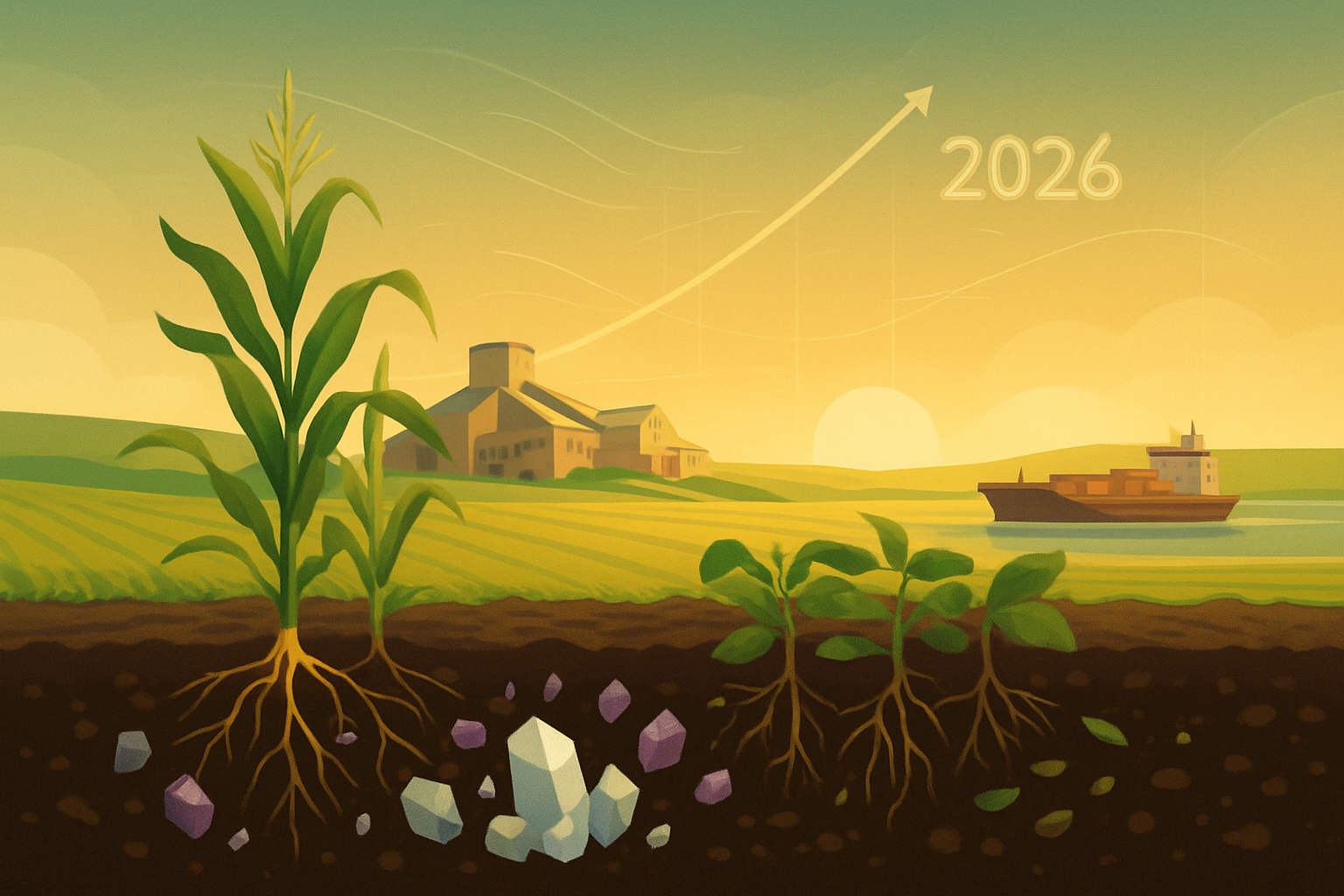
The global agricultural landscape in 2026 is defined by a delicate balance between soaring food demand and the geopolitical volatility of nutrient supply chains. At the center of this equilibrium sits The Mosaic Company (NYSE: MOS), the world’s leading producer of concentrated phosphate and a top-tier potash supplier. As of March 20, 2026, Mosaic finds itself at a critical juncture, navigating a transition from the extreme price spikes of the early 2020s to a more stable, yet operationally complex, market environment.
With a footprint spanning from the salt mines of Saskatchewan to the phosphate beds of Florida and the expansive agricultural frontier of Brazil, Mosaic is an essential pillar of global food security. This research feature explores the company’s current strategic positioning, financial health, and the multifaceted risks and opportunities it faces in a 2026 economy marked by regional conflicts and a rapid push toward sustainable farming.
Historical Background
The Mosaic Company was forged in October 2004 through the landmark merger of IMC Global Inc. and the fertilizer division of Cargill, Inc. This union created a vertically integrated giant capable of controlling the two most critical components of the NPK (Nitrogen, Phosphorus, Potassium) fertilizer triad.
Historically, the company’s narrative has been one of consolidation and strategic geographic expansion. A transformative milestone occurred in 2018 when Mosaic completed the $2.5 billion acquisition of Vale S.A.’s fertilizer business, rebranding it as Mosaic Fertilizantes. This move effectively doubled the company’s presence in Brazil—the world’s fastest-growing agricultural market—and secured its status as the premier provider for South American growers. Since then, Mosaic has evolved from a traditional mining firm into a sophisticated global logistics and biosciences enterprise.
Business Model
Mosaic’s business model is structured around three primary segments, each contributing uniquely to its revenue and operational stability:
- Phosphates: Mosaic is the world's largest producer of finished phosphate products. It mines phosphate rock in Florida and Louisiana, processing it into concentrated fertilizers like Diammonium Phosphate (DAP) and Monoammonium Phosphate (MAP).
- Potash: The company operates high-capacity potash mines in Canada (Colonsay and Esterhazy) and the U.S. (Carlsbad). This segment is characterized by high barriers to entry and long-term asset life, serving both North American and international markets.
- Mosaic Fertilizantes: This Brazil-based segment combines mining, chemical processing, and a vast distribution network. It provides a natural hedge against North American seasonality, as Brazil’s planting cycles typically peak during the U.S. winter.
The company generates revenue primarily through the sale of these commodities to wholesalers, retail distributors, and industrial customers. Increasingly, it is diversifying into high-margin specialty products and biologicals through its Mosaic Biosciences division.
Stock Performance Overview
As of late March 2026, Mosaic’s stock performance reflects the cyclical nature of the commodity markets it inhabits.
- 1-Year Performance: The stock has gained approximately 10.5% over the past 12 months, trading in a range of $26 to $29. This modest recovery follows a stabilizing period after the 2024 price corrections.
- 5-Year Performance: Looking back to 2021, the stock is down roughly 14.8%. This decline is deceptive; it follows the historic "super-cycle" peak of 2022, when the Russia-Ukraine conflict sent fertilizer prices to record highs. Investors who entered at the peak have seen significant value erosion, while those who held through the cycle have experienced high volatility.
- 10-Year Performance: Over the long term, Mosaic has faced a compound annual growth rate (CAGR) for net income of roughly -6%, illustrating the difficulty of maintaining consistent growth in a sector prone to extreme supply-side shocks and price normalization.
Financial Performance
Mosaic’s financial results for 2025 showed a significant recovery from a lackluster 2024.
- Revenue & Earnings: In 2025, revenue rose 9% to $12.1 billion, up from $11.1 billion in 2024. Net income tripled during the same period to $541 million, driven by a 20% increase in potash sales volumes and improved margins in the Brazil segment.
- Margins: Adjusted EBITDA reached $2.4 billion in 2025. However, margins remain sensitive to input costs. Management noted that every $10 per tonne increase in the price of sulfur (a key phosphate input) impacts quarterly EBITDA by approximately $10 million.
- Balance Sheet: Total debt has risen to $4.25 billion as of early 2026, partly due to increased capital expenditures aimed at asset reliability and the development of rare earth projects. Cash flow from operations remains robust at over $1.5 billion, supporting a dividend yield currently hovering around 3.2%.
Leadership and Management
The current leadership team is focused on operational "fortification" rather than aggressive acquisition. Bruce Bodine, who took over as President and CEO in January 2024, has emphasized cost-efficiency and asset reliability. Bodine, a veteran with over 20 years at Mosaic, is viewed as a "steady hand" who understands the technical complexities of the company's mining operations.
Supporting him is CFO Luciano Siani Pires, who joined in early 2025 from the mining giant Vale. Siani Pires brings deep experience in capital allocation within the Brazilian market, which is critical given that nearly a third of Mosaic’s business now flows through its South American operations. The board is generally well-regarded for its governance, though it faces increasing pressure from ESG-focused institutional investors to accelerate decarbonization efforts.
Products, Services, and Innovations
While bulk DAP and Potash remain the core of the business, Mosaic is pivoting toward high-value innovation:
- MicroEssentials: This patented premium fertilizer line combines multiple nutrients (N, P, S, and Zn) into a single granule, ensuring uniform distribution. It continues to command a significant price premium over standard DAP.
- Mosaic Biosciences: Launched as a dedicated division, this unit saw $68 million in sales in 2025. Products focus on microbial technology that helps plants better utilize soil-bound nutrients, reducing the need for traditional chemical inputs.
- Rare Earth Extraction: In a 2026 breakthrough, Mosaic is advancing its partnership with Rainbow Rare Earths at the Uberaba site in Brazil. They are developing a process to extract rare earth elements from phosphogypsum—a byproduct of phosphate production—potentially turning a waste stream into a strategic asset for the green energy transition.
Competitive Landscape
Mosaic operates in a highly concentrated global market. Its primary rivals include:
- Nutrien Ltd. (NYSE: NTR): The dominant force in potash and the world’s largest agricultural retailer. Nutrien’s massive retail footprint gives it a data advantage over Mosaic, though Mosaic maintains a slight edge in phosphate production volumes.
- CF Industries (NYSE: CF): While primarily a nitrogen player, CF competes for "wallet share" among farmers. In early 2026, CF has outperformed Mosaic due to its lower exposure to volatile sulfur prices.
- International Competitors: Mosaic faces stiff competition from the OCP Group (Morocco) in phosphates and Belaruskali (Belarus) and Uralkali (Russia) in potash. While sanctions on Belarusian potash were partially eased in early 2026 to stabilize food prices, these state-backed giants remain the primary "price-setters" in the global potash market.
Industry and Market Trends
The fertilizer industry in 2026 is governed by two major trends: "Capacity Discipline" and "Nutrient Efficiency."
Global demand for grain remains at record levels, driven by a growing population and the expansion of the biofuels sector in North America and Brazil. However, China’s decision to maintain strict export restrictions on phosphates through the first half of 2026 has kept global supply tight. In the potash sector, prices have stabilized around $255–$275 per tonne as the market absorbs the return of some Eastern European supply. Investors are increasingly looking at "nutrient-use efficiency" (NUE) as a key metric, as farmers seek to lower costs and meet new environmental standards.
Risks and Challenges
Mosaic faces a trio of significant risks in the current environment:
- Geopolitical Input Shocks: The 2026 tensions in the Middle East and the intermittent closure of the Strait of Hormuz have caused sudden spikes in the price of sulfur and ammonia. Since Mosaic is a net buyer of these raw materials for its phosphate production, these spikes directly erode profit margins.
- Litigation: Mosaic is currently a defendant in a high-profile class-action lawsuit (Union Line Farms v. Mosaic) filed in March 2026, alleging that major fertilizer producers colluded to limit capacity and keep prices artificially high.
- Weather and Logistics: Climate volatility continues to impact both production (hurricanes in the Gulf of Mexico) and demand (delayed planting seasons in the Midwest).
Opportunities and Catalysts
Despite the risks, several catalysts could drive Mosaic’s stock higher in the second half of 2026:
- Brazil Growth: The continued expansion of soybean and corn acreage in Brazil remains Mosaic’s strongest long-term growth lever.
- Rare Earth Commercialization: Positive results from the Uberaba pilot project could lead to a re-rating of the stock as a "green tech" play rather than just a commodity miner.
- Earnings Upside: If China relaxes its export bans later in 2026, it could lead to higher global volumes, though potentially lower prices; however, Mosaic’s low-cost Canadian potash mines (Esterhazy K3) remain highly profitable at current price floors.
Investor Sentiment and Analyst Coverage
Wall Street is currently "cautiously optimistic" on Mosaic, with a consensus rating of Moderate Buy.
Analysts from Bank of America and Barclays have recently noted that while the "easy money" from the 2022 price spike is gone, Mosaic is a fundamentally stronger company today than it was a decade ago. Institutional ownership remains very high at ~95.8%, dominated by passive giants like Vanguard and BlackRock. Retail sentiment is mixed, with some investors wary of the company’s high debt load and the legal uncertainties surrounding the fertilizer industry's pricing practices.
Regulatory, Policy, and Geopolitical Factors
Regulation is a double-edged sword for Mosaic. On one hand, the company is benefiting from the FAST-41 federal program, which is accelerating the permitting process for its Riverview Gypstack expansion in Florida. The U.S. government views domestic fertilizer production as a matter of national security.
On the other hand, the environmental scrutiny of phosphogypsum (the radioactive byproduct of phosphate mining) is intensifying. While Mosaic recently saw a lawsuit regarding "radioactive road" pilot projects dismissed, the long-term cost of managing its "gypstacks" remains a multi-billion dollar environmental liability that investors must account for.
Conclusion
The Mosaic Company enters the mid-point of 2026 as a lean, operationally focused giant in a world that cannot afford to stop eating. For investors, the bull case rests on the company’s dominant position in the "balanced to tight" phosphate market and its strategic foothold in Brazil. The bear case is anchored in the inherent volatility of commodity cycles and the rising costs of raw material inputs and environmental compliance.
In the near term, Mosaic is an attractive play for those looking for a high-yielding, value-oriented stock that acts as a proxy for global food demand. However, the shadow of antitrust litigation and geopolitical instability in energy markets suggests that the path ahead will remain as cyclical and challenging as the soil the company helps to enrich.
This content is intended for informational purposes only and is not financial advice.