
Tag: Quantum Computing

  • Apple (AAPL) Deep-Dive: Goldman’s Conviction, the AI Supercycle, and the Quantum Frontier

    Apple (AAPL) Deep-Dive: Goldman’s Conviction, the AI Supercycle, and the Quantum Frontier

    As of March 26, 2026, Apple Inc. (NASDAQ: AAPL) stands at a historic valuation, flirting with a $4 trillion market capitalization. While the company has long been defined by the hardware perfection of the iPhone, the narrative in 2026 has shifted toward its transformation into an "AI and Security Fortress." With Goldman Sachs recently reiterating a high-conviction "Buy" rating and a price target of $330, investors are increasingly focused on two pillars of future growth: the integration of "Apple Intelligence" and the company’s pioneering work in Post-Quantum Cryptography (PQC). This article examines whether Apple’s hybrid AI strategy and its defensive lead in quantum-safe security will drive the next decade of alpha.

    Historical Background

    Founded in 1976 by Steve Jobs, Steve Wozniak, and Ronald Wayne, Apple began as a pioneer of the personal computing revolution. Its early milestones—the Apple II, the Macintosh, and the subsequent "wilderness years" without Jobs—set the stage for one of the greatest corporate turnarounds in history upon his return in 1997. The 2001 launch of the iPod and the 2007 debut of the iPhone redefined consumer electronics, moving Apple from a niche computer maker to a dominant global lifestyle brand.

    Under the leadership of Tim Cook, who took the helm in 2011, Apple transitioned from a hardware-centric company to an ecosystem powerhouse. The decade between 2016 and 2026 saw the explosion of the Services segment and the successful transition to in-house silicon (M-series and A-series chips), which provided the computational foundation for the AI and quantum-security leaps the company is making today.

    Business Model

    Apple operates a vertically integrated business model often referred to as a "Walled Garden." This ecosystem creates high switching costs for users, ensuring recurring revenue through hardware cycles and digital services.

    • Hardware: The iPhone remains the primary revenue driver, supplemented by the iPad, Mac, and "Wearables, Home, and Accessories" (Apple Watch, AirPods, and the Vision Pro line).
    • Services: This high-margin segment includes the App Store, Apple Cloud, Apple Music, Apple Pay, and Apple TV+. In early 2026, Services margins reached a staggering 75.4%.
    • Hybrid AI Model: By 2026, Apple’s business model has incorporated "AI as a Utility." Rather than charging a flat subscription for basic AI, Apple leverages AI to drive premium hardware upgrades while reportedly collecting "traffic acquisition" and "intelligence partnership" fees from partners like Google and OpenAI.

    Stock Performance Overview

    Apple’s stock has been a cornerstone of institutional and retail portfolios for over a decade.

    • 1-Year Performance: As of late March 2026, AAPL has seen a +14.50% total return, navigating a volatile tech landscape where investors rotated between pure-play AI software and legacy hardware.
    • 5-Year Performance: The stock has delivered a +115.13% return, significantly outperforming the broader market.
    • 10-Year Performance: Long-term shareholders have seen a massive ~1,031% return, effectively a 10-bagger since 2016, driven by aggressive share buybacks and dividend growth.
      Despite a ~7% YTD dip in early 2026 due to broader macroeconomic cooling, the stock remains resilient compared to its "Magnificent Seven" peers.

    Financial Performance

    Apple’s financial engine continues to operate at record efficiency.

    • FY 2025 Results: Revenue hit a record $416.2 billion, with a net income of $112.0 billion.
    • Q1 2026 (Holiday Quarter): Apple reported revenue of $143.8 billion (up 16% YoY). Gross margins expanded to 47.2%, reflecting the shift toward higher-margin Services and cost efficiencies in Apple Silicon.
    • Cash Position: Apple ended 2025 with a net cash position of approximately $60 billion, continuing its policy of returning nearly all free cash flow to shareholders via buybacks and dividends.

    Leadership and Management

    CEO Tim Cook continues to lead with a focus on operational excellence and supply chain resilience. While Cook has signaled that the board is actively engaged in succession planning, he remains firmly in control as of March 2026.

    • Succession Watch: John Ternus, SVP of Hardware Engineering, has emerged as the clear frontrunner to eventually succeed Cook. His increased visibility at the March 2026 "MacBook Neo" launch event signaled his rising influence within the executive team.
    • Strategic Governance: The management team is currently focused on navigating the dual challenges of global antitrust litigation and the rapid integration of generative AI across the product stack.

    Products, Services, and Innovations

    Apple’s 2026 product roadmap is dominated by Apple Intelligence and Secure Communication.

    • Siri 2.0 (Code-named "Campo"): Expected to be fully unveiled at WWDC 2026, this iteration of Siri utilizes a "hybrid intelligence" framework, leveraging on-device processing for privacy and Google’s Gemini models for complex reasoning.
    • PQ3 Security: Apple has set a new industry standard with PQ3, a post-quantum cryptographic protocol for iMessage. As quantum computers pose a theoretical threat to current encryption, Apple’s "Level 3" security makes its ecosystem the most robust against future "Harvest Now, Decrypt Later" attacks.
    • Apple Silicon: The M5 and A19 Pro chips (3nm and 2nm processes) are optimized specifically for LLM (Large Language Model) inference, giving Apple a competitive edge in "On-Device AI."

    Competitive Landscape

    Apple faces a multi-front battle:

    • AI Rivals: Microsoft (NASDAQ: MSFT) and Google (NASDAQ: GOOGL) have a lead in cloud-based AI, but Apple’s control over 2 billion active devices gives it a unique distribution advantage for "Agentic AI."
    • Hardware Rivals: Samsung continues to challenge in the foldable space, though Apple’s rumored "iPhone Fold" (potentially late 2026/2027) remains a highly anticipated wildcard.
    • Ecosystem Rivals: Meta (NASDAQ: META) competes aggressively in the spatial computing (AR/VR) arena, though Apple’s Vision Pro 2 is positioned at the high-end enterprise and prosumer market.

    Industry and Market Trends

    The "AI Supercycle" is the defining trend of 2026. Consumers are beginning to upgrade hardware not just for better cameras, but for the local processing power required to run autonomous AI agents. Additionally, the industry is shifting toward "Confidential Computing," where data privacy is no longer a feature but a regulatory requirement—a trend Apple anticipated years ago.

    Risks and Challenges

    • Regulatory Headwinds: The DOJ’s antitrust lawsuit remains the largest overhang. A trial focused on the smartphone monopoly is slated for late 2026, which could potentially force changes to the "Walled Garden" business model.
    • EU Compliance: The Digital Markets Act (DMA) has forced Apple to allow third-party app stores in Europe, threatening the lucrative "Apple Tax" (30% commission).
    • Geopolitical Risk: Dependence on Chinese manufacturing and the TSMC (Taiwan) supply chain remains a systemic risk, despite efforts to diversify into India and Vietnam.

    Opportunities and Catalysts

    • Goldman Sachs "Buy" Conviction: Goldman analyst Michael Ng maintains a $330 price target, arguing that the market underestimates the tailwinds from the AI-driven iPhone 17/18 refresh cycle.
    • The "Siri 2.0" Launch: The June 2026 WWDC event is a massive catalyst; if Apple successfully demonstrates a truly autonomous AI agent, it could trigger a significant valuation rerating.
    • Quantum Security Advantage: As enterprise customers become more wary of quantum threats, Apple’s PQ3 protocol could drive higher adoption of iPads and Macs in the corporate and government sectors.

    Investor Sentiment and Analyst Coverage

    Sentiment remains cautiously optimistic. While some hedge funds trimmed positions in early 2026 due to valuation concerns, institutional ownership remains high. Wall Street consensus is largely a "Moderate Buy," with Goldman Sachs being one of the more aggressive bulls. Retail sentiment is buoyed by the "buy the dip" mentality that has historically rewarded AAPL shareholders.

    Regulatory, Policy, and Geopolitical Factors

    Apple is currently navigating a "coordinated global enforcement wave." Beyond the US and EU, regulators in Japan and the UK are considering similar "Open Ecosystem" mandates. On the policy front, Apple is benefiting from US incentives for domestic chip packaging, though it remains exposed to any escalation in US-China trade tensions.

    Conclusion

    Apple Inc. in March 2026 is a company in transition, evolving from a hardware vendor into a specialized AI and security provider. The Goldman Sachs $330 price target reflects a belief that Apple’s 2-billion-device install base is the ultimate "moat" for distributing generative AI. While regulatory risks in the US and EU present real challenges to the App Store’s margins, the company’s lead in Post-Quantum Cryptography and its record-breaking cash flow provide a significant safety net. For investors, the upcoming WWDC 2026 will be the "litmus test" for whether Apple can turn its "AI and Quantum" potential into a tangible earnings driver for the next decade.


    This content is intended for informational purposes only and is not financial advice.

  • Honeywell (HON): The Great Industrial Unlocking of 2026

    Honeywell (HON): The Great Industrial Unlocking of 2026

    As of March 19, 2026, the industrial landscape looks vastly different than it did even three years ago. At the epicenter of this transformation is Honeywell International Inc. (NASDAQ: HON), a company that has spent the last century defining the "conglomerate" model only to spend the last 24 months systematically dismantling it. Today, Honeywell stands at a historic crossroads: it is no longer the slow-moving giant of the mid-20th century, but a lean, software-integrated powerhouse focused on the most critical challenges of the 21st century—automation, sustainable aviation, and the energy transition.

    With the recent spinoff of its Advanced Materials business (now trading as Solstice Advanced Materials) and the impending Initial Public Offering (IPO) of its quantum computing arm, Quantinuum, investors are witnessing the "Great Unlocking" of one of America’s most storied industrial icons.

    Historical Background

    The Honeywell story is one of constant reinvention. It began in 1885 when Albert Butz invented the "damper flapper," a predecessor to the modern thermostat. By 1927, his company merged with Mark C. Honeywell’s Heating Specialty Co. to form the Minneapolis-Honeywell Regulator Co. Over the next several decades, the company became synonymous with precision controls, playing a pivotal role in the Apollo 11 moon landing and the development of the first digital computers.

    The most defining moment of the modern era came in 1999, when AlliedSignal acquired Honeywell in a $13.8 billion deal. Although AlliedSignal was the surviving entity, the "Honeywell" name was retained for its global prestige. For two decades, under the leadership of CEOs like Dave Cote and Darius Adamczyk, the company perfected the "Honeywell Operating System," driving massive margin expansion. However, by 2023, activist pressure from Elliott Management and a shifting macroeconomic environment led to a radical strategic pivot: the transition from a diversified conglomerate into a set of focused, high-growth technology leaders.

    Business Model

    Today, Honeywell’s business model is organized around three primary global megatrends. Following its 2025 restructuring, the company operates through four core segments:

    1. Aerospace Technologies: The crown jewel of the portfolio, providing everything from propulsion engines to advanced avionics for commercial, business, and defense aircraft.
    2. Building Automation: A leader in making "smart buildings" a reality. This segment integrates hardware with the Honeywell Forge software platform to optimize energy use, air quality, and security.
    3. Industrial Automation: This segment focuses on the "Physical AI" revolution—automating warehouses, supply chains, and manufacturing plants through robotics and sensing technologies.
    4. Process Automation and Technology (PA&T): Formed from the core of the legacy Energy and Sustainability Solutions business, this unit focuses on clean energy technologies, including sustainable aviation fuel (SAF) and carbon capture.

    Stock Performance Overview

    Over the last decade, HON has been a bedrock of many institutional portfolios, though its performance has evolved through distinct phases.

    • 10-Year Horizon (2016–2026): Investors have seen a steady, compounding return. Shares that traded around $100 in early 2016 have more than doubled, supported by consistent dividend growth and aggressive share repurchases.
    • 5-Year Horizon (2021–2026): This period was marked by the post-pandemic recovery and the "conglomerate discount" era. After peaking in 2021, the stock traded sideways for several years as the market waited for a catalyst.
    • 1-Year Horizon (2025–2026): The last 12 months have seen a significant rerating. Following the successful spinoff of the Advanced Materials division in October 2025, HON shares have outperformed the S&P 500 as the "breakup" thesis gained momentum, with the stock currently trading near all-time highs as the market anticipates the full Aerospace separation later this year.

    Financial Performance

    For the fiscal year ending December 31, 2025, Honeywell reported robust financial results that reflected its higher-margin software and services pivot.

    • Revenue: $37.6 billion (adjusted for the Advanced Materials divestiture), representing a 6% organic growth rate.
    • Earnings Per Share (EPS): Adjusted EPS reached $9.78, a 12% increase year-over-year.
    • Margins: Operating margins expanded to a record 23.5%, driven by the "Honeywell Accelerator" operating model.
    • Backlog: The company enters 2026 with a record backlog of over $37 billion, providing multi-year visibility, particularly in the Aerospace sector.
    • Capital Allocation: Honeywell continues to be a cash-flow machine, generating $6.2 billion in free cash flow in 2025, much of which was returned to shareholders via a dividend that has seen 15 consecutive years of increases.

    Leadership and Management

    CEO Vimal Kapur, who took the reins in mid-2023, has been the architect of the current transformation. Known for his "operator" mindset, Kapur has moved away from the more cautious approach of his predecessors. His strategy focuses on "Physical AI"—the intersection of industrial data and automation.

    Under Kapur, the management team has become more agile, shedding underperforming business units and doubling down on high-growth technology. The board of directors has also been refreshed to include more experts in software and sustainability, reflecting the company’s forward-looking mandate.

    Products, Services, and Innovations

    Honeywell’s R&D engine is currently focused on three disruptive areas:

    • Quantinuum: Honeywell’s majority-owned quantum computing venture is the world leader in trapped-ion technology. With its 2026 IPO filing, Quantinuum is poised to become a standalone leader in the next generation of computing.
    • Sustainable Aviation Fuel (SAF): Through its UOP division, Honeywell’s Ecofining™ technology is the global standard for producing SAF. As airlines race to meet net-zero targets, Honeywell’s role as the primary technology provider remains a massive long-term tailwind.
    • Honeywell Forge: This "Industrial IoT" platform is the software glue of the company. It uses AI to analyze data from thousands of sensors in a refinery or a skyscraper to predict maintenance needs and reduce carbon footprints.

    Competitive Landscape

    Honeywell faces elite competition across all its segments:

    • Aerospace: RTX Corporation (NYSE: RTX) and GE Aerospace (NYSE: GE) remain the primary rivals. However, Honeywell’s dominance in Auxiliary Power Units (APUs) and business jet avionics provides a high-moat niche.
    • Automation: In Building Automation, Siemens AG (OTC: SIEGY) and Johnson Controls (NYSE: JCI) are fierce competitors. In Industrial Automation, Honeywell battles Rockwell Automation (NYSE: ROK) and Emerson Electric (NYSE: EMR).
    • Differentiation: Honeywell’s advantage lies in its "full-stack" approach—offering both the physical hardware (valves, sensors, engines) and the sophisticated software layer that manages it.

    Industry and Market Trends

    The "Industrial Renaissance" in North America is a significant tailwind. As companies move manufacturing closer to home (near-shoring), the demand for high-end industrial automation has surged. Furthermore, global decarbonization mandates are forcing industrial giants to retrofit older facilities with the types of energy-efficiency and carbon-capture technologies that Honeywell specializes in.

    Risks and Challenges

    No investment is without risk. Honeywell faces three primary hurdles:

    1. Macroeconomic Sensitivity: Despite its pivot to software, the company remains sensitive to global GDP growth and interest rates, which affect capital expenditure in the building and industrial sectors.
    2. Execution Risk: The ongoing "breakup" and spinoff strategy is complex. Any delays in the 2026 Aerospace separation could sour investor sentiment.
    3. Geopolitical Tensions: With a significant global footprint, Honeywell is vulnerable to supply chain disruptions and trade restrictions, particularly concerning high-tech components in the Aerospace and Automation sectors.

    Opportunities and Catalysts

    • The Quantinuum IPO: Expected in mid-2026, this event could unlock billions in value for Honeywell shareholders, as the market begins to price the quantum business as a high-growth tech play rather than an industrial subsidiary.
    • Aerospace Separation: The planned split into an independent Aerospace entity is the final piece of the value-unlocking puzzle.
    • M&A: With a strong balance sheet, Honeywell is expected to remain active in "bolt-on" acquisitions, particularly in the industrial software and cybersecurity space.

    Investor Sentiment and Analyst Coverage

    Wall Street is currently "Overweight" on HON. Analysts from major firms like Goldman Sachs and Morgan Stanley have praised the company's "portfolio pruning," noting that the simplified structure should lead to multiple expansion. Hedge fund interest has surged following the Elliott Management entry in 2023, and institutional ownership remains high at over 75%.

    Regulatory, Policy, and Geopolitical Factors

    The regulatory environment is largely a tailwind for Honeywell. The U.S. Inflation Reduction Act (IRA) and European Green Deal provide massive subsidies for the types of clean-energy and carbon-capture projects Honeywell enables. However, the company must navigate tightening SEC climate disclosure rules and increasing scrutiny over defense contracts, which constitute a significant portion of its Aerospace revenue.

    Conclusion

    Honeywell International is no longer just a "legacy industrial." In 2026, it has redefined itself as a high-tech orchestrator of the physical world. While the complexity of its restructuring may keep some cautious investors on the sidelines, the fundamental strengths of the company—its record backlog, dominance in sustainable aviation, and leadership in quantum computing—make it a compelling case for those seeking exposure to the next industrial revolution. Investors should watch the upcoming Quantinuum IPO and the progress of the Aerospace spinoff as the final catalysts for this storied firm's modern transformation.


    This content is intended for informational purposes only and is not financial advice.
  • The $100 Million Milestone: How IonQ Is Industrializing the Quantum Frontier

    The $100 Million Milestone: How IonQ Is Industrializing the Quantum Frontier

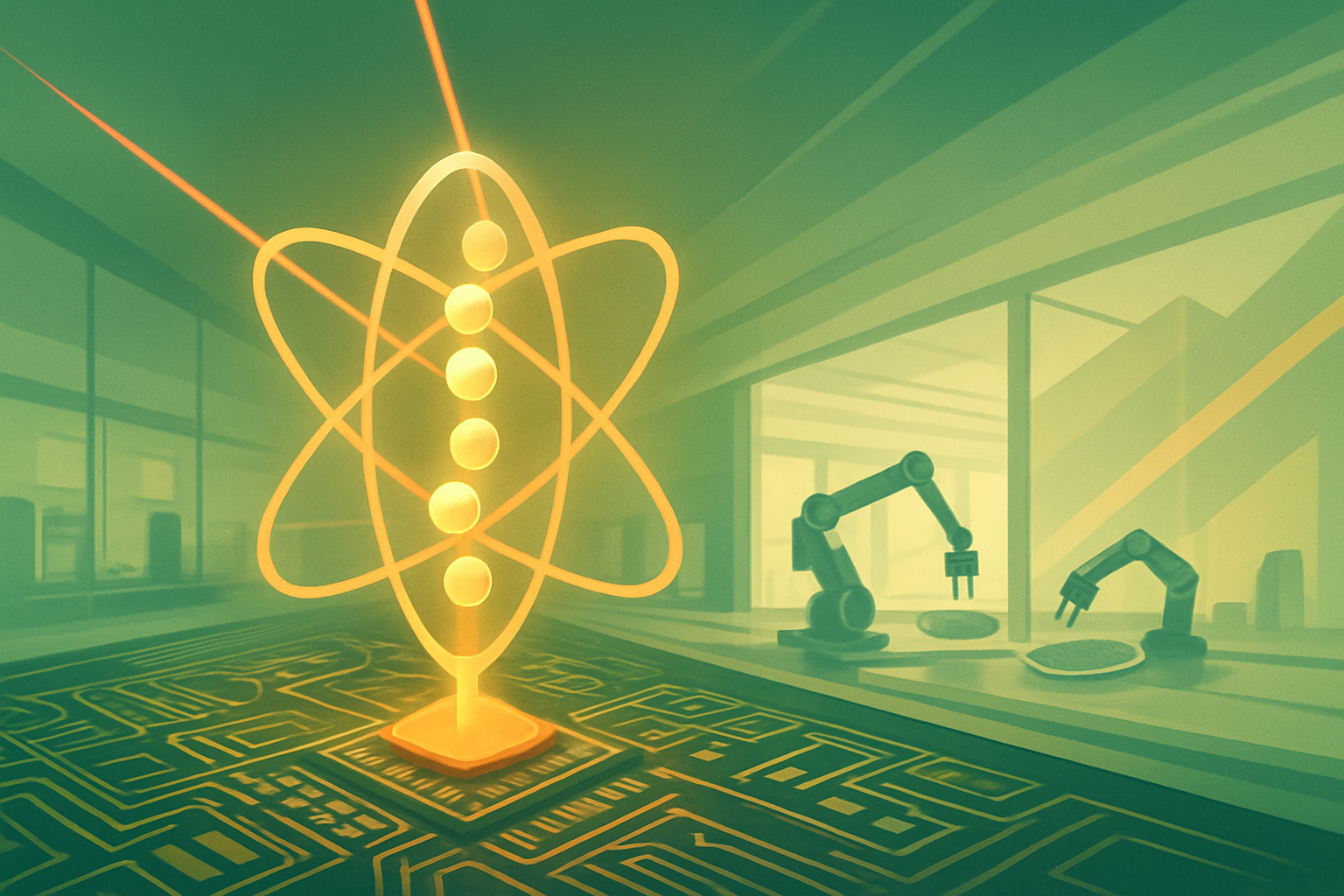
    The fiscal year 2025 earnings report for IonQ (NYSE: IONQ) has sent shockwaves through the technology sector. By reporting over $100 million in annual revenue, IonQ has become the first pure-play quantum computing company to cross this critical threshold of commercial maturity. Combined with a massive $1.8 billion acquisition of SkyWater Technology (NASDAQ: SKYT) and a doubling of revenue guidance for 2026, the company is signaling that the "Quantum Era" is no longer a future prospect—it is a present reality.

    The Quantum Inflection Point

    As of February 27, 2026, IonQ has moved beyond the "proof-of-concept" phase. While the industry spent the last decade debating which qubit architecture would prevail, IonQ’s trapped-ion systems have delivered the most consistent path to commercial scale. The company’s recent financial results have validated a business model that combines high-margin cloud access with massive "sovereign quantum" hardware sales.

    Historical Context: From Lab to Fab

    Founded in 2015 by Dr. Christopher Monroe and Dr. Jungsang Kim, IonQ’s journey from University of Maryland research to a NYSE-listed leader has been marked by technical rigor. The 2021 SPAC merger provided the war chest needed to transition from hand-built scientific instruments to the automated manufacturing processes now housed in their Bothell, Washington facility. This transition was accelerated in early 2024 when the company reached its #AQ 35 milestone ahead of schedule, proving that its engineering roadmap was more than just marketing.

    The SkyWater Acquisition: A Strategic Masterstroke

    The January 2026 acquisition of SkyWater Technology for $1.8 billion represents the most significant M&A activity in the history of quantum computing. SkyWater, a U.S.-based semiconductor foundry with deep ties to the Department of Defense, provides IonQ with something its competitors lack: a captive, "trusted" supply chain.

    • Vertical Integration: IonQ can now design, prototype, and manufacture its ion traps and control electronics in-house.
    • Accelerated Scaling: The integration of Electronic Qubit Control (EQC) directly onto silicon wafers—a specialty of SkyWater—is the bridge to achieving 200,000+ qubits by 2028.
    • Revenue Diversification: SkyWater adds an immediate $300M+ revenue base from classical semiconductor services, providing a financial cushion for quantum R&D.

    Financial Performance and 2026 Guidance

    IonQ’s 2025 revenue of $105.2 million exceeded even the most optimistic analyst estimates. However, the true catalyst for the recent stock rally was the 2026 guidance. Management expects revenue to jump to $210M–$230M, a 100% year-over-year increase. This growth is driven by:

    1. System Sales: Multi-million dollar hardware placements with global research hubs.
    2. QCaaS Growth: Increased enterprise adoption of the "Tempo" (AQ 64) system via Amazon Braket and Azure Quantum.
    3. Government Contracts: Expanded "Sovereign Quantum" initiatives in the U.S. and Europe.

    Stock Performance and Investor Sentiment

    Over the past year, IONQ has outperformed the broader tech indices significantly. After the volatility of 2022-2023, the stock has found a steady base of institutional support. Wall Street analysts have largely shifted to "Buy" or "Strong Buy" ratings, viewing the SkyWater deal as the final piece of the puzzle for "de-risking" the company’s manufacturing future.

    Competitive Landscape

    While IBM (NYSE: IBM) and Quantinuum remain formidable rivals, IonQ’s trapped-ion approach offers superior qubit connectivity and lower error rates compared to superconducting methods. Furthermore, by being the only player with a dedicated domestic foundry (via SkyWater), IonQ has established a moat that is increasingly difficult for international or smaller domestic rivals to cross.

    Risks and Opportunities

    Risks:

    • Integration Complexity: Merging the cultures of a quantum startup and a traditional semiconductor foundry.
    • Technical Thresholds: The jump to 1,000+ algorithmic qubits requires unproven photonic interconnect technology.

    Opportunities:

    • AI Synergy: Using quantum systems to accelerate the training of next-generation AI models.
    • Security: Capitalizing on the shift toward Post-Quantum Cryptography (PQC) as a service.

    Conclusion: Watching the "Quantum Doubling"

    As we move through 2026, the primary metric for investors will be IonQ’s ability to meet its "doubling" revenue guidance. If the company can successfully integrate SkyWater and maintain its technical lead, it will not only dominate the quantum market but will become a fundamental pillar of the global computing infrastructure. The era of the "General Purpose Quantum Computer" is officially underway, and IonQ is currently the architect-in-chief.


    This content is intended for informational purposes only and is not financial advice.

  • Honeywell’s Great Simplification: The Industrial Giant Reinvents for the Future

    Honeywell’s Great Simplification: The Industrial Giant Reinvents for the Future

    Honeywell International Inc. (NASDAQ: HON) currently finds itself at a critical juncture. For years, the company was hailed as the "gold standard" of the multi-industry model, but in recent years, investors have demanded more focus and less complexity. Today, Honeywell is responding with a radical "simplification" strategy. The company is actively spinning off its major divisions—including its massive Aerospace wing and its Advanced Materials business—to unlock shareholder value. In a market where pure-play companies often command higher valuations than conglomerates, Honeywell’s transition into a more concentrated "Automation and Energy" powerhouse is the primary narrative driving investor interest in 2026.

    Historical Background

    Honeywell’s roots trace back to 1885 when Albert Butz invented the "damper flapper," a predecessor to the modern thermostat. The company officially became Honeywell Heating Specialty Co. in 1906 and grew through decades of innovation in temperature control and aerospace. A pivotal moment occurred in 1999 when Honeywell was acquired by AlliedSignal, though the Honeywell name was retained for its global brand recognition.

    Throughout the early 21st century, under the leadership of Dave Cote and later Darius Adamczyk, Honeywell became synonymous with operational excellence through the "Honeywell Operating System" (HOS). However, the conglomerate model began to face headwinds in the early 2020s as specialized rivals in aerospace and automation outperformed. This led to the 2024-2025 decision to break the company apart, signaling the end of the traditional conglomerate era for the firm.

    Business Model

    As of early 2026, Honeywell’s business model is undergoing a transition. While it historically operated four distinct segments, it has recently reorganized to align with global megatrends:

    • Aerospace Technologies: Engines, avionics, and auxiliary power units. This remains the crown jewel but is currently being prepared for a standalone public listing (expected Q3 2026).
    • Building Automation: Providing the "brains" for modern infrastructure. This segment focuses on energy optimization, fire safety, and security through a software-heavy "Building-as-a-Service" model.
    • Industrial Automation: Primarily focused on sensing, measurement, and control. This unit has been streamlined following the divestiture of its lower-margin warehouse productivity units.
    • Energy and Sustainable Technology: This high-growth segment manages large-scale industrial control systems and proprietary technologies for carbon capture, hydrogen production, and sustainable aviation fuel (SAF).

    The revenue model is increasingly shifting toward recurring software-as-a-service (SaaS) and long-term service agreements, reducing the cyclicality that traditionally plagued industrial stocks.

    Stock Performance Overview

    Honeywell’s stock performance has reflected its status as a transitioning giant. Over the one-year horizon (Feb 2025–Feb 2026), the stock has outperformed the broader industrial sector, buoyed by the announcement of the Aerospace spin-off and the successful IPO of its Advanced Materials unit, Solstice.

    On a five-year basis, the stock has provided steady, albeit moderate, returns. It faced a period of stagnation between 2022 and 2024 as the market grew weary of its conglomerate structure. However, the 2025 pivot led to a re-rating. Looking back ten years, HON has been a dependable dividend grower, though it has trailed high-growth tech indices. The current valuation reflects a "spin-off premium" as investors bet that the individual parts of Honeywell will be worth more than the whole.

    Financial Performance

    In its latest earnings report (Q4 2025), Honeywell demonstrated strong financial discipline.

    • Revenue: Reported at $37.4 billion for FY 2025, an 8% increase year-over-year.
    • Margins: Adjusted segment margins reached a record 22.5%, showcasing the company's ability to maintain pricing power despite inflationary pressures.
    • Earnings per Share (EPS): Q4 2025 adjusted EPS came in at $2.59, up 17% from the previous year.
    • Cash Flow: The company generated $5.1 billion in Free Cash Flow (FCF) in 2025, with 2026 guidance forecasting an increase to between $5.3 billion and $5.6 billion.
    • Valuation: Trading at a P/E ratio of approximately 22.8x, Honeywell sits at the higher end of its historical range, reflecting market optimism regarding its restructuring.

    Leadership and Management

    CEO Vimal Kapur took the helm in June 2023 and has moved with unexpected speed to reshape the portfolio. Kapur is widely regarded as a "simplifier" who is focused on eliminating internal bureaucracy. His strategy—dubbed "Honeywell Accelerator"—aims to speed up product development cycles and integrate artificial intelligence across all hardware lines. Kapur’s background in the company’s high-growth Performance Materials segment has influenced his focus on the "Energy Transition" as a primary profit driver. The board of directors has been refreshed recently to include more software and venture capital expertise, reflecting the shift toward a "Physical AI" future.

    Products, Services, and Innovations

    Honeywell’s innovation pipeline is currently dominated by three major initiatives:

    1. Quantinuum: Honeywell remains the majority owner of this quantum computing leader. With a confidential S-1 filed for a 2026 IPO, Quantinuum’s Helios computer is considered the world's most accurate commercial quantum system, offering a massive potential catalyst for HON shareholders.
    2. Honeywell Forge: This IoT platform is the backbone of the company’s software strategy, providing "digital twins" for industrial plants and autonomous building management.
    3. Ecofining Technology: As the world moves toward net-zero, Honeywell’s Ecofining process has become the market leader in converting renewable feedstocks into Sustainable Aviation Fuel (SAF).

    Competitive Landscape

    Honeywell faces fierce competition in every segment:

    • In Aerospace: It competes with RTX (NYSE: RTX), GE Aerospace (NYSE: GE), and France’s Safran. The upcoming spin-off is intended to allow Honeywell Aerospace to compete more effectively with GE as a pure-play aviation entity.
    • In Building Automation: Key rivals include Siemens (OTC: SIEGY), Schneider Electric, and Johnson Controls (NYSE: JCI). Honeywell distinguishes itself through its integrated software-first approach.
    • In Industrial Controls: Emerson Electric (NYSE: EMR) and Rockwell Automation (NYSE: ROK) are primary competitors. Honeywell’s edge lies in its deep vertical integration in the oil and gas and chemicals sectors.

    Industry and Market Trends

    Three macro drivers are currently favoring Honeywell’s portfolio:

    • The Great Decarbonization: Global mandates for energy efficiency in commercial buildings and the push for hydrogen energy are creating massive tailwinds for the Energy and Sustainable Technology segment.
    • Onshoring and Automation: As Western nations move manufacturing back home to mitigate geopolitical risks, the demand for AI-driven factory automation and sensing equipment has surged.
    • Aviation Recovery and Defense: Global air travel has surpassed 2019 levels, driving demand for aftermarket parts, while increased global defense spending provides a stable floor for the Aerospace division.

    Risks and Challenges

    Despite the positive momentum, Honeywell faces significant risks:

    • Execution Risk: Managing the simultaneous spin-off of multiple multi-billion-dollar divisions is an operational minefield. Any delays in the Aerospace split could weigh on the stock.
    • Geopolitical Headwinds: Soft demand in China and parts of Europe continues to drag on the Industrial Automation segment.
    • Regulatory and Cost Pressures: While Honeywell has been successful in raising prices, persistent inflation in labor and raw materials (aluminum, specialized electronics) requires constant vigilance to protect margins.
    • Macroeconomic Cyclicality: Despite the shift to software, a significant portion of Honeywell’s revenue still depends on large-scale capital expenditure cycles in the industrial and energy sectors.

    Opportunities and Catalysts

    The year 2026 is expected to be a "catalyst-rich" environment for HON:

    • The Aerospace Spin-off (Q3 2026): This is the most anticipated event. Historically, spin-offs of high-quality assets like Honeywell's Aerospace wing have led to significant value creation for both the parent and the new entity.
    • Quantinuum IPO: A potential $15B–$20B valuation for the quantum computing unit could provide a massive cash infusion or a direct benefit to HON shareholders.
    • M&A Activity: Following recent acquisitions like Carrier Security and CAES, Honeywell is expected to remain active in acquiring "tuck-in" software companies to bolster its Building Automation segment.

    Investor Sentiment and Analyst Coverage

    Wall Street sentiment is currently "cautiously optimistic." The involvement of activist firm Elliott Investment Management in 2024 served as the catalyst for the current restructuring, and most analysts have since upgraded the stock. Institutional ownership remains high, with major funds like Vanguard and BlackRock holding significant positions. Retail sentiment is generally positive, driven by Honeywell’s history of dividend reliability and the excitement surrounding its quantum computing prospects.

    Regulatory, Policy, and Geopolitical Factors

    Honeywell operates in a highly regulated environment. The second Trump Administration’s trade policies (as of 2025-2026) have introduced new complexities, particularly regarding tariffs on Chinese electronics components. However, Honeywell’s focus on "Made in America" automation solutions aligns well with domestic policy goals. Furthermore, the company is a major beneficiary of U.S. and EU subsidies for "green" technology, including the Inflation Reduction Act’s incentives for carbon capture and hydrogen infrastructure.

    Conclusion

    As of February 2026, Honeywell International Inc. is no longer the "sleepy" conglomerate of the past. It is a company in the middle of a high-stakes evolution. By spinning off its Aerospace and Advanced Materials businesses, the "new" Honeywell is betting that its focus on Physical AI, automation, and sustainable energy will command a premium valuation. For investors, the next 12 months will be defined by execution: can management successfully navigate these massive spin-offs while maintaining the operational excellence that has been the company’s hallmark for decades? While risks remain, the combination of a record $37 billion backlog and leading positions in future-critical technologies makes Honeywell a compelling study in industrial transformation.


    This content is intended for informational purposes only and is not financial advice.


    Date: 2/20/2026
    Exchange: NASDAQ
    Ticker: HON
    Sector: Industrials / Technology
    Headquarters: Charlotte, North Carolina, USA

  • The Renaissance of Big Blue: A Deep-Dive into IBM’s 2026 AI and Hybrid Cloud Dominance

    The Renaissance of Big Blue: A Deep-Dive into IBM’s 2026 AI and Hybrid Cloud Dominance

    Date: February 12, 2026

    Introduction

    Once dismissed as a "legacy tech" giant struggling to find its footing in the cloud era, International Business Machines Corporation (NYSE: IBM) has effectively completed one of the most significant pivots in corporate history. As of early 2026, the company formerly known primarily for its hardware mainframes has re-emerged as a high-margin powerhouse in hybrid cloud and generative AI. Today, Big Blue is no longer just a defensive dividend play; it is a central orchestrator of the multi-cloud world, leveraged by enterprises to govern and deploy AI at scale. With the integration of strategic acquisitions like HashiCorp and the explosive growth of its watsonx platform, IBM has successfully transitioned from a laggard to a leader in the enterprise technology stack.

    Historical Background

    Founded in 1911 as the Computing-Tabulating-Recording Company (CTR) and renamed IBM in 1924, the company’s history is a mirror of the computing age itself. From the early punch-card tabulators to the 1964 launch of the System/360 mainframe—which revolutionized business computing—IBM dominated the 20th century. However, the late 20th and early 21st centuries proved challenging. While IBM helped pioneer the PC, it famously missed the initial transition to public cloud services, ceding ground to newcomers like Amazon (NASDAQ: AMZN) and Microsoft (NASDAQ: MSFT).

    The modern era of IBM began in earnest in 2020 when Arvind Krishna took over as CEO. Krishna spearheaded the $34 billion acquisition of Red Hat (completed in 2019) and the subsequent spin-off of Kyndryl (NYSE: KD), IBM's lower-margin managed infrastructure services business. This structural reset allowed the company to focus exclusively on the two most critical vectors of modern technology: Hybrid Cloud and Artificial Intelligence.

    Business Model

    IBM’s business model in 2026 is built on three distinct but symbiotic pillars:

    1. Software (45% of Revenue): This is the crown jewel. It includes Red Hat, the open-source hybrid cloud platform, and the watsonx AI and data platform. Software carries the highest margins and provides the recurring revenue that has fueled IBM’s recent valuation re-rating.
    2. Consulting: Serving as the "boots on the ground," IBM Consulting helps enterprises implement complex AI and cloud strategies. In an era of "AI confusion," this segment acts as a high-touch sales engine for IBM's software products.
    3. Infrastructure: While no longer the primary driver, IBM's Z-Series mainframes and storage solutions remain critical for highly regulated industries like banking and government, providing steady cash flow and a platform for hybrid cloud integration.

    Stock Performance Overview

    The last five years have seen a remarkable shift in IBM’s stock trajectory.

    • 1-Year Performance: Over the past 12 months, IBM has outperformed the S&P 500, rising over 28% as the market recognized the company's AI-driven margin expansion.
    • 5-Year Performance: Investors who bought into Krishna's vision in 2021 have seen their shares more than double, a stark contrast to the flat performance of the previous decade.
    • 10-Year Performance: On a decade-long horizon, IBM still carries the "weight" of its 2015-2020 stagnation, but recent gains have brought its total return, including dividends, back into a competitive range with major tech benchmarks.

    Financial Performance

    IBM's 2025 fiscal year was its most profitable in over a decade.

    • 2025 Revenue: $67.54 billion (up 7.6% year-over-year).
    • Net Income: $10.59 billion, a 75.9% increase from 2024.
    • Free Cash Flow (FCF): A decade-high $14.7 billion.
    • AI-Generated Estimates for 2026:
      • Projected Revenue: ~$71.2 billion (assuming 5.5% growth).
      • Projected EPS (Non-GAAP): $10.78 – $13.60.
      • FCF Guidance: IBM has officially guided for $15.7 billion in free cash flow for 2026, signaling robust capital return potential.

    Leadership and Management

    Arvind Krishna remains at the helm, widely credited with transforming IBM's culture into one of technical excellence and "speed over perfection." His leadership team, including CFO James Kavanaugh, has been lauded for disciplined capital allocation. The board has also been refreshed with leaders from the software and semiconductor industries, reflecting the company’s focus on the "stack" rather than just the "service."

    Products, Services, and Innovations

    IBM’s 2026 product lineup is dominated by three major innovations:

    • watsonx & Granite 4.0: The latest iteration of IBM’s AI models are specifically designed for the enterprise. Unlike consumer-facing LLMs, Granite models are "sovereign," meaning they can run entirely within a client’s private data center, ensuring data privacy and regulatory compliance.
    • HashiCorp Integration: Following the 2025 acquisition, IBM has integrated Terraform into its cloud suite, making it the industry standard for managing multi-cloud infrastructure.
    • Quantum Advantage: In early 2026, IBM announced that its "Nighthawk" quantum processor achieved "Quantum Advantage" for specific financial modeling tasks, moving the technology from the realm of science fiction to commercial utility.

    Competitive Landscape

    IBM occupies a unique "Middle Ground" in the tech ecosystem.

    • VS. Hyperscalers (AWS, Azure, GCP): While the Big Three own the public cloud, IBM wins when clients want a hybrid approach—using multiple clouds plus on-premise servers. Red Hat OpenShift is the industry's leading platform for this "agnostic" approach.
    • VS. AI Pure Plays (OpenAI, Anthropic): IBM doesn't compete for the most "creative" AI. Instead, it competes on AI governance and trust, helping banks and healthcare providers ensure their AI isn't hallucinating or leaking sensitive data.

    Industry and Market Trends

    Two macro trends are currently favoring IBM:

    1. Sovereign AI: Governments and highly regulated sectors are moving away from centralized AI models hosted in the U.S. and toward models they can "own" and run locally. IBM’s hybrid-first approach fits this trend perfectly.
    2. Infrastructure as Code (IaC): As cloud environments become more complex, the need for automated management (via HashiCorp and Red Hat) has become an essential utility for modern IT.

    Risks and Challenges

    Despite its success, IBM faces several headwinds:

    • Consulting Macro-Sensitivity: IBM Consulting is vulnerable to global economic slowdowns. If enterprises tighten their belts, large-scale digital transformation projects are often the first to be paused.
    • Legacy Drag: A portion of IBM’s revenue still comes from "legacy" maintenance contracts which are slowly declining, requiring the high-growth segments to grow even faster to compensate.
    • Execution Risk in Quantum: The commercialization of quantum computing is in its infancy. If the expected ROI for clients doesn't materialize by 2027, the stock may lose its "innovation premium."

    Opportunities and Catalysts

    • M&A Potential: With over $15 billion in annual FCF, IBM is well-positioned to acquire niche AI or cybersecurity firms throughout 2026.
    • Mainframe Refresh: 2026 is expected to be a "cycle year" for a new Z-Series mainframe, which typically provides a multi-quarter boost to infrastructure revenue and high-margin maintenance contracts.

    Investor Sentiment and Analyst Coverage

    Wall Street sentiment has shifted from "Neutral" to "Moderate Buy" over the last 18 months. Institutional ownership has increased as hedge funds began viewing IBM as a reasonably priced alternative to the "expensive" Magnificent Seven.

    • Median Price Target: $330.07.
    • Dividend: With a current yield of approximately 2.5% and 31 years of consecutive increases, IBM remains a "Dividend Aristocrat" favorite for income-focused portfolios.

    Regulatory, Policy, and Geopolitical Factors

    IBM is a major beneficiary of the global push for AI regulation. As a vocal advocate for "responsible AI," the company’s watsonx.governance tool helps clients comply with the EU AI Act and emerging U.S. federal guidelines. Geopolitically, IBM's focus on "sovereign" clouds allows it to operate in regions that are increasingly wary of data being transferred to foreign public cloud providers.

    Conclusion

    As of February 2026, IBM has successfully shed its skin. The company has moved from being a provider of "yesterday’s hardware" to "tomorrow’s infrastructure." For investors, IBM represents a unique hybrid: it offers the safety of a high-yield dividend and a robust balance sheet, combined with the growth potential of a leading AI and quantum platform. While risks in the consulting segment and the competitive pressure from hyperscalers remain, IBM’s focus on the "governed enterprise" has carved out a profitable and defensible niche. In the 2026 tech landscape, Big Blue is back, and this time, it’s digital-first, AI-driven, and highly relevant.


    This content is intended for informational purposes only and is not financial advice.

  • The Engine of the Intelligence Age: A Deep-Dive into Microsoft’s AI Foundry and Quantum Leap (MSFT)

    The Engine of the Intelligence Age: A Deep-Dive into Microsoft’s AI Foundry and Quantum Leap (MSFT)

    As of January 27, 2026, Microsoft Corporation (NASDAQ: MSFT) stands not merely as a software giant, but as the foundational utility for the burgeoning intelligence economy. On the eve of its fiscal second-quarter 2026 earnings report, the company finds itself at a pivotal juncture. Having successfully transitioned from the "Cloud First" era of the 2010s to the "AI First" era of the early 2020s, Microsoft is now pioneering the "Agentic Era."

    The focus of investors has shifted from simple generative chatbots to sophisticated autonomous agents—autonomous software entities capable of executing complex workflows without human intervention. Central to this strategy is the newly rebranded "Microsoft Foundry," a comprehensive AI infrastructure and development platform that has become the third pillar of the company’s business alongside Microsoft 365 and Azure. Coupled with a historic breakthrough in quantum computing via the Majorana-1 chip, Microsoft is attempting to lock in its technological dominance for the next several decades.

    Historical Background

    Founded in 1975 by Bill Gates and Paul Allen, Microsoft’s history is a three-act play of dominance, stagnation, and rebirth. The first act, defined by the Windows operating system and the Office suite, saw Microsoft achieve a near-monopoly on the personal computing market, though it ended with bruising antitrust battles in the late 1990s.

    The second act, the Steve Ballmer era (2000–2014), was a period of financial growth but missed opportunities in mobile and search, often described as a "lost decade" for innovation. The third and current act began in 2014 with Satya Nadella. Under Nadella, Microsoft executed one of the most successful corporate turnarounds in history, pivoting to the Azure cloud platform and adopting an open, collaborative stance toward competitors and open-source software.

    In late 2022, the partnership with OpenAI marked the beginning of Microsoft’s aggressive push into Generative AI. By 2024, the company had integrated "Copilots" across its entire software stack. Now, in 2026, Microsoft is moving beyond assisting humans to providing the underlying "Foundry" where the world’s AI agents are built and run.

    Business Model

    Microsoft’s business model is structured around three primary segments, each increasingly infused with AI capabilities:

    1. Intelligent Cloud: This is the company’s growth engine, anchored by Azure and the newly elevated Microsoft Foundry. It provides infrastructure-as-a-service (IaaS), platform-as-a-service (PaaS), and now AI-as-a-service.
    2. Productivity and Business Processes: This segment includes the Microsoft 365 suite (Word, Excel, PowerPoint), LinkedIn, and Dynamics 365. The revenue model has shifted toward per-user AI "upsell" fees, where Copilot subscriptions add significant margin to the traditional SaaS model.
    3. More Personal Computing: This includes Windows OEM licensing, Surface devices, and the massive gaming division (Xbox), which was significantly expanded by the 2023 acquisition of Activision Blizzard.

    The genius of the 2026 business model lies in the "Flywheel Effect": AI models are trained on Azure, deployed via Microsoft Foundry, and consumed through Copilots within Microsoft 365, with data flowing back into Microsoft Fabric to refine the entire system.

    Stock Performance Overview

    Over the last decade, Microsoft has been a premier wealth generator.

    • 10-Year Horizon: Since early 2016, the stock has risen from roughly $50 to its current level near $470, a nearly 10-fold increase fueled by the cloud transition.
    • 5-Year Horizon: Investors have seen a consistent upward trajectory, with MSFT outperforming the S&P 500 significantly as it surpassed a $3 trillion market capitalization in 2024.
    • 1-Year Horizon: The last 12 months have been a period of consolidation and "show-me" growth. After hitting an all-time high of $555.45 in October 2025, the stock has pulled back to approximately $470.28 as the market weighs the massive $97 billion annual capital expenditure budget against current earnings growth.

    Financial Performance

    Microsoft enters the Q2 FY2026 earnings season with formidable numbers.

    • Revenue Growth: Analysts are expecting Q2 revenue of approximately $80.3 billion, representing a 15.2% year-over-year increase.
    • Azure Performance: Azure (inclusive of AI Foundry services) remains the metric that moves the needle, with a projected growth rate of 37% on a constant currency basis.
    • AI Revenue Run Rate: Microsoft's AI services have reached an annual revenue run rate of approximately $26 billion, making it one of the fastest-growing software businesses in history.
    • Capital Expenditure (CapEx): The "elephant in the room" is the spending. Microsoft is projected to spend nearly $98 billion on AI infrastructure in FY2026—a level of investment that exceeds the total annual revenue of most Fortune 500 companies.

    Leadership and Management

    Satya Nadella continues to be regarded by analysts as one of the world’s premier CEOs. His strategy of "ruthless prioritization" has allowed Microsoft to stay ahead of more nimble startups. The leadership team is bolstered by:

    • Amy Hood (CFO): Known for her disciplined approach to margins and transparent communication regarding the AI spend-to-revenue lag.
    • Mustafa Suleyman (CEO of Microsoft AI): Recruited from Inflection and DeepMind, Suleyman oversees the consumer and professional AI product strategy.
    • Kevin Scott (CTO): The architect of the OpenAI partnership and the lead on the company's "Maia" custom silicon efforts.

    Products, Services, and Innovations

    Microsoft’s current innovation pipeline is dominated by two frontier technologies:

    1. Microsoft AI Foundry:
    Formerly known as Azure AI Foundry, this platform was elevated in late 2025 to serve as an "Agent Factory." It allows enterprises to choose from a "Model Garden" that includes OpenAI’s GPT-5 (and early previews of GPT-6), Anthropic’s Claude 4.5, and Microsoft’s own Phi series. The platform’s unique "Foundry Control Plane" allows businesses to govern autonomous agents that handle everything from supply chain management to customer service.

    2. The Majorana-1 Quantum Chip:
    In early 2025, Microsoft announced the Majorana-1, the world’s first Quantum Processing Unit (QPU) using topological qubits. Unlike the "noisy" qubits used by competitors, topological qubits are physically protected from environmental interference. This breakthrough has placed Microsoft in the lead for building a "fault-tolerant" quantum computer capable of solving chemistry and materials science problems that are impossible for classical computers.

    Competitive Landscape

    Microsoft faces a multi-front war:

    • Cloud Infrastructure: Amazon (NASDAQ: AMZN) and Alphabet (NASDAQ: GOOGL) remain fierce rivals. While AWS has the largest market share, Azure is closing the gap through its AI-integrated stack.
    • Enterprise AI: Companies like Salesforce (NYSE: CRM) and ServiceNow (NYSE: NOW) are building their own agentic frameworks, competing for the "application layer" of the enterprise.
    • Silicon: In response to NVIDIA (NASDAQ: NVDA)'s dominance, Microsoft has accelerated its in-house chip production. The Maia 200 AI Accelerator, launched in early 2026, aims to reduce Microsoft's dependency on high-priced third-party GPUs.

    Industry and Market Trends

    The dominant trend in 2026 is the shift from Generative AI (summarizing text/generating images) to Agentic AI (taking actions). The global economy is beginning to see "Sovereign AI" clouds—nationalized data centers where governments run Microsoft Foundry on-premises to ensure data sovereignty. Furthermore, the convergence of AI and Quantum (often called "Quantum-Classical Hybrid" computing) is becoming a real-world requirement for pharmaceutical and energy sectors.

    Risks and Challenges

    Despite its dominance, Microsoft faces several high-stakes risks:

    • The "CapEx Chasm": If the $98 billion infrastructure investment does not yield a proportional increase in Azure revenue by 2027, investors may penalize the stock’s valuation.
    • Security Vulnerabilities: Microsoft’s cloud services have been the target of several high-profile state-sponsored cyberattacks in recent years. Any major breach of its "AI Agents" could devastate enterprise trust.
    • OpenAI Dependence: While Microsoft has diversified by investing in Anthropic, much of its competitive advantage remains tied to the success and stability of OpenAI.

    Opportunities and Catalysts

    • Q2 Earnings (Jan 28, 2026): The immediate catalyst. Strong guidance on Azure AI margins could trigger a relief rally.
    • Quantum Commercialization: The launch of the 2026 Quantum Pioneers Program (QuaPP) provides a pathway for the first commercially useful quantum applications.
    • Sovereign AI Deals: Massive multi-year contracts with governments in the EU, Middle East, and Asia to build localized AI Foundries represent a multi-billion dollar untapped market.

    Investor Sentiment and Analyst Coverage

    Wall Street remains largely bullish, with 90% of analysts carrying a "Buy" or "Strong Buy" rating on MSFT as of January 2026. Institutional investors like BlackRock and Vanguard have maintained their core positions, though some hedge funds have trimmed holdings due to valuation concerns relative to the massive CapEx. Retail sentiment is generally positive, buoyed by the "AI Utility" narrative.

    Regulatory, Policy, and Geopolitical Factors

    Microsoft is under intense scrutiny from the EU’s Digital Markets Act (DMA) and the US Federal Trade Commission (FTC). The focus has shifted from "bundling" software to "compute dominance"—whether Microsoft’s control of the AI infrastructure layer creates an unfair advantage for its own software. Geopolitically, Microsoft’s expansion into "Sovereign AI" requires delicate navigation of data privacy laws and US export controls on high-end silicon.

    Conclusion

    Microsoft enters 2026 as the undisputed architect of the AI-native enterprise. By successfully rebranding its AI services into the "Foundry" and making a historic leap in quantum computing with the Majorana-1 chip, the company has positioned itself far beyond the traditional software market.

    While the staggering capital expenditure levels present a near-term risk to margins, the long-term thesis remains intact: Microsoft is building the "operating system" for the next century of computing. Investors should closely watch the Q2 FY2026 earnings call for updates on "Agentic" adoption rates and any further clarity on the timeline for fault-tolerant quantum computing. In a world increasingly defined by intelligence-as-a-service, Microsoft is not just a participant—it is the provider.


    This content is intended for informational purposes only and is not financial advice.
  • Intel’s 2026 Crossroads: Navigating Supply Bottlenecks and the Quantum Horizon

    Intel’s 2026 Crossroads: Navigating Supply Bottlenecks and the Quantum Horizon

    As of January 27, 2026, Intel Corporation (Nasdaq: INTC) finds itself at the most critical juncture in its 58-year history. Once the undisputed titan of the semiconductor world, the company is now halfway through a radical, high-stakes transformation dubbed "IDM 2.0." While the Silicon Valley pioneer has successfully hit several key technical milestones in the past year, the market’s reaction remains lukewarm. Investors are currently weighing a "soft" first-quarter outlook and persistent supply constraints against the long-term promise of its 1.8nm manufacturing process (Intel 18A) and the emerging frontier of quantum computing.

    Intel is no longer just a chipmaker; it is attempting to become the Western world’s premier foundry—a "National Champion" for U.S. chip sovereignty. However, as the Q1 2026 guidance suggests, the road to redemption is paved with operational friction and intense competition from both traditional rivals and its own largest potential customers.

    Historical Background

    Founded in 1968 by Robert Noyce and Gordon Moore, Intel was the architect of the microprocessor revolution. For decades, it maintained a "tick-tock" manufacturing cadence that left competitors in the dust. The "Intel Inside" campaign of the 1990s made it a household name, and by the early 2010s, it controlled over 90% of the lucrative server and PC markets.

    However, the late 2010s saw a period of stagnation. Stumbles in transitioning to 10nm and 7nm nodes allowed Taiwan Semiconductor Manufacturing Co. (TSMC) to seize the lead in process technology, while Advanced Micro Devices (Nasdaq: AMD) surged in market share. In 2021, Pat Gelsinger returned as CEO to overhaul the company, a tenure that lasted until late 2024. Under his leadership, Intel committed to "five nodes in four years." As of early 2025, leadership passed to Lip-Bu Tan, the former Cadence CEO, who has shifted the focus toward a "Foundry First" model, emphasizing financial discipline and yield optimization over raw expansion.

    Business Model

    Intel’s business model is currently undergoing a structural divorce. The company has separated its financial reporting into two primary buckets: Intel Products and Intel Foundry.

    1. Intel Products: This includes the Client Computing Group (CCG), which focuses on PC and laptop processors (Core Ultra series); the Data Center and AI (DCAI) segment, which produces Xeon processors and Gaudi AI accelerators; and the Network and Edge (NEX) division.
    2. Intel Foundry: This is the capital-intensive manufacturing arm. It aims to manufacture chips not only for Intel but also for external "fabless" companies like Microsoft, Nvidia, and AWS.

    Additionally, Intel holds significant stakes in Mobileye (autonomous driving) and Altera (FPGA), though both have been partially spun off or moved toward independence to unlock value.

    Stock Performance Overview

    Intel’s stock performance has been a saga of volatility. Over the 10-year horizon, INTC has significantly underperformed the PHLX Semiconductor Index (SOX), as it missed the initial mobile revolution and the early AI boom.

    On a 5-year basis, the stock has traded in a wide range, often retreating to "value play" territory as manufacturing delays spooked investors. However, the 1-year performance leading into 2026 showed signs of a recovery, fueled by the official launch of the 18A node and the receipt of billions in CHIPS Act subsidies. Despite this, the recent 13–17% drop following the January 2026 earnings call has wiped out several months of gains, leaving the stock in a "show-me" state as it struggles to maintain its 2025 momentum.

    Financial Performance

    Intel’s Q4 2025 results were a "beat and fade." Revenue reached $13.7 billion, surpassing analyst estimates of $13.4 billion, with a non-GAAP EPS of $0.15. However, the Q1 2026 outlook was the primary driver of recent bearishness.

    Management guided for Q1 revenue between $11.7 billion and $12.7 billion, with a non-GAAP EPS of $0.00 (breakeven). Gross margins are also expected to contract to roughly 34.5% in the short term. This margin pressure stems from the high "start-up" costs of the 18A node and a global spike in the cost of materials. While the balance sheet has been bolstered by a $7.86 billion final payout from the U.S. CHIPS Act and a $5 billion strategic equity investment from Nvidia, Intel remains a capital-heavy business with a high burn rate as it builds out massive fabs in Ohio and Arizona.

    Leadership and Management

    The transition from Pat Gelsinger to Lip-Bu Tan in 2025 marked a shift from visionary engineering to pragmatic execution. Tan, a veteran of the EDA (Electronic Design Automation) industry, has been tasked with fixing Intel’s "Foundry" problem—specifically, making the manufacturing arm profitable as a standalone entity.

    Tan’s strategy has involved a 15% reduction in workforce and a more selective approach to R&D. While Gelsinger was the "architect" of the turnaround, Tan is the "operator" focused on yields and customer acquisition. The board remains under pressure to prove that the "Foundry First" model can eventually match the 50%+ margins seen by TSMC, a feat that many analysts believe is still several years away.

    Products, Services, and Innovations

    The crown jewel of Intel’s 2026 lineup is Panther Lake (Core Ultra Series 3), the first major consumer product built on the Intel 18A process. Early benchmarks for Panther Lake’s integrated Xe3 GPU suggest it can compete with entry-level discrete graphics cards from Nvidia, potentially revolutionizing the thin-and-light laptop market.

    In the data center, the Xeon 6 family (Granite Rapids and Sierra Forest) is Intel's primary weapon against AMD’s EPYC dominance. Furthermore, Intel is heavily marketing its AI PC vision, embedding NPUs (Neural Processing Units) across its entire product stack to handle local AI workloads.

    Competitive Landscape

    Intel faces a "war on three fronts":

    • The CPU Front: AMD continues to be a formidable rival. As of early 2026, AMD’s server market share sits near 30%, with its Zen 6 architecture challenging Intel’s Xeon 6 in power efficiency.
    • The AI Front: Nvidia (Nasdaq: NVDA) remains the king of data center AI. While Intel’s Gaudi 3 and future Falcon Shores chips offer a cost-effective alternative, Nvidia’s software moat (CUDA) remains difficult to penetrate.
    • The Foundry Front: TSMC is the "gold standard." To win over customers like Apple or Qualcomm, Intel Foundry must prove it can deliver yields and reliability on par with the Taiwanese giant.

    Industry and Market Trends

    Three macro trends are currently defining Intel’s trajectory:

    1. Sovereign Supply Chains: Governments are subsidizing domestic chip production to reduce reliance on East Asian supply chains. Intel is the primary beneficiary of this "reshoring" trend in the U.S. and Europe.
    2. The AI PC Cycle: A massive refresh cycle is expected in 2026 as businesses and consumers upgrade to hardware capable of running on-device generative AI.
    3. Advanced Packaging: As Moore’s Law slows down, "packaging" multiple chips together (chiplets) has become the new frontier. Intel’s Foveros technology is a key differentiator here.

    Risks and Challenges

    The primary headwind for Intel in early 2026 is supply constraints. Specifically:

    • Substrate Shortages: A lack of specialized substrates and "Advanced Packaging" capacity has created a bottleneck. Intel is currently unable to package chips as fast as it can print them.
    • Memory Costs: A global DRAM and HBM (High Bandwidth Memory) shortage has driven up prices by over 60% year-over-year, eating into Intel’s margins.
    • 18A Yield Risk: While 18A is in manufacturing, yields are reportedly between 55% and 75%. For the node to be truly profitable, Intel needs to push these yields above 80% by the end of 2026.

    Opportunities and Catalysts

    The Majorana-1 Factor: One of the most intriguing long-term catalysts is the progress in quantum computing. While Microsoft (Nasdaq: MSFT) made waves with its Majorana-1 quantum chip in 2025, the development has a profound secondary impact on Intel. As a lead foundry partner for Microsoft’s AI silicon, Intel is uniquely positioned to become the manufacturer of choice for the "quantum-classical hybrid" systems of the future. The development of Majorana-type topological qubits requires specialized materials and cryogenic-compatible manufacturing—areas where Intel’s research in silicon spin qubits and its "Tunnel Falls" chip have already established a technical foundation.

    If Intel can leverage its 18A node to manufacture the classical control logic required for Microsoft’s Majorana chips, it could secure a dominant position in the nascent quantum-as-a-service market.

    Investor Sentiment and Analyst Coverage

    Wall Street is currently split into two camps. The Bulls point to Intel’s low valuation (trading at a fraction of Nvidia’s P/E ratio) and its strategic importance to U.S. national security. They see the $5 billion investment from Nvidia as a "seal of approval" for Intel’s foundry capabilities.

    The Bears, however, are concerned by the "soft" Q1 guidance and the breakeven EPS. They argue that Intel is "trying to do too much at once"—rebuilding its manufacturing lead while simultaneously fighting a price war in the CPU market. Institutional sentiment has been cautious, with many hedge funds waiting for "clean" earnings reports that show expanding margins before committing long-term capital.

    Regulatory, Policy, and Geopolitical Factors

    Intel is perhaps the most "geopolitically sensitive" stock in the S&P 500.

    • CHIPS Act: The company has received nearly $20 billion in total grants and loans from the U.S. government, making it a "too big to fail" asset for the Department of Commerce.
    • Export Controls: Tightening restrictions on AI chip exports to China remain a risk for Intel’s data center business, though the company has developed "China-specific" versions of its processors to mitigate the impact.
    • Trade Policy: With potential shifts in U.S. trade policy in 2026, Intel’s massive domestic footprint provides a hedge against potential tariffs on imported chips.

    Conclusion

    Intel in 2026 is a study in "Technical Success vs. Operational Reality." On one hand, the company has achieved the "impossible" by bringing five process nodes to market in record time and securing high-profile foundry customers like Microsoft and Nvidia. On the other hand, the financial fallout of this transition—marked by soft guidance and acute supply constraints—continues to test investor patience.

    The impact of the Majorana-1 quantum development highlights a future where Intel could be the foundry for the world’s most advanced computing paradigms. However, for the stock to truly decouple from its "legacy" reputation, Intel must first solve its yield and packaging bottlenecks. Investors should watch the 18A yield reports and the Q2 2026 recovery closely. Intel is no longer a "safe" dividend stock; it is a high-stakes bet on the future of Western manufacturing.


    This content is intended for informational purposes only and is not financial advice. Today's Date: 1/27/2026.