April 9, 2026
Introduction
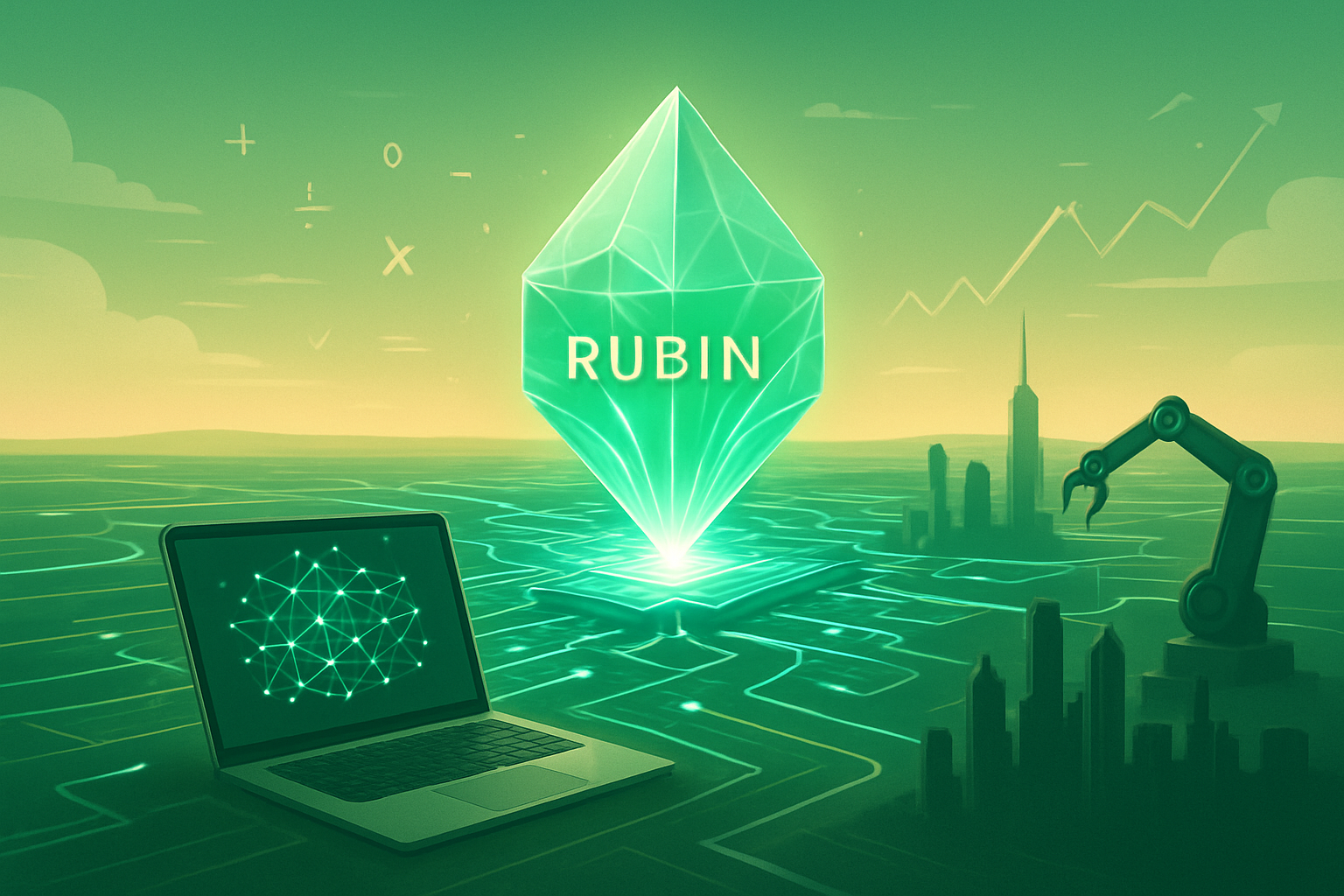
As of early 2026, the global technology sector finds itself in the midst of a radical architectural transition. At the epicenter of this transformation stands NVIDIA Corporation (NASDAQ: NVDA), a company that has evolved from a niche producer of graphics processing units (GPUs) into the sovereign orchestrator of the world’s artificial intelligence infrastructure. Today, April 9, 2026, NVIDIA is once again the focus of intense market scrutiny following the confirmed deployment of its groundbreaking Vera Rubin platform.
The immediate catalyst is a landmark tripartite arrangement involving Meta Platforms (NASDAQ: META) and the specialized cloud provider CoreWeave. This deal—estimated at $21 billion—sees Meta securing early-access capacity to Rubin-based clusters to power its next generation of "Agentic AI" models. This move solidifies NVIDIA’s position not just as a chip vendor, but as the indispensable platform provider for the trillion-dollar "AI Factory" economy.
Historical Background
NVIDIA was founded in 1993 by Jensen Huang, Chris Malachowsky, and Curtis Priem with a vision to bring 3D graphics to the gaming and multimedia markets. The company’s trajectory shifted permanently in 1999 with the release of the GeForce 256, marketed as the world’s first GPU. However, the true "big bang" moment for NVIDIA occurred in 2006 with the introduction of CUDA (Compute Unified Device Architecture). By allowing researchers to use GPUs for general-purpose mathematical calculations, NVIDIA inadvertently laid the groundwork for the modern AI revolution.
Over the last decade, NVIDIA transitioned from a gaming-centric business to a data center powerhouse. The release of the "Ampere" architecture in 2020 and the "Hopper" (H100) architecture in 2022 catalyzed the generative AI explosion. The subsequent 2024 "Blackwell" launch proved that NVIDIA could maintain a blistering pace of innovation, leading to a 10-for-1 stock split in June 2024 that democratized ownership of the stock during its ascent toward a multi-trillion-dollar valuation.
Business Model
NVIDIA’s business model is a masterclass in platform "stickiness." It operates through four primary segments, though the Data Center division now accounts for over 85% of total revenue.
- Data Center: Focused on selling complete "AI Factories"—including GPUs, CPUs (Grace/Vera), DPUs (BlueField), and networking (Quantum/Spectrum-X).
- Gaming: Providing GeForce GPUs for PCs and laptops, which remains a high-margin legacy business.
- Professional Visualization: Serving the workstation market with RTX technologies for digital twins and industrial design.
- Automotive and Robotics: Providing the "brains" for autonomous vehicles through the NVIDIA DRIVE platform and robotics through NVIDIA Isaac.
Crucially, NVIDIA’s revenue is increasingly driven by NVIDIA AI Enterprise, a software suite that creates a recurring revenue stream by providing the libraries and frameworks necessary to deploy AI at scale.
Stock Performance Overview
NVIDIA’s stock performance has rewritten the record books of financial history.
- 1-Year (2025-2026): Over the past 12 months, NVDA has surged approximately 65%, driven by the anticipation and rollout of the Rubin architecture and higher-than-expected "Sovereign AI" spending by national governments.
- 5-Year (2021-2026): Investors have seen a staggering return of over 1,200% as the company captured the lion's share of the global shift toward accelerated computing.
- 10-Year: For the long-term holder, the performance is nearly incomparable, with the stock price up over 35,000% since 2016 (adjusting for splits). Notable moves include the massive "gap-up" events in early 2024 and the late-2025 rally as Rubin prototypes began sampling to tier-1 customers.
Financial Performance
NVIDIA's financial metrics for the current fiscal period reflect its near-monopolistic command over high-end AI compute.
- Revenue Growth: Analysts project FY2027 revenue to approach $180 billion, a significant leap from the $60.9 billion reported in FY2024.
- Margins: Gross margins remain exceptionally high, hovering between 75% and 78%, despite rising costs for advanced HBM4 memory and TSMC (NYSE: TSM) 3nm wafers.
- Cash Flow: The company generates robust free cash flow, allowing it to invest $2 billion directly into CoreWeave in early 2026 to ensure its partner has the capital to build out Rubin-ready data centers.
- Valuation: Trading at a forward P/E ratio of approximately 35x based on 2027 earnings projections, the stock remains expensive by traditional standards but is viewed by many as reasonably priced relative to its triple-digit earnings growth potential.
Leadership and Management
Founder-CEO Jensen Huang remains the visionary face of NVIDIA. His strategy of "one-year release cycles"—moving from Blackwell to Rubin in record time—has kept competitors in a perpetual state of catch-up. Huang is supported by a seasoned leadership team, including Colette Kress (CFO), who has been credited with the company’s disciplined financial scaling and aggressive share buyback programs.
The board of directors is lauded for its corporate governance and strategic foresight, particularly in pivoting NVIDIA toward networking (Mellanox acquisition) and software-defined infrastructure long before they became industry standards.
Products, Services, and Innovations
The focus of 2026 is the Vera Rubin platform (R100/R200).
- The Rubin Architecture: Fabricated on TSMC’s N3P (3nm) process, the Rubin GPU features HBM4 memory, delivering up to 22 TB/s of bandwidth. This is designed to solve the "memory wall" that hampered previous architectures during massive-scale inference.
- Vera CPU: The Rubin platform is often deployed as a "Vera Rubin Superchip," integrating NVIDIA’s next-generation ARM-based CPU (Vera) for seamless data movement between processor and memory.
- Networking: The deployment includes the NVLink 6 switch, capable of interconnecting tens of thousands of GPUs into a single "giant GPU" cluster.
Competitive Landscape
While NVIDIA dominates, the competitive landscape is intensifying:
- AMD (NASDAQ: AMD): The Instinct MI400 series has gained traction among cost-conscious cloud providers, particularly for specific inference workloads.
- Hyperscaler ASICs: Google (NASDAQ: GOOGL), Amazon (NASDAQ: AMZN), and Microsoft (NASDAQ: MSFT) continue to develop their own silicon (TPUs, Trainium, Maia). However, these internal chips lack the versatility and the CUDA software ecosystem that makes NVIDIA the default choice for external developers.
- Intel (NASDAQ: INTC): Following its foundry turnaround, Intel’s Gaudi 4 has shown promise in the mid-market, though it struggles to compete at the ultra-high-end "frontier model" level.
Industry and Market Trends
Three macro trends are currently driving NVIDIA’s growth:
- Sovereign AI: Countries like Japan, Saudi Arabia, and France are investing billions to build domestic AI infrastructure to ensure "data sovereignty."
- The Shift to Inference: While 2023-2024 was about training models, 2026 is the year of Inference. The Vera Rubin platform is specifically optimized for "Reasoning" models that require high-throughput memory to generate complex responses in real-time.
- Agentic AI: The rise of autonomous AI agents that can browse the web, book flights, and manage supply chains has increased the demand for "always-on" compute capacity.
Risks and Challenges
Despite its dominance, NVIDIA faces significant headwinds:
- Regulatory Scrutiny: Antitrust investigations in the EU and the US are focusing on NVIDIA’s dominance in the AI software layer (CUDA).
- Supply Chain Concentration: NVIDIA is heavily reliant on TSMC and specialized memory makers like SK Hynix (KRX: 000660). Any geopolitical instability in the Taiwan Strait remains a "black swan" risk.
- Capex Digestion: There is a persistent fear that hyperscalers (Microsoft, Meta) may eventually hit a "ceiling" in their capital expenditures, leading to a cyclical downturn in GPU demand.
Opportunities and Catalysts
The Meta/CoreWeave deal is the primary near-term catalyst. By leasing Rubin-based capacity through CoreWeave, Meta can accelerate the deployment of "Llama 5" (expected late 2026) without waiting for its own data center retrofits to complete.
- New Markets: NVIDIA’s entry into "Physical AI"—powering humanoid robots and automated factories—represents a trillion-dollar frontier that is only beginning to be priced in.
- M&A Potential: With a massive cash pile, rumors persist of NVIDIA acquiring a major high-speed networking or photonics company to further optimize its chip-to-chip communication.
Investor Sentiment and Analyst Coverage
Wall Street remains predominantly "Bullish." High-profile analysts have recently raised price targets into the $275–$300 range (post-split). Institutional ownership is at record highs, with major hedge funds viewing NVDA as a "core technology utility." However, a vocal minority of "bears" warns that the 2026 Rubin cycle might be the last "parabolic" growth phase before the market reaches saturation.
Regulatory, Policy, and Geopolitical Factors
The geopolitical landscape remains a minefield.
- Export Controls: Strict US Department of Commerce restrictions continue to limit the performance of chips NVIDIA can sell to China, forcing the company to design specific "downgraded" versions that face stiff competition from local Chinese rivals like Huawei.
- Incentives: Conversely, the US CHIPS Act and similar European legislation are subsidizing the construction of the very data centers that house NVIDIA’s hardware, providing an indirect but powerful tailwind.
Conclusion
NVIDIA in 2026 is no longer just a component of the AI era; it is the infrastructure upon which the era is built. The deployment of the Vera Rubin platform via the Meta/CoreWeave deal marks a shift toward a "Service-Oriented Architecture" where the world’s largest tech companies compete for access to NVIDIA’s latest silicon.
For investors, the central question is no longer about NVIDIA’s technological superiority—which is established—but about the sustainability of the massive capital expenditures required to fuel this growth. As long as the "cost per token" continues to fall and the utility of AI agents continues to rise, NVIDIA remains the most formidable force in the global economy. Investors should closely monitor the Q2 2026 earnings call for Rubin’s initial shipment volumes and any updates on the "Rubin Ultra" roadmap for 2027.
This content is intended for informational purposes only and is not financial advice. Today's date is April 9, 2026.