
Tag: Tech Analysis

  • The $3.7 Trillion Orchard: A Deep Dive into Apple’s AI-Driven Future (AAPL)

    The $3.7 Trillion Orchard: A Deep Dive into Apple’s AI-Driven Future (AAPL)

    As of March 31, 2026, Apple Inc. (NASDAQ: AAPL) stands at a historic crossroads. Valued at approximately $3.7 trillion, the Cupertino-based titan is currently celebrating its 50th anniversary—an era defined by a dramatic pivot from being a premier hardware manufacturer to a global leader in personalized, privacy-centric Artificial Intelligence. While the company has seen its crown as the world's most valuable entity challenged by AI infrastructure giants like Nvidia, Apple’s dominance in the consumer ecosystem remains unrivaled.

    The story of Apple in 2026 is one of a "walled garden" expanding its borders into the cloud and generative AI, while simultaneously defending those borders against unprecedented regulatory scrutiny from both the U.S. Department of Justice and the European Commission. With the recent Worldwide Developers Conference (WWDC) cycles focusing almost exclusively on "Apple Intelligence," the company has successfully convinced investors that the iPhone is not just a phone, but the primary gateway to the AI age.

    Historical Background

    Founded on April 1, 1976, by Steve Jobs, Steve Wozniak, and Ronald Wayne, Apple’s journey is arguably the most storied in corporate history. From the early success of the Apple II to the near-bankruptcy of the mid-1990s, the company’s trajectory changed forever with the return of Steve Jobs and the subsequent launch of the iMac, iPod, and, most pivotally, the iPhone in 2007.

    Under the leadership of Tim Cook, who took the helm in 2011, Apple transitioned from an innovation-led "hit factory" to an operational juggernaut. Cook oversaw the expansion of the "Services" business and the vertical integration of Apple Silicon (the M-series and A-series chips), which decoupled the company’s performance from traditional chip manufacturers. By 2026, the company has navigated three distinct eras: the Personal Computer era, the Mobile era, and now, the Intelligence era.

    Business Model

    Apple’s business model is built on a high-margin "Hardware-as-a-Gateway" strategy. The company designs and sells premium hardware—iPhone, Mac, iPad, and Wearables—which act as the entry point for a lucrative ecosystem of services.

    • Hardware (74% of Revenue): The iPhone remains the centerpiece, contributing over half of total net sales. However, the mix has shifted toward "Pro" and "Ultra" models, driving higher Average Selling Prices (ASPs).
    • Services (26% of Revenue): This segment includes the App Store, iCloud, Apple Music, Apple TV+, and Apple Pay. By fiscal year 2025, Services reached a record 75.4% gross margin, effectively becoming Apple’s primary profit engine.
    • The Ecosystem Lock-in: The "stickiness" of iMessage, iCloud, and now Apple Intelligence creates high switching costs, ensuring a predictable upgrade cycle from its 2.2 billion active device install base.

    Stock Performance Overview

    Over the past decade, Apple has been one of the greatest wealth-creation engines in history.

    • 10-Year Performance: From approximately $25 (split-adjusted) in March 2016 to $247.31 today, the stock has delivered nearly a 10x return, significantly outperforming the S&P 500.
    • 5-Year Performance: Since March 2021, the stock has risen roughly 105%, fueled by the post-pandemic digital acceleration and the initial 5G upgrade cycle.
    • 1-Year Performance: In the last 12 months, AAPL has seen a 28% gain, largely driven by the successful launch of the iPhone 17 and the integration of the A19 chip, which brought more advanced on-device AI capabilities to the masses.

    Financial Performance

    In its fiscal year 2025 report, Apple posted revenue of $416.2 billion, a 6.4% year-over-year increase. Despite global economic volatility, the company’s net income reached a staggering $112 billion, with a diluted EPS of $7.46.

    Key financial metrics for the TTM (Trailing Twelve Months) include:

    • Gross Margin: 46.9%, a testament to the growth of Services and high-end hardware.
    • Cash Reserves: Apple continues to maintain one of the world's largest cash piles, despite spending over $90 billion annually on share repurchases and dividends.
    • Debt: The company maintains a "net cash neutral" goal, carrying manageable debt while leveraging its high credit rating to fund buybacks.

    Leadership and Management

    Tim Cook remains at the helm as CEO, though at age 65, succession planning is the most discussed topic among institutional investors. Cook’s tenure has been characterized by supply chain mastery and fiscal discipline.

    The inner circle has seen some transition:

    • John Ternus: Now the Senior VP of Hardware Engineering, Ternus is widely regarded as the "heir apparent." His visibility during the iPhone 17 and Vision Pro 2 launches has solidified his status.
    • Jeff Williams: The COO and "operations wizard" continues to oversee Apple Watch and health initiatives, though he is also approaching traditional retirement age.
    • Recent Shifts: 2025 saw the departure of several long-time veterans, including AI head John Giannandrea and General Counsel Kate Adams, sparking a "changing of the guard" narrative within the executive suite.

    Products, Services, and Innovations

    The focus in 2026 is squarely on Apple Intelligence. Unlike competitors who rely on massive cloud data centers, Apple’s strategy emphasizes "On-Device AI."

    • iPhone 17 & 17 Pro: These devices feature the A19 chip, which allows for complex multi-modal AI processing without data leaving the phone.
    • Vision Pro 2: Released in early 2026, the second generation of Apple’s spatial computer is lighter, cheaper, and more integrated with Mac workflows, though it remains a niche product compared to the iPhone.
    • Siri 2.0: The latest software update at WWDC 2025 transformed Siri into a true "agent" capable of executing tasks across third-party apps, such as "Draft a summary of my last meeting and send it to the group chat in Slack."

    Competitive Landscape

    Apple is currently locked in a three-way battle for market cap supremacy with Nvidia (NASDAQ: NVDA) and Microsoft (NASDAQ: MSFT).

    • AI Infrastructure: Nvidia holds the lead in valuation due to the hardware-level AI boom, but Apple controls the "edge"—the devices people actually use to interact with AI.
    • Smartphone Rivals: In China, Huawei and Xiaomi continue to challenge Apple with high-end foldable devices. However, Apple regained market share in late 2025 as its AI features were localized for the Chinese market.
    • Services Competition: Apple TV+ competes with Netflix, while Apple Music battles Spotify. Apple’s advantage remains its ability to bundle these services (Apple One).

    Industry and Market Trends

    The two dominant trends in 2026 are Generative AI on the Edge and Supply Chain Diversification.

    • Edge AI: As consumers become more privacy-conscious, the demand for local AI processing—rather than cloud-based processing—is skyrocketing. Apple is the clear leader in this architecture.
    • The India Shift: Apple has successfully moved 25% of its iPhone production to India as of 2025. This "China+1" strategy is vital for mitigating geopolitical risks and tapping into the growing Indian middle class.

    Risks and Challenges

    Apple’s path is not without significant hurdles:

    • Regulatory Siege: The U.S. DOJ’s antitrust lawsuit, which alleges Apple uses its ecosystem to lock out competitors, is moving toward a potential trial in 2027.
    • EU Compliance: The Digital Markets Act (DMA) has forced Apple to allow third-party app stores in Europe, threatening the highly profitable "Apple Tax."
    • Innovation Saturation: There is a constant risk that the iPhone has reached "peak innovation," where incremental hardware updates no longer drive massive upgrade cycles.

    Opportunities and Catalysts

    • Health Tech: Apple is rumored to be nearing a breakthrough in non-invasive blood glucose monitoring for the Apple Watch, a "holy grail" for medical technology.
    • AI Monetization: Analysts expect Apple to introduce a premium "Apple Intelligence+" subscription tier by 2027, potentially adding billions to high-margin recurring revenue.
    • Emerging Markets: India’s rapid adoption of premium smartphones offers a growth runway that could mirror China’s expansion from a decade ago.

    Investor Sentiment and Analyst Coverage

    Wall Street remains largely bullish on AAPL, viewing it as a "flight to quality" asset.

    • Ratings: Approximately 70% of analysts carry a "Buy" or "Strong Buy" rating.
    • Price Targets: Median price targets for 2026 hover around the $265-$275 range, implying roughly 10% upside from current levels.
    • Institutional Ownership: Major firms like Berkshire Hathaway and Vanguard maintain massive positions, though Warren Buffett’s firm trimmed its stake slightly in 2024-2025 to rebalance into energy and infrastructure.

    Regulatory, Policy, and Geopolitical Factors

    The geopolitical landscape is Apple’s biggest wildcard.

    • U.S.-China Relations: Continued tariffs and export controls on advanced chips affect Apple’s supply chain costs and its ability to sell advanced AI features in the Chinese market.
    • Privacy Regulation: While Apple benefits from a "privacy-first" brand, new laws regarding data sovereignty and AI training could limit the scope of Apple Intelligence in certain jurisdictions.

    Conclusion

    As Apple prepares to enter its second half-century, its $3.7 trillion valuation reflects a company that has successfully reinvented itself for the AI era. By leveraging its vast install base and high-performance silicon, Apple has turned the "threat" of generative AI into a primary growth catalyst.

    Investors should monitor the progression of the DOJ lawsuit and the adoption rates of the Vision Pro 2 as indicators of long-term health. However, with a record-breaking Services margin and a hardware cycle that remains resilient, Apple enters its 50th year as the quintessential "compounder"—a stock that blends safety, growth, and unparalleled brand loyalty.


    This content is intended for informational purposes only and is not financial advice.

  • The Sovereign of Silicon: A Deep Dive into Nvidia’s $4 Trillion AI Empire (2026)

    The Sovereign of Silicon: A Deep Dive into Nvidia’s $4 Trillion AI Empire (2026)

    Date: March 30, 2026

    Introduction

    As of early 2026, NVIDIA Corp. (NASDAQ: NVDA) has transcended its origins as a high-end graphics card manufacturer to become the undisputed architect of the global "Intelligence Economy." With a market capitalization fluctuating between $4.1 trillion and $4.4 trillion, Nvidia now rivals the GDP of major sovereign nations. This research feature explores how a single fabless semiconductor company achieved a valuation that dwarfs traditional manufacturing giants, driven by a relentless innovation cycle and a software-defined ecosystem that rivals the dominance of the internet's early protocols.

    Historical Background

    Founded in 1993 by Jensen Huang, Chris Malachowsky, and Curtis Priem, Nvidia initially focused on the niche market of 3D graphics for gaming. The company’s trajectory changed forever in 2006 with the launch of CUDA (Compute Unified Device Architecture). By allowing researchers to use GPUs for general-purpose mathematical calculations, Nvidia planted the seeds for the modern AI revolution. While the industry initially viewed CUDA as a distraction from gaming, it became the foundation for the Deep Learning breakthrough of 2012 (AlexNet) and the subsequent Generative AI explosion of 2023. Today, Jensen Huang remains at the helm, often cited as one of the most successful tech founders in history.

    Business Model

    Nvidia operates a "fabless" business model, meaning it designs the silicon but outsources the actual fabrication to giants like Taiwan Semiconductor Manufacturing Company (NYSE: TSM). This allows Nvidia to maintain an asset-light structure with elite margins.

    • Data Center (85%+ of Revenue): The core engine, providing H100, B200 (Blackwell), and the upcoming R200 (Rubin) GPUs to cloud providers and enterprises.
    • Gaming: Legacy high-performance GPUs (GeForce RTX) for PC gaming.
    • Professional Visualization: Omniverse and design tools for digital twins.
    • Automotive and Robotics: Providing the "brains" for autonomous vehicles and humanoid robots.
      Nvidia’s "secret sauce" is its software stack. For every dollar spent on hardware, the company seeks to capture recurring value through its AI Enterprise software, NIMs (Nvidia Inference Microservices), and specialized libraries for industries ranging from healthcare to weather forecasting.

    Stock Performance Overview

    Nvidia’s stock performance has been nothing short of historic.

    • 1-Year: Since March 2025, the stock has risen approximately 52%, fueled by the successful ramp-up of the Blackwell architecture and the announcement of the Rubin platform.
    • 5-Year: NVDA has seen a staggering 1,200%+ increase, vastly outperforming the S&P 500 and the Nasdaq 100.
    • 10-Year: Investors who held NVDA through the last decade have witnessed a total return exceeding 25,000%.
      The 10-for-1 stock split in mid-2024 significantly boosted liquidity and retail participation, cementing its status as a cornerstone of the modern "Mag Magnificent Seven."

    Financial Performance

    In the fiscal year ended January 2026, Nvidia reported a record $215.9 billion in revenue, a 65% year-over-year increase.

    • Profitability: Net income reached $120.07 billion. Gross margins sit at a staggering 75.2%, a figure virtually unheard of in hardware manufacturing.
    • Cash Flow: Free cash flow (FCF) exceeds $80 billion annually, allowing for aggressive R&D and strategic buybacks.
    • Valuation: Despite its massive market cap, Nvidia’s forward P/E ratio remains surprisingly grounded near 35x-40x, as earnings growth continues to match or exceed price appreciation.

    Leadership and Management

    CEO Jensen Huang is the defining figure of the semiconductor age. His management style is characterized by a "flat" organizational structure (reportedly having 50 direct reports) and a culture of "speed as a strategy." The board of directors includes heavyweights from tech and finance, focused on navigating the transition from a chip company to a system and software provider. Governance is generally rated highly, though the company’s heavy reliance on Huang’s vision presents a notable "key man" risk.

    Products, Services, and Innovations

    Nvidia is currently transitioning to its Rubin (R200) architecture, unveiled at CES 2026.

    • Rubin Architecture: Utilizing TSMC’s 3nm process and HBM4 (High Bandwidth Memory), Rubin chips offer 3x the efficiency for massive Mixture-of-Experts (MoE) AI models compared to Blackwell.
    • Vera CPU: Nvidia’s custom 88-core CPU designed to pair with Rubin GPUs, further reducing reliance on Intel or AMD processors.
    • Physical AI: The "Cosmos" simulation engine and Project GR00T are making Nvidia the primary platform for training the next generation of humanoid robots.
    • Networking: Through the acquisition of Mellanox, Nvidia’s Spectrum-X ethernet and InfiniBand solutions represent roughly 15% of data center revenue, solving the "bottleneck" problem in AI clusters.

    Competitive Landscape

    Nvidia maintains a market share of approximately 85-90% in AI accelerators, but competition is intensifying:

    • Advanced Micro Devices (NASDAQ: AMD): The Instinct MI350/450 series is gaining ground as a cost-effective alternative for inference.
    • Custom Silicon: Hyperscalers like Alphabet (NASDAQ: GOOGL), Amazon (NASDAQ: AMZN), and Microsoft (NASDAQ: MSFT) are developing internal chips (TPUs, Trainium, Maia) to reduce CAPEX.
    • Intel Corp. (NASDAQ: INTC): While struggling in manufacturing, Intel’s Gaudi 3 continues to find niche enterprise customers, though it lacks the software ecosystem of CUDA.

    Industry and Market Trends

    Three major trends are defining 2026:

    1. Sovereign AI: Nation-states (Japan, UK, UAE) are building national AI clouds to protect data sovereignty, creating a massive new customer class for Nvidia.
    2. Agentic AI: The shift from "chatbots" to "agents" that can execute tasks requires significantly more compute power, sustaining demand for the B200 and R200 series.
    3. Liquid Cooling: As chips now pull over 1,000W-2,000W each, the data center industry is undergoing a massive shift to liquid-cooled racks (like the GB200 NVL72).

    Risks and Challenges

    • Concentration Risk: A handful of Big Tech companies (the "hyperscalers") account for a large portion of Nvidia's revenue. Any slowdown in their AI spending could be catastrophic.
    • Supply Chain: Nvidia is entirely dependent on TSMC for fabrication and SK Hynix/Micron for HBM. Any disruption in the Taiwan Strait remains a "black swan" risk.
    • Valuation Bubble: Critics argue that the "AI ROI" (Return on Investment) has yet to materialize for many enterprises, potentially leading to a "digestion period" where orders slow down.

    Opportunities and Catalysts

    • Edge AI: Bringing Blackwell-level performance to edge devices and robotics.
    • Healthcare: BioNeMo, Nvidia’s generative AI for drug discovery, is currently in clinical trials with several pharmaceutical giants.
    • Software Recurring Revenue: The transition to a software-as-a-service (SaaS) model through Nvidia AI Enterprise could significantly expand valuation multiples.

    Investor Sentiment and Analyst Coverage

    Wall Street remains overwhelmingly bullish. Of the 60+ analysts covering the stock, over 90% maintain "Buy" or "Strong Buy" ratings. The consensus price target for late 2026 sits near $195. Hedge funds have slightly trimmed positions to manage concentration, but institutional ownership remains at record levels. Retail sentiment is characterized by "HODL" (Hold On for Dear Life) conviction, viewing Nvidia as the "Cisco of the 21st century" but with much higher margins.

    Regulatory, Policy, and Geopolitical Factors

    The regulatory landscape is a minefield. The Chip Security Act of 2026 has tightened controls on "smuggling" chips into restricted regions. While a late 2025 policy shift allowed Nvidia to resume selling slightly throttled chips (H200 series) to China under a "Sovereignty Surcharge" and strict volume caps, the relationship remains tense. Furthermore, antitrust regulators in the EU and US are closely monitoring Nvidia’s dominance in the AI software stack to ensure fair competition.

    Conclusion

    Nvidia stands at the pinnacle of the technology world in March 2026. By evolving from a "chip maker" into a "platform provider," the company has decoupled its valuation from the capital-intensive cycles of traditional manufacturing. While risks regarding China and customer concentration are real, Nvidia’s "one-year innovation cadence" and the deepening moat of the CUDA ecosystem make it the primary beneficiary of the transition to an AI-first civilization. For investors, the question is no longer about the price of the chip, but the value of the intelligence it generates.


    This content is intended for informational purposes only and is not financial advice.
  • The $200 Billion Gamble: Inside Amazon’s (AMZN) 2026 AI Supercycle

    The $200 Billion Gamble: Inside Amazon’s (AMZN) 2026 AI Supercycle

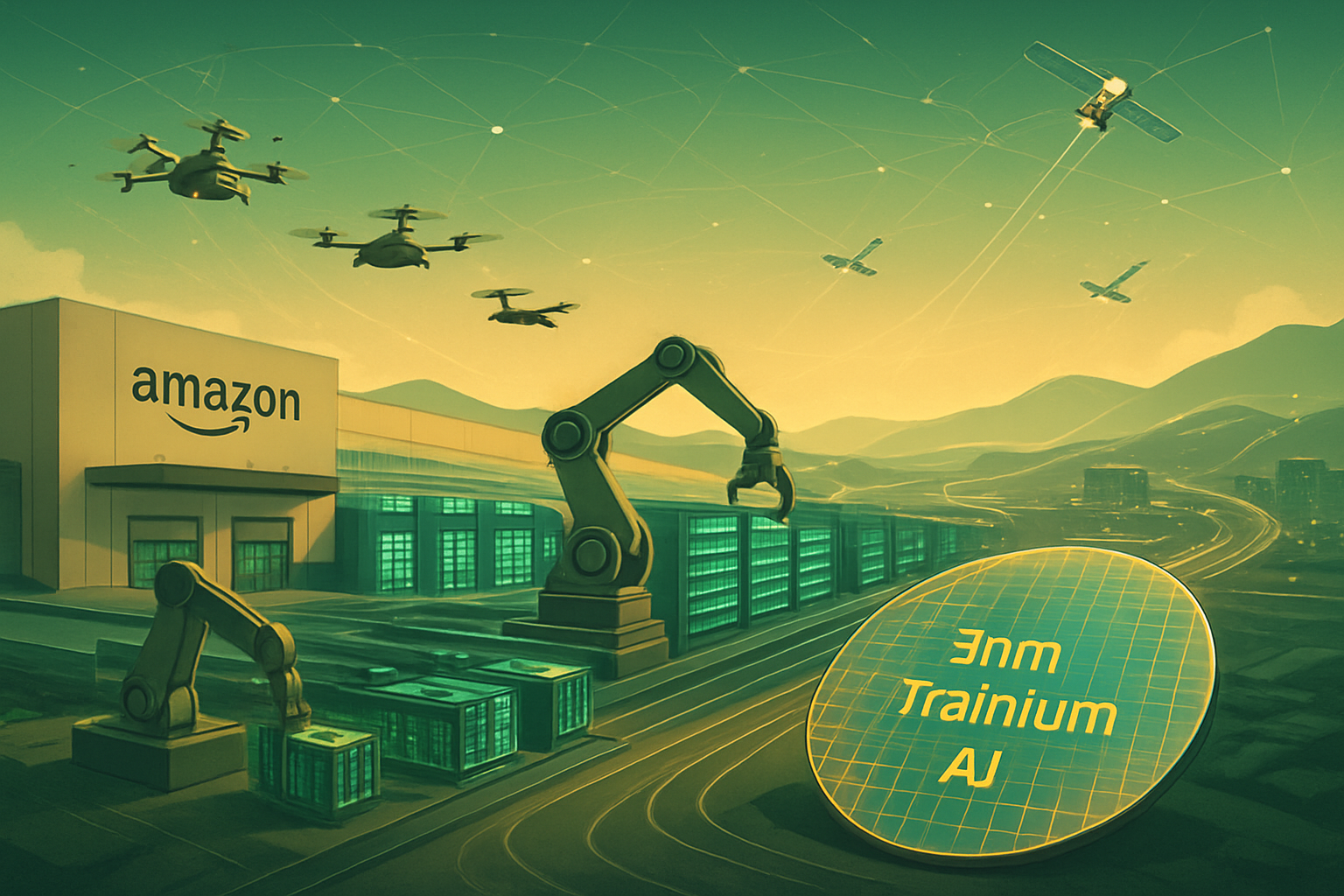
    As of March 30, 2026, Amazon.com, Inc. (NASDAQ: AMZN) finds itself at a defining crossroads that echoes its most ambitious—and controversial—periods of the past. After a year of record-breaking profitability in 2025, the company has pivoted into what analysts are calling the "Great AI Build-out." With a staggering $200 billion capital expenditure guidance for the 2026 fiscal year, Amazon is betting its future on a vertically integrated AI stack, ranging from proprietary 3nm silicon to global satellite internet via its "Amazon Leo" project. While the market’s immediate reaction has been one of "capex sticker shock," the underlying narrative remains the same: Amazon is sacrificing short-term liquidity to secure a dominant position in the next two decades of compute infrastructure.

    Historical Background

    Founded in 1994 by Jeff Bezos as an online bookstore in a Seattle garage, Amazon’s history is a relentless sequence of transformations. What began as a retail disruptor evolved into a logistical juggernaut, a cloud pioneer with the 2006 launch of Amazon Web Services (AWS), and a digital media powerhouse.

    The company’s most significant shifts have always been marked by periods of massive internal investment that the market initially doubted. From the multi-billion dollar build-out of its fulfillment network in the early 2010s to the $13.7 billion acquisition of Whole Foods in 2017, Amazon has consistently doubled down on capital-intensive "flywheels." Today, under the leadership of Andy Jassy, the company has completed its latest pivot: transitioning from a provider of third-party cloud tools to a manufacturer of the very silicon and intelligence that powers the global economy.

    Business Model

    Amazon’s business model in 2026 is a complex ecosystem of four primary engines:

    1. Cloud Infrastructure (AWS): The highest-margin segment, now providing not just storage and compute, but a full Generative AI lifecycle including foundational models (Bedrock) and custom chips.
    2. Global Retail (1P & 3P): A massive marketplace driven by Prime memberships. In 2025, the retail wing reached peak efficiency through regionalization and warehouse robotics.
    3. Digital Advertising: A high-growth ($60B+ revenue) segment that leverages Amazon’s vast consumer data to place ads on its marketplace and Prime Video.
    4. Emerging Infrastructure: This includes the newly rebranded Amazon Leo (satellite internet) and Amazon’s health and pharmacy services.

    Stock Performance Overview

    As of March 30, 2026, AMZN shares are trading in the $199–$207 range. The stock’s trajectory reflects a tug-of-war between long-term growth and immediate free cash flow (FCF) concerns.

    • 1-Year Performance: -1.0%. The stock has pulled back roughly 20% from its 2025 highs following the announcement of the $200 billion capex plan.
    • 5-Year Performance: +29.6%. A steady climb that weathered the post-pandemic correction and was buoyed by the 2024 AI rally.
    • 10-Year Performance: +624.5%. Amazon remains one of the decade's premier wealth creators, significantly outperforming the S&P 500.

    Financial Performance

    Amazon’s 2025 fiscal year was a masterclass in operational efficiency. The company reported:

    • Revenue: $716.9 billion, a 12% year-over-year increase.
    • Net Income: A record $77.7 billion.
    • Operating Margins: North American retail margins surged to 8%, driven by the deployment of the "Proteus" autonomous robots. AWS maintained robust 35% margins.
    • The Capex Surge: The pivot to a $200 billion 2026 capex budget has temporarily depressed FCF expectations, a move that management defends as necessary for "Silicon Sovereignty."

    Leadership and Management

    CEO Andy Jassy has fully stepped out of Jeff Bezos's shadow, establishing a reputation as a "disciplined builder." Under his tenure, the company has become more focused on margins and internal efficiencies than the experimental "wild west" era of the late 2010s.

    • Matt Garman (CEO of AWS): Taking over in 2024, Garman has steered AWS toward custom silicon (Trainium/Inferentia) to reduce reliance on external vendors.
    • Doug Herrington (CEO of Worldwide Amazon Stores): Credited with the "Regionalization" of the US logistics network, which halved shipping times while reducing costs.

    Products, Services, and Innovations

    Innovation in 2026 is centered on "Vertical AI Integration."

    • Trainium3 Silicon: Built on a 3nm process, Amazon’s newest AI chip is claiming a 40% cost advantage over third-party GPUs for large-scale model training.
    • Amazon Bedrock: This platform has become the "OS of AI," allowing enterprises to swap between models (Anthropic, Meta, Amazon’s own Titan) with ease.
    • Amazon Leo (formerly Kuiper): With over 200 satellites in orbit, the service began offering "Leo Ultra" (1 Gbps) internet to remote enterprise and AWS customers in March 2026.

    Competitive Landscape

    Amazon faces a multi-front war:

    • Cloud: Microsoft (25% market share) and Google Cloud (13%) are closing the gap on AWS (31%). Microsoft’s partnership with OpenAI remains a formidable threat in the enterprise application layer.
    • Retail: Walmart (WMT) has successfully mirrored Amazon’s logistics efficiency, while budget players like Temu and Shein continue to pressure the low-end consumer segment.
    • AI Hardware: While Amazon is moving toward its own chips, it must still maintain a delicate partnership with NVIDIA (NVDA) to satisfy demand for H100 and Blackwell GPUs.

    Industry and Market Trends

    The "Generative AI Phase 2" is the dominant trend of 2026. The market has moved past the hype of "chatbots" and into "inference at scale." Enterprises are now looking for the cheapest, most efficient way to run AI models daily, rather than just training them. This favors Amazon’s Inferentia chips and AWS’s sprawling data center footprint. Additionally, "Sovereign AI"—where nations require data and compute to remain within borders—has opened new revenue streams for AWS's government-cloud divisions.

    Risks and Challenges

    • Capex Overbuild: There is a non-trivial risk that the $200 billion investment in 2026 creates "ghost data centers" if AI demand cools.
    • Regulatory Scrutiny: The FTC's landmark antitrust case, led by Chair Lina Khan, continues to loom over the company, focusing on "Project Nessie" and the alleged "Buy Box" self-preferencing.
    • Labor Relations: As Amazon automates more of its fulfillment with robotics, tensions with labor unions and regulatory bodies regarding workplace safety and displacement remain high.

    Opportunities and Catalysts

    • Prime Video Advertising: The full integration of AI-driven, non-intrusive ads into Prime Video is expected to add $10 billion to the bottom line by 2027.
    • Healthcare: Amazon Pharmacy’s integration with One Medical is finally showing signs of scale, offering a "Prime-like" experience for healthcare.
    • Custom Silicon Revenue: Amazon’s chip business is now a $10B+ annual run-rate business, offering higher margins than traditional third-party software resale.

    Investor Sentiment and Analyst Coverage

    Wall Street remains divided. "Bulls" see the 2026 capex as a visionary land grab similar to the 2006 AWS launch. "Bears" argue that Amazon is becoming a "utility company" with diminishing returns on capital. Current consensus is a "Moderate Buy," with a 12-month price target averaging $245, suggesting significant upside once the capex cycle matures. Institutional ownership remains high at over 60%, led by Vanguard and BlackRock.

    Regulatory, Policy, and Geopolitical Factors

    Geopolitically, Amazon is navigating the "Chip Wars." Its move into 3nm chip design makes it reliant on TSMC (TSM) in Taiwan, exposing it to regional tensions. Domestically, the EU’s Digital Markets Act (DMA) has forced Amazon to change how it uses seller data, creating a potential headwind for its private-label brands.

    Conclusion

    Amazon in 2026 is a company that has chosen to embrace the volatility of innovation. By committing $200 billion to AI and satellite infrastructure, it is attempting to build the "backbone" of the next digital era. While the stock may face short-term pressure as free cash flow is diverted to data centers and custom silicon, the underlying strength of its 31% cloud market share and its newly efficient retail engine provide a safety net. For the long-term investor, the key question is not whether Amazon is spending too much, but whether any other company can afford to keep up.


    This content is intended for informational purposes only and is not financial advice.

  • Apple (AAPL) Deep-Dive: Goldman’s Conviction, the AI Supercycle, and the Quantum Frontier

    Apple (AAPL) Deep-Dive: Goldman’s Conviction, the AI Supercycle, and the Quantum Frontier

    As of March 26, 2026, Apple Inc. (NASDAQ: AAPL) stands at a historic valuation, flirting with a $4 trillion market capitalization. While the company has long been defined by the hardware perfection of the iPhone, the narrative in 2026 has shifted toward its transformation into an "AI and Security Fortress." With Goldman Sachs recently reiterating a high-conviction "Buy" rating and a price target of $330, investors are increasingly focused on two pillars of future growth: the integration of "Apple Intelligence" and the company’s pioneering work in Post-Quantum Cryptography (PQC). This article examines whether Apple’s hybrid AI strategy and its defensive lead in quantum-safe security will drive the next decade of alpha.

    Historical Background

    Founded in 1976 by Steve Jobs, Steve Wozniak, and Ronald Wayne, Apple began as a pioneer of the personal computing revolution. Its early milestones—the Apple II, the Macintosh, and the subsequent "wilderness years" without Jobs—set the stage for one of the greatest corporate turnarounds in history upon his return in 1997. The 2001 launch of the iPod and the 2007 debut of the iPhone redefined consumer electronics, moving Apple from a niche computer maker to a dominant global lifestyle brand.

    Under the leadership of Tim Cook, who took the helm in 2011, Apple transitioned from a hardware-centric company to an ecosystem powerhouse. The decade between 2016 and 2026 saw the explosion of the Services segment and the successful transition to in-house silicon (M-series and A-series chips), which provided the computational foundation for the AI and quantum-security leaps the company is making today.

    Business Model

    Apple operates a vertically integrated business model often referred to as a "Walled Garden." This ecosystem creates high switching costs for users, ensuring recurring revenue through hardware cycles and digital services.

    • Hardware: The iPhone remains the primary revenue driver, supplemented by the iPad, Mac, and "Wearables, Home, and Accessories" (Apple Watch, AirPods, and the Vision Pro line).
    • Services: This high-margin segment includes the App Store, Apple Cloud, Apple Music, Apple Pay, and Apple TV+. In early 2026, Services margins reached a staggering 75.4%.
    • Hybrid AI Model: By 2026, Apple’s business model has incorporated "AI as a Utility." Rather than charging a flat subscription for basic AI, Apple leverages AI to drive premium hardware upgrades while reportedly collecting "traffic acquisition" and "intelligence partnership" fees from partners like Google and OpenAI.

    Stock Performance Overview

    Apple’s stock has been a cornerstone of institutional and retail portfolios for over a decade.

    • 1-Year Performance: As of late March 2026, AAPL has seen a +14.50% total return, navigating a volatile tech landscape where investors rotated between pure-play AI software and legacy hardware.
    • 5-Year Performance: The stock has delivered a +115.13% return, significantly outperforming the broader market.
    • 10-Year Performance: Long-term shareholders have seen a massive ~1,031% return, effectively a 10-bagger since 2016, driven by aggressive share buybacks and dividend growth.
      Despite a ~7% YTD dip in early 2026 due to broader macroeconomic cooling, the stock remains resilient compared to its "Magnificent Seven" peers.

    Financial Performance

    Apple’s financial engine continues to operate at record efficiency.

    • FY 2025 Results: Revenue hit a record $416.2 billion, with a net income of $112.0 billion.
    • Q1 2026 (Holiday Quarter): Apple reported revenue of $143.8 billion (up 16% YoY). Gross margins expanded to 47.2%, reflecting the shift toward higher-margin Services and cost efficiencies in Apple Silicon.
    • Cash Position: Apple ended 2025 with a net cash position of approximately $60 billion, continuing its policy of returning nearly all free cash flow to shareholders via buybacks and dividends.

    Leadership and Management

    CEO Tim Cook continues to lead with a focus on operational excellence and supply chain resilience. While Cook has signaled that the board is actively engaged in succession planning, he remains firmly in control as of March 2026.

    • Succession Watch: John Ternus, SVP of Hardware Engineering, has emerged as the clear frontrunner to eventually succeed Cook. His increased visibility at the March 2026 "MacBook Neo" launch event signaled his rising influence within the executive team.
    • Strategic Governance: The management team is currently focused on navigating the dual challenges of global antitrust litigation and the rapid integration of generative AI across the product stack.

    Products, Services, and Innovations

    Apple’s 2026 product roadmap is dominated by Apple Intelligence and Secure Communication.

    • Siri 2.0 (Code-named "Campo"): Expected to be fully unveiled at WWDC 2026, this iteration of Siri utilizes a "hybrid intelligence" framework, leveraging on-device processing for privacy and Google’s Gemini models for complex reasoning.
    • PQ3 Security: Apple has set a new industry standard with PQ3, a post-quantum cryptographic protocol for iMessage. As quantum computers pose a theoretical threat to current encryption, Apple’s "Level 3" security makes its ecosystem the most robust against future "Harvest Now, Decrypt Later" attacks.
    • Apple Silicon: The M5 and A19 Pro chips (3nm and 2nm processes) are optimized specifically for LLM (Large Language Model) inference, giving Apple a competitive edge in "On-Device AI."

    Competitive Landscape

    Apple faces a multi-front battle:

    • AI Rivals: Microsoft (NASDAQ: MSFT) and Google (NASDAQ: GOOGL) have a lead in cloud-based AI, but Apple’s control over 2 billion active devices gives it a unique distribution advantage for "Agentic AI."
    • Hardware Rivals: Samsung continues to challenge in the foldable space, though Apple’s rumored "iPhone Fold" (potentially late 2026/2027) remains a highly anticipated wildcard.
    • Ecosystem Rivals: Meta (NASDAQ: META) competes aggressively in the spatial computing (AR/VR) arena, though Apple’s Vision Pro 2 is positioned at the high-end enterprise and prosumer market.

    Industry and Market Trends

    The "AI Supercycle" is the defining trend of 2026. Consumers are beginning to upgrade hardware not just for better cameras, but for the local processing power required to run autonomous AI agents. Additionally, the industry is shifting toward "Confidential Computing," where data privacy is no longer a feature but a regulatory requirement—a trend Apple anticipated years ago.

    Risks and Challenges

    • Regulatory Headwinds: The DOJ’s antitrust lawsuit remains the largest overhang. A trial focused on the smartphone monopoly is slated for late 2026, which could potentially force changes to the "Walled Garden" business model.
    • EU Compliance: The Digital Markets Act (DMA) has forced Apple to allow third-party app stores in Europe, threatening the lucrative "Apple Tax" (30% commission).
    • Geopolitical Risk: Dependence on Chinese manufacturing and the TSMC (Taiwan) supply chain remains a systemic risk, despite efforts to diversify into India and Vietnam.

    Opportunities and Catalysts

    • Goldman Sachs "Buy" Conviction: Goldman analyst Michael Ng maintains a $330 price target, arguing that the market underestimates the tailwinds from the AI-driven iPhone 17/18 refresh cycle.
    • The "Siri 2.0" Launch: The June 2026 WWDC event is a massive catalyst; if Apple successfully demonstrates a truly autonomous AI agent, it could trigger a significant valuation rerating.
    • Quantum Security Advantage: As enterprise customers become more wary of quantum threats, Apple’s PQ3 protocol could drive higher adoption of iPads and Macs in the corporate and government sectors.

    Investor Sentiment and Analyst Coverage

    Sentiment remains cautiously optimistic. While some hedge funds trimmed positions in early 2026 due to valuation concerns, institutional ownership remains high. Wall Street consensus is largely a "Moderate Buy," with Goldman Sachs being one of the more aggressive bulls. Retail sentiment is buoyed by the "buy the dip" mentality that has historically rewarded AAPL shareholders.

    Regulatory, Policy, and Geopolitical Factors

    Apple is currently navigating a "coordinated global enforcement wave." Beyond the US and EU, regulators in Japan and the UK are considering similar "Open Ecosystem" mandates. On the policy front, Apple is benefiting from US incentives for domestic chip packaging, though it remains exposed to any escalation in US-China trade tensions.

    Conclusion

    Apple Inc. in March 2026 is a company in transition, evolving from a hardware vendor into a specialized AI and security provider. The Goldman Sachs $330 price target reflects a belief that Apple’s 2-billion-device install base is the ultimate "moat" for distributing generative AI. While regulatory risks in the US and EU present real challenges to the App Store’s margins, the company’s lead in Post-Quantum Cryptography and its record-breaking cash flow provide a significant safety net. For investors, the upcoming WWDC 2026 will be the "litmus test" for whether Apple can turn its "AI and Quantum" potential into a tangible earnings driver for the next decade.


    This content is intended for informational purposes only and is not financial advice.

  • The Light Engine of AI: A Comprehensive Deep Dive into Lumentum Holdings (LITE)

    The Light Engine of AI: A Comprehensive Deep Dive into Lumentum Holdings (LITE)

    As of today, March 25, 2026, the technology sector is grappling with a profound shift in infrastructure priorities. While the "AI Gold Rush" began with GPUs, it has evolved into a race for the "plumbing" that connects them. At the center of this transformation is Lumentum Holdings Inc. (NASDAQ: LITE), a company that has transitioned from a steady telecommunications supplier to a high-growth "light engine" powerhouse. With its recent inclusion in the S&P 500 and a multi-billion-dollar strategic partnership with industry titan Nvidia, Lumentum has become a critical bellwether for the health of global AI scaling.

    Historical Background

    Lumentum was born out of one of the most significant corporate splits in the history of the optical industry. Established on August 1, 2015, the company was spun off from JDS Uniphase (JDSU), inheriting the legacy firm's Communications and Commercial Optical Products (CCOP) business. In its early years, Lumentum focused on optical components for long-haul telecommunications and metro networks.

    The company’s growth strategy has been defined by aggressive, strategic acquisitions. In 2018, Lumentum acquired Oclaro for $1.8 billion, a move that secured its dominance in Indium Phosphide (InP) laser technology. This was followed by the 2022 acquisition of NeoPhotonics, which bolstered its high-speed coherent optics portfolio. Most recently, the 2023-2024 acquisition of CloudLight for $750 million marked Lumentum’s decisive pivot toward the cloud data center market, setting the stage for the explosive growth seen in early 2026.

    Business Model

    Lumentum operates a vertically integrated manufacturing and design model. Unlike many of its "fab-lite" competitors, Lumentum produces its own laser chips, giving it superior control over performance, cost, and supply chain reliability. The company reports in two primary segments:

    1. Cloud & Networking (approx. 88% of revenue): This segment is the primary engine of the company. It provides high-speed optical transceivers (800G and 1.6T), Optical Circuit Switches (OCS), and advanced amplifiers. Its customer base has shifted from traditional telecom providers like Ciena and Nokia to "Hyperscale" data center operators—Google, Amazon, Meta, and Microsoft.
    2. Industrial Tech (approx. 12% of revenue): This division focuses on high-power commercial lasers for precision manufacturing and Vertical-Cavity Surface-Emitting Lasers (VCSELs). These VCSEL components are essential for 3D sensing in consumer electronics (such as smartphones) and LiDAR systems for the burgeoning autonomous vehicle market.

    Stock Performance Overview

    Lumentum’s stock performance reflects its transition into an AI "darling."

    • 1-Year Performance: Over the past twelve months, LITE has seen a staggering 145% increase, driven by massive beat-and-raise earnings cycles and the "Nvidia effect" following their 2026 partnership.
    • 5-Year Performance: Looking back to March 2021, the stock has grown approximately 450%. Much of this growth was concentrated in the 2024-2026 window as the AI infrastructure cycle took hold.
    • 10-Year Performance: Since its spin-off in 2015, the stock has returned nearly 900% for long-term holders. While the mid-2010s were characterized by cyclical telecom volatility, the current decade has seen a structural re-rating of the stock's valuation multiples.

    Financial Performance

    In its latest quarterly report (Q2 FY2026), Lumentum reported record-breaking revenue of $665.5 million, representing a 65.5% year-over-year increase. The company’s profitability metrics have scaled alongside its top line; non-GAAP gross margins reached 42.5%, and operating margins expanded to 25.2%.

    However, the balance sheet presents a complex picture. Lumentum currently carries approximately $3.18 billion in convertible notes. In early 2026, the company issued a technical disclosure regarding these notes, as the soaring stock price triggered conversion thresholds. While this creates a "going concern" technicality in accounting terms, the company maintains a robust cash position of $1.15 billion and continues to generate strong free cash flow, suggesting the debt is a management exercise rather than a liquidity crisis.

    Leadership and Management

    A major turning point for the company occurred in February 2025, when Michael Hurlston took over as CEO, succeeding long-time leader Alan Lowe. Hurlston, a veteran of Broadcom and Finisar, brought what analysts call a "semiconductor-first" mindset to Lumentum. Under his leadership, the company has abandoned the "component-only" mindset, instead positioning itself as a systems-level partner. His focus on "capacity reservation" deals has secured long-term revenue visibility that was previously impossible in the historically "lumpy" optical sector.

    Products, Services, and Innovations

    Lumentum’s competitive edge lies in its "Laser Moat." The company currently commands between 50% and 60% of the global market for Electro-absorption Modulated Lasers (EMLs). These are the high-performance engines required for 800G and 1.6T transceivers.

    Beyond lasers, the company’s Optical Circuit Switching (OCS) technology is a breakthrough innovation. OCS allows for the physical reconfiguration of data center networks without converting light signals back into electricity. This drastically reduces power consumption and latency—two of the biggest hurdles in training Large Language Models (LLMs). At the OFC 2026 conference, Lumentum debuted its 1.6T DR4 OSFP prototypes, signaling its readiness for the next generation of AI clusters.

    Competitive Landscape

    Lumentum operates in a fiercely competitive environment. Its primary Western rival is Coherent Corp. (NYSE: COHR). While Coherent has a larger total revenue base due to its broader industrial laser business, Lumentum has outpaced it in the high-margin AI transceiver segment over the last 18 months.

    The company also faces significant pressure from Chinese module makers such as InnoLight and Eoptolink. These firms currently dominate about 60% of the volume for 800G transceivers. Lumentum’s strategy to counter this is "geographic de-risking"—building state-of-the-art fabrication facilities in places like Greensboro, North Carolina, and Thailand to cater to Western customers who demand non-China-sourced high-security hardware.

    Industry and Market Trends

    The "Optical Supercycle" is the defining trend for Lumentum. As AI models move from training to inference, the demand for machine-to-machine traffic is exploding.

    • Scale-Out vs. Scale-Up: Modern AI architectures require massive "East-West" traffic within data centers, making high-speed optics more essential than ever.
    • Copper-to-Optics: We are reaching the physical limits of copper wiring for short-range connections. The industry is rapidly moving toward Co-Packaged Optics (CPO), where the laser is brought directly into the server rack, a transition Lumentum is uniquely positioned to lead given its laser IP.

    Risks and Challenges

    Despite its current momentum, Lumentum faces significant risks:

    • Customer Concentration: A massive portion of Lumentum’s revenue comes from just a handful of "Cloud Titans." If any of these companies—Microsoft, Meta, or Google—pause their AI capital expenditures, Lumentum’s revenue would suffer immediately.
    • Geopolitical Sensitivity: Export controls on high-end optics to China remain a volatile factor. Any further escalation in trade tensions could disrupt Lumentum's supply chain or restrict its addressable market.
    • Refinancing/Dilution: The $3.18 billion in convertible debt could lead to significant shareholder dilution if the stock price remains high and holders choose to convert to equity.

    Opportunities and Catalysts

    The primary catalyst for 2026 is the ramping of the $2 billion strategic partnership with Nvidia. As Nvidia begins shipping its next-generation AI platforms later this year, Lumentum’s integrated OCS and EML solutions will be core components.

    Additionally, the potential for further M&A remains. With a market capitalization now exceeding $50 billion, Lumentum has the "currency" to acquire smaller innovators in silicon photonics or DSP (Digital Signal Processing) software, further cementing its vertical integration.

    Investor Sentiment and Analyst Coverage

    Wall Street sentiment on LITE is currently "Strongly Bullish." Following its addition to the S&P 500, institutional ownership has surged. High-profile analysts from firms like BNP Paribas and Rosenblatt have recently raised their price targets toward the $900-$1,000 range, citing Lumentum as the "picks and shovels" play of the AI era. While some retail sentiment has expressed concern over its high trailing P/E ratio, the institutional consensus is that forward earnings will compress this multiple as AI revenues materialize on the balance sheet.

    Regulatory, Policy, and Geopolitical Factors

    Lumentum is a major beneficiary of the U.S. government’s push for semiconductor and high-tech manufacturing domesticity. The company has leveraged incentives from the CHIPS and Science Act to expand its domestic laser fabrication capabilities. However, it must navigate a complex regulatory environment regarding the export of high-speed optical switches, which are increasingly viewed as dual-use technologies with both commercial and military applications.

    Conclusion

    Lumentum Holdings Inc. stands at a historic crossroads. By successfully navigating the transition from a telecom provider to an AI infrastructure leader, it has achieved a valuation and market position that was unimaginable five years ago. Its dominance in high-speed laser technology and its strategic alignment with the world’s largest chipmakers provide a significant competitive moat.

    For investors, the key to watching Lumentum lies in the "conversion" cycle—both the conversion of its debt into equity and the conversion of AI pilot projects into permanent, high-volume optical infrastructure. While the risks of customer concentration and geopolitical headwinds remain, Lumentum’s role as the "light engine" of the modern world makes it a cornerstone of the AI-driven economy.


    This content is intended for informational purposes only and is not financial advice.

  • Microsoft (MSFT) 2026 Analysis: From Copilots to Autonomous Agents

    Microsoft (MSFT) 2026 Analysis: From Copilots to Autonomous Agents

    As of March 25, 2026, Microsoft Corporation (NASDAQ: MSFT) stands at a pivotal crossroads in its fifty-year history. After a decade of unprecedented growth fueled by the "cloud-first" revolution, the tech giant is now navigating the complex transition from a provider of productivity software to the dominant orchestrator of the "Agentic AI" era. While its market capitalization remains among the highest in the world, Microsoft finds itself in a season of recalibration. Investors are weighing the immense capital expenditures required for AI infrastructure against a "valuation reset" that has seen the stock pull back from its 2025 highs. This report explores how Microsoft is balancing its legacy dominance with the high-stakes pursuit of autonomous intelligence.

    Historical Background

    Founded in 1975 by Bill Gates and Paul Allen, Microsoft’s journey is one of the most storied in corporate history. From its early dominance in the PC operating system market with Windows and the productivity suite Office, the company became synonymous with the personal computing revolution. However, the "lost decade" under Steve Ballmer saw the company miss critical shifts in mobile and search. The appointment of Satya Nadella as CEO in 2014 marked a radical transformation. Nadella shifted the culture from "know-it-all" to "learn-it-all" and pivoted the business toward the cloud (Azure). By the early 2020s, a visionary $13 billion partnership with OpenAI positioned Microsoft as the early leader in Generative AI, setting the stage for the current era of "Copilots" and autonomous agents.

    Business Model

    Microsoft operates a diversified, high-margin business model centered around three primary segments:

    • Productivity and Business Processes: This includes the Office 365 suite (now fully integrated with Copilot), LinkedIn, and Dynamics 365. Revenue is primarily subscription-based (SaaS), providing highly predictable cash flows.
    • Intelligent Cloud: Consisting of Azure and server products, this is the company's growth engine. In 2026, Azure has transitioned into an "AI-First" cloud, offering massive compute for LLMs and specialized "Sovereign Cloud" solutions for governments.
    • More Personal Computing: This segment covers Windows, devices (Surface), and the expanded Xbox gaming division. Following the integration of Activision Blizzard, gaming has become a significant vertical, driven by the Game Pass subscription model rather than one-off hardware sales.

    Stock Performance Overview

    Microsoft has been a cornerstone of the "Magnificent Seven," providing stellar returns over the long term, though recent volatility has tested investor patience.

    • 10-Year Performance: A staggering +591.42% return, reflecting the successful transition to the cloud.
    • 5-Year Performance: +64.98%, a CAGR of approximately 10.5%, outperforming the broader S&P 500.
    • 1-Year Performance: -4.42%. After hitting a 52-week high of $555.45 in July 2025, the stock has corrected to its current price of $372.74 (as of March 25, 2026). This decline reflects a broader market shift as investors demand "proof of ROI" for AI investments and digest higher interest rates.

    Financial Performance

    Financial results for Fiscal Year 2025 and the first half of 2026 remain robust.

    • Revenue: FY2025 revenue reached $281.7 billion, a 15% year-over-year increase.
    • Net Income: Surpassed $100 billion for the first time in FY2025 ($101.8 billion).
    • Azure Growth: Azure revenue grew by 39% in Q2 2026, with approximately 14 percentage points of that growth directly attributed to AI workloads.
    • Valuation: The stock currently trades at a more reasonable P/E ratio compared to the 40x+ seen during the 2025 AI peak, as earnings catch up to the initial hype.

    Leadership and Management

    Under CEO Satya Nadella, Microsoft’s leadership team is regarded as one of the most stable and visionary in tech. CFO Amy Hood has been praised for her disciplined capital allocation, particularly in managing the massive $50B+ annual CAPEX for AI data centers. Kevin Scott (CTO) continues to lead the technical partnership with OpenAI. However, 2026 has seen increased scrutiny on governance, particularly regarding the company's "de facto" control over OpenAI and the transparency of its AI safety protocols.

    Products, Services, and Innovations

    Innovation in 2026 is defined by "Agentic AI" and Small Language Models (SLMs).

    • GPT-5 Integration: Copilot now runs on GPT-5.2, featuring a "Think Deeper" mode for complex reasoning and "Work IQ" for personalized workflow memory.
    • Phi Series (SLMs): Microsoft’s Phi-4 model has become a market leader for on-device AI. It is 10x smaller than traditional LLMs but outperforms them in specialized tasks like math and coding, enabling high-speed AI on Windows "Copilot+" PCs.
    • Gaming: The Activision Blizzard integration is complete, with Call of Duty driving record Game Pass subscriptions (surpassing 40 million users).

    Competitive Landscape

    The competitive environment has shifted from a race for "the best model" to a race for "the best agent."

    • Cloud: Azure (22-25% market share) is gaining ground on AWS (28-31%), while Oracle (OCI) has emerged as a high-growth challenger in the hybrid-cloud space.
    • AI Agents: Salesforce’s "Agentforce" is a major rival in the enterprise CRM space, while Anthropic’s "Claude Code" is challenging GitHub Copilot for developer mindshare.
    • On-Device AI: Apple Intelligence is Microsoft's primary competitor for individual professional users, leveraging its tight integration of hardware and privacy-first AI.

    Industry and Market Trends

    Two dominant trends are shaping 2026:

    1. The Shift to SLMs: Enterprises are moving away from massive, expensive LLMs in favor of Smaller Language Models (like Microsoft's Phi) that are cheaper to run and can reside locally on devices.
    2. Sovereign Clouds: Due to geopolitical tensions, governments in Europe and Asia are demanding "Sovereign Clouds" where data never leaves their borders. Microsoft has responded with "Azure Local," allowing fully air-gapped AI operations.

    Risks and Challenges

    • AI ROI Concerns: There is growing investor skepticism regarding how quickly AI investments will translate into bottom-line profits.
    • Execution Risk: Integrating AI across every product line has led to "feature bloat," forcing Microsoft to roll back some AI features in Windows 11 due to performance issues.
    • OpenAI Dependency: Any disruption in the relationship with OpenAI—or regulatory action against it—remains a single point of failure risk.

    Opportunities and Catalysts

    • Cybersecurity: Microsoft's security business is now a $30B+ annual revenue driver. The integration of "Security Copilot" offers a major growth lever as cyberattacks become more sophisticated.
    • Autonomous Agents: The transition from "assistants" to "agents" that can book travel, process invoices, and write code autonomously represents a massive untapped licensing opportunity.
    • Healthcare AI: Through Nuance and Azure Health Bot, Microsoft is capturing a significant share of the AI-driven clinical documentation market.

    Investor Sentiment and Analyst Coverage

    Wall Street remains broadly "Bullish" but cautious on the entry price. Out of 55 analysts covering the stock, 48 maintain a "Buy" or "Strong Buy" rating. Hedge fund sentiment has cooled slightly from the "overweight" positions of 2024, as many managers have rotated into "second-derivative" AI plays like power utilities and specialized hardware. Retail sentiment is mixed, with some frustration over the recent 20% pullback from all-time highs.

    Regulatory, Policy, and Geopolitical Factors

    Microsoft faces a "regulatory pincer" in 2026:

    • US FTC: Investigating the Microsoft-OpenAI partnership as a potential anti-competitive "de facto merger."
    • EU DMA: The European Commission has forced Microsoft to unbundle Teams from Office and allow third-party AI (like Google Gemini) to be the default on Windows PCs in Europe.
    • Geopolitics: Tension between the US and the EU over "Big Tech" regulation has placed Microsoft in the middle of potential trade retaliations.

    Conclusion

    Microsoft in 2026 is a company of immense strength facing the "innovator's dilemma" in real-time. It has successfully integrated Activision Blizzard and scaled Azure to new heights, yet it must now prove that its massive AI bets can sustain long-term margin expansion. For investors, the current pullback may represent a "reset" to more attractive valuation levels, but the path forward requires navigating intense regulatory scrutiny and a more fragmented competitive landscape. Microsoft remains the "safe harbor" of the tech world, but the "Agentic AI" era will require more than just scale—it will require agility.


    This content is intended for informational purposes only and is not financial advice.

  • The Atomic Architects: A Deep Dive into Applied Materials (AMAT) in the AI Supercycle

    The Atomic Architects: A Deep Dive into Applied Materials (AMAT) in the AI Supercycle

    As of March 25, 2026, the semiconductor industry has transitioned from a cyclical hardware market into the foundational infrastructure of the global economy. At the heart of this transformation sits Applied Materials, Inc. (NASDAQ: AMAT), a company often described by Wall Street analysts as the "toll-booth" of the AI era. While chip designers like NVIDIA (NASDAQ: NVDA) capture the headlines, Applied Materials provides the literal atomic-level engineering required to manufacture the processors and high-bandwidth memory (HBM) that make modern artificial intelligence possible.

    With a market capitalization hovering near $300 billion and a stock price trading in the $370 range—near all-time highs—Applied Materials is currently in focus due to its indispensable role in the "AI Supercycle." As the industry moves toward 2nm transistor architectures and advanced packaging, AMAT’s mastery of materials science has made it a primary beneficiary of a capital expenditure boom that shows few signs of slowing.

    Historical Background

    Founded in 1967 in a small workshop in Santa Clara, California, Applied Materials is one of the foundational pillars of Silicon Valley. Its early years were marked by the vision of Michael A. McNeilly and later James C. Morgan, who served as CEO for nearly three decades. The company went public in 1972, but its truly transformative moment came in the late 1980s with the introduction of the Precision 5000 platform.

    The Precision 5000 changed the industry by allowing multiple manufacturing steps—such as chemical vapor deposition (CVD) and etching—to occur in a single vacuum environment. This innovation significantly increased throughput and yield for chipmakers. Throughout the 1990s and 2000s, AMAT aggressively expanded its portfolio through R&D and acquisitions, cementing its lead in deposition, removal, and ion implantation. Under the current leadership of Gary Dickerson, who took the helm in 2013, the company shifted its focus from being a mere equipment provider to a "materials engineering" powerhouse, a strategy that has paid off handsomely as chip complexity has scaled beyond the limits of simple lithography.

    Business Model

    Applied Materials operates a diversified but highly integrated business model organized into three primary segments. Notably, in early 2026, the company underwent a minor reporting reorganization to better align its hardware growth with customer cycles.

    • Semiconductor Systems (~74% of revenue): This is the company’s "engine room." It develops and sells equipment for the fabrication of semiconductor devices. This includes tools for atomic layer deposition (ALD), physical vapor deposition (PVD), and chemical mechanical planarization (CMP). In 2026, this segment absorbed the 200mm equipment business, previously part of services, to centralize hardware sales for both leading-edge and "ICAPS" (IoT, Communications, Automotive, Power, and Sensors) markets.
    • Applied Global Services (AGS) (~22% of revenue): This segment provides spare parts, maintenance, and software to optimize fab performance. AGS is highly prized by investors for its recurring revenue profile; over 65% of its revenue is now generated through long-term service agreements, providing a buffer during periods of slower equipment sales.
    • Display and Adjacent Markets (~4% of revenue): AMAT manufactures equipment for making liquid crystal displays (LCDs) and organic light-emitting diodes (OLEDs). While this segment has historically been volatile, it is currently benefiting from a massive shift toward OLED screens in tablets and laptops (the "IT OLED" cycle).

    Stock Performance Overview

    Over the past decade, AMAT has been a "wealth compounder" of the highest order. As of March 2026:

    • 10-Year Performance: The stock has surged approximately 1,895%, reflecting the transition from the mobile/smartphone era to the cloud and AI eras.
    • 5-Year Performance: A gain of roughly 224%, significantly outperforming the S&P 500.
    • 1-Year Performance: The stock has soared ~135% since March 2025. This parabolic move was fueled by the "AI Gold Rush" and a specific surge in demand for High-Bandwidth Memory (HBM) manufacturing equipment, where AMAT has a dominant market share in packaging and through-silicon via (TSV) formation.

    Despite this run, the stock faced significant volatility in late 2025 due to geopolitical tensions, which have since stabilized following diplomatic breakthroughs in early 2026.

    Financial Performance

    AMAT’s financial health in 2026 remains robust, characterized by record revenues and disciplined capital allocation.

    • Fiscal Year 2025: The company reported record net revenue of $28.37 billion, a 4.4% increase over FY 2024. Non-GAAP EPS stood at $9.42, a significant beat over consensus.
    • Q1 Fiscal 2026 (Jan 2026): Revenue hit $7.01 billion, with GAAP EPS of $2.54. The company generated $1.69 billion in cash from operations during the quarter.
    • Valuation & Capital Return: AMAT currently trades at a forward P/E ratio of roughly 28x, which is a premium to its historical average of 15-18x, but in line with peers like Lam Research (NASDAQ: LRCX). In March 2026, the board approved a 15% dividend hike to $0.53 per share, marking nearly a decade of consecutive increases. The company is also aggressively executing a $10 billion share repurchase authorization.

    Leadership and Management

    The leadership team is led by Gary Dickerson (President and CEO), who is widely credited with refocusing the company on the "PPACt" (Power, Performance, Area, Cost, and Time-to-market) framework. Dickerson’s strategy emphasizes that as Moore’s Law slows down, materials engineering must fill the gap to provide performance gains.

    He is supported by Brice Hill (SVP & CFO), who joined from Xilinx and has been instrumental in improving the company's margin profile through better supply chain management. Dr. Prabu Raja leads the Semiconductor Products Group, overseeing the technical innovations that keep AMAT ahead of rivals like Tokyo Electron (OTC: TOELY). The management team is generally regarded as highly disciplined, with a reputation for meeting or exceeding guidance.

    Products, Services, and Innovations

    Innovation is the lifeblood of AMAT. In 2025-2026, the company’s focus has centered on three key technical "inflection points":

    1. Gate-All-Around (GAA) Transistors: As chipmakers like TSMC (NYSE: TSM) and Intel (NASDAQ: INTC) transition to 2nm and below, they are moving from FinFET to GAA transistor structures. AMAT’s Centura Xtera Epi and Sym3 Z Magnum etch systems are essential for building these complex 3D architectures.
    2. Advanced Packaging (EPIC): AMAT’s new $5 billion EPIC (Equipment and Process Innovation and Commercialization) center in Silicon Valley has become a hub for hybrid bonding research. Hybrid bonding allows for copper-to-copper connections between stacked chips, which is critical for the next generation of AI GPUs and HBM.
    3. High-Bandwidth Memory (HBM): AMAT dominates the equipment market for HBM, which is used in AI servers. Its tools for TSV (Through-Silicon Via) etching and deposition are the industry standard.

    Competitive Landscape

    AMAT operates in a "co-opetition" environment within the Wafer Fab Equipment (WFE) market. Its primary rivals include:

    • ASML (NASDAQ: ASML): While ASML has a monopoly on EUV lithography (printing the patterns), AMAT is the leader in deposition and etch (building the physical structures). The two are often viewed as the "indispensable pair" of semiconductor manufacturing.
    • Lam Research (NASDAQ: LRCX): AMAT’s closest direct competitor in the etching and deposition space. Lam is particularly strong in 3D NAND memory, while AMAT holds an edge in logic and foundry.
    • KLA Corporation (NASDAQ: KLAC): KLA dominates metrology and inspection (finding defects). While AMAT has its own metrology business (the PROVision eBeam line), KLA remains the clear leader in that niche.
    • Tokyo Electron (TEL): A formidable Japanese rival that competes across almost all of AMAT’s categories, particularly in "track" systems and thermal processing.

    Industry and Market Trends

    The semiconductor industry is currently navigating several macro trends:

    • The $1 Trillion Goal: Industry analysts project that the total semiconductor market will reach $1 trillion by 2030. AMAT management is positioning the company to capture a larger slice of this pie as the complexity of manufacturing increases the "WFE intensity" (the amount of equipment spending required per chip).
    • The End of General-Purpose Computing: The rise of "domain-specific" chips for AI and automotive is creating a need for more varied and specialized manufacturing processes, which benefits AMAT’s broad tool portfolio.
    • Sovereign Resilience: Governments in the US, Europe, and Japan are spending hundreds of billions (e.g., the CHIPS Act) to build domestic fabs. This creates "extra" demand for AMAT as capacity is built for strategic reasons rather than just market demand.

    Risks and Challenges

    Despite its strengths, AMAT is not without risks:

    • China Export Controls: In late 2025, the US expanded export restrictions via the "BIS Affiliates Rule," which initially threatened over $600 million in AMAT’s annual revenue. While a 2026 diplomatic "suspension" of these rules has provided relief, the risk of a "re-triggering" of these controls in late 2026 remains a major overhang.
    • Cyclicality: While AI provides a structural tailwind, the broader semiconductor market remains cyclical. A downturn in consumer electronics or automotive demand could still impact AMAT’s earnings.
    • Valuation Risk: With the stock trading near historical high multiples, any miss in earnings or guidance could lead to a sharp contraction in price.

    Opportunities and Catalysts

    • The 2nm Transition: As major foundries move into high-volume manufacturing of 2nm chips in late 2026, AMAT expects a significant uptick in demand for its GAA-specific toolsets.
    • Advanced Packaging Adoption: The move toward "Chiplets" and 3D stacking is in its early innings. Management estimates that the market for advanced packaging equipment will grow at twice the rate of the overall WFE market through 2028.
    • M&A Potential: With a massive cash pile and strong free cash flow, there is persistent speculation that AMAT might look to acquire smaller players in the metrology or power-semiconductor space to further bolster its "all-in-one" solution capability.

    Investor Sentiment and Analyst Coverage

    Wall Street remains overwhelmingly bullish on AMAT. As of March 2026, approximately 26 of 34 major analysts have a "Buy" or "Strong Buy" rating. Several firms, including Barclays and Stifel, recently raised their price targets to $450, citing the resilience of the AI cycle.

    Institutional ownership remains high at over 80%. Notably, Citadel Investment Group (Ken Griffin) significantly increased its stake in late 2025. Retail sentiment is also positive, often tracking the broader "AI narrative" alongside names like NVIDIA and AMD.

    Regulatory, Policy, and Geopolitical Factors

    The geopolitical landscape is the single most important external variable for AMAT. The company is a key recipient of support from the U.S. CHIPS and Science Act, which is helping fund its EPIC research center.

    However, the "tech cold war" with China remains a double-edged sword. While it creates domestic demand, China has historically represented nearly 30% of AMAT’s sales. The October 30, 2025, South Korea Summit between President Trump and President Xi resulted in a one-year suspension of the most restrictive export rules. Investors should mark November 9, 2026, on their calendars, as that is the current expiration date for the suspension. Any failure to renew this "truce" could introduce significant revenue headwinds for FY 2027.

    Conclusion

    Applied Materials stands as a titan of the semiconductor industry, uniquely positioned to profit from the physical complexity of the AI era. Its move toward advanced materials engineering and the recurring revenue of its services segment has created a more resilient business model than in decades past.

    For investors, AMAT offers a compelling "picks and shovels" play on the future of technology. While the stock’s current valuation demands perfection and the geopolitical landscape remains a minefield of "expiration dates," the company’s technical moat and indispensable role in the 2nm and HBM transitions make it a foundational holding for any tech-focused portfolio. Watching the 2026 year-end regulatory updates and the initial yield reports of 2nm foundries will be the key to determining if AMAT can reach the elusive $450 price target.


    This content is intended for informational purposes only and is not financial advice.

  • The Intelligence Supercycle: A Deep Dive into Apple’s (AAPL) 2026 Transformation

    The Intelligence Supercycle: A Deep Dive into Apple’s (AAPL) 2026 Transformation

    As of March 24, 2026, Apple Inc. (NASDAQ: AAPL) remains the quintessential barometer for both the technology sector and the broader global economy. With a market capitalization hovering near $3.66 trillion, the Cupertino giant finds itself at a critical juncture. For decades, Apple’s narrative was defined by hardware excellence and ecosystem "stickiness." Today, that narrative is being rewritten by the rapid integration of generative artificial intelligence and a fundamental shift in its global manufacturing footprint.

    The financial community is currently laser-focused on Apple for two primary reasons: the upcoming Worldwide Developers Conference (WWDC) in June, which promises the full realization of "Apple Intelligence," and the company's surprisingly resilient performance in the face of regulatory headwinds in Europe and the United States. As Finterra explores in this deep dive, Apple is no longer just a smartphone company; it is a global services and intelligence platform navigating the most significant technological shift since the introduction of the internet.

    Historical Background

    Founded in 1976 by Steve Jobs, Steve Wozniak, and Ronald Wayne, Apple’s journey is one of the most storied in corporate history. From the garage-born Apple I to the Macintosh that "redefined" personal computing in 1984, the company’s early years were marked by brilliant innovation followed by internal turmoil, leading to Jobs’s ouster in 1985.

    The "Second Coming" of Jobs in 1997 saved a nearly bankrupt Apple, initiating a golden era of product launches: the iMac (1998), the iPod (2001), and the revolutionary iPhone (2007). The iPhone did more than just dominate the market; it created a self-sustaining ecosystem of software and services. Since Tim Cook took the helm in 2011, Apple has transitioned from a hit-driven hardware company into an operational juggernaut. Under Cook’s leadership, Apple’s market value increased from $350 billion to over $3 trillion, driven by the expansion of the Services segment and the successful launch of wearables like the Apple Watch and AirPods.

    Business Model

    Apple operates a vertically integrated business model where hardware, software, and services are designed to work seamlessly together. This "walled garden" creates high switching costs for consumers and generates recurring revenue.

    • iPhone (50% of Revenue): Remains the flagship product and the primary entry point into the ecosystem.
    • Services (26% of Revenue): This high-margin segment includes the App Store, iCloud, Apple Music, Apple Pay, and Apple TV+. It is the company’s fastest-growing and most profitable engine.
    • Wearables, Home, and Accessories: Includes the Apple Watch, AirPods, and HomePod. This segment acts as an "ecosystem glue," keeping users tethered to their iPhones.
    • Mac and iPad: Mature segments that cater to creative professionals and students, seeing a resurgence in 2025 thanks to the integration of M-series chips specialized for AI workloads.

    Apple’s customer base is characterized by extreme brand loyalty, with an installed base that recently surpassed 2.5 billion active devices.

    Stock Performance Overview

    Over the last decade, AAPL has been one of the most consistent wealth creators for investors.

    • 10-Year Performance: As of March 2026, Apple has delivered a total return of nearly 5,000% (including dividends) over the past decade. It has consistently outperformed the S&P 500.
    • 5-Year Performance: The stock has more than doubled since March 2021, rising approximately 106%. This growth was fueled by the 5G iPhone cycle and the explosive growth of the Services division.
    • 1-Year Performance: The past year has seen a steady 15% climb. While it faced volatility in mid-2025 due to concerns over AI "laggardness," the stock rebounded sharply in late 2025 following record-breaking holiday sales and the successful initial rollout of Apple Intelligence.

    Financial Performance

    Apple’s financial engine remains unparalleled in its ability to generate cash.

    • FY 2025 Results: Revenue hit $416.16 billion, up 6.4% year-over-year. Net income reached a staggering $112 billion.
    • Q1 2026 (Dec 2025): Apple posted an all-time record quarterly revenue of $143.8 billion. Gross margins expanded to 48.2%, driven by the premiumization of the iPhone line (Pro and Pro Max models) and the growth of high-margin Services.
    • Cash Flow and Valuation: Apple generated over $100 billion in free cash flow in 2025, much of which is returned to shareholders through aggressive buybacks and dividends. Trading at a forward P/E of roughly 31x, it carries a premium valuation, reflecting its perceived safety and growth in the AI era.

    Leadership and Management

    Apple is currently navigating a generational leadership transition.

    • Tim Cook (CEO): Now 65, Cook continues to lead with a focus on operational excellence and privacy. However, succession planning is the "elephant in the room."
    • John Ternus (SVP, Hardware Engineering): Widely regarded by analysts as the "heir apparent" to Cook. His visibility has increased significantly in 2025 and 2026, often leading major product reveals.
    • Sabih Khan (COO): Following the retirement of Jeff Williams in late 2025, Khan now oversees Apple’s massive global supply chain—a role critical to the company's "China + 1" diversification strategy.
    • Craig Federighi (SVP, Software Engineering): The face of the AI pivot, Federighi is the architect behind the "Apple Intelligence" integration across iOS and macOS.

    Products, Services, and Innovations

    The focus of 2026 is undoubtedly Apple Intelligence. Unlike competitors who focused on standalone chatbots, Apple’s strategy is "Invisible AI"—integrating Large Language Models (LLMs) directly into the OS to perform tasks across apps.

    • WWDC 2026 Preview: The upcoming June conference is expected to unveil "Siri 2.0," a fully agentic version of the assistant capable of understanding on-screen context and performing complex multi-step actions (e.g., "Find the flight details in my email and add the hotel address to my calendar").
    • M-Series Chips: The M5 and A19 Pro chips are now designed with massive Neural Engines specifically for local AI processing, a key differentiator that allows Apple to maintain its privacy-first stance.
    • Vision Pro: While still a niche product, the second-generation Vision Pro (launched in late 2025) has seen better-than-expected adoption in enterprise training and high-end entertainment.

    Competitive Landscape

    Apple faces a "three-front war" in the AI era:

    1. Google (Alphabet Inc.): Remains the primary rival in mobile OS. While Google's Gemini is technically advanced, Apple's control over the hardware gives it an edge in "on-device" privacy.
    2. Microsoft and NVIDIA: In the race for market cap supremacy, Microsoft’s early lead in enterprise AI (Copilot) has forced Apple to accelerate its own roadmap.
    3. Samsung: Continues to lead in hardware volume but struggles to match Apple's ecosystem integration. Samsung's "Galaxy AI" is seen as a strong competitor in the Android space, often beating Apple to market with new features.

    Industry and Market Trends

    The "China + 1" strategy is the dominant trend in Apple's supply chain. To mitigate geopolitical risks, Apple is aggressively shifting production. By the end of 2026, Apple aims to manufacture 40-45% of its iPhones in India. Vietnam has simultaneously become the primary hub for Mac and iPad assembly.

    Additionally, the trend of "Premiumization" continues. Consumers are increasingly opting for the most expensive "Pro" models, which has allowed Apple to grow revenue even as total unit shipments of smartphones globally have plateaued.

    Risks and Challenges

    Despite its dominance, Apple faces significant risks:

    • Antitrust Litigation: The U.S. Department of Justice (DOJ) lawsuit, focusing on Apple’s "moat" and alleged anticompetitive behavior regarding iMessage and the App Store, remains a multi-year overhang.
    • EU Regulation: The Digital Markets Act (DMA) has forced Apple to allow alternative app stores and side-loading in Europe. This could eventually erode the lucrative 30% "Apple Tax" on digital goods.
    • AI Execution: If "Siri 2.0" fails to meet the high expectations set for WWDC 2026, Apple risks being viewed as a "legacy" hardware company in a generative AI world.

    Opportunities and Catalysts

    • AI Monetization: Analysts expect Apple to introduce an "Apple Intelligence+" subscription tier by late 2026, creating a new recurring revenue stream.
    • Health Tech: The integration of AI into health data (via Apple Watch) remains a massive, untapped opportunity in the insurance and clinical sectors.
    • The "AI PC" Upgrade Cycle: The need for local AI processing is expected to trigger a significant refresh cycle for Macs and iPads in 2026-2027.

    Investor Sentiment and Analyst Coverage

    Sentiment remains "Moderately Bullish." Wall Street analysts, such as Dan Ives at Wedbush, maintain price targets as high as $350, citing the "AI-driven supercycle." Institutional ownership is stable at 67.9%, with major firms like Vanguard and BlackRock maintaining their positions. Berkshire Hathaway, while having trimmed its stake slightly in 2024, remains a top shareholder, signaling Warren Buffett’s continued confidence in Apple’s "moat."

    Regulatory, Policy, and Geopolitical Factors

    Geopolitics is perhaps Apple's greatest external challenge. The tension between the U.S. and China directly impacts Apple’s ability to sell in one of its largest markets and manufacture at scale. While the shift to India is progressing, Apple remains deeply reliant on Chinese components and logistics. Any escalation in trade tariffs or "tech nationalism" in Beijing could disrupt the Q4 2026 launch of the iPhone 18.

    Conclusion

    Apple Inc. enters the mid-2020s not as a company in decline, but as one in profound transformation. It has successfully navigated the "post-iPhone" anxiety by building a massive Services empire, and it is now betting the house on "Apple Intelligence."

    Investors should watch the June 2026 WWDC closely. It will be the litmus test for whether Apple can turn generative AI from a competitive threat into a proprietary advantage. While regulatory hurdles are real and the transition from China is complex, Apple’s fortress-like balance sheet and unmatched user loyalty make it the "gold standard" of the tech world. As we look toward 2027, the question isn't whether Apple can survive the AI revolution, but how much of it they will eventually own.


    This content is intended for informational purposes only and is not financial advice.

  • Bandwidth for the AI Era: A Comprehensive Deep-Dive into Ciena Corporation (CIEN)

    Bandwidth for the AI Era: A Comprehensive Deep-Dive into Ciena Corporation (CIEN)

    As of today, March 20, 2026, the global technology landscape is undergoing a fundamental shift in how data moves between the massive clusters of compute power required for Artificial Intelligence (AI). At the heart of this physical transformation sits Ciena Corporation (NYSE: CIEN), a company that has evolved from a traditional telecommunications hardware vendor into the indispensable architect of the "AI Super-cycle."

    Ciena is currently in sharp focus following its recent re-inclusion in the S&P 500 index in February 2026, a move that signaled the market's recognition of optical networking as a critical pillar of the AI economy. With a record backlog and a technological lead in high-capacity transport, Ciena represents a pure-play investment in the "plumbing" of the modern internet—the fiber-optic systems that allow disparate data centers to function as a single, massive AI supercomputer.

    Historical Background

    Founded in 1992 by David Huber and Kevin Jennings, Ciena was a pioneer in Dense Wavelength Division Multiplexing (DWDM), a technology that revolutionized the capacity of fiber-optic cables by allowing multiple "colors" of light to travel simultaneously. The company’s 1997 IPO was, at the time, one of the largest in history for a venture-backed startup.

    However, Ciena’s path has not been linear. Like many in the sector, it was nearly derailed by the dot-com crash in the early 2000s. Under the leadership of Gary Smith, who took the helm in 2001, the company underwent a multi-decade transformation. It survived by focusing on R&D and strategic acquisitions—most notably the 2010 purchase of Nortel Networks' Metro Ethernet Networks business, which gave Ciena the scale to compete globally. Over the last five years, Ciena has successfully pivoted its focus from traditional service providers (like AT&T and Verizon) toward "Hyperscalers" and "Neoscalers," a shift that has defined its current era of growth.

    Business Model

    Ciena operates through four primary segments that provide a comprehensive networking stack:

    1. Networking Platforms: The core of the business (approx. 75% of revenue), consisting of the 6500 Packet-Optical Platform and Waveserver families. These systems transport massive amounts of data over long distances and between data centers.
    2. Global Services: A high-margin segment providing deployment, maintenance, and consulting services. This provides a steady stream of recurring revenue as customers upgrade their infrastructure.
    3. Blue Planet Automation Software: A cloud-native platform that allows network operators to automate the management of multi-vendor networks.
    4. Platform Software and Services: Focused on network management and data analytics.

    Historically, Ciena sold to telecommunications companies. Today, its business model is increasingly dominated by Direct Cloud Providers. In 2025, for the first time, cloud providers like Meta, AWS, and Google surpassed traditional telcos as Ciena’s largest customer vertical, representing over 42% of total revenue.

    Stock Performance Overview

    Ciena’s stock (CIEN) has historically been characterized by cyclicality, but the 2024–2026 period has seen a sustained breakout.

    • 1-Year Performance: Over the past 12 months, CIEN has outperformed the broader S&P 500, rising approximately 45%. This surge was driven by the massive deployment of its WaveLogic 6 (WL6) technology.
    • 5-Year Performance: Looking back to 2021, the stock has nearly tripled. While 2022 and 2023 were difficult years due to post-pandemic inventory corrections, the "AI pivot" in late 2023 catalyzed a major recovery.
    • 10-Year Performance: On a decade-long horizon, Ciena has transformed from a $20 stock into a high-growth tech leader. Long-term investors have benefited from the company’s ability to maintain a technology lead over larger competitors.

    Financial Performance

    The fiscal year 2025 was a landmark for Ciena, and the momentum has carried into 2026.

    • Revenue: FY2025 revenue reached a record $4.77 billion. For FY2026, analysts project revenue between $5.9 billion and $6.3 billion, an aggressive 24% year-over-year jump.
    • Backlog: Ciena entered 2026 with an unprecedented $7.8 billion backlog. This provides the company with high revenue visibility, a rarity in the hardware sector.
    • Margins: Adjusted operating margins improved from ~9.7% in 2024 to 11.2% in late 2025, with projections of 17% by the end of 2026 as higher-margin WL6 software and pluggable optics ship at volume.
    • Valuation: CIEN currently trades at a forward P/E of approximately 48x. While high compared to its historical average of 15x–20x, it reflects its new status as an AI-infrastructure play rather than a legacy telco vendor.

    Leadership and Management

    Ciena is led by one of the longest-tenured CEOs in the tech industry. Gary B. Smith (CEO since 2001) is credited with steering the company through multiple industry collapses and technological shifts. His strategy of "diversification through dominance"—dominating the optical layer while diversifying the customer base—is the blueprint for Ciena’s current success.

    In August 2025, Marc Graff took over as CFO, bringing a focus on operational leverage and cost discipline. Under Graff, Ciena has maintained relatively flat operating expenses even as revenue has surged. David Rothenstein, Chief Strategy Officer, has been the architect of Ciena's M&A strategy, including the pivotal 2025 acquisition of Nubis Communications, which moved Ciena "inside the data center."

    Products, Services, and Innovations

    Ciena’s competitive edge is built on its WaveLogic coherent optical processors.

    • WaveLogic 6 Extreme (WL6e): Released at scale in 2025, WL6e is the industry’s first 1.6 Terabit-per-second (1.6T) coherent engine. It allows operators to double the capacity of existing fiber while reducing power consumption by 50% per bit—a critical factor for power-hungry AI data centers.
    • WaveLogic 6 Nano (WL6n): A "pluggable" 800G form factor that allows cloud providers to insert high-speed optical connections directly into switches and routers.
    • AI Fabric & Nubis Technology: Through the Nubis acquisition, Ciena now offers Co-Packaged Optics (CPO). This technology allows optical connections to sit closer to the GPU, facilitating the massive bandwidth needed for intra-rack and intra-cluster communication in AI training models.

    Competitive Landscape

    Ciena operates in a consolidated but fiercely competitive market.

    • Nokia (NYSE: NOK): Following its acquisition of Infinera in 2025, Nokia has become Ciena's primary Western rival. Nokia now holds a roughly 20% global market share, comparable to Ciena’s 19%. However, Ciena is generally perceived to have a 12-to-18-month lead in 1.6T engine technology.
    • Cisco Systems (NASDAQ: CSCO): While Cisco dominates the routing and switching markets, it has struggled to match Ciena’s performance in long-haul optical transport. Cisco’s "Silicon One" strategy competes with Ciena’s WaveLogic, but Ciena remains the preferred vendor for specialized high-performance DCI.
    • Huawei: While Huawei remains the global leader by volume (approx. 33% share), it is effectively barred from North American and most European markets due to security concerns, leaving a massive vacuum that Ciena has filled.

    Industry and Market Trends

    Two major macro trends are driving Ciena’s 2026 growth:

    1. AI "Scale-Across" Architecture: AI models have grown so large they can no longer fit in a single rack. They must be "scaled across" multiple geographically distributed data centers. This requires massive, low-latency "Interconnects" (DCI), which is Ciena’s core competency.
    2. The 1.6T Upgrade Cycle: The industry is currently moving from 400G/800G standards to 1.6T. As the first to market with a viable 1.6T solution, Ciena is capturing the early, high-margin portion of this upgrade cycle.

    Risks and Challenges

    Despite the bullish narrative, Ciena faces several significant risks:

    • Customer Concentration: While Ciena has diversified, a small group of Hyperscalers now accounts for a large portion of revenue. If a company like Meta or Google pauses infrastructure spending, Ciena’s earnings could be severely impacted.
    • Supply Chain & 3nm Chips: Ciena’s next-generation processors rely on advanced 3nm semiconductor nodes. Any disruption in the high-end chip supply chain (primarily TSMC) would delay WL6 shipments.
    • Inventory Cycles: The networking industry is notoriously cyclical. The massive backlog built up in 2024 and 2025 could eventually lead to a "digestive period" where orders slow down as customers integrate their new capacity.

    Opportunities and Catalysts

    • BEAD Program Spending: The U.S. government’s $42.45 billion Broadband Equity, Access, and Deployment (BEAD) program is finally hitting the "deployment phase" in 2026. Ciena’s "Build America, Buy America" (BABA) compliant products are positioned to capture billions in "middle-mile" fiber funding.
    • Subsea Expansion: As AI demand goes global, there is a surge in new subsea cable projects connecting AI clusters across continents. Ciena is the dominant provider for subsea line terminal equipment.
    • M&A Potential: With a strong balance sheet and a high stock price, Ciena is expected to remain acquisitive, likely targeting AI-networking startups in the silicon photonics space.

    Investor Sentiment and Analyst Coverage

    Investor sentiment toward Ciena has shifted from "cautious" in 2024 to "highly optimistic" in 2026. Wall Street currently carries an overwhelming "Buy" or "Strong Buy" rating on the stock.

    • Institutional Backing: Institutional ownership remains high (over 90%), with major moves from tech-focused hedge funds in late 2025.
    • S&P 500 Inclusion: The Feb 2026 inclusion in the S&P 500 has forced passive index funds to buy CIEN, providing a steady floor for the stock price. Analysts frequently cite Ciena as the "best way to play the AI infrastructure build-out without paying Nvidia-level valuations."

    Regulatory, Policy, and Geopolitical Factors

    Ciena is a major beneficiary of the ongoing "de-risking" from Chinese technology. As Western governments mandate the removal of Huawei and ZTE equipment from their networks, Ciena has emerged as the most trusted Western alternative.

    However, the "Build America, Buy America" (BABA) requirements present a double-edged sword. While it protects Ciena from foreign competition in US-funded projects, it has required the company to shift more manufacturing to high-cost U.S.-based facilities, which could put pressure on gross margins if not managed correctly.

    Conclusion

    Ciena Corporation (NYSE: CIEN) enters the second half of the decade as a transformed entity. No longer just a supplier to phone companies, it is now a critical infrastructure provider for the AI era. With a 1.6T technological lead, a massive multi-billion dollar backlog, and a customer base that includes the world's most powerful technology companies, Ciena's position has never been stronger.

    However, for investors, the high valuation and the inherent cyclicality of the hardware business require a balanced perspective. The key for Ciena in 2026 and beyond will be its ability to successfully integrate "inside the data center" technologies (via Nubis) and maintain its 18-month innovation lead over a consolidated Nokia/Infinera. For those looking for a foundational play on the physical expansion of the AI-driven internet, Ciena remains the definitive "Optical King."


    This content is intended for informational purposes only and is not financial advice.

  • Apple at 50: The AI Super-Cycle and the $3.7 Trillion Frontier

    Apple at 50: The AI Super-Cycle and the $3.7 Trillion Frontier

    As of March 19, 2026, Apple Inc. (NASDAQ: AAPL) stands on the precipice of its 50th anniversary, a milestone that marks its evolution from a hobbyist computer company in a California garage to a $3.7 trillion global titan. Today, Apple is no longer just a hardware manufacturer; it is a sprawling digital ecosystem that defines the intersection of technology and lifestyle. With the recent success of the iPhone 17 "super-cycle" and the rapid maturation of "Apple Intelligence," the company has silenced critics who feared it was lagging in the generative AI race. This report explores Apple’s current standing, its financial health, and the strategic hurdles it must clear as it enters its second half-century.

    Historical Background

    Founded on April 1, 1976, by Steve Jobs, Steve Wozniak, and Ronald Wayne, Apple’s history is a narrative of radical disruption. From the Macintosh in 1984 to the near-bankruptcy of the mid-1990s, the company’s trajectory changed forever with Jobs’ return in 1997. The ensuing decade saw the release of the iMac, iPod, and the 2007 debut of the iPhone—the device that revolutionized the smartphone industry and remains Apple's primary revenue driver.

    Under the leadership of Tim Cook, who took the helm in 2011, Apple transitioned from a visionary hardware-first company into a diversified services powerhouse. The last decade has been defined by the expansion of the "Walled Garden," the launch of the Apple Watch and AirPods, and the transition to in-house silicon (M-series chips), which has decoupled Apple’s performance from traditional chip-making cycles.

    Business Model

    Apple’s business model is built on "ecosystem lock-in," where hardware, software, and services are seamlessly integrated to create high switching costs for users.

    • iPhone: Remains the cornerstone, contributing roughly 50% of total revenue.
    • Services: Includes the App Store, iCloud, Apple Music, Apple Pay, and Apple TV+. This segment now generates over $100 billion annually with gross margins near 75%.
    • Wearables, Home, and Accessories: Driven by AirPods and the Apple Watch, which command dominant market shares in their respective categories.
    • Mac and iPad: Positioned as productivity tools, powered by Apple’s industry-leading M-series chips.

    The "Apple Intelligence" platform, launched in late 2024 and significantly expanded in 2025, has become the new glue for this model, incentivizing users to upgrade to the latest hardware to access on-device AI capabilities.

    Stock Performance Overview

    Apple has remained a "safe haven" for investors, consistently outperforming the S&P 500 over long horizons.

    • 1-Year Performance: AAPL has returned 19.32% over the past twelve months, buoyed by strong iPhone 17 sales and a record-breaking 2025 holiday quarter.
    • 5-Year Performance: Investors have seen a 109.22% return, as the company successfully navigated the post-pandemic supply chain crisis and the transition to high-margin services.
    • 10-Year Performance: A staggering 955.1% total return. An investment in early 2016 has nearly decupled, reflecting Apple’s ability to grow its earnings base even at massive scale.

    Financial Performance

    In Fiscal Year 2025, Apple reported a record $416.2 billion in revenue, representing a 6.4% year-over-year increase. Net income reached $112.0 billion, with earnings per share (EPS) growing 22% to $7.46.

    Crucially, Apple’s gross margin expanded to 46.9%, a record high driven by the "premiumization" of the iPhone lineup (with a higher mix of Pro and Pro Max models) and the continued growth of high-margin Services. As of Q1 2026, Apple maintains a fortress balance sheet with over $160 billion in cash and marketable securities, allowing for $32 billion in shareholder returns through buybacks and dividends in the last quarter alone.

    Leadership and Management

    Tim Cook continues to serve as CEO, recently dismissing retirement rumors ahead of the company's 50th anniversary. However, the succession plan is becoming clearer. John Ternus, the Senior Vice President of Hardware Engineering, has emerged as the heir apparent, recently expanding his oversight to include the industrial design team.

    The executive suite is currently undergoing a "generational shift." Longtime veterans like John Giannandrea (AI), Lisa Jackson (Environment), and Kate Adams (General Counsel) are expected to retire in 2026. The appointment of Jennifer Newstead as General Counsel signals a more aggressive stance in navigating the global regulatory environment.

    Products, Services, and Innovations

    The current product lineup is led by the iPhone 17 series, which analysts cite as the most successful launch since the iPhone 12. The base iPhone 17 received a significant RAM and display upgrade to support "Apple Intelligence," narrowing the gap between the base and Pro models.

    Apple Intelligence is the flagship innovation of 2026. While maintaining a "privacy-first" approach with on-device processing, Apple has reportedly partnered with Google to integrate the Gemini model for complex, cloud-based queries. The highly anticipated Siri 2.0, slated for release in Spring 2026, promises a truly conversational assistant capable of cross-app task execution.

    The Spatial Computing Question

    While the Vision Pro (launched in 2024) showcased Apple's technical prowess, it has faced a difficult market reception. With fewer than 400,000 units sold to date and a $3,500 price tag, the device remains a niche product. Reports indicate that Apple has slashed production and redirected R&D toward a rumored "Vision Air" or "Vision Lite"—a more affordable consumer-grade headset expected in late 2026.

    Competitive Landscape

    Apple faces intensifying competition on two fronts:

    • Hardware Rivalry: In China, Huawei’s resurgence and aggressive local competition have forced Apple to utilize deep trade-in discounts to maintain its 2025 market share gains. Samsung remains the primary global rival, frequently beating Apple to market with foldable form factors.
    • AI Arms Race: Google, Microsoft, and Meta are ahead in raw LLM (Large Language Model) capabilities. Apple’s strategy is to win on "user experience" rather than raw compute power, banking on its hardware-software integration to make AI feel intuitive.

    Industry and Market Trends

    The tech sector in 2026 is dominated by the "Edge AI" trend—moving AI processing from the cloud to the device. Apple is perfectly positioned for this, as its custom silicon (A-series and M-series) was designed with neural engines years before the AI boom. Additionally, the "premiumization" of the smartphone market continues, with consumers increasingly willing to pay $1,200+ for devices they keep for 4-5 years, a trend that directly benefits Apple’s margins.

    Risks and Challenges

    • Antitrust Litigation: The US Department of Justice’s lawsuit against Apple is currently in trial. A negative ruling could force changes to the App Store’s commission structure or how iMessage interacts with third-party apps.
    • Vision Pro Stagnation: If Apple cannot find a "killer app" or lower the price point for spatial computing, the Vision Pro could become a rare hardware failure for the company.
    • Geopolitical Exposure: While Apple has diversified manufacturing into India and Vietnam, its supply chain and consumer demand remain heavily tethered to China.

    Opportunities and Catalysts

    • The iPhone 17e: Expected in mid-2026, this budget-friendly model could bring Apple Intelligence to the mass market, potentially capturing millions of older iPhone users who have been reluctant to upgrade.
    • Services Expansion: With over 1 billion paid subscriptions, Apple has room to monetize its AI features through an "Apple Intelligence+" subscription tier.
    • Automotive and Health: While the "Apple Car" was shelved, the technology developed is reportedly being integrated into advanced CarPlay systems and autonomous driving software licensing.

    Regulatory, Policy, and Geopolitical Factors

    In the European Union, the Digital Markets Act (DMA) remains a persistent headache, though Apple scored a major win in February 2026 when the EU Commission ruled that Apple Maps and Apple Ads would not be designated as "gatekeepers." In the US, the political climate remains tense, with both parties signaling a desire for stricter oversight of Big Tech’s data privacy and market dominance.

    Investor Sentiment and Analyst Coverage

    Wall Street maintains a "Strong Buy" consensus on AAPL. Analysts, led by Dan Ives at Wedbush, have set a median price target of $300.00, representing approximately 20% upside from current levels. Institutional ownership remains high, with Vanguard and BlackRock continuing to hold core positions. Retail sentiment is largely positive, driven by the belief that Apple’s AI story is just beginning to translate into earnings growth.

    Conclusion

    Apple Inc. in 2026 is a company in transition—from a hardware-centric innovator to an AI-integrated services ecosystem. While the Vision Pro’s slow start and regulatory clouds in the US and EU provide reasons for caution, the company’s financial fundamentals have never been stronger. The iPhone 17 super-cycle has proven that the "Walled Garden" is as resilient as ever. For investors, the key over the next 12 months will be the successful launch of Siri 2.0 and the potential introduction of a more accessible spatial computing device. Apple remains the quintessential "quality" stock: expensive by traditional metrics, but unmatched in its ability to generate cash and command consumer loyalty.


    This content is intended for informational purposes only and is not financial advice.