Today, January 26, 2026, the market is still digesting a dramatic 17% plunge in Intel's share price following its Q4 2025 earnings report. Despite technical milestones that would usually signal a triumphant comeback, a "perfect storm" of supply chain bottlenecks and conservative forward guidance has left investors questioning the timing of the company's long-awaited "IDM 2.0" payoff.
Intel Corporation (NASDAQ: INTC) remains the cornerstone of the Western semiconductor industry, yet its journey over the last several years has been nothing short of a corporate odyssey. After years of manufacturing delays and losing ground to rivals like Advanced Micro Devices (NASDAQ: AMD) and NVIDIA Corporation (NASDAQ: NVDA), Intel entered 2026 with a new CEO, a landmark manufacturing partnership with Apple Inc. (NASDAQ: AAPL), and a successful ramp-up of its 18A process node.
However, the 17% stock collapse on January 23, 2026, served as a stark reminder that technical prowess does not always equal financial predictability. While the company beat earnings expectations for the final quarter of 2025, a dismal Q1 2026 outlook—driven by a "memory chip crunch" and depleted inventory buffers—sent shares reeling. This deep dive explores whether this plunge is a final "shakeout" before a massive recovery or a sign that the "Intel Turnaround" is still years away from fruition.
Historical Background
Founded in 1968 by Robert Noyce and Gordon Moore, Intel essentially created the modern computing era. From the 4004 microprocessor to the "Intel Inside" marketing blitz of the 1990s, the company maintained a near-monopoly on the PC and server markets for decades. Its "Tick-Tock" manufacturing model was the gold standard for industry progress until the mid-2010s, when Intel began to stumble on the transition to 10nm and 7nm processes.
The late 2010s and early 2020s were characterized by "stagnation and lost leadership." Under previous leadership, Intel fell behind Taiwan Semiconductor Manufacturing Company (NYSE: TSM) in transistor density, allowing AMD to seize significant market share in both the consumer and data center segments. In 2021, Pat Gelsinger returned to the company with the ambitious "IDM 2.0" strategy, aiming to regain process leadership by 2025 and open Intel's doors as a world-class foundry. By late 2024, the slow pace of this transition led to Gelsinger's departure, ushering in the current era under CEO Lip-Bu Tan.
Business Model
Intel’s business model is currently undergoing its most radical shift in 50 years. Traditionally an Integrated Device Manufacturer (IDM), Intel is now splitting its operations into two distinct, but synergistic, arms:
- Intel Product: This includes the Client Computing Group (CCG), which focuses on PC processors like the new "Panther Lake" series; the Data Center and AI (DCAI) group; and the Network and Edge (NEX) group.
- Intel Foundry: This segment operates as a standalone business unit, competing directly with TSMC and Samsung. It manufactures chips for both Intel Product and external "foundry" customers.
By separating the financial reporting of these two units, Intel aims to provide transparency into the high costs of building out its manufacturing "fabs" (fabrication plants) while protecting the margins of its design business.
Stock Performance Overview
The last five years have been a rollercoaster for INTC shareholders. Between 2021 and 2024, the stock lost nearly 60% of its value as the company poured tens of billions into capital expenditures while revenue growth stalled.
In 2025, the stock saw a brief "renaissance," gaining 40% as the 18A node showed promising yields and NVIDIA took a $5 billion equity stake in the company. However, the recent 17% plunge has erased much of those gains, bringing the stock back to levels not seen since the summer of 2025. Currently, Intel remains a "underperformer" compared to the PHLX Semiconductor Index (SOX) over a 10-year horizon, highlighting the massive gap the company still needs to close to reward long-term holders.
Financial Performance
Intel’s Q4 2025 earnings, reported last week, showed a company in the middle of a painful transition.
- Revenue: $13.7 billion (a 4% YoY decline, but slightly above analyst estimates).
- Earnings Per Share (EPS): $0.15 (Non-GAAP), beating the $0.08 estimate.
- The Guidance Shock: The catalyst for the 17% drop was the Q1 2026 revenue guidance of $11.7–$12.7 billion, significantly lower than the $12.5 billion consensus.
- Margins: Gross margins remain under pressure near 40%, far below the 60%+ levels Intel enjoyed during its era of dominance. The high cost of ramping up new fabs in Arizona and Ohio continues to weigh on the bottom line.
Leadership and Management
In March 2025, Intel appointed industry veteran Lip-Bu Tan as CEO. Tan, the former CEO of Cadence Design Systems, is widely respected for his focus on execution and "engineering-first" culture.
Under Tan, Intel has moved away from the "everything for everyone" approach. He has streamlined the product roadmap, focused on high-margin foundry wins (like the Apple 18A deal), and implemented a disciplined 15% workforce reduction to right-size the company’s cost structure. While the recent guidance was weak, many analysts credit Tan with being "brutally honest" about supply chain realities, a departure from the perceived over-optimism of previous regimes.
Products, Services, and Innovations
Intel’s technical roadmap is finally delivering on its promises.
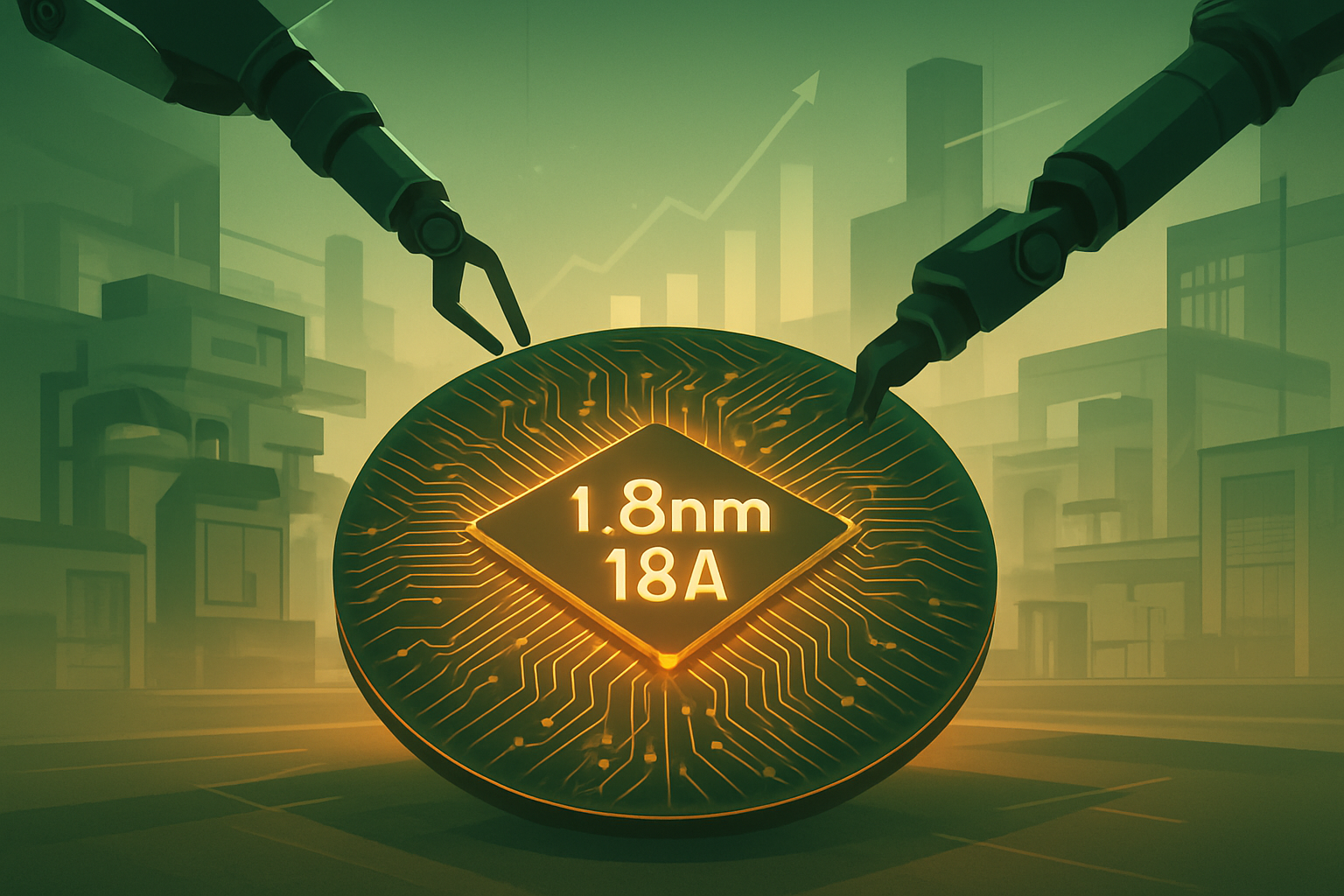
- 18A Process Node: Reaching High-Volume Manufacturing (HVM) in early 2026, 18A introduces PowerVia (backside power delivery) and RibbonFET (gate-all-around transistors). These are critical for catching up to TSMC’s 2nm process.
- Panther Lake (Core Ultra Series 3): Launched at CES 2026, this chip is Intel’s flagship "AI PC" processor. Built on 18A, it claims a 27-hour battery life and an NPU (Neural Processing Unit) capable of 50 TOPS, making it a formidable competitor to Apple’s M-series chips.
- Intel Foundry Services (IFS): The crowning achievement of late 2025 was securing Apple as a customer for 18A-P silicon, marking the first time the iPhone maker has utilized Intel’s manufacturing for its proprietary designs.
Competitive Landscape
Intel is fighting a two-front war:
- Manufacturing: It competes with TSMC (NYSE: TSM). While Intel has reached 18A, TSMC still holds the lion's share of the world's most advanced chip orders (including NVIDIA’s flagship AI GPUs).
- Design: It competes with AMD (NASDAQ: AMD) in the CPU market and NVIDIA (NASDAQ: NVDA) in AI accelerators. AMD has successfully used TSMC’s superior nodes for years to take data center market share, a trend Intel is only now starting to stabilize with its "Clearwater Forest" Xeon chips.
Interestingly, the lines have blurred. NVIDIA’s $5 billion investment in Intel has turned a fierce rival into a "co-opetitor," as the two companies collaborate on custom x86 CPUs that integrate NVIDIA RTX graphics for the AI PC era.
Industry and Market Trends
The semiconductor world in 2026 is defined by "Sovereign AI" and the "AI PC."
- AI PCs: The industry is betting that every consumer will want a laptop capable of running local Large Language Models (LLMs). Intel is at the forefront of this, aiming for 45% of the AI PC market by 2027.
- Deglobalization: Geopolitical tensions have forced a "reshoring" of chip manufacturing. Intel is the primary beneficiary of this trend in the U.S., positioning itself as the "secure, domestic alternative" to Asian-based foundries.
Risks and Challenges
The 17% plunge was caused by "short-term operational friction," but the long-term risks remain significant:
- Supply Chain Fragility: A shortage of specialized substrates and high-bandwidth memory (HBM) has prevented Intel from meeting demand, even as its factories are ready.
- Execution Risk: Ramping up a new process node (18A) is notoriously difficult. Any yield issues in 2026 could jeopardize the Apple and Microsoft (NASDAQ: MSFT) foundry contracts.
- Cash Flow: Intel is burning through cash to build fabs. While the U.S. government has taken a 10% stake to provide a cushion, the company’s dividend remains a distant memory.
Opportunities and Catalysts
- The "Whale" Customers: The Apple contract is a proof-of-concept. If Intel can successfully manufacture for Apple, other "hyperscalers" like Amazon (NASDAQ: AMZN) or Google (NASDAQ: GOOGL) may move their custom silicon to Intel Foundry.
- NVIDIA Collaboration: The upcoming "NVIDIA-powered Intel CPUs" could redefine the gaming and workstation markets, leveraging NVIDIA’s software ecosystem with Intel’s manufacturing scale.
- The 18A-P Ramp: If yields continue to exceed 60% through 2026, Intel will finally be able to claim "the best transistors in the world," a title it hasn't held in a decade.
Investor Sentiment and Analyst Coverage
Wall Street remains deeply divided on Intel.
- Bulls: Point to the 18A success and the Apple partnership as evidence that the "hard part" is over. They view the 17% drop as a "generational buying opportunity."
- Bears: Argue that Intel is "too little, too late" in the AI data center race and that the capital requirements of a foundry business will prevent meaningful share price appreciation for years.
- Institutional Moves: Hedge fund activity has increased in late 2025, with several major players taking contrarian "long" positions, though retail sentiment remains scarred by years of poor performance.
Regulatory, Policy, and Geopolitical Factors
Intel is now a "quasi-sovereign" entity. In August 2025, the U.S. federal government acquired a 9.9% equity stake in the company. This move has fundamentally changed the risk profile.
- Regulatory Relief: Many of the strict requirements of the initial CHIPS Act have been waived in exchange for the equity stake, giving Intel more operational flexibility.
- Geopolitics: As the only Western company capable of leading-edge manufacturing, Intel is "too important to fail" for the U.S. Department of Defense. This provides a unique "policy floor" for the stock, though it also limits the company's ability to operate in certain international markets, particularly China.
Conclusion
Intel at the start of 2026 is a study in contradictions. It has finally achieved the process leadership that eluded it for a decade, yet its stock price is being punished for the "messiness" of the transition. The 17% plunge in late January is a painful reminder that the road to redemption is rarely a straight line.
For investors, Intel is no longer a "safe" blue-chip dividend play; it is a high-stakes "turnaround" story with a government-backed safety net. The coming twelve months will be defined by one word: Execution. If Lip-Bu Tan can navigate the current supply chain "crunch" and deliver the Apple 18A orders on time, the 17% drop of January 2026 may be remembered as the final hurdle before Intel reclaimed its throne. If not, the company risks becoming a perpetual "value trap" in an industry that moves faster than ever.
This content is intended for informational purposes only and is not financial advice.